Council on Energy, Environment and Water Integrated | International | Independent


Context: India has already notified a green steel taxonomy, operationalised certification, and established emissions reporting systems, creating an emerging supply of certified green steel.
Key insight: Our assessment finds that concerns around the availability, cost, and quality of green steel might be misplaced. Certified supply is already burgeoning, and existing policy frameworks could support significantly higher production if backed by demand.
CEEW recommendation: India should prioritise certified green steel in public procurement, improve disclosure of green steel consumption, strengthen state-level procurement, and invest in high-quality scrap-based steelmaking to accelerate market adoption.
Public discourse on green public and private procurement of steel in India often stalls on three crucial concerns: limited supply, cost premiums, and quality constraints. Yet our analysis suggests that these concerns can be overcome. India is not facing a supply vacuum in green steel. The supply is already emerging within India's own regulatory framework.
Around 90 steel producers have received ratings under the government's notified green steel taxonomy, as of 31 March 2026, covering a certified production volume of 12.40 million tonnes (Mt). Of this, roughly 9.0 Mt across 66 producers falls within the highest 5-star category, 1.33 Mt across 13 producers is rated 4-star, and about 2.08 Mt across 11 products is rated 3-star. Our assessment indicates that thermo-mechanically treated (TMT) bars account for the dominant share of certified green steel, with over 10.02 Mt of output out of a total certified production volume of 12.40 Mt. The remaining 2.39 Mt is spread across other types of finished products such as hot rolled coils, pipes, wire rods, and others. India also has the Carbon Credit Trading Scheme (CCTS) framework under the Indian Carbon Market, where draft emission-intensity targets have been proposed for steel plants in India. However, we observe two divergences between the green steel certification and the CCTS framework. These two divergences merit closer scrutiny because they show why supply exists, even as the frameworks tell different stories.
We observe that most green steel certifications have been issued to finished steel producers, who procure crude steel from primary and secondary producers. Our evaluation indicates that of the total 12.40 Mt of certified green steel output, only eight plants — accounting for 1.69 Mt — are covered under the CCTS framework. This is because the emission accounting boundaries for green steel certification extend to finished steel production, which primarily includes downstream processes such as rolling mills. These rolling mills typically buy crude steel from primary and secondary steel producers that produce steel from iron ore, scrap or a combination of both. On the other hand, the CCTS framework aims to maximise emissions coverage in the steel sector and hence focuses on upstream primary producers, such as integrated steel plants and sponge iron plants.
The other divergence relates to the fact that under the Green Steel Taxonomy, producers can certify a portion of their production volume or a dedicated plant, whereas the CCTS operates at the level of the entire plant boundary. This difference is reflected in the wide variance in certified steel output across CCTS-covered units. For example, for the eight plants that are covered under both green steel certification and CCTS, the amount of green steel certified ranges from 2.6 to 90.6 per cent of the total output. However, it should be noted that, this percentage is derived by comparing two datasets with different base years — the numerator (NISST-certified green steel volume) reflects production verified during 2024–25, while the denominator (total plant output) is drawn from the CCTS baseline year of 2023–24. The wide variance across plants — from 2.6 to 90.6 per cent — could reflect a range of factors: declining total output, a shift to lower-emission feedstock, greater use of scrap, or a move to renewable energy for rolling mills and induction furnaces. Without detailed plant-level operational data spanning both time periods, it is difficult to attribute the variation to any single factor. Nonetheless, this wide range underscores the point that the share of output certified as green varies significantly depending on what the producer chooses to certify and the operational choices it makes at the plant level.
The two frameworks also play complementary roles: the NISST framework enables early supply of green steel from downstream producers in the near term, but certified volumes from these segments are currently lower in tonnage and may not always meet the scale requirements of large infrastructure projects. By contrast, the CCTS, by covering upstream primary producers at the facility level, will be instrumental in driving decarbonisation of steelmaking over the long term. Together, they point to a supply base that is already performing well: the weighted-average emissions intensity of certified green steel is about 1.42 tonnes of carbon dioxide per tonne of finished steel (tCO₂/tfs), which is below the benchmark of 2.2 tCO₂/tfs used to define green steel under the national taxonomy. The supply, in other words, is there. But a natural question follows: how durable and scalable is this supply, and what stands in the way of translating it into procurement action? There are several myths and operational challenges that cloud the path forward, and it is worth examining each of them carefully.
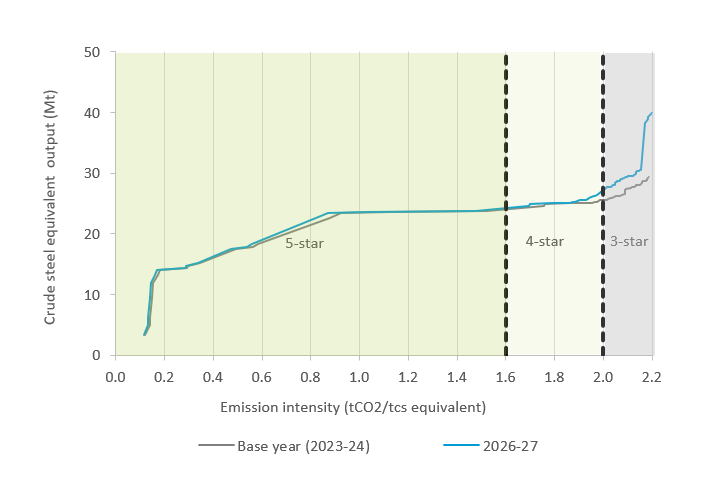
Operationalising green procurement faces multiple challenges and myths. Three concerns recur most often: availability, cost and quality. Each is worth examining in turn. The first concern is availability. As discussed earlier, as of March 2026, India has already certified 12.40 Mt of green steel. However, data from the draft emission-intensity targets for the steel sector under the CCTS can also be leveraged to provide a ballpark estimate of the total green steel supply. As indicated in Figure 1, our analysis suggests that by 2026–27, nearly 40 Mt of steel production could qualify under the defined green thresholds. A significant portion of this green steel could be 5-star rated (24 Mt). The growth in green steel over the base year comes almost entirely as 3-star; 5-star output stays flat. This estimate is based on the assumption that obligated entities are able to meet the draft emission-intensity targets without purchasing carbon credit certificates. The purchase of carbon credit certificates would, however, mean that the volume of green steel availability will be lower. Further, green steel availability could increase in the future as emission-intensity norms tighten. In other words, the supply of green steel could be higher and increasingly certified within India's regulatory framework. The data, therefore, point to an important fact: India does not appear likely to face a supply vacuum in green steel. However, what remains unresolved is whether public and private procurement will recognise and create further demand for it.
Figure 1. India could have about 40 Mt of green steel, of which 24 Mt could be 5-star rated, by FY 2026-27.
Source: CEEW analysis based on draft CCTS targets released by MoEFCC in June 2026
Note: The draft CCTS targets are expressed per tonne of crude steel equivalent output. In contrast, green steel star ratings are based on emission intensity per tonne of finished steel. However, emissions from finishing processes are relatively minor compared to overall emissions from the sector and therefore will only marginally affect the results of the analysis.
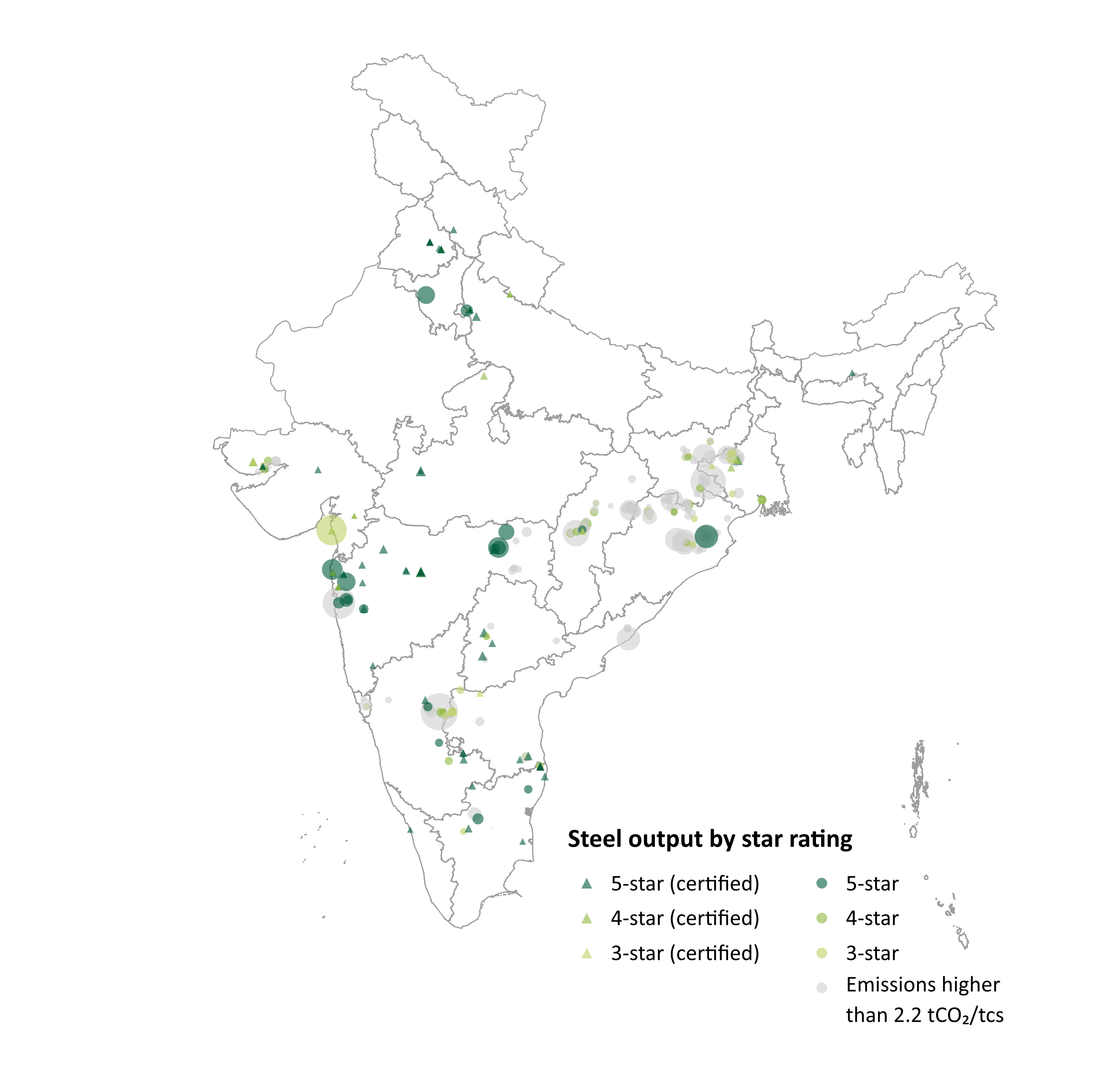
The CCTS framework covers 255 steel plants across India, representing about 148.7 Mt of output (Figure 2), providing a broad database for emissions tracking. The map illustrates that while CCTS-covered plants are spread across major steel-producing states, most NISST-certified units — predominantly finished steel producers — are geographically distinct from primary steel plants concentrated in resource-rich states like Odisha, Jharkhand, and Chhattisgarh. This reflects the value chain split between upstream primary production and downstream finishing discussed earlier. In other words, the institutional framework for identifying and verifying lower-emission steel is emerging. If CCTS targets are finalised and tightened, more plants are expected to meet green thresholds, further expanding certified supply available for procurement.
Figure 2. CCTS data indicates green steel is widely available across India, demonstrating readiness for scaled public procurement
Source: CEEW illustration of draft CCTS targets released by MoEFCC in June 2026 and NISST certifications received till March 2026
Note:
The second concern is the cost premium. However, from a green procurement perspective, this obstacle might be substantially mitigated, as green steel is already sold at competitive prices in the market. Except for a few cases where green steel was procured for private consumption, the 12.40 Mt of certified green steel is potentially available in the market at competitive prices that may not always attract a premium; potentially, 29.35 Mt of green steel could be available based on the 2023–24 CCTS baseline data.
Further, as our research indicates, the emission intensity of steel can be reduced by around 8–15 per cent without increasing steel costs by leveraging low-hanging fruit such as energy efficiency and renewable energy. Steel players across the industry are already undertaking these measures as standard practice to remain competitive, without charging a premium for these initiatives. Therefore, green steel might not always attract a premium for both private and public consumption. Even where a modest premium exists, its impact on overall infrastructure project budgets is likely to be marginal. This suggests that cost is unlikely to be a binding constraint for scaling green steel procurement.
The third challenge relates to the quality of green steel. Based on emission intensity data, a significant share of certified green steel appears to be produced using scrap in induction furnaces, which face quality constraints relative to blast furnaces or gas-based DRI routes. Scrap availability is expected to become increasingly constrained in the coming years, with implications for both the volume and cost of scrap-based green steel, making it critical to develop policies that strengthen scrap collection and availability in the market. These challenges can be overcome through strategic sourcing and demand-supply linkages. For example, a few Government of India schemes, especially those related to residential construction, might not require the same steel quality as other sectors, such as the automotive or defence industry. Therefore, for green procurement, the government can take a strategic decision based on whether green steel meets end-use quality criteria. Second, integrated steel plants (ISPs) that produce gas-based direct-reduced iron (DRI) can provide the high-quality steel needed for public infrastructure projects. An ISP, for instance, reports emission intensities of 1.97–2.08 tCO₂/tfs for its certified HR and CR coil — just under the green threshold — reflecting primary steelmaking that has a green steel certificate. Finally, ISPs are also investing in setting up scrap-based steel plants that may meet the quality standards required for infrastructure projects by adopting better practices.
India has already developed a roadmap and action plan for reducing the emission intensity of steel, notified a green steel taxonomy, operationalised measurement, reporting, and verification (MRV) systems, and enabled certification through the NISST at a modest cost of around INR 2 per tonne. Draft CCTS targets have also been released for steel's emission intensity; if finalised and tightened over the next few years, these could increase the availability of green steel.
However, when it comes to green procurement, the policy signals have been mixed. The Green Steel Mission referenced in the Ministry of Steel's Year-End Review 2024 included proposed provisions to stimulate demand, with an initial outlay of INR 15,000 crore. By late 2025, public reporting suggested a smaller INR 5,000 crore scheme; however, parliamentary responses stated that no Green Steel Mission proposal or PLI scheme for green steel was under consideration. Recent responses to parliamentary questions indicate limited progress on operationalising green public procurement or the broader mission framework. The result is a pause in momentum. Supply is expanding, but demand-side policy has yet to keep pace.
The government can therefore adopt a strategic approach to green public procurement. Where certified green steel is available at prices comparable to conventional steel — which might increasingly be the case across several product categories — procurement agencies can prioritise the lower-emission option without paying a premium. Doing so would create a clear demand signal, encouraging more producers to certify their output and further expanding the supply base. This demand signal remains absent. While public procurement agencies already utilise green steel, they seldom recognise its certified status, leaving manufacturers without a clear incentive to seek certification.
Private consumption of green steel also has a critical role to play. However, currently, there is no publicly available data on how much certified green steel has been purchased by private buyers in India, or how many companies have done so. Tracking where certified steel is sold would help identify which sectors and buyers are already absorbing green steel, and where demand is missing. Certified green steel producers could also disclose their end users.
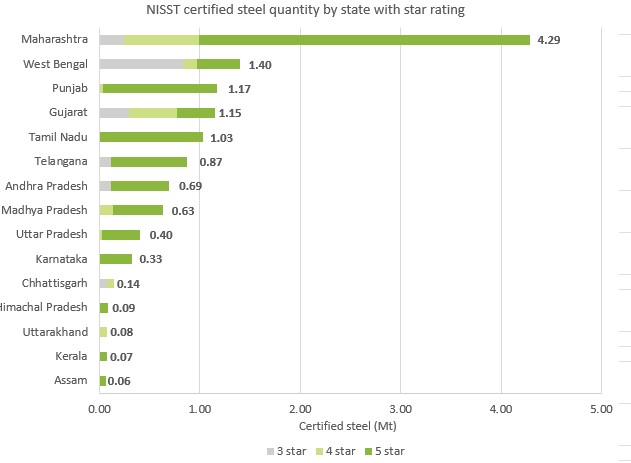
Figure 3 presents certified green steel volumes by state and star rating from the NISST dataset. Maharashtra leads at 4.29 Mt, with 26 plants, far ahead of any other state. West Bengal, Punjab, Gujarat, and Tamil Nadu each contribute around one Mt, but with strikingly different profiles. Tamil Nadu's 9 plants all carry 5-star ratings, making it the most highly rated cluster. Punjab's 15 plants (The 15 plants have 19 products certified) average only about 0.08 Mt each — a base of smaller secondary producers typical of Mandi Gobindgarh. West Bengal's six plants average about 0.23 Mt per plant, suggesting larger individual facilities, though four of its six plants are 3-star rated. Across all states, 5-star steel dominates, with 66 plants contributing to nine Mt, while 3-star plants (11 in number) contribute just 2.08 Mt at nearly twice the emission intensity.
Figure 3. Five-star steel dominates certified output across states that depend on scrap based steelmaking
Source: CEEW analysis of NISST certification received till March 2026
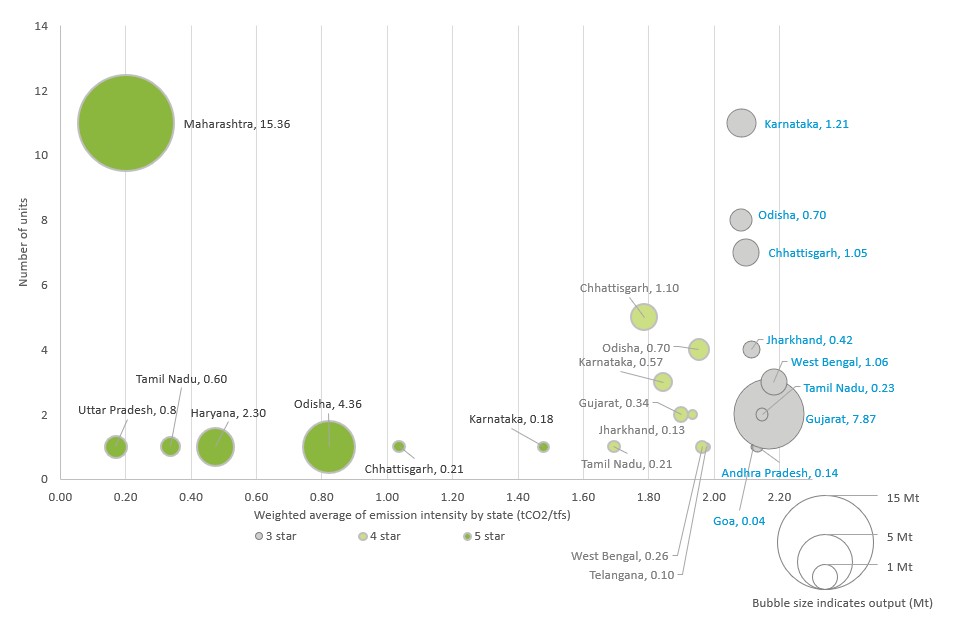
A state-level analysis of CCTS data also reveals a similar trend. Figure 4 shows the plot of the weighted-average emission intensity of green steel across various states and the number of units that have been covered under the CCTS framework. The size of the bubble corresponds to the total green steel potential in these states if they meet the draft CCTS targets. Our assessment indicates that states such as Maharashtra, Gujarat, and Odisha could account for around 73 per cent of overall green steel availability by FY 2026–27. Maharashtra and Odisha could also lead in the availability of 5-star-rated green steel if the targets are met. These two states provide more than 80 per cent of the total 5-star-rated steel, with Maharashtra having 11 different plants qualifying. While Gujarat is a significant player, its position in the emerging green steel landscape could face hurdles if national benchmarks undergo further tightening. Given that much of its production currently trends above the two tCO₂/tcs, future shifts in the regulatory framework may necessitate deeper operational adjustments to maintain its certified supply status.
Figure 4. CCTS data indicates green steel availability across states by star rating
Source: CEEW analysis based on draft CCTS targets released by MoEFCC in June 2026
Comparing the two figures highlights where this supply is coming from. Odisha features strongly in the CCTS data but is absent from the NISST dataset, suggesting its output is concentrated in primary steelmaking. In contrast, Tamil Nadu and Punjab rank higher in the NISST data, pointing to a stronger secondary steel sector. Maharashtra stands out in both, combining scale with a high share of 5-star steel.
Tamil Nadu for instance has also recently announced a Green Steel Production Initiative with an outlay of INR 300 crore over five years to promote environmentally sustainable steel production and reduce emissions from steel rolling mills, signalling emerging state-level support for green steel. These states are well-placed to take an early lead. Procurement policies for public works, housing and infrastructure could be a starting point. Transparent disclosure of the share of certified green steel used in state-funded projects could also help build market confidence and visibility. Other larger steel-producing states such as Chhattisgarh, West Bengal, Jharkhand and Karnataka could replicate and adapt learnings from these states.
To further expand supply, states could support producers through targeted measures such as incentives for waste heat recovery (including ESCO models), lower open access charges for renewable power, group captive procurement for smaller units, and enabling the sale of surplus captive coal power to the grid. These steps could help more producers meet green steel certification thresholds, though the pace of progress will depend on how certification benchmarks evolve alongside state industrial policies.
The evidence suggests that India does not need to wait for technological breakthroughs or large fiscal incentives to begin green steel procurement. The foundations are already in place, and early supply is emerging across multiple product categories. The following six steps can move India from readiness to action. A phased approach can help build confidence while allowing markets to adjust.
Decarbonising India's steel demand requires a preference for certified green steel in both public and private procurement, creating a basis for sustained demand creation. With the taxonomy notified, certification processes operationalised, and growing interest from steel producers, India has laid the groundwork for the adoption of green steel. This is a critical moment to translate that foundation into progress as anticipated in the steel decarbonisation roadmap without losing momentum. Our analysis shows that supply is already emerging at scale based on India's draft CCTS targets, and in many cases may be available at competitive prices. By aligning central and state-level signals, strengthening transparency, and improving quality in secondary steelmaking, policymakers and industry can accelerate the decline in the sector's overall emissions intensity. Beyond reducing emissions, this shift can open new market opportunities and strengthen India's competitiveness in low-carbon technologies.
The authors are grateful to Swaroop Banerjee, Vice President – Sustainability, JSW; Nandan Sharalaya, Programme Lead, Climate Catalyst, for reviewing the blog and Sabarish Elango, Programme Lead, CEEW, for his inputs.
Karthik Shetty is a Consultant, and Deepak Yadav is Senior Programme Lead at Council on Energy, Environment and Water (CEEW). Send your comments to [email protected].



Add new comment