Council on Energy, Environment and Water Integrated | International | Independent

17 Sep 2026 | 10:00 AM - 12:00 pm IST
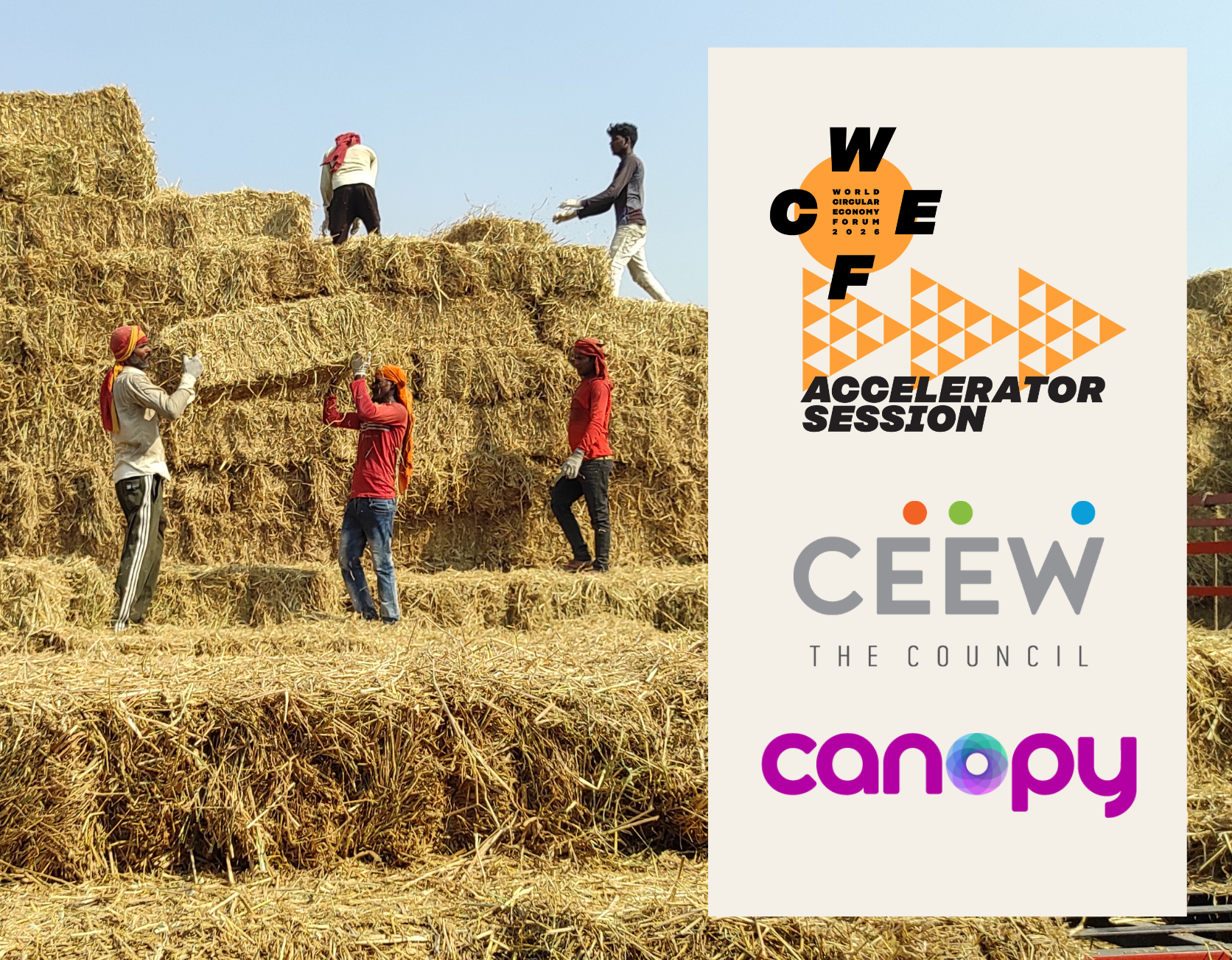
Council on Energy, Environment and Water (CEEW) is organising an accelerator session "Securing Biomass for a Circular Bioeconomy in India" on 17 September 2026 as part of the World Circular Economy Forum 2026 in New Delhi, India.
How should India prioritise its surplus agricultural biomass across feed&fodder, soil health, materials and energy? This closed-door roundtable brings together policymakers, researchers, aggregators and industry to surface where these competing uses collide in practice, and to explore the urgency in need for a shared allocation framework.
This event is an accelerator session at the World Circular Economy Forum 2026 (wcef2026.com). On social media, you can follow the event with #WCEF2026.
Organisers: Council on Energy, Environment and Water
Date and Time: 17th Sept 10am-12pm IST (11:30pm-1:30am CST)
Venue: Sagarmatha, Council on Energy, Environment and Water (CEEW), New Delhi (TBC)
Format: Contact for invitation
Target audience: Policymakers, Public officials, Business leaders, Market Operators Financiers and Investors, , NGOs, Think tanks
India generates approx 150-230 million tonnes of surplus agricultural biomass every year — a resource increasingly claimed by feed and fodder, soil health, bio-based materials (such as bio-packaging and moulded fibre products), and energy pathways (compressed biogas, biomass-to-power). Each claim is legitimate and separately governed and the result is growing competition for the same tonne of residue.
This WCEF accelerator session convenes a closed-door, multi-stakeholder roundtable to explore how India should plan for the biomass security essential to propel a green economy . Drawing on CEEW's research on green economy, crop residue management and the circular economy, the session will surface evidence of where this competition creates real operational challenges — in governance, aggregation, financing and project delivery — and test appetite for moving toward a shared framework.
This conversation is directly relevant to the global transition to a circular economy, where multiple viable end-uses increasingly compete for the same biomass resource. It will contribute toward a shared policy framework for biomass allocation in India — one that does not yet exist.
10:00 – 10:10 | Welcome and Context setting
10:10 – 10:20 | Opening remarks by attendees
10:20 – 11:00 | Session 1: Roundtable Discussion — where allocation breaks down in practice
11:05 – 11:45 | Session 2: Roundtable Discussion — Actionable discussion towards allocation principles
11:45 – 11:55 | Summarising and way forward
11:55 – 12:00 | Closing remarks & Photo op
Shruti Nambiar
Lead