Council on Energy, Environment and Water Integrated | International | Independent

- Carpooling alone could cut G20 passenger transport emissions by up to 20% annually in 2050
- Developed countries and China would account for 80–88% of these savings
- By 2050, these Mission LiFE-style behaviour shifts could cumulatively save oil use equivalent to 59% of 2024 global oil demand
New Delhi, 03 September 2026: As governments accelerate the shift to electric vehicles, a new, independent study by the Council on Energy, Environment and Water (CEEW) released today finds that if commuters across G20 countries carpooled, used buses more, and worked from home part of the week, passenger transport emissions could fall by 408–538 million tonnes of CO₂ (MtCO₂) a year by 2050 — roughly equal to South Africa's entire annual carbon emissions in 2024.
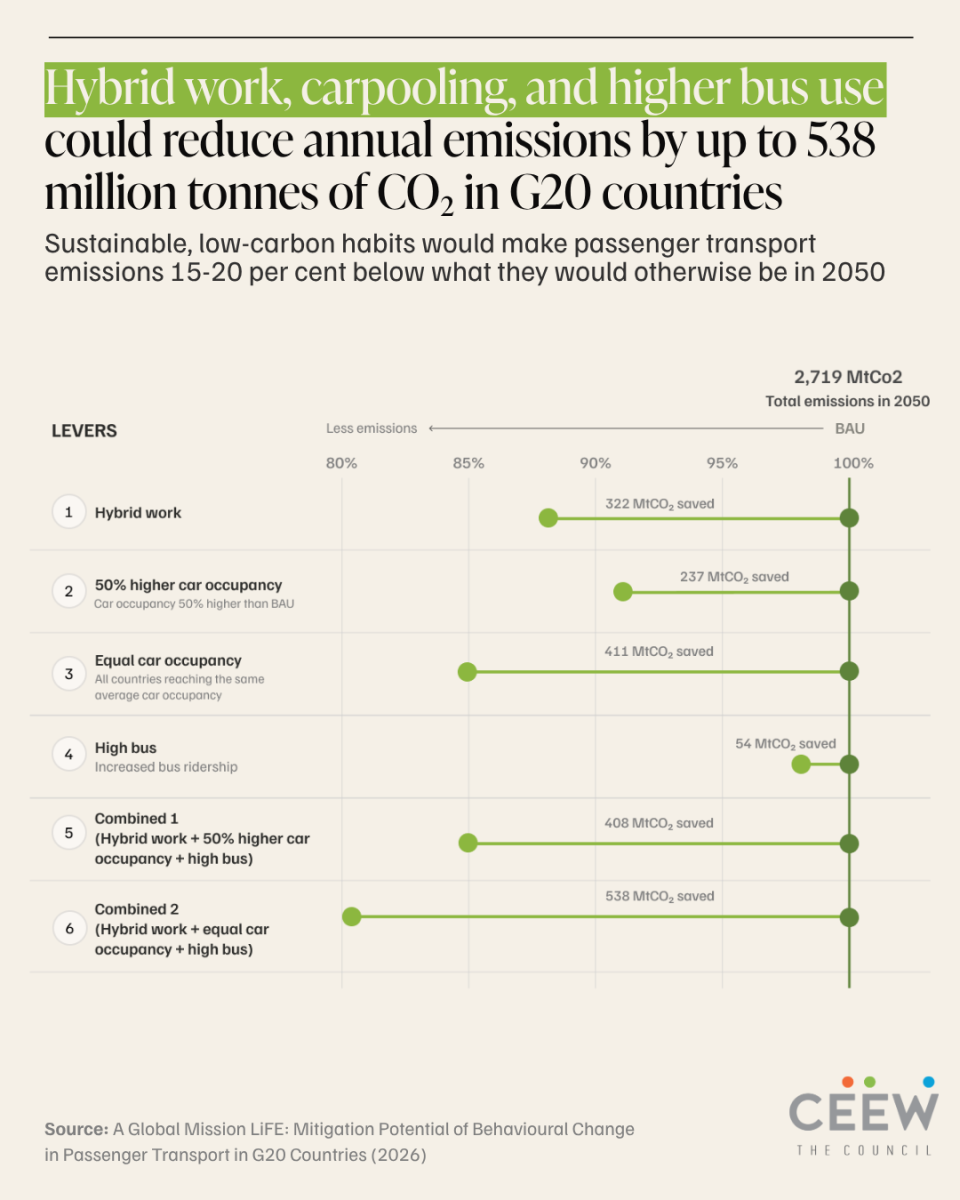
The CEEW study, A Global Mission LiFE: Mitigation Potential of Behavioural Change in Passenger Transport in G20 Countries, builds on India's Mission LiFE (Lifestyle for Environment) — the framework launched at COP26 to place sustainable, low-carbon habits at the heart of everyday choices — and models what happens if similar shifts took hold across G20 countries. But the benefits of carpooling, hybrid work, and bus use are not evenly spread. Developed countries and China — where car ownership and average travel distances are highest — would deliver 80–88 per cent of the combined savings, with the United States and EU-15 alone contributing 61–63 per cent. Per person, the gap is starker still: an average American's per-capita emissions-savings potential from these combined shifts is up to 56 times an Indian's.
Dr Vaibhav Chaturvedi, Senior Fellow, CEEW, said, “Mission LiFE was India's call to go beyond production and make climate action about responsible consumption. This CEEW study gives that vision a global evidence base. The largest gains from shifts in transport behaviour are in high-emitting economies, where mobility systems are most car-dependent. This is a call for smarter cities, better workplaces, cleaner mobility, and lower oil dependence towards improving quality of life.”
The same shift could also ensure energy security, and the biggest beneficiaries would be the largest oil users. This is because high car ownership and long travel distances, behind their emissions savings, also make them the largest consumers of transport oil. Behaviour change could save ~2,715 million tonnes of oil use in transport between 2025 and 2050, about 59 per cent of global oil demand in 2024, cumulatively worth ~USD 2.3 trillion at April 2026 oil prices. For countries most exposed to oil-price shocks from geopolitical conflict, this is as much a hedge as a climate measure.
Carpooling alone, the single largest lever at 236–411 MtCO₂ a year, sees up to 92 per cent of its savings concentrated in developed countries and China — reflecting higher car ownership and lower average vehicle occupancy.
Rohini Dikshit, Programme Associate, CEEW, said, “Our study shows that the geography of emission savings matters. Developed countries and China have the greatest absolute savings potential because their mobility systems are more car-dependent, while India's per-capita potential is much lower. For India and other developing Countries, the opportunity is to avoid future lock-in to private-vehicle dependence. For richer, car-dependent economies, behaviour change must become a near-term climate mitigation lever.”
CEEW recommends that G20 countries place the measurement of behavioural mitigation on the climate policy agenda, so that common methods for verifying these savings can be incorporated into national climate plans. Developed countries and China, where the potential is greatest, should move fastest — through carpooling platforms, hybrid work norms, and congestion and parking charges. Developing countries should prioritise expanding and electrifying bus fleets and building shared-mobility incentives before introducing measures that restrict private vehicle use.
Read the full study, A Global Mission LiFE: Mitigation Potential of Behavioural Change in Passenger Transport in G20 Countries, by Rohini Dikshit, Chetna Arora, Pallavi Das, and Vaibhav Chaturvedi, here.
*Note: The countries in the two categories are: Developing Countries (Argentina, Brazil, India, Indonesia, Mexico, South Africa) and Developed Countries + China (Australia-NZ, Canada, China, EU-15, Turkey, Japan, Saudi Arabia, Russia, South Korea, USA). This study uses the Global Change Analysis Model (GCAM V8.2) to model hybrid work as reduced commuting frequency, carpooling as higher vehicle occupancy, and bus use as a shift in commuter preference across G20 countries, which account for 84 per cent of global GDP and 78 per cent of global CO₂ emissions.
For media queries and interviews, contact:
Tulshe Agnihotri – [email protected]
About CEEW
The Council on Energy, Environment and Water (CEEW) — a homegrown institution with headquarters in New Delhi — is among the world's leading climate think tanks. The Council is also often ranked among the world's best-managed and independent think tanks. It uses data, integrated analysis, and strategic outreach to explain — and change — the use, reuse, and misuse of resources. It prides itself on the independence of its high-quality research and strives to impact sustainable development at scale in India and the Global South. In over 14 years of operation, CEEW has impacted over 400 million lives and engaged with over 20 state governments. Follow us on X (formerly Twitter) @CEEWIndia or on LinkedIn for the latest updates.