Council on Energy, Environment and Water Integrated | International | Independent

Context: PM Surya Ghar has recorded over 54 lakh rooftop solar installations, covering around 64 lakh households, but many urban households lack access to a suitable private rooftop.
CEEW analysis: Virtual net metering can decouple solar access from rooftop ownership by letting multiple consumers share electricity from a single installation.
Recommendation: States and distribution companies should streamline billing, rooftop leasing and approvals while ensuring the PM Surya Ghar platform can support shared solar models, including non-ownership models that reach renters.
Under the PM Surya Ghar: Muft Bijli Yojana, rooftop solar installations have crossed 54 lakh, as of October 2026, just over two years since its launch. Because it requires a rooftop, this scheme works best for consumers who can physically host a system on their own premises. However, for many urban households, especially those in rented accommodation or multi-dwelling units, access to a suitable rooftop is often limited or nonexistent, constraining participation nationwide. Apartment residents often share a common rooftop; tenants generally cannot install systems on rented properties; and buildings in dense cities may simply not have enough suitable roof space to begin with.
This is where virtual net metering (VNM) comes in.
Virtual net metering is a mechanism that allows consumers to access solar energy without installing individual systems on their own premises. It has gained particular importance in the light of PM Surya Ghar’s target of one crore households by March 2027. An NSS 2018 housing survey found that nearly a third of urban dwelling units are flats in shared multi-storey structures, while the Census 2011 reported that more than one in four urban households live in rented accommodation. With India's next census underway and cities increasingly growing vertically, the share of households living in flats and in rented accommodation is likely to have increased further.
The Council on Energy, Environment and Water's recent household survey on rooftop solar adoption points to the same challenge. The survey found that four in five consumers interested in rooftop solar had not initiated the installation process. Among them, 10 per cent cited inadequate roof space, and four per cent cited a lack of roof ownership as barriers. These are structural constraints that cannot be addressed by subsidies and awareness campaigns alone. They require a different way of delivering rooftop solar.
Instead of each household installing an individual rooftop system, a larger solar plant can be installed on a suitable site, such as a large institutional rooftop, a common rooftop in a residential society, or a commercial building in the same distribution area. The distribution network then allocates the generated electricity among multiple consumers, who receive credits on their electricity bills based on their assigned share.
Unlike conventional rooftop solar, where generation is linked to a single consumer, VNM relies on the distribution company's (discom) billing system to accurately allocate generation across multiple consumers. In simple terms, VNM separates solar ownership from rooftop ownership.
This is not a novel arrangement. Variants of shared and community solar models already exist globally, including those in the United States and in Australia. In India, Parthivi Pacific Apartments, a residential society in Raipur, Chhattisgarh, is among the first domestic VNM projects. The society commissioned a 60 kW shared rooftop solar system under the PM Surya Ghar scheme in 2025, enabling 20 households to receive solar credits through VNM. Residents invested in the project under a capex model, with central subsidies significantly reducing upfront costs. The system generates around 7,500–8,000 units of electricity each month, helping households offset a significant share of their electricity consumption and collectively deliver an expected annual savings of INR 6.3 lakh on power bills.
For residents, it opens access without demanding rooftop ownership. For discoms, it can replace many small, fragmented systems with fewer, larger installations that are easier to plan. For cities, it creates space to use underused roofs, such as those on public buildings, warehouses, and transport infrastructure, as shared generation hubs. The attraction is both equity and efficiency. VNM can be used as a system tool by targeting sites with available roof space and grids capable of handling it, while the benefits flow to the consumers who need them.
Although the concept is simple, implementation still involves several choices: who hosts the plant, where it is located, which consumers receive the credits, how those credits are allocated, who develops the project, and how the commercial arrangement is structured. Those choices determine whether VNM can work.
That is why the same framework can serve different use cases, from solarising a residential society to a public building or another large rooftop inside the same distribution network. The design needs to fit the consumer group, the grid context, and the local commercial setup.
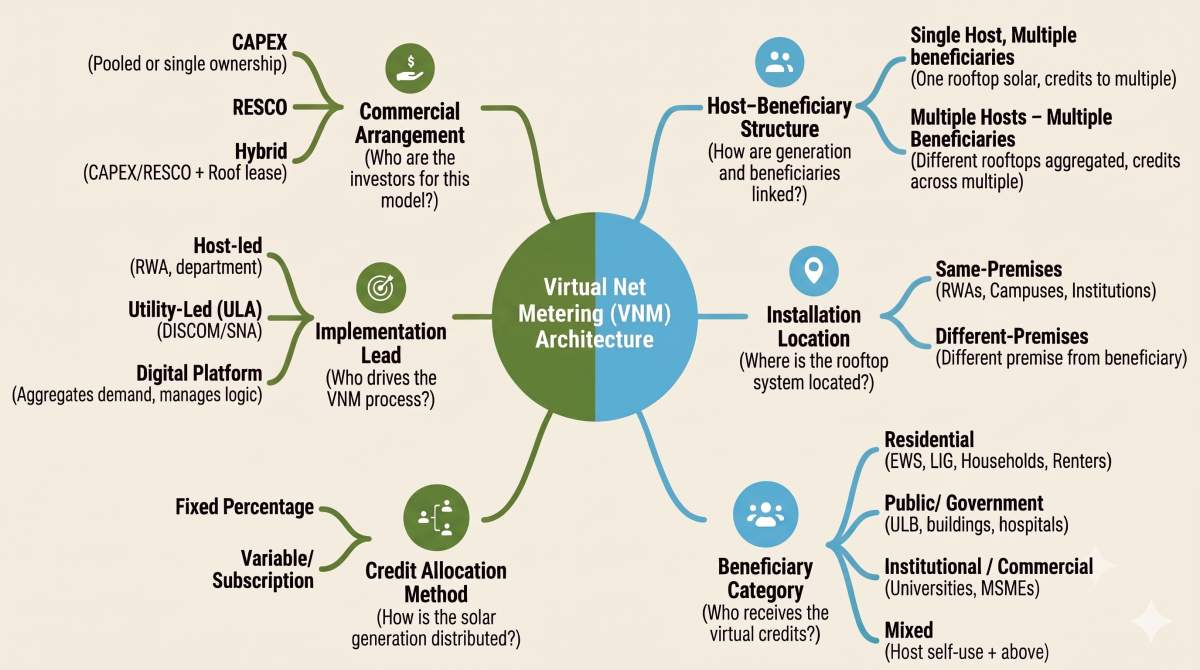
Source: CEEW
State policy determines much of the design flexibility visualised above. Some states, such as Delhi, introduced enabling provisions even before the Ministry of New and Renewable Energy (MNRE) released the VNM standard operating procedures in February 2023. Today, 22 states and 7 Union Territories have notified or introduced VNM frameworks.
These frameworks, however, differ considerably in practice. For instance, Maharashtra's VNM is available only to residents of multi-storied buildings and housing societies. At the same time, Delhi extends it to a wider range of consumers, including domestic, institutional and government categories. Delhi also waives wheeling charges, banking charges, and cross-subsidy surcharge entirely for systems commissioned before March 2027, while Madhya Pradesh exempts only banking charges; wheeling charges and network losses apply to participating consumers. Distribution transformer loading limits vary from 50 per cent in Telangana to 100 per cent in Chhattisgarh. These policies directly affect the viability of VNM projects and determine whether consumers who need VNM can access it.
To translate VNM foundations into a scalable offering for consumers, four areas must be addressed.
As PM Surya Ghar moves towards its one-crore-household target, India’s rooftop solar journey must expand beyond a model centred primarily on individual rooftop systems. VNM can enable this shift by allowing multiple consumers to participate in a shared system, but only if households can join easily and discoms can implement it in practice.
Harpreet Singh is Programme Lead at the Council on Energy, Environment and Water (CEEW). Send your comments to [email protected].



Add new comment