Council on Energy, Environment and Water Integrated | International | Independent


- India's market for solar panel parts could more than double, from USD ~3.6 billion in September 2026 to USD ~7.8 billion (2.2 times) by March 2028.
- India’s chemical industry already has much of what it takes to make battery electrolyte domestically; today, nearly all of it, about 5% of a cell’s cost, is imported.
- Timely commissioning of planned plants and assured demand could help new capacity reach buyers faster.
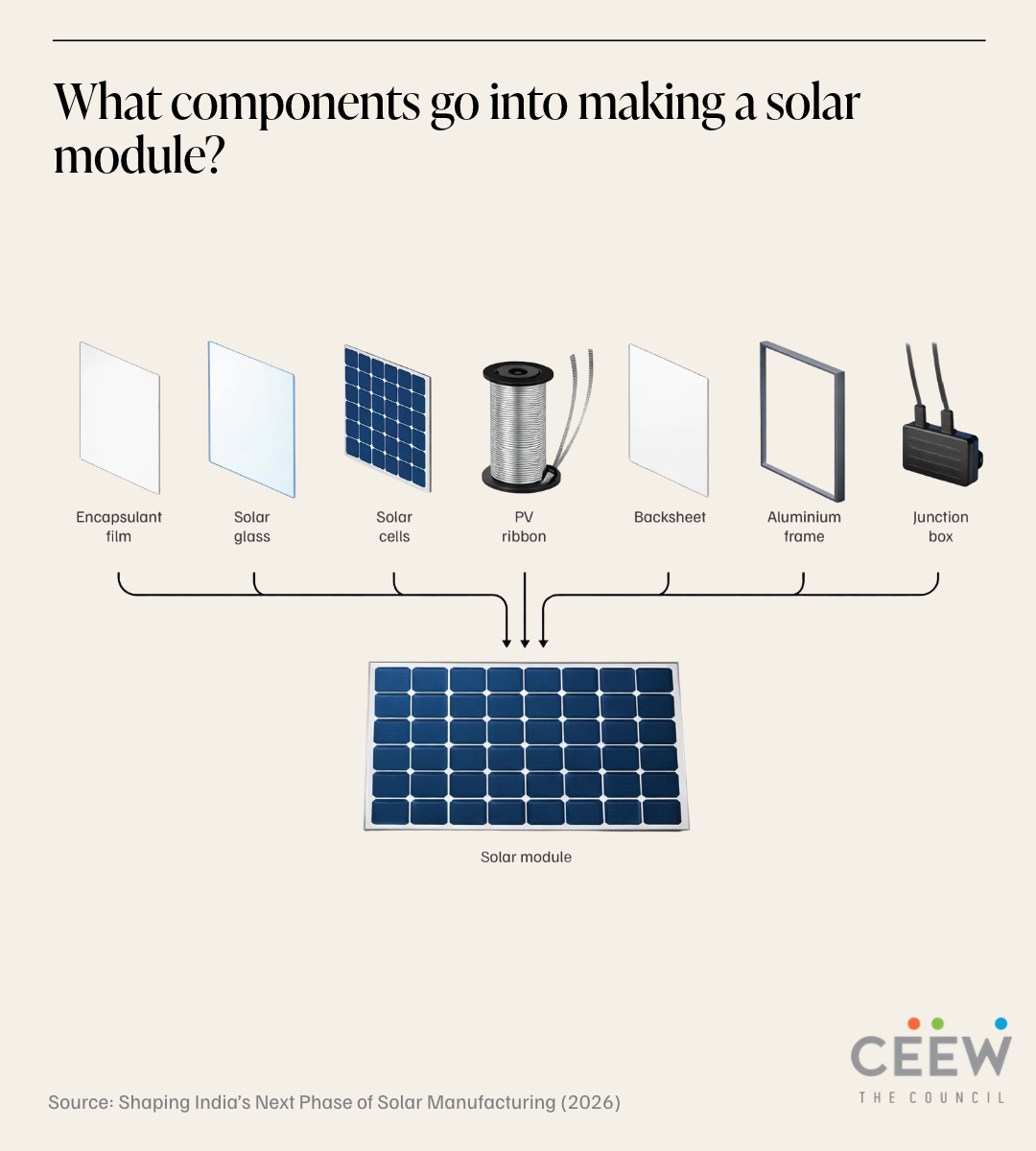
New Delhi, 05 November 2026: India's market for the components that go into a solar panel could more than double, from about USD 3.6 billion (INR 34,200 crores) in September 2026 to USD 7.8 billion (INR 74,100 crores) by March 2028, finds a new study by the Council on Energy, Environment and Water (CEEW). The industry calls these components the bill of materials (BOM): the solar glass, the aluminium frame, the copper ribbons that carry current, the encapsulant sheets that seal the cells, the backsheet and the junction box at the back. They are everything in a panel except the solar cells themselves. India’s solar module manufacturing capacity reached 228.5 GW in September 2026, and makers of these parts are now scaling up to meet the increased demand. The study was released at the Bharat Renewable Energy Summit & Expo 2026 in New Delhi, together with a second CEEW study on battery electrolyte. Both find that India has the industrial base to make these parts. To help that capacity reach buyers at scale, timely commissioning and steady demand are needed, which needs to be supported by setting technical standards and testing infrastructure.
Speaking at the Ministerial Plenary, Shri Pralhad Joshi, Union Minister for New and Renewable Energy, said, “In 2014, solar installed capacity was 2.8 GW; today it is 172 GW. If you can provide stable renewable energy, industry prefers it: first, it is clean energy, and second, relatively, it is cheaper. When there is a market, there is an investment; and when there is an investment, there will be progress.”
The Ministry of New and Renewable Energy (MNRE) organised the Summit at Bharat Mandapam, New Delhi, from 2 to 5 November. CEEW was a knowledge partner and hosted 14 sessions across four days of the summit.
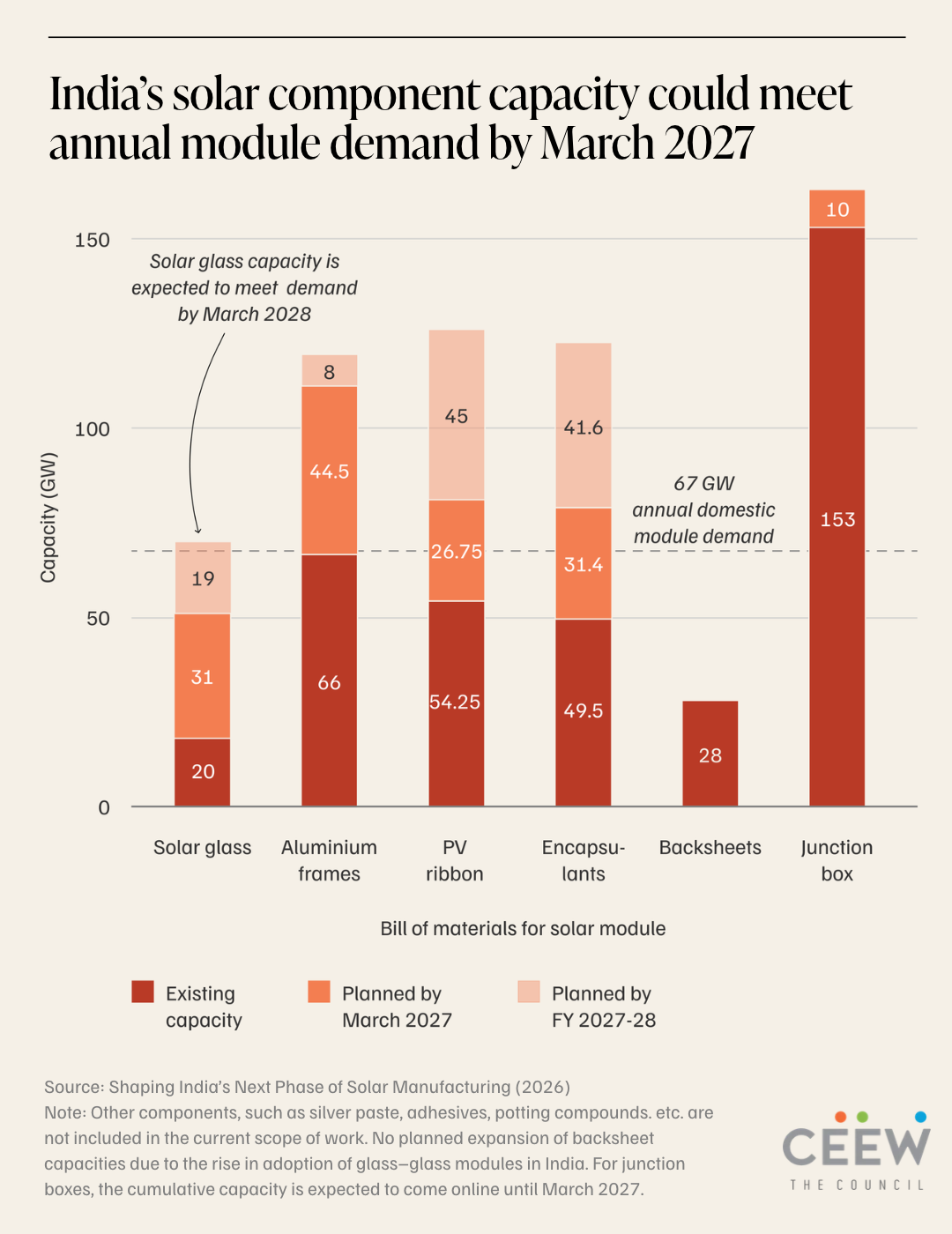
Company announcements suggest that India could become self-reliant for most components by March 2028, if facilities are commissioned on time. Domestic annual manufacturing capacities in September 2026 ranged from 20 GW for glass to 153 GW for junction boxes. If planned expansions arrive on schedule, frames, ribbons and encapsulants could cover India’s estimated annual module demand of about 67 GW by March 2027, and glass by March 2028. Junction boxes already do. Backsheets are the exception: no new capacity is planned because glass-glass modules are taking over, a sign of how quickly module technology is changing.
Winning buyers’ confidence is the next step. In the study’s consultations with stakeholders across BOM components, module makers reported their willingness to switch to domestic products over imported fare, provided costs and performance are matched. Domestic capacity needs to keep pace with deployment. Between FY2021 and FY2026, glass imported in India grew 63 per cent a year, from USD 129 million to USD 1.48 billion. Aluminium frame imports grew 88 per cent a year and junction box imports 92 per cent. In FY2026, China supplied 66 per cent of India’s glass imports and 70 per cent of frame imports, while Vietnam and Thailand supplied 34 and 31 per cent of encapsulant imports. Building domestic supply would reduce module makers’ exposure to price swings and to trade decisions taken elsewhere.
The winds have begun to shift. China withdrew its VAT rebate on photovoltaic exports in April 2026, and India's anti-dumping duties on glass, frames and EVA encapsulants stay in force until 2029. Together, they raise the landed cost of imports. The CEEW study cautions that this helps only if domestic plants arrive on time. Delays could increase the cost of solar module manufacturing.
Building capability alongside capacity. Indian makers have room to expand into newer variants, such as multi-busbar and reflective ribbons that raise module efficiency, low-temperature ribbons for heterojunction cells, and composite frames. They still import key raw materials. Without standardised testing criteria across the industry, each manufacturer follows its own testing practices. And none of the six components has a dedicated customs code (Harmonised System classification). Imports arrive under several codes, so even India’s own import trade figures are best estimates, and anti-dumping duties are harder to enforce.
Rishabh Jain, Fellow, CEEW said, "India has shown it can assemble a solar module at scale. The next test is whether we can make the parts at scale and of quality. Thankfully the investments have been committed and manufacturing capacities are on its way. Sustained investment coupled with local demand can make India an alternative supply chain for solar bill of materials."
Batteries: the capability already exists. Electrolyte makes up about 5 per cent of the total cost of a battery cell and is crucial for its performance and safety. Indian companies have announced domestic cell manufacturing capacity of about 150 GWh and CEEW analysis suggests that India would require 60,000 to 90,000 tonnes of electrolyte annually. The CEEW battery study, the first in a series on localising battery cell components, finds that the capability to make electrolytes already exists in India’s chemical industry. What is missing is purity standards, testing infrastructure and specialised equipment, rather than the technology itself.
A domestic testing laboratory could cut months from approvals. India has limited accredited domestic facilities to test battery-grade electrolyte. Producers send samples to South Korea, Japan and Germany, which adds months, laboratory fees and courier costs to every approval. The CEEW study estimates that a domestic facility would cost about USD 1.6 million (INR 15 crore).
Dr Akanksha Tyagi, Senior Programme Lead, said, “India has a unique opportunity to become a global player in electrolyte manufacturing. Its chemical industry and research institutions have existing capabilities in raw material, machines, processes and talent that can be leveraged to get a headstart into manufacturing electrolytes commercially.”
To make products easier to compare and track, the solar study recommends dedicated customs codes for each component variant before the Union Budget 2027–28. It also recommends uniform testing standards from the Ministry of New and Renewable Energy (MNRE), the Bureau of Indian Standards (BIS) and industry. The battery study recommends domestic testing laboratories whose certificates are accepted abroad. To make demand for solar components certain, the MNRE should bring all six components under the Approved List of Models and Manufacturers (ALMM), listed by January 2028 and effective from January 2029, with the Domestic Content Requirement extended to them from January 2028. CEEW further proposes local sourcing norms that move from voluntary to partial to full, backed by an Approved List of Battery Component Manufacturers, a milestone-linked capital subsidy for cell components, and joint ventures in which Indian firms co-own what they develop.
Read the full studies released at the event:
Both studies were supported by the New Energy Industrial Strategy (NEIS) Center.
Note: The solar study draws on capacity data from the Solar Ancillary Manufacturers' Association (SAMA) as of September 2026, Ministry of Commerce and Industry trade data for FY2021 to FY2026 (import shares are by value), and consultations with 14 stakeholders: 12 across the six components (one each for glass and junction boxes, two each for frames, ribbons and backsheets, four for encapsulants), one equipment supplier and one reliability-testing expert. The battery study's electrolyte demand is the authors' estimate from BatPaC modelling, at 0.42 to 0.58 kg per kWh depending on chemistry.
About CEEW
The Council on Energy, Environment and Water (CEEW)—a home-grown institution with headquarters in New Delhi—is among the world’s leading climate think tanks. The Council uses data, integrated analysis, and strategic outreach to support public policy, transform markets, shape technology, and nudge behaviour. It addresses pressing regional and global challenges through an integrated and internationally focused approach. The Council prides itself on the independence of its high-quality research and strives to impact sustainable development at scale.