Council on Energy, Environment and Water Integrated | International | Independent

- New coal may not be the least-cost option for meeting Rajasthan’s 2030 power shortfall
- RE-plus-storage could additionally earn discoms INR 35 billion through market sales in 2030
- It would also mean 11x more FTE jobs and INR 600 billion in investment over the next five years, and 24% lower carbon emissions in 2030
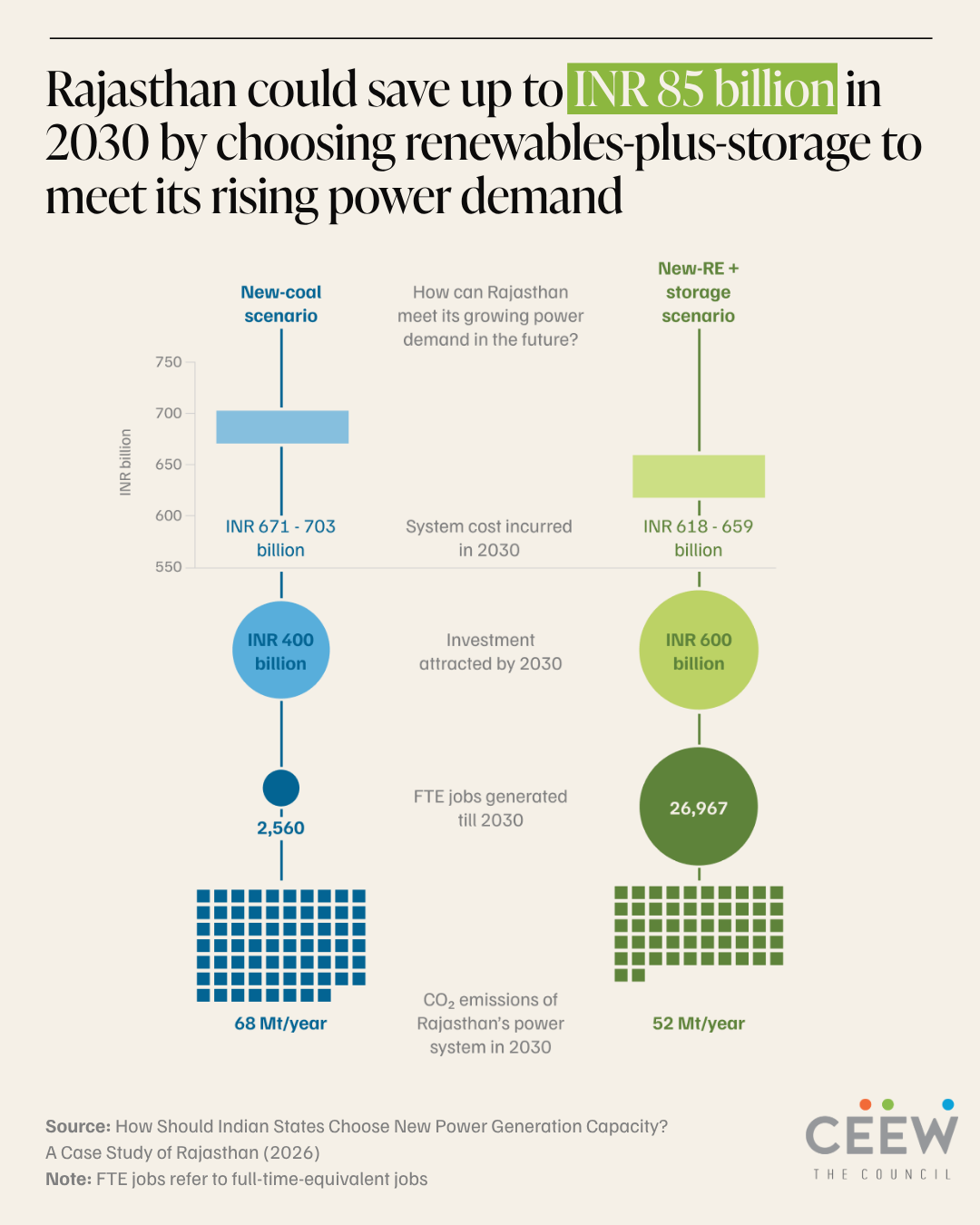
Delhi, 15 September 2026: Rajasthan could save up to INR 85 billion in power procurement costs in 2030 by meeting its emerging reliability needs through renewable energy (RE) and storage rather than new coal capacity, according to a new study by the Council on Energy, Environment and Water (CEEW) launched today.
The study, How Should Indian States Choose New Power Generation Capacity? A Case Study of Rajasthan, assesses a February 2025 proposal by Rajasthan distribution companies (discoms) to contract for 3,200 MW of new coal capacity to address projected shortages. CEEW finds that Rajasthan’s 2030 shortfall is fundamentally a timing and flexibility problem, not just a capacity one. Nearly 90 per cent of the projected 5.5-billion-unit deficit occurs during non-solar hours, when solar generation is unavailable, and the system needs resources that can respond swiftly to demand. Using 15-minute production-cost simulations for 2030, the study compares three pathways — business-as-usual, adding 3,200 MW of new coal, and an equivalent energy provided by an RE-plus-storage combination of solar, wind, and battery storage — to determine which best meets Rajasthan’s needs at the lowest cost.
Disha Agarwal, Fellow, Council on Energy, Environment and Water (CEEW), said, “Discoms should evaluate options based on grid needs and overall system cost, rather than technology-level costs alone. Our analysis shows that RE-plus-storage can meet Rajasthan’s future reliability needs at lower cost than the proposed coal capacity. SECI’s recent round-the-clock RE bid discovered a tariff lower than recently contracted or proposed new coal capacity in several states. Such studies establish the need for planning exercises that states must undertake continuously as technology capabilities and costs change rapidly and demand becomes more uncertain.”
Replacing new coal with RE-plus-storage in Rajasthan could generate net savings of INR 11.4–85 billion in 2030, and help discoms earn ~INR 35 billion in additional revenue by selling surplus power in the exchanges, the CEEW study finds.
The clean pathway could create ~27,000 full-time-equivalent (FTE) jobs by 2030, against 2,560 under new coal, while attracting ~INR 600 billion in clean energy investment. It would also cut the state’s power-sector CO2 emissions by 24 per cent, to 52 million tonnes against 68 million tonnes under new coal — relevant given Rajasthan’s electricity requirement grew at 8 per cent CAGR between FY22 and FY25, with demand projected to reach 1.5 times FY25 levels by FY30.
The Rajasthan case points to a wider planning gap. The CEEW study finds that 3,200 MW of new coal capacity — designed to generate over 20 billion units annually to address a 5.5-billion-unit deficit — would still leave ~1 per cent of demand unmet, short of the Central Electricity Authority’s 0.05 per cent reliability benchmark. Elsewhere, recent state procurements show a similar disconnect: Bihar and Assam contracted 5,600 MW of new coal capacity in 2025 at fixed costs of INR 4.17–4.54 per unit, even though the underlying planning studies assumed capex that implied fixed costs of under INR 2.55 per unit for the same technology.
CEEW recommends that state discoms institutionalise scenario-based integrated resource planning, that procurement frameworks target least-cost outcomes at the system-level by allowing all mainstream technologies to compete, and that state regulators build the technical capacity to evaluate procurement proposals independently.
The webinar brought together policymakers, including from the Ministry of New and Renewable Energy, the Solar Energy Corporation of India, AIDA member distribution utilities, and power-sector experts, to discuss how Indian states can procure reliable electricity at the least cost, how procurement frameworks should evolve, and how regulators can support consumer-friendly outcomes.
Read the full study, How Should Indian States Choose New Power Generation Capacity? A Case Study of Rajasthan, by Arushi Relan and Disha Agarwal, here.
*Note: The study compares the proposed coal capacity with an equivalent RE and storage combination integrated into the state’s procurement mix, and assesses its ability to meet demand at the same reliability level for every 15-minute block throughout 2030. State discoms should conduct robust, scenario-based integrated resource planning (IRP) to assess demand projections and identify an optimal supply mix that meets demand in line with the reliability criteria set by the Central Electricity Authority (CEA).
For media queries and interviews, contact:
Tulshe Agnihotri – [email protected]
About CEEW
The Council on Energy, Environment and Water (CEEW) — a homegrown institution with headquarters in New Delhi — is among the world’s leading climate think tanks. The Council is also often ranked among the world’s best-managed and independent think tanks. It uses data, integrated analysis, and strategic outreach to explain — and change — the use, reuse, and misuse of resources. It prides itself on the independence of its high-quality research and strives to impact sustainable development at scale in India and the Global South. In over 14 years of operation, CEEW has impacted over 400 million lives and engaged with over 20 state governments. Follow us on X (formerly Twitter) @CEEWIndia or on LinkedIn for the latest updates.