Council on Energy, Environment and Water Integrated | International | Independent

Biomass-based fibres (BBFs), are derived from lignocellulosic residues of agricultural and allied sectors (Jayaprakash et.al 2022). These fibres are transformed through specialised mechanical or chemical processes into both filament and staple forms, suitable for a variety of applications in textiles, technical textiles, and as composite reinforcements. BBFs replicate the mechanical strength, durability and many other properties of traditional natural fibres like cotton, jute, and linen, and synthetic fibres such as viscose, modal, polyester, carbon, and aramid (Jhanji Dhir 2022). Their properties can be tailored through various processing techniques to meet the specific needs of different industries. They are also cost-effective biodegradable fibres with lower environmental and carbon footprints in comparison to other natural fibres. The combination of versatility and sustainability has positioned BBFs as a forward-thinking solution in materials science.
Odisha's Textile and Handloom industry generates INR 600 crore annually and employs 200,000 individuals, with women comprising 50 to 60 per cent of the workforce (Odisha Apparel and Technical Textile Policy 2022). Leveraging its rich heritage in traditional textiles and as one of the key producers of natural fibres like cotton, jute, and silk, Odisha can potentially enhance its competitive advantage. Supported by the progressive Apparel and Technical Textile Policy of 2022, the state could accelerate establishing a dedicated textile park, boosting its export capabilities through the development of sustainable fibres. This strategic expansion, aligning with global trends towards environmental responsibility, could position Odisha as a leading and pioneer manufacturer.
Jobs, market and investment opportunity1
By expanding cultivating horticultural crops such as coconut, banana, and pineapple on cropland of area of ~84,000 hectares by 2030, Odisha has the potential to produce an estimated 0.76 million metric tonnes per annum (MMTPA) of bio-based fibres: coir, banana fibre, and pineapple leaf fibre (PALF). The establishment and operation of the associated fibre value chain—covering biomass aggregation, fibre extraction unit construction, and the operation and maintenance of extraction units—could lead to the creation of ~11,100 full-time equivalent (FTE) jobs 2 in the state.
Coir fibre extraction: By 2030, the extraction of an additional ~0.75 million metric tonnes per annum (MMTPA) of coir (coconut fibre) from coconut husks, which are in turn derived from coconuts produced on a total cultivable area of ~54,000 hectares in Odisha, is projected to generate ~7,000 full-time equivalent (FTE) jobs. This projection requires the establishment of around 250 coir extraction units, each with a daily production capacity of 10 tonnes, alongside the aggregation of coconut husks.
The market opportunity for coir in Odisha in 2030, with an annual production capacity of 0.75 million metric tonnes, is estimated at ~USD 243 million, assuming a price of INR 27 per kilogram (kg). Additionally, the investment required to establish 250 coir extraction units is estimated at ~USD 260 million, with the aim of scaling up production capacity by 2030.
Puri, Khurda, Cuttack, Balasore, and Ganjam, which together contribute over 85 per cent of total production (Mishra et al. 2024), are highly suitable for establishing coir extraction units due to the presence of extensive coconut plantations. The districts of Puri, Ganjam, and Cuttack, which already host numerous downstream industries such as carpet, mattress, doorstep, rope, wall hanging, and ceiling manufacturing from coir, are particularly well positioned to capitalise on their robust raw material base.
Banana fibre extraction: By 2030, the extraction of approximately 9,000 tonnes per annum (TPA) of banana fibre from banana pseudostems cultivated on an estimated 27,500 hectares of land in Odisha is projected to generate ~4,000 full-time equivalent (FTE) jobs 3 . This employment generation will be supported by the establishment of ~1,000 banana fibre extraction units, each with an average daily production capacity of 30 kilograms (kg) of banana fibre.
The market opportunity for banana fibre by 2030, with an annual production capacity of ~9000 tonnes, is estimated at approximately USD 34 million, based on a price of INR 315 per kg of banana fibre. Furthermore, the investment opportunity to establish 1,000 banana fibre extraction units is projected to be around USD 50 million.
Angul, Balasore, and Sundargarh are the prime districts for banana cultivation in Odisha, offering the most extensive cultivable areas suited for this crop. These districts are optimal locations for establishing banana fibre extraction units due to availability of banana pseudostems and the raw materials within a 50-100 km radius. Additionally, Bolangir and Khurda also present viable options, enhancing their suitability for such initiatives due to promotion of banana tissue culture by Sambalpur University in Western Odisha (NABARD 2023).
Pineapple leaf fibre (PALF) extraction: By 2030, the extraction of 2,000 tonnes per annum (TPA) of PALF from 3,000 hectares in Odisha is expected to generate 100 full-time equivalent (FTE) jobs, supported by 40 PALF extraction units, each with a daily production capacity of 150 kg.
With an annual production of ~2000 tonnes, the market opportunity for PALF is projected at USD 12 million at INR 494 per kg, while the investment opportunity to set up 40 units is around INR 0.5 million.
Gajapati and Rayagada districts are high-potential districts for establishing PALF extraction units due to abundant pineapple leaf availability. Gajapati's potential is enhanced by the presence of a pineapple processing plant and extensive cultivation over approximately 600 hectares in the Gumma, Mohana, Rayagada, and R Udayagiri blocks (Orissa Review 2010). Keonjhar and Balasore districts also offer opportunities for similar developments.
Expand the state’s raw material base and export capabilities: The handloom industry in Odisha, the state’s largest cottage industry, employs 4 per cent of the population, driven by abundant raw materials like cotton, jute, and silk. Odisha is a major producer of cotton and silk, producing 85 MT of hand-spun and hand-woven silk annually, and is renowned for its traditional textiles and skilled workforce. Additionally, around 15,000 families engage in sericulture (HTHD, n.d.). The sector includes ginning, pressing, spinning, and weaving, with a strong processing infrastructure. With two upcoming integrated textile parks, Odisha is well-positioned to diversify its fibre portfolio by incorporating bio-based fibres (BBFs), thus enhancing its competitive edge in the global sustainable textile market.
Waste management and climate action: The production of natural fibres demonstrates a substantially lower environmental impact, evidenced by their carbon footprint, which is approximately 80 per cent lower than glass fibres (Beus, Carus and Barth 2019). This disparity is further accentuated in the textile manufacturing sector; for example, the production of a polyester T-shirt is responsible for 5.5 kg of CO₂ equivalent, significantly surpassing the 2.1 kg emitted in the production of a cotton T-shirt (Filho et.al 2022). India generates approximately 1.6 million metric tonnes per annum (MMTPA) of textile waste, presenting a significant challenge to sustainable waste management. Odisha has the potential to lead the way in addressing this issue through innovative private sector interventions into alternatives such as BBFs, similar to the Odisha Textile Manufacturing Pvt. Ltd (FibretoFashion 2024)
Protecting marine biodiversity: Synthetic fibres are a significant source of microplastics, accounting for 35 per cent of the microplastics found in the world’s oceans, as reported by the International Union for Conservation of Nature (IUCN 2017). This prevalence underscores synthetic fibres as the primary contributor to microplastic pollution, which adversely affects marine biodiversity. The inherent biodegradability of BBFs offers comparable advantages, potentially reducing microplastic pollution in marine environments, akin to traditional natural fibres such as cotton and wool.
Livelihood and farm incomes: Odisha's average household farm income is approximately INR 5,000 per month, ranking among the lowest in the country (PIB 2022). This highlights the critical need for economic diversification within the state. Recent research suggests that the cultivation of horticultural crops can increase farm incomes by a factor of 2.78 (ICAR 2022)4 .Additionally, the development of value chains centred on the value-added processing of horticultural waste, such as bio-based fertilisers (BBFs), could further enhance farm incomes by an estimated 30 per cent, particularly through the establishment of decentralised processing units. In this context, BBFs emerge as a promising avenue for Odisha, aligning with the state's economic and agricultural development objectives (Vaishali KVK n.d.).
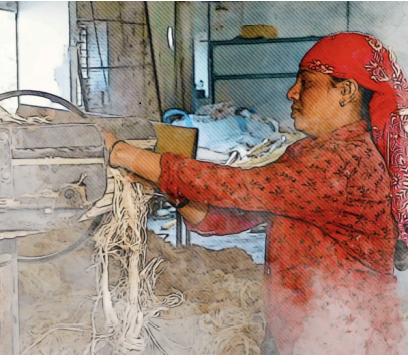
Mangalam Kalpatharu Enterprise, based in Burhanpur district of Madhya Pradesh, presents a commendable case of turning an environmental challenge into a profitable business opportunity. As of 2021, with a quarter of the district's arable land dedicated to banana cultivation, the issue of banana waste became pressing as the post-harvest waste was either dumped or burnt. In response, the enterprise innovated a method for utilising banana bast fibre from the pseudostems, which are otherwise discarded. Their processing plant, operational for seven months annually, manages to convert 300 to 400 pseudostems daily into 30 to 40 kgs of fibre, employing six women and three men in the process. The fibre extraction and combing processes have not only provided employment but also created a new revenue stream. In addition, the plant also leverages on manufacturing SAP-based bio inputs, handicrafts made from banana fibre to demonstrate the potential value addition. Sourcing waste within a 15 km radius and with an investment of 25 lakhs INR, the plant now boasts an impressive annual revenue of 18 to 20 crores INR, demonstrating a sustainable model for agricultural waste management5 .
1. Role of departments:
The Handlooms, Textiles & Handicrafts Department (HTHD): can promote R&D initiatives by collaborating with technological universities, textile engineering departments, and institutions. By encouraging research into blending BBFs with traditional fibres, HTHD can facilitate innovation in the textile sector. Additionally, HTHD can advocate for regulations that support the adoption of BBFs within traditional and handloom textiles in collaboration with the industries department, helping integrate sustainable fibres into these industries.
Industries Department: This nodal department could be responsible for the policy deployment related to BBF manufacturing, in coordination with the Apparel and Textile Policy. It may provide incentives and set regulatory mandates for the use of BBFs in manufacturing while accelerating R&D efforts. The department could also focus on establishing integrated dedicated parks and offering incentives to industries, leveraging the state's competitive advantage in sustainable fibre availability.
Odisha Assembly of Small and Medium Enterprises (OASME): OASME could play a key role in advocating for small and medium enterprises (SMEs) involved in BBF manufacturing. It may offer a networking platform, promote the sharing of best practices, and facilitate access to training programmes and incubation through Start-up Odisha. OASME could assist SMEs in overcoming challenges related to technology adoption, financing, and market linkages, thereby enhancing their operational capabilities.
Industrial Development Corporation of Odisha (IDCO): IDCO could be instrumental in developing industrial infrastructure tailored for the biomass processing and fibre manufacturing sectors, including the creation of dedicated parks or zones. It may provide essential support by offering access to land, utilities, and logistical assistance, which could significantly reduce operational costs and foster the establishment of new enterprises in the BBF sector.
Micro, Small & Medium Enterprise Department (MSME), Odisha: This department could focus on the development and promotion of micro, small, and medium enterprises within the state. It may offer subsidies, financial support, and policy guidance specifically tailored to biomass-to-fibre manufacturing. The MSME department could collaborate with OASME to develop effective communication tools for technology transfer in partnership with ICRAF and its subsidiary research institutions.
Directorate of Export Promotion and Marketing: This directorate could identify export opportunities for BBF products and assist manufacturers in adhering to international standards and certifications. It may facilitate participation in international trade fairs, establish connections with overseas buyers, and aid in navigating export-related procedures. This directorate could work closely with ORMAS to strengthen market linkages.
Startup Odisha: Startup Odisha could foster innovation in the BBF sector by providing startups with mentoring, funding, and incubation support. It may encourage the development of new technologies and business models that improve efficiency, sustainability, and competitiveness in the technical textile market. Startup Odisha could collaborate with IDCO to support the development of upstream industries.
Odisha Skill Development Authority (OSDA): Skill development could be a key factor in the growth and development of the BBF manufacturing sector. OSDA may collaborate with OASME to facilitate training programmes for technicians and workers, ensuring a skilled workforce for the efficient operation and maintenance of centralised production plants.
2. Role of the private sector:
Investors and financiers: Private investors and financiers could play a key role in providing capital for the establishment and expansion of BBF production facilities. Their investments may support infrastructure development and R&D efforts aimed at advancing technology and scaling BBF manufacturing.
Industry collaboration: Industries in textiles, technical textiles, and biotechnology could collaborate with BBF manufacturers to develop innovative products tailored to the textile industry’s needs. These industries may also represent potential customers, driving demand and market growth.
Research and development: There is an opportunity for the private sector to invest in R&D focused on material science for blending fibres. By partnering with academic institutions and research organisations, the private sector could lead innovation, improve production techniques, and enhance BBF properties and applications.
Distribution and marketing: Private companies could establish distribution networks and marketing strategies to effectively reach manufacturers and promote BBF adoption. They may also provide technical assistance and training to help manufacturers understand the benefits and applications of blended bio-based fibres
3. Role of local administration and civil society organisations (CSOs):
Market awareness and engagement: Through initiatives like Mission Shakti, CSOs can enhance market awareness by conducting targeted outreach to farmers, artisans, and local communities, educating them on the economic, environmental, and health benefits of BBFs. Through strategic campaigns, workshops, and community engagement, CSOs can drive interest in BBF adoption, while facilitating the formation of fibre-based farmer-producer organisations (FPOs) to streamline supply chains and improve access to resources and funding.
Operational support and capacity development: CSOs can drive the successful implementation of BBF enterprises by offering specialised training in fibre collection, extraction, and value-addition techniques. Additionally, they can serve as intermediaries, connecting artisans with financial institutions for funding and providing advisory support on production scalability and business development strategies
Market access and business linkages: CSOs can play a pivotal role in facilitating market access for BBF producers by organising business expos, trade fairs, and utilising e-commerce platforms to connect suppliers with a broader customer base. By promoting adherence to quality standards and encouraging product innovation, CSOs can help enhance the marketability of BBF products. These strategic market linkages will ensure consistent demand, drive business growth, and position local enterprises to tap into both domestic and global markets.
1. Limited technical feasibility: BBFs have recently been recognised as promising alternatives to traditional fibres in various applications. However, many novel BBFs suffer from inadequate mechanical strength, performance, and durability. Often, these fibres require additional finishing treatments to meet the desired properties (Fuentes, et al. 2022). Their utilisation is primarily constrained by unfavourable spinning characteristics, such as thickness, low uniformity, stiffness, and limited elongation (Muzyczek, 2012; Roy and Lutfar, 2012a). Additionally, the full potential of BBFs is restricted by a lack of comprehensive research and a fundamental understanding of how to process these raw materials into composite materials suitable for industrial uses, including textiles and technical textiles (Siengchin, et al. 2018).
Way forward: To effectively harness the potential of BBFs as replacements for traditional fibres, R&D efforts must focus on enhancing BBFs for use in blends with traditional fibres, thereby reducing the reliance on conventional materials. This approach requires a concentrated effort in process development and material science, driven by the growing demand for alternative materials in the fibre industry. Strategic investment in R&D could accelerate advancements in BBFs' performance characteristics, enabling more efficient processing techniques and improving product quality for broader commercial adoption. Mandates for fibre manufacturing industries to use blending with BBFs may aid in facilitating R&D efforts like it has for ethanol production in India. Such initiatives must prioritise facilitating BBFs integration into existing manufacturing systems and meet industry standards.
2. Commercial manufacturing viability: Traditionally, BBFs are used for producing handicrafts, ropes, twines, handloom products, and ethnic clothing. However, these applications add minimal value to the fibres. The focus on producing low-end items with limited value addition may not provide adequate economic returns for the farmers and labourers involved (Basu, et al. 2019). In addition, except for flax fibre and coir, the commercialisation of most BBFs for industrial production remains nascent. Further, the decentralised procurement of raw materials for bio-fibre extraction introduces significant logistical challenges, leading to increased transportation costs for the industry. The scarcity of integrated manufacturing plants in the bio-fibre sector further diminishes the profit margins of entities engaged in the production process. This limited commercial viability has resulted in their low adoption across various applications. The situation is compounded by insufficient research into their processing, which is crucial for making BBFs a competitive alternative to the widely available and less expensive synthetic and traditional natural fibres.
Way forward: To enhance process efficiency in the BBFs industry, it is crucial to develop strong raw material clusters based on local availability and implement centralised procurement of waste biomass for BBF production. This strategy will streamline the supply chain, reduce transportation costs, and increase the economic viability of BBFs.
3. Inadequate information on fibre crops/feedstocks: Odisha has multiple fibre-oriented feedstocks like Water Hyacinth, Sisal, Seaweed-based, Linseeds etc. However, the data and information on surplus feedstocks is not readily available. In addition, technical potentials, parameters of availability and accessibility of the feedstock is critical for the industries or manufacturing set up to understand the perishabilities and storage capacity requirements and plant capacity requirements.
Way forward: A comprehensive state-wide census on fibre-related crops, alongside the assessment of surplus feedstock utilisation rates, is essential to understanding the supply dynamics of bio-based fibres (BBFs). Mapping crop yields and available residues will facilitate the development of a resource repository, aiding the identification of suitable feedstocks for BBF applications and manufacturing requirements. Furthermore, think tanks and civil society organisations (CSOs), in collaboration with subject matter experts, can establish eligibility criteria or matrices for crop residues, ensuring optimal conversion potential for fibre production.
4. Lack of storage and logistical infrastructure: The absence of adequate storage and logistical infrastructure for bio-based fibres (BBFs) hampers the efficient collection, preservation, and transportation of raw materials. This results in supply chain inefficiencies, inconsistent feedstock availability, and increased costs for producers.
Way forward: set up Common Facility Centres (CFCs), treatment and dyeing facilities, raw material banks, and resource centres at key production clusters for farmer groups. This infrastructure will streamline the production process, ensuring efficient, standardised manufacturing practices. The first phase can focus on pilot projects to assess feasibility and scalability.
1. Market risk3 : Natural fibres, while inherently hydrophilic, require binding with non-biodegradable resins for uses in composites and must be processed with binders in textile applications due to their coarse structures. While the need for further processing of these BBFs for application, industries area increasingly seek sustainable alternatives where biodegradable synthetic fibres like PLA (Polylactic Acid) and PGA (Polyglycolic Acid) are emerging as strong competitors in both textile and composite markets due to their broader application range. Although currently more costly, largely because of scale, their growing popularity represents a significant market risk for manufacturers of BBFs. As PLA and PGA fibres move towards economies of scale and become more cost-effective, their industrial acceptance could challenge the position of BBFs as a preferred sustainable material, intensifying the competition in the market. Such risk can be mitigated through creation of a market for blended BBFs in the traditional natural and synthetic bio-fibres such as viscose/rayon.
Mitigation: To enhance competitiveness, focus on developing blended BBFs with synthetic bio-fibres like viscose/rayon, leveraging advanced processing technologies to reduce reliance on non-biodegradable resins. Scaling up production through clusters and shared facilities will lower costs, while promoting BBFs in niche markets that prioritise sustainability can expand their application range and market presence.
2. Soil fertility: The commercialisation of natural BBFs as high-value commodities presents a significant risk to soil health. Farmers, incentivised by lucrative market prices, may opt to sell entire crop residues to manufacturers, overlooking the critical benefits of using these residues for soil enrichment. For instance, the application of banana pseudostem in fields can naturally increase soil potassium levels (FAO n.d.), and using coir pith as mulch can enhance soil structure and moisture retention. When these organic materials are removed from the agricultural cycle for industrial use, the natural soil enrichment process is disrupted. This shift away from traditional in-situ management of crop residues can lead to an increased reliance on synthetic fertilisers to maintain soil fertility, further exacerbating soil degradation. Localised regulations for the in-situ crop-residue management can be helpful to mitigate this risk.
Mitigation: A more sustainable approach would involve incentivising the use of only surplus crop residues, ensuring that agricultural practices maintain their ecological benefits while promoting the commercialisation of BBFs. Fair and affordable price point discovery , while promoting BBFs in niche markets that prioritise sustainability can expand their application range and market presence.
Scoping of biomass-based fibre value chain
For our analysis of the bio-based fibre (BBF) value chain in Odisha, we focus on value chain elements from biomass aggregation to fibre extraction, as value-addition processes diverge across sectors like textiles and composites. Our scope prioritises only agricultural residues from coconut, banana, and pineapple, identified as high-potential feedstocks capable of yielding over 2 MTPA— a critical threshold for commercial viability. This targeted approach ensures alignment with the minimum production requirements for economically sustainable BBF extraction units.
As a result, direct employment opportunities created for bio-based packaging material manufacturing includes the following components:
Collection and aggregation of relevant feedstocks: This phase involves the collection, aggregation, and storage of pertinent feedstocks. In this case the feedstocks are Coconut husks for coir extraction, Pineapple leaf for PALF extraction, Pseudostems for banana fibres.
Manufacturing packaging materials from collected feedstocks: This phase encompasses the establishment of greenfield biorefineries for the production of packaging materials, construction and operations and maintenance of biorefineries
We assume the central business units of the value chain are extraction units (manufacturing facility).
To estimate the potential for bio-based packaging material manufacturing in Odisha by 2030, we conducted a technical feasibility analysis focusing on the supply side of feedstock availability within the state for various 2-G biomasses across crops. We assumed the historical trends of increase in crop acreage and yields for all the shortlisted crops in Odisha until the total suitability area of the crops identified through secondary literature.
It was assumed for various crops that crop acreage to maximise at the following levels by 2030:
For coconut production, the suitability area - ~54000 ha
For banana Cultivation, the Mission for Horticulture Development (MIDH) - ~27000 hectares (ICAR n.d.)6
For Pineapple cultivation, the historical average increase - ~3000 hectares
Considering the historical yield increase rates from 2015-16 to 2020-21, we estimated the total production from 2025 to 2030. And further, the fibre yields (available in various units) were applied on either estimated production or the crop acreage through 2025 to 2030 to get total fibre production in 2030.
Estimations of total fibre production (MMTPA or TPA):
Coir:
The total coir production in Odisha is derived as a function of coir yield and the total availability of coconut husk for fibre extraction. Coir yield is assumed to constitute 30 per cent of the total husk weight. Coconut husk, in turn, is assumed to account for approximately 35 per cent of the total fruit weight, with an average fruit weight of 1.5 kg. The availability of husk for fibre extraction is further constrained by two factors: (i) only 20 per cent of the total grown fruits in the state are assumed to be available for processing, and (ii) of the total husk generated, only 50 per cent is considered accessible for industrial use (APICOL, n.d.). Notably, only 5 per cent of the total available husk is utilised for coir production3.
Banana fibre:
The total production of banana fibre from pseudostems is calculated based on an estimated yield of 100 grams of fibre per pseudostem. The plantation density is assumed to be 4,444 plants per hectare7
PALF:
The total production of pineapple leaf fibre (PALF) is estimated based on a plantation density of 45,000 plants per hectare8 , with an assumed availability of 40 tonnes of leaves per hectare. The fibre yield is considered to be 2.5 per cent of the total leaf biomass available.
Data collection:
Our analysis leveraged secondary literature, including detailed project reports available online, and primary data collected through key informant interviews (KIIs) with significant stakeholders in the BBF industry, focusing on coir, banana, and pineapple sectors. We used a combination of purposive and convenience sampling to select 10 key players for interviews, gathering insights on employment numbers, capacity utilisation, and minimum production capabilities at their facilities etc.
The KIIs were structured to capture quantitative and qualitative information on the fibre extraction/manufacturing process. The quantitative section focused on the number of people employed at various stages, both contractual and permanent, required for various stages of manufacturing as per the manufacturing unit. Additionally, qualitative questions explored skill requirements, risks, and challenges, alongside potential interventions to address these challenges in various stages of the manufacturing or the production.
Note: Biomass aggregation related details were included in the KIIs for minimum production capabilities.
The data collected covered the specific activities within our scoped value chains. We developed metrics such as the full-time equivalent (FTE) and job multiplier based on the average number of working days per year, which was derived from industry-specific insights obtained through the interviews. A tailored questionnaire was used to ensure all relevant data points were efficiently captured during these interviews
a. FTE factor 1: for Operation and Maintenance of Coir, Banana and pineapple fibre extraction units:

It should be noted that, under this analysis, any reduction in jobs due to automation has not been accounted for. Also, agricultural employment has not been accounted for.
b. FTE factor 2: for biomass aggregation for extraction units:

c. To capture the design and construction elements of the value chains, we estimated FTE factor 3 based on the number of people involved in design and construction per business unit considered.

This approach provides a direct correlation between the volume of fibre produced and the number of steady jobs created, offering a clear view of the employment landscape within these sectors
Table 1: Category-wise FTEs
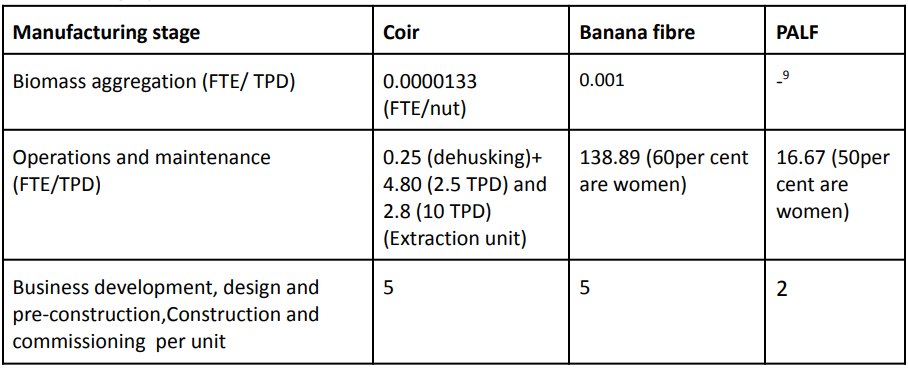
The number of business units are estimated based on the amount of fibre production expected by 2030. Each business unit, a standardised capacity has been considered based on 6 case study analysis across the sub-value chains. The standardised business/units or extraction units considered are as following:
Coir de-husking unit capacity which runs for 300 days: 22000 nuts per day
Coir extracting unit which runs for 300 days: 2.5 TPD and 10 TPD (the nuts are divided between the two)
Banana extraction unit which runs for 7 months in a year: 300 pseudostems per day/ 0.03 TPD production
PALF extraction unit which runs for 300 days : 0.15 TPD
To estimate the potential market opportunity for BBFs of coir, banana fibre and PALF in Odisha, we multiplied the total production of fibre by 2030 for each fibre category by the current prices for fibres (Coir - INR 27/tonne; Banana Fibre - INR 315/kg; Pineapple - INR 494/kg)
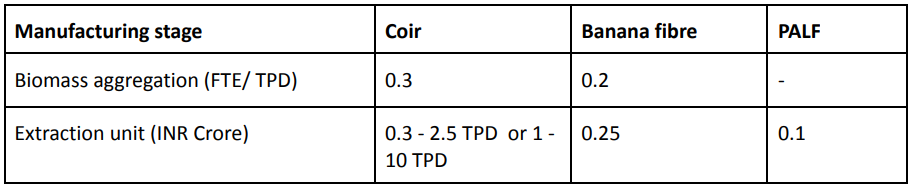
Investment opportunity estimation
Investments are intended to cover all costs incurred for asset creation (CAPEX) to achieve production of fibre quantity in 2030. In cases where the total number of units/facilities required to satisfy the demand by 2030 resulted in decimal places, it was rounded off.
Table 1: CAPEX for at various stages of the value chain10
APICOL. n.d. “BANKABLE PROJECT PROPOSAL ON COIR BASED INDUSTR.” Agricultural Promotion and Investment Corporation of Odisha Ltd.
https://apicol.nic.in/images/Model%20DPRs/Horticulture/Coir%20based%20In...
Basu, Arindam, A.K. Pandey, M.S. Parmar, and Shweta Chauhan. 2019. "Value Added Products from Natural Fibres of Indian Himalayan Region." International Journal of Engineering Research & Technology (IJERT).
Beus, N., Carus, M., & Barth, M. 2019. Carbon Footprint and Sustainability of Different Natural Fibres for Biocomposites and Insulation Material. EIHA | Only pan-European membership organization in the industrial hemp sector.
https://eiha.org/media/2019/03/19-03-13-Study-Natural-Fibre-Sustainability-Carbon-Footprint.pdf
Fibre2Fashion. 2024. “India's Odisha clears 15 projects, to see textile waste recycling unit.” Fibre2Fashion.
https://www.fibre2fashion.com/news/industrial-textiles-news/india-s-odis...
Filho, W. L., Perry, P., Hiem, H., Dinis, M. P., Moda, H., Ebhuoma, E., & Paco, A. 2022. An overview of the contribution of the textiles sector to climate change. Frontiers in Environmental Science, 10.
https://doi.org/10.3389/fenvs.2022.973102
Fuentes, Keyla M, Melissa Gomez, Hernan Robolledo, Jose Miguel Figueroa, Pablo Zamora, Leopoldo Naranjo-Briceño. 2022. "Nanomaterials in the Future Biotextiles Industry: A new cosmovision to obtain smart textiles." Frontiers in Nanotechnology.
HTHD. n.d. “At a glance: Handloom Tab.” Handlooms, Textiles & Handicrafts Department Government of Odisha. https://handloom.odisha.gov.in/handloomtab/glance.
ICAR. 2022. “Doubling Farmers' Incomes: Statewise analysis.” Indian Council of Agricultural Research. https://icar.org.in/sites/default/files/2022-12/DFI-Statewise-Summary.pdf
ICAR. n.d. “BANANA- Crop prodile.” Krishi Vigyan Kendra. https://kvk.icar.gov.in/API/Content/PPupload/k0560_41.pdf.
IUCN. 2017. “Primary Microplastics in the Oceans’. IUCN Systems.
https://portals.iucn.org/library/sites/library/files/documents/2017-002-En.pdf
Jayanarayan Mishra, Kumudini Verma, Anup Behera and Santosh Kumar Mohanty. 2024. “Exploring the socio-economic landscape: A comprehensive analysis of coir sector workers in Puri district of coastal Odisha.” International Journal of Agriculture Extension and Social Development 7, no. 3 (January).
Jayaprakash, Kuzhandaivel, Atieh Osama, Rajinikanth Rajagopal, Bernard Goyette, and Obulisamy Parthiba Karthikeyan. 2022. "Agriculture Waste Biomass Repurposed into Natural Fibers: A Circular Bioeconomy Perspective'' Bioengineering 9, no. 7: 296. https://doi.org/10.3390/bioengineering9070296
Jhanji Dhir, Y. 2022. Natural Fibres: The Sustainable Alternatives for Textile and Non-Textile Applications. IntechOpen. doi: 10.5772/intechopen.10639
Muzyczek, M. 2012. Handbook of Natural Fibres. Woodhead Publishing Series in Textiles. https://doi.org/10.1533/9780857095510.2.312
NABARD. 2023. Banana Cultivation finds priority in Western Odisha. NABARD - National Bank For Agriculture And Rural Development. https://www.nabard.org/news-article.aspx?id=25&cid=552&NID=529
Nayak, S. S., & Mahapatra, B. 2016. GROWTH AND PERFORMANCE OF COIR INDUSTRY IN ODISHA. International Educational Scientific Research Journal, 2(4). https://doi.org/10.21276/2455-295X
Odisha Apparel and Technical Textile Policy. 2022. Odisha Apparel and Technical Textile Policy. Industries Department, Government of Odisha. https://investodisha.gov.in/download/Apparel-Technical-Textiles-Policy-2022.pdf
Orissa Review. 2010. The (Pine) Apples of Odisha's Eyes. The Orissa Review, 82-85. https://magazines.odisha.gov.in/Orissareview/2010/October/engpdf/82-85.pdf
PIB. 2022. “Income of Farmers.” Press Information Bureau. https://pib.gov.in/PressReleasePage.aspx?PRID=1884228.
Roy, S. and Lutfar, L.B. 2012. ‘2 - Bast fibres: jute’, in: Kozłowski, R. M. (ed.), Handbook of Natural Fibres 1, Woodhead Publishing Series in Textiles, Woodhead Publishing, Sawston, UK.
Siengchin, Suchart, Jyotishkumar Parameswaranpillai, Mohammad Jawaid, and Sanjay MR. 2018. "A Comprehensive Review of Techniques for Natural Fibres as Reinforcement in Composites: Preparation, Processing and Characterization." Carbohydrate Polymers.
Vaishali KVK. n.d. “Success stories; Banana Extraction.” https://vaishali.kvk4.in/doc/Success-story.pdf.