Council on Energy, Environment and Water Integrated | International | Independent

Context: Air pollution costs India an estimated INR 7 lakh crore annually, yet less than one per cent of corporate sustainability investments are linked to improving air quality.
Key insight: Corporate social responsibility (CSR) funding can complement public spending by supporting clean mobility, waste management, crop-residue management, cleaner construction, and air-quality monitoring. However, most programmes lack measurable clean-air outcomes and remain concentrated around corporate hubs rather than pollution hotspots.
CEEW recommendation: Companies could align CSR investments with pollution burdens, measure air-quality and health outcomes, support evidence-based pollution control solutions, and strengthen India's air-quality data systems.
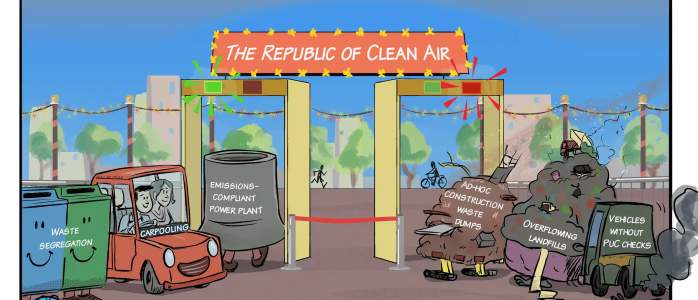
On July 9, heavy rain gave Delhi its first “good” air day in nearly three years. Three days later, its air-quality index had jumped from 48 to 261—back into the “poor” category—and remained there the following day. The reversal is a reminder that clean air cannot be left to rainfall, wind direction or episodic emergency measures. It requires sustained investment in reducing emissions, measuring exposure and protecting public health.
India Inc. has the resources to help. In FY 2023–24, India spent ~INR 3,500 crore in corporate social responsibility (CSR) funds under the environmental sector. This is comparable to the annual budget of the Ministry of Environment, Forest and Climate Change for that year and about five times the allocation for the National Clean Air Programme, India’s flagship clean air programme for the same year. Yet, clean air remains one of the least prioritised areas when it comes to India Inc.’s CSR spending.
That makes air pollution a prime CSR opportunity, sitting at the intersection of public welfare and health, economic productivity, and truly measurable impact. Polluted air harms the same people, places, and markets on which business depends. It raises healthcare costs, weakens labour productivity, disrupts supply chains, reduces agricultural output, and makes cities less livable. Estimates suggest that air pollution costs India INR 7 lakh crore every year, around three per cent of GDP. Indian companies may be increasingly investing in decarbonisation and environmental sustainability goals (ESG) commitments at a CAGR of 20–23 per cent, but less than one per cent of these investments have direct or indirect air quality benefit linkages.
If the private sector takes ownership and actively engages in cleaning the air, several opportunities emerge to realign their spending towards a shared goal with far-reaching economic consequences. Planting saplings, awareness campaigns, certifications, workshops, or isolated sustainable transition initiatives can only go so far without clean air goals or end with measurable pollution reduction. Even fewer programmes track ambient air-quality gains or public-health benefits.
CSR support has already helped deploy electric buses in Goa operated by the Kadamba Transport Corporation and electric rickshaws in Maharashtra, expanding low-emission mobility and livelihoods for women and low-income households. CSR-backed composting units and material recovery facilities in Pune and Bangalore have helped communities process waste locally, reducing emissions from transport and landfilling. CSR partnerships have also supported crop-residue management technologies and farmer training, offering alternatives to stubble burning while improving productivity and income through shared-equipment models in Kurukshetra, Haryana. A fourfold path lies ahead to scale this.
First, CSR programmes must measure clean-air gains, not just visible outputs. Existing initiatives, if aligned with air pollution reduction data, highlight co-benefits, define social impact and encourage innovative interventions. Tree plantation, for instance, remains popular because it is simple, visible, and politically feasible. With India's pledge under the Paris Agreement and national targets for increasing forest cover, tree-planting CSR projects offer companies a strategic way to contribute. The Mahindra Group’s Project Hariyali, launched in 2007 in partnership with the Mahindra Foundation and Naandi Foundation, began with a target of planting one million trees annually and expanded to the Araku Valley in 2010. It has planted over 25 million trees, cultivated 19 native species, and supported 26,000 tribal farmer families. These are important gains. How can such projects reduce pollution exposure? Evidence shows that vegetation can act as a barrier to particulate matter, and some species reduce exposure more effectively than others. Yet companies rarely choose species using air-pollution mitigation criteria. For instance, urban forestry projects can adopt established tools such as the i-Tree Eco model, developed by the US Forest Service or Envi-Met, which estimates the amount of air pollution exposure mitigated annually based on species mix, canopy size and tree health. This would shift the focus from planting targets to measurable air-quality outcomes.
Second, CSR funding must follow pollution burdens, without being constrained by corporate geography. About 75 per cent of CSR expenditure in India remains concentrated in states and urban centres where large companies are headquartered or operate major facilities, including Maharashtra and Gujarat. As a result, many of the most severely polluted regions, like Delhi NCR, receive disproportionately little clean air investment. The mismatch is starker across the Indo-Gangetic Plain and the crop-residue burning belt of Punjab and Haryana, among the world’s most polluted regions. Only a handful of companies have supported pilots on crop-residue management and alternatives to stubble burning. If CSR allocations were guided by pubic health risks posed by air pollution rather than the location of corporate offices, more resources would flow to these million-plus polluted cities and would ensure that CSR resources reach the communities bearing the public health burden.
Third, companies must back technical solutions premised on research that addresses pollutants. CEEW’s recent pilot in Gurugram shows how responsible real estate companies like Signature Global (India) Limited could demonstrate clean construction practices and reduce health risks for workers. While such initiatives should be part of responsible business operations, CSR funding can help in outreach and capacity building to replicate and scale similar interventions. Cutting emissions from brick kilns, diesel fleets and biomass burning could rapidly reduce particulate matter exposure for nearby communities while also advancing climate objectives through reducing black carbon. Allowing CSR programmes to demonstrate tangible impact on both public health and climate.
Finally, CSR could help build India’s clean-air data backbone. Effective air-quality management depends on monitoring networks, source apportionment, emissions inventories, exposure mapping, transparent outcome measurement, and public disclosure. India’s monitoring infrastructure remains inadequate, especially beyond metropolitan centres. State Pollution Control Boards also face technical and analytical capacity constraints. Companies could support hyperlocal monitoring, satellite and sensor integration, open-access air-quality data systems, community-level exposure mapping, and independent verification. Bosch has already developed urban air-quality monitoring and emissions analytics platforms globally, showing how private-sector innovation can strengthen public governance.
The next phase of CSR leadership must enable companies to see that clean air is both a social responsibility and long-term economic value creation. CSR could definitively help India breathe easier, but only if companies treat clean air as a strategic priority, not an accidental co-benefit.
Prarthana Borah is Fellow and Arpan Patra is Programme Lead at the Council on Energy, Environment and Water (CEEW). Send your comments to [email protected].






Add new comment