Council on Energy, Environment and Water Integrated | International | Independent

Context: India’s tariff subsidy burden has nearly doubled since FY20, with discoms billing INR 2.40 lakh crore in FY25 for agricultural and residential consumers. While the rapid uptake of RTS is expected to help moderate the residential subsidy burden over time by reducing grid consumption, its impact on subsidy expenditure will become more evident with time. This underscores the need to assess how electricity subsidies are designed and delivered, particularly where overlapping support to the same consumers may increase the fiscal burden.
CEEW analysis: Under net metering, households that undersize their rooftop solar systems can keep residual grid consumption within free or subsidised tariff slabs, letting them stack central and state capital subsidies on top of recurring tariff subsidies; left unaddressed, this overlap could add up to ~INR 1 lakh crore to the cumulative fiscal burden under an aggressive undersizing scenario, nationally.
Recommendation: India should shift towards more equitable compensation mechanisms such as net billing, use utility-led aggregation models to solarise low-income households, and prevent duplication of benefits so that households receiving PM Surya Ghar capital subsidies are not also drawing recurring tariff subsidies.
India's tariff philosophy has been to provide affordable and accessible electricity to all consumers. For the residential segment, this socially responsive approach has been operationalised through a range of policy and regulatory instruments. Subsidised rooftop solar (RTS) systems are one of them.
The Indian government’s flagship scheme, PM Surya Ghar: Muft Bijli Yojana (PMSGY), aims to promote energy independence, reduce reliance on the grid, and provide affordable electricity by enabling RTS installations. The scheme targets installations across one crore households and has already benefited more than 60 lakh households, with installations growing by ~3 lakh households per month in FY 2026–27.
But what happens when commitments like these translate into an ever-growing fiscal burden?
In FY25, distribution companies (discoms) collectively billed INR 2.40 lakh crore in tariff subsidies for agricultural and residential consumers, nearly double the amount in FY20. The extent to which RTS adoption translates into lower subsidy expenditure will become more evident with time. The rising subsidy burden underscores the need to examine how electricity subsidies are designed and delivered. Sometimes overlapping support is extended to the same consumer, increasing the fiscal burden on governments and raising questions around their intended utilisation.
For residential consumers, subsidies are primarily provided through three mechanisms.
While the latter functions as an internal revenue-balancing mechanism, the first two are borne directly by state governments, which compensate discoms for their foregone revenue. A total of 24 states and Union Territories provide residential tariff support through either per-unit subsidies or free electricity schemes, as reflected in their respective State Electricity Regulatory Commission (SERC) tariff orders (Figure 1).
Figure 1: States have allocated a significant budget for electricity subsidies across India
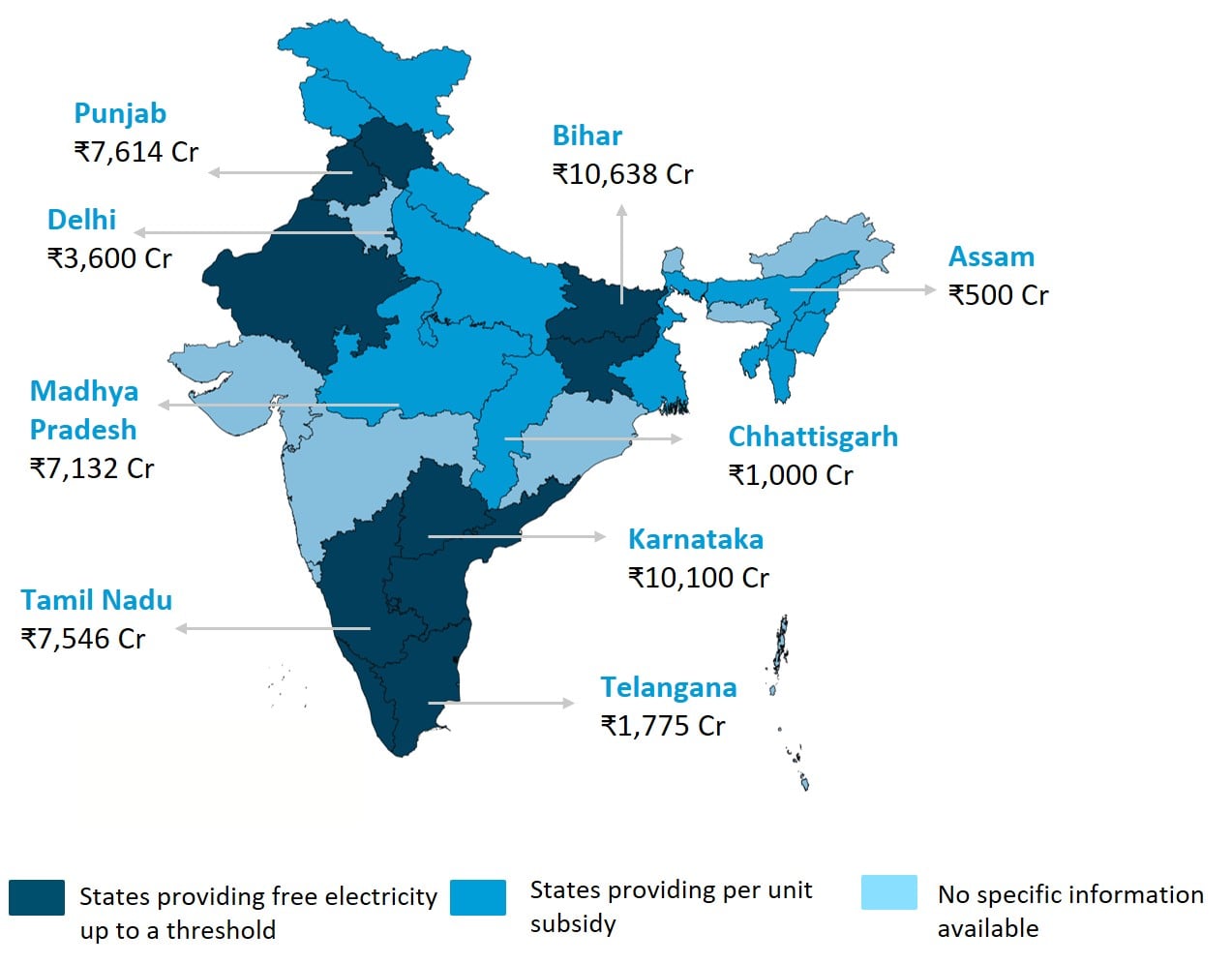
Source: Authors’ compilation from state policy and budget documents
Note: The budget figures correspond to a few key states (FY26 data). Because most states report a consolidated power subsidy budget, it does not necessarily reflect allocations exclusively for residential electricity subsidies.
Under the PMSGY scheme, capital subsidies help households install RTS systems, reducing upfront costs. Complementing central support, several states also offer subsidies to further incentivise adoption.
Over the medium to long term, consumers with RTS systems are expected to become increasingly self-sufficient, with the residential segment's collective reliance on the grid gradually diminishing. At the system level, such interventions could moderate the recurring fiscal burden of electricity tariff subsidy expenditure, reduce system inefficiencies and support the transition towards a more cost-reflective tariff structure.
The current subsidy structure caps central government financial support for general-category residential consumers at INR 78,000 for systems up to 3 kW, making it a key determinant of RTS system-sizing decisions. High-electricity-consumption households may opt for smaller-sized systems to maximise subsidy benefits and minimise upfront expenditure. Roof space, structural integrity, and other technical constraints also contribute to undersizing.
Figure 2: Consumers with an undersized RTS system remain heavily dependent on the grid
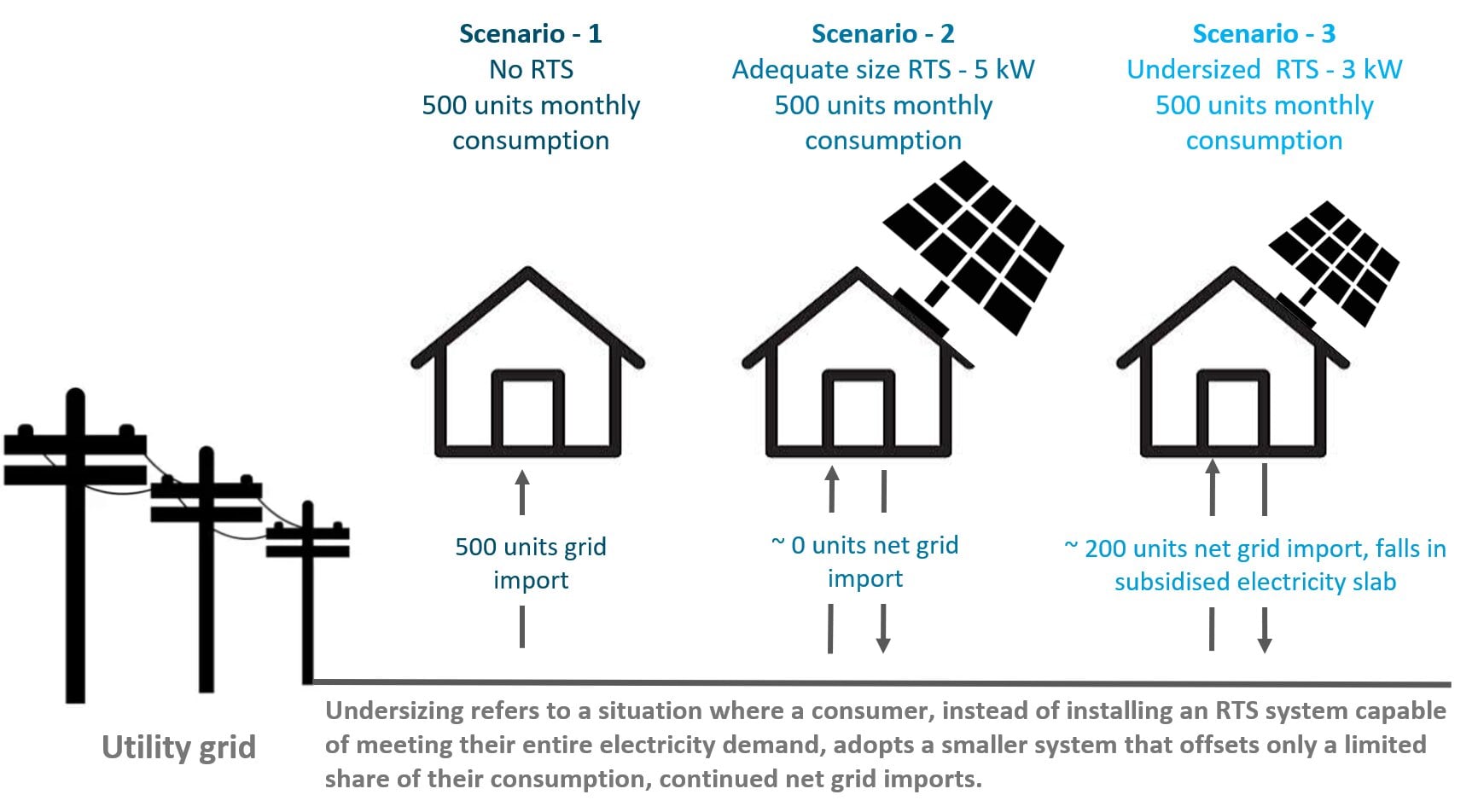
Source: Authors’ analysis
Under the net-metering regime, consumers pay only for the net difference between electricity imported from the grid and the surplus solar generation exported to the grid (see Figure 2). Consequently, if a household deliberately undersizes its RTS system, its net grid consumption may fall within the free electricity slab (in case states provide such benefits); the entire electricity bill, or at least the energy charges, may be fully subsidised. In states that provide per-unit subsidies, consumers may continue to receive them on electricity imported from the grid after accounting for solar generation, reducing the effective tariff payable.
For example, a consumer in Punjab with an average monthly electricity requirement of 500 units who has the rooftop capacity to install a 5 kW RTS system. However, due to the aforementioned factors, the consumer may opt to install a smaller 3 kW system, which would generate 300 units per month (assuming a capacity utilisation factor of 14 per cent). Consequently, the consumer’s net grid consumption is reduced to roughly 200 units. Under the current tariff policy in Punjab, households are eligible for up to 300 units of free electricity per month. Consequently, the consumer’s net grid consumption falls entirely within the free electricity slab, effectively eliminating the electricity bill.
Additionally, the consumer could continue to avail both central and state capital subsidies, while also benefiting from recurring tariff subsidies on grid electricity consumption.
The potential fiscal impact varies by state because tariff structures and subsidy designs differ. To reflect this variation, two states are selected as examples from each of the two broad tariff subsidisation mechanisms:
Category A – Free electricity scheme: Punjab, and Category B – Per-unit subsidy: Assam
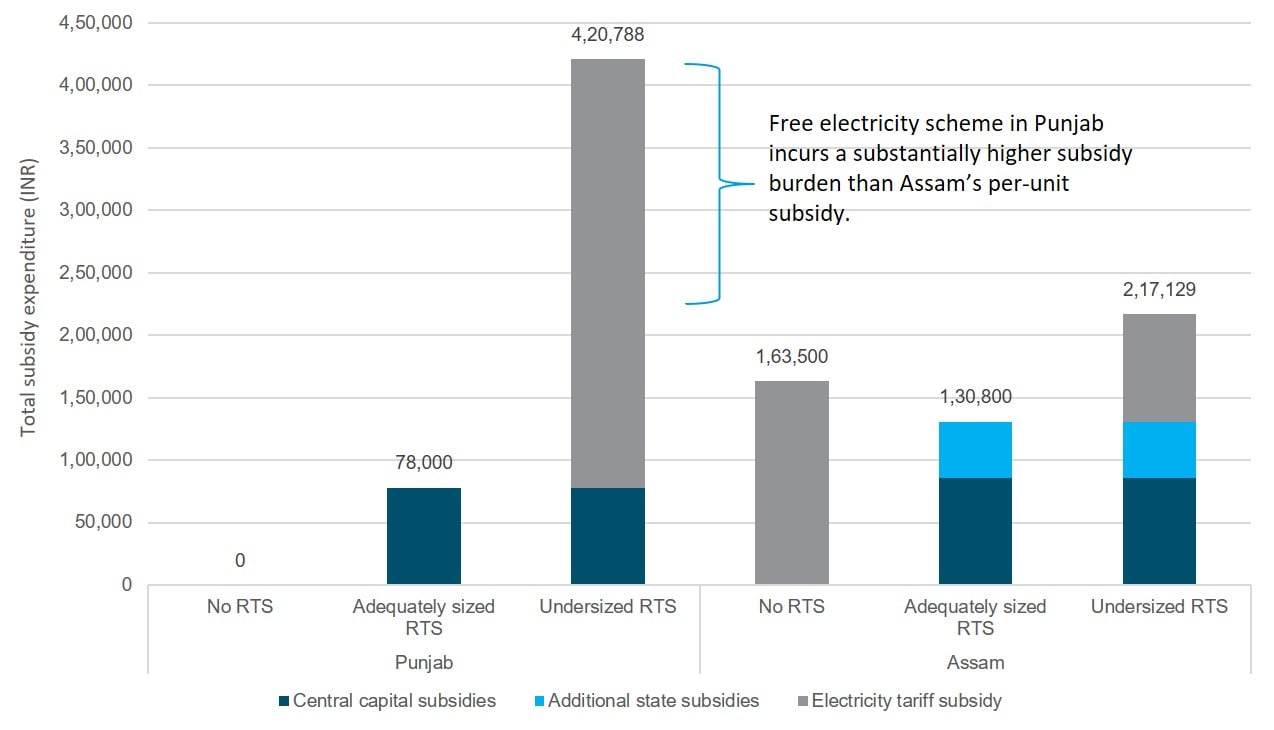
Figure 3: States offering free electricity subsidies tend to have a higher fiscal impact compared to those providing per-unit tariff subsidies
Source: Authors’ analysis
Note: The above estimates represent total subsidy expenditure per consumer over the RTS system's 25-year lifetime, assuming the current subsidy mechanism remains unchanged. Fiscal impacts are estimated as the difference between the SERC-approved retail tariff and the effective tariff payable (energy charges only) after accounting for free electricity schemes and per-unit subsidies (where applicable). Solar generation and consumer electricity demand are assumed to remain constant over the analysis period.
For consumer A, no RTS scenario in Punjab results in zero subsidy cost because the consumer's electricity consumption exceeds the 300-unit threshold for the free electricity scheme. An adequately sized RTS system reduces grid consumption sufficiently to move the consumer out of the subsidy regime, thereby reducing the electricity tariff subsidy burden. In contrast, an undersized RTS system reduces grid consumption only partially, keeping the consumer eligible for an electricity tariff subsidy. As a result, the government's total subsidy expenditure increases nearly fivefold, reaching up to INR 4 lakh.
Eligible consumer B in Assam receives a per-unit electricity subsidy (up to 500 units), which explains the expenditure under the no-RTS scenario. With an adequately sized RTS system, the consumer offsets nearly all grid electricity consumption, reducing the state's recurring electricity subsidy burden by INR ~30,000. However, an undersized RTS system meets only part of the electricity demand, requiring the consumer to continue drawing subsidised grid electricity and effectively doubling the subsidy burden compared to an adequately sized RTS system, even with capital subsidies (both state and central). The analysis indicates that free electricity subsidy mechanisms tend to have a greater fiscal impact than per-unit tariff subsidies.
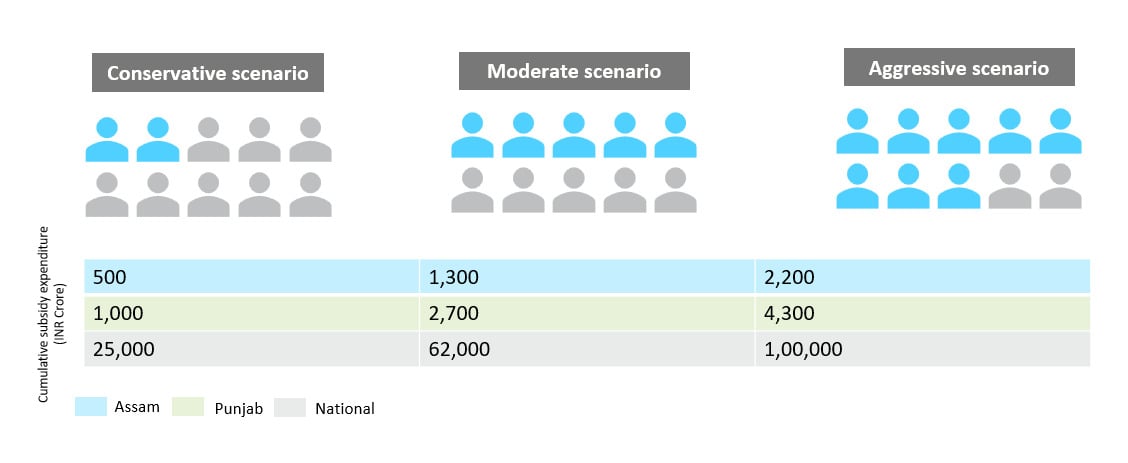
Figure 4 scales up the per-consumer fiscal impact to estimate the broader implications. At the national level, the estimated impact could reach up to ~INR 1 lakh crore, depending on the share of consumers opting for undersized RTS systems. Without data on the prevalence of undersized RTS systems, the estimates are based on a sensitivity analysis. The analysis assumes that 10 per cent of total electricity consumers have a sanctioned load above 3 kW, and that 50 per cent of them adopt RTS. Among these adopters, we consider three undersizing scenarios: 20 per cent (conservative), 50 per cent (moderate), and 80 per cent (aggressive).
Figure 4: Potential cumulative fiscal impact nationwide could reach up to INR 1 lakh crore
Source: Authors’ analysis
Targeted, effective policy reforms could play a critical role in achieving the dual objectives of affordable electricity and efficient subsidy utilisation.
While the government has focused on scaling rooftop solar deployment, it must look beyond capacity addition to ensure long-term sustainability and resource optimisation. However, the choice of installed system size ultimately rests with consumers, and the government cannot dictate the size of systems installed, but can play a critical role in framing the right incentives.
The proposed measures could prevent duplication of tariff subsidies, ensure more efficient targeting of subsidy expenditure to intended beneficiaries, and improve the fiscal sustainability of central and state subsidies.
Sanskriti Gupta is an ex-researcher, Debanjan Bagui is a Programme Associate, and Bhawna Tyagi is a Senior Programme Lead at the Council on Energy, Environment and Water (CEEW). Send your comments to [email protected]




Add new comment