Council on Energy, Environment and Water Integrated | International | Independent

Context: India has installed rooftop solar systems in more than 5 million households under the PM Surya Ghar Muft: Bill Yojana, with a target of solarising 10 million households by March 2027.
CEEW analysis: Irregular maintenance reduces electricity generation, consumer savings, and system performance, while a mature maintenance ecosystem could create an annual market worth up to INR 144 billion and support around 0.3 million FTE jobs.
Recommendation: Standardise maintenance services, improve consumer awareness, and support scalable public and private-sector business models for rooftop solar maintenance.
Under the PM Surya Ghar: Muft Bill Yojana, more than 5 million households have already adopted rooftop solar systems (RTS) in India, leading to 18 GW of installed RTS capacity. The scheme aims to achieve solarisation of 10 million households by March 2027. To ensure these RTS installations consistently generate electricity over their 25-year lifetime, they must be maintained regularly.
study by the Council on Energy, Environment and Water (CEEW) revealed that only half of RTS adopters monitor daily system performance and two-thirds clean their panels at least once a month. If left unaddressed, factors such as dust, air pollution, bird droppings, and equipment faults can significantly reduce electricity generation efficiency.
While current policy mandates five years of free maintenance support for RTS systems, the scope of the free services is not clearly defined. As a result, the support provided during this period often differs from expectations. Consultations with CEEW researchers and RTS developers indicated that maintenance costs are typically embedded in the installation cost, with no explicit mention of cleaning services as part of the maintenance offered. RTS developers visit from once a month to once a year, and these visits are often reactive rather than proactive, suggesting maintenance is mainly carried out at the consumer's request rather than through scheduled visits.
The consequences of such irregular maintenance are not limited to just the consumer. It ripples across the entire ecosystem.
Scaling RTS adoption needs to be matched with reliable, affordable, and accessible maintenance services. What is currently viewed as an operational challenge could evolve into a multi-billion service market. If India achieves the national target of solarising 10 million households (30 GW) by 2027 and maintains a monthly service frequency, the estimated operation and maintenance (O&M) market could reach around INR 54 billion annually. With bundled service offerings—cleaning, electrical checks, and other preventive maintenance services—the market potential could rise to INR 144 billion, supporting ~0.3 million FTE jobs in the O&M sector (The cited figures represent indicative phased market potential, assuming all 10 million households (30 GW capacity) transition to paid services after the initial five-year free maintenance period).
Realising this market potential depends on closing the gap between the maintenance currently on offer and what a reliable service ecosystem requires. Three priorities are central to this:
First, the Ministry of New and Renewable Energy (MNRE) should issue a standard operating procedure (SOP) on RTS maintenance, highlighting the scope of services, minimum frequency of visits, and service quality standards to be provided during the free maintenance period, along with manufacturer and developer responsibilities in case of panel damage or failures during the warranty period. The SOP could apply only to new installations, i.e., systems commissioned after the notification date. To avoid disrupting existing service agreements and prevent uncertainty between consumers and vendors, existing consumers could voluntarily opt for paid maintenance services from empanelled service providers under the proposed model outlined below.
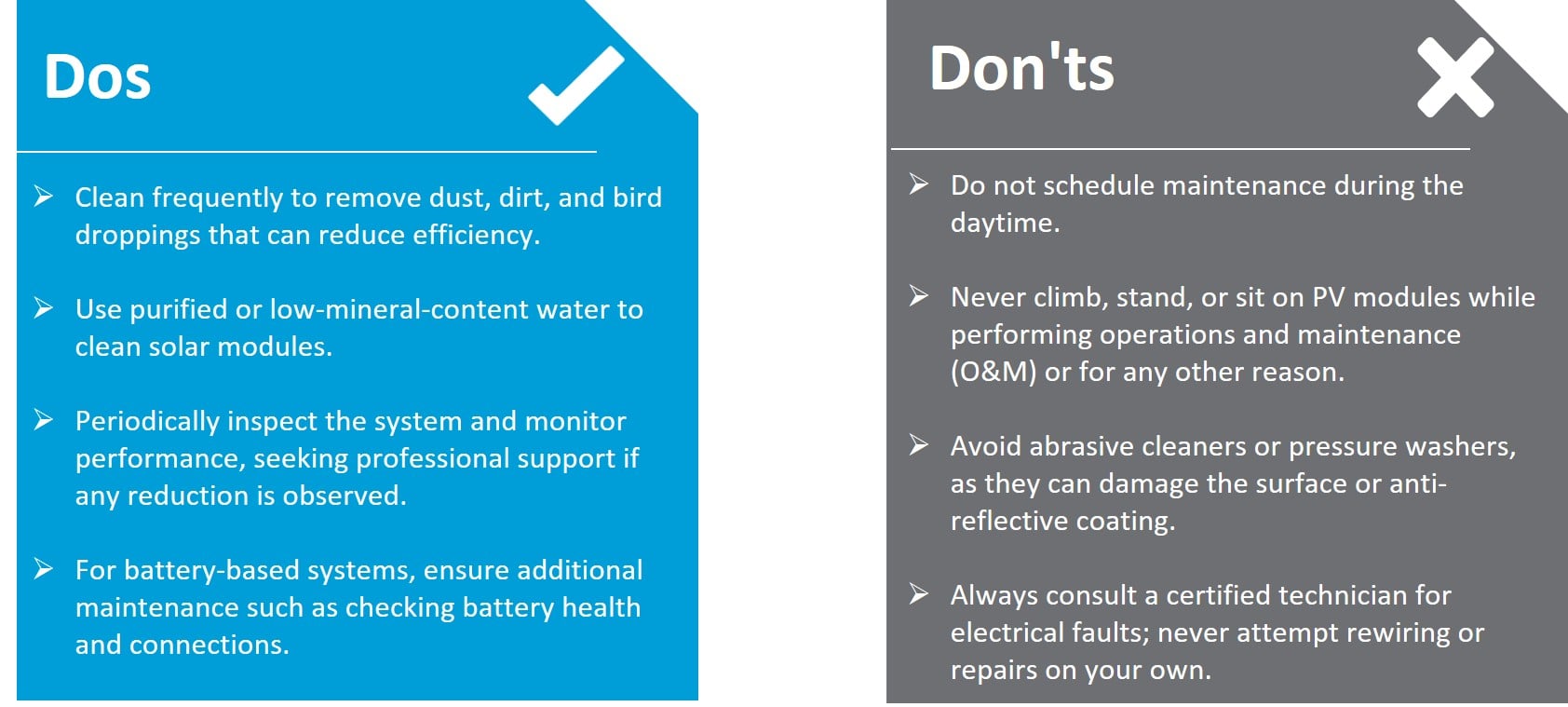
Second, consumer awareness must be strengthened. Guidelines on basic do's and don'ts for self-cleaning, dedicated awareness campaigns highlighting the value of regular maintenance, and automated alerts to nudge consumers could improve understanding, encourage timely maintenance, and help create a sustainable market for maintenance services (Figure 1).
Figure 1. Ensuring reliable performance through best practices
Source: Authors’ analysis
Third, with demand established, scalable business models will be needed to mainstream maintenance services, especially after the free maintenance period ends, and shift the sector from a one-time capital investment to a long-term service economy. The proposed business models below can unlock the maintenance market and drive mass adoption.
1. Government-led pay-per-use service model
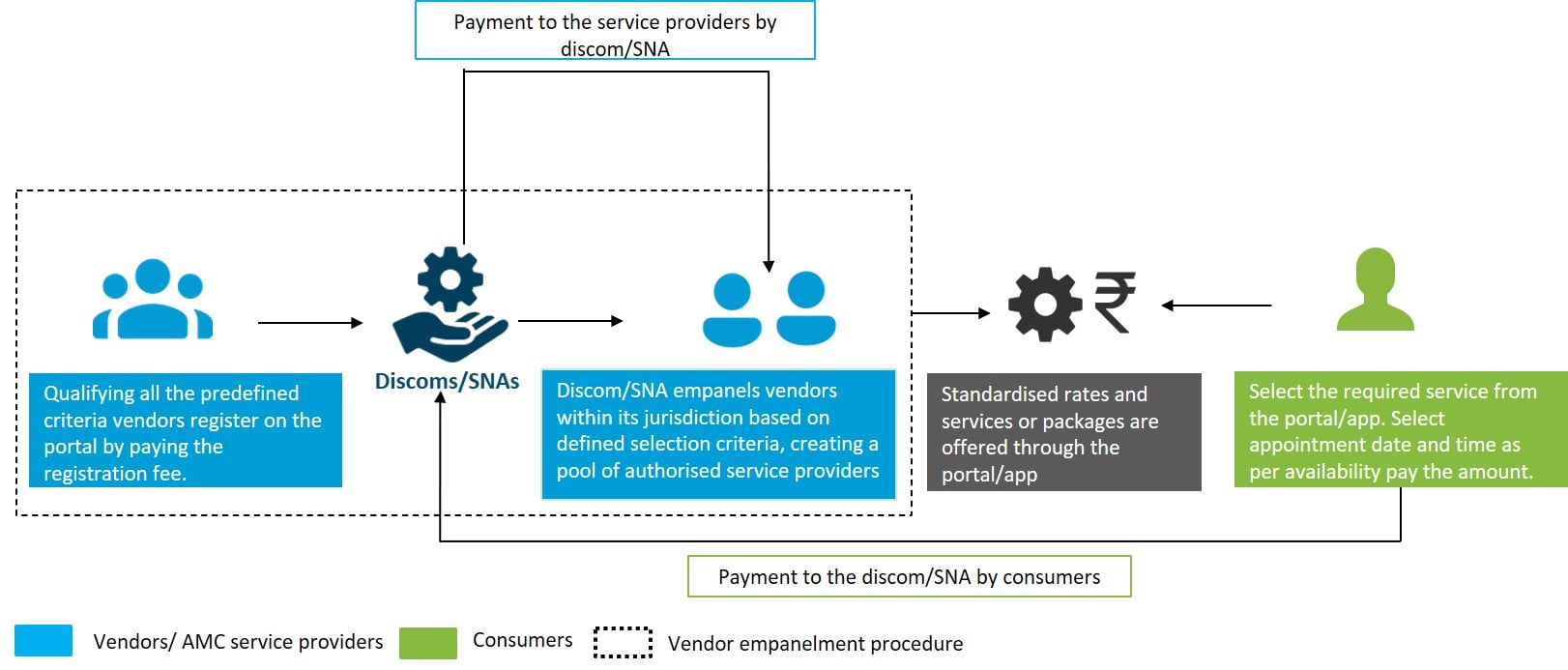
Similar to how the Government of India has designed the national RTS portal as a one-stop platform to streamline the consumer experience and application process for RTS adoption, maintenance services could also be integrated under the same platform. Discoms or state nodal agencies (SNAs) can act as trusted intermediaries rather than delivering services directly. They will be responsible for vendor verification, service delivery, performance validation via geo-tagged evidence or similar verification mechanisms, and payment management (Figure 2).
Figure 2. A public-intermediated pay-per-use model for rooftop solar maintenance
Source: Authors’ analysis
Upon meeting the eligibility criteria, vendors or service providers will be empanelled by the discom or SNA. Empanelled vendors could offer standardised, modular Annual Maintenance Contract packages. Consumers can browse, book, and pay for services through a single interface.
This model ensures high regulatory oversight and transparent grievance redressal. Although it requires significant institutional bandwidth from already-stretched discoms, facilitation fees could create an additional revenue stream. This could be piloted under the utility-led aggregation model, which has completed 1.6 lakh installations for Pradhan Mantri Awas Yojana (PMAY), BPL and SC/ST households across four states. This would allow MNRE to assess the effectiveness of an empanelled maintenance model before scaling it up.
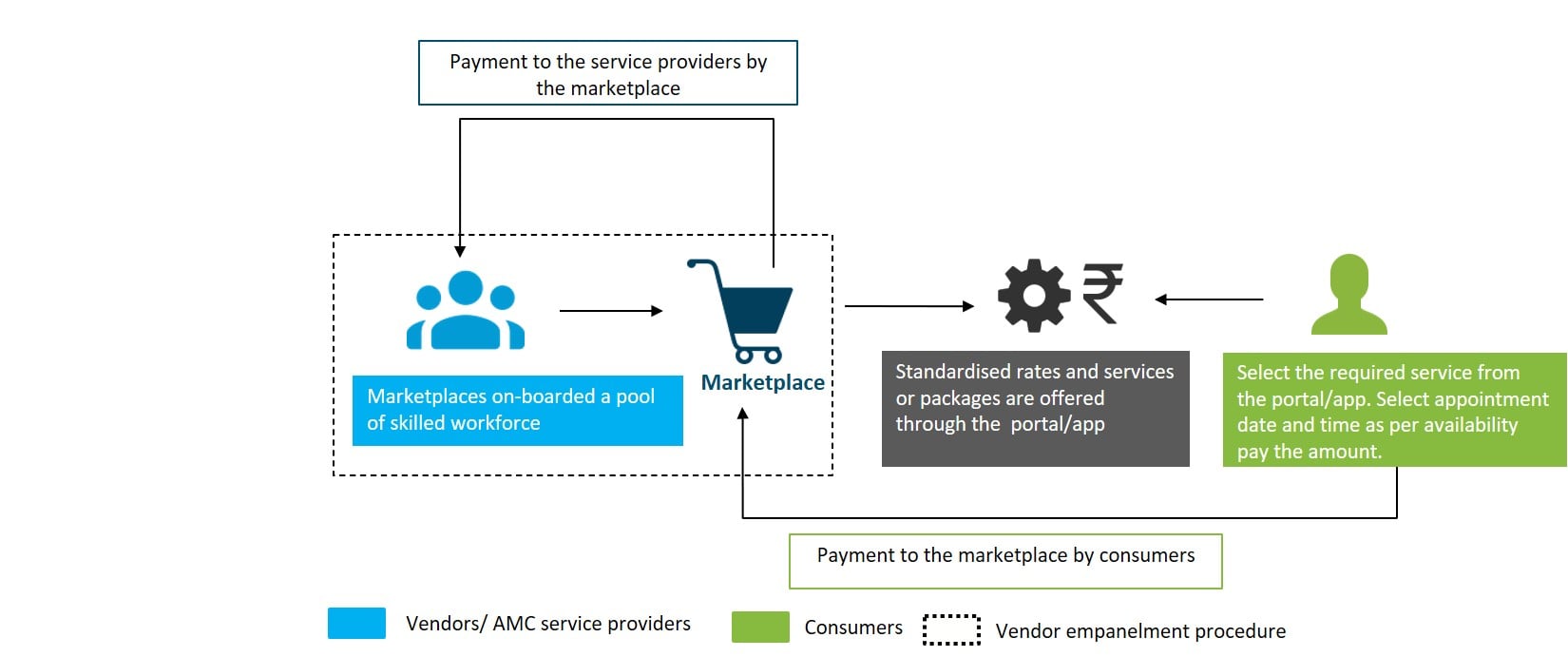
While the former may add administrative burden for discoms or SNAs, the alternative is to let the market drive the transition. Imagine booking a solar system cleaning or inverter inspection as easily as scheduling a home appliance repair or booking a household cleaning appointment. In the marketplace model, private platforms aggregate skilled, certified technicians and connect RTS owners with verified service providers. With transparent pricing, modular service offerings, and quality assurance, such platforms could make solar maintenance more accessible while creating a scalable business opportunity (Figure 3).
Figure 3. A digital marketplace for rooftop solar maintenance
Source: Authors’ analysis
The platform is responsible for vendor verification, service delivery, performance validation via geo-tagged evidence or similar mechanisms, and payment management. Its success depends on consumer trust and consistent service quality, making standardised guidelines and oversight critical.
While the SOP would standardise the scope of services covered under the mandatory five-year free maintenance period, consumers would still be able to choose additional or alternative service packages based on their needs under different business models. In practice, both models can coexist—similar to the EV charging ecosystem, where public and private networks operate in parallel—enabling a broader, more competitive RTS maintenance market.
Debanjan Bagui is a Programme Associate and Prateek Aggarwal is a Senior Programme Lead at the Council on Energy, Environment and Water (CEEW). Send your comments to [email protected]






Add new comment