Council on Energy, Environment and Water Integrated | International | Independent


Context: Despite various measures, stubble burning continues to affect air quality, ecology, soil, and public health across India, beyond Punjab and Haryana. Without proactive crop residue management policies, India now risks a nationwide agricultural residue-burning crisis.
CEEW analysis: Existing strategies to control stubble burning have fallen short because of monitoring gaps, low adoption of in situ CRM machinery, and sub-optimal use of straw for energy and material creation. Although official reports record a ~90 per cent fall in farm fires in Punjab and Haryana over five years, findings suggest that peak stubble burning has slowly shifted from afternoons to evenings — a shift that polar-orbiting satellites do not capture.
Recommendation: To curb stubble burning, the central government needs to tailor solutions to each district’s cropping profile, apply lessons from Punjab and Haryana, build facilities and supply chains only where end-user demand for straw is viable, and push for behavioural change and awareness.
The Commission for Air Quality Management (CAQM) has mandated stubble management plans across Punjab, Haryana, Rajasthan and Uttar Pradesh since 2021. Bans, fines, subsidised machinery and biomass co-firing mandates have introduced sustainable residue management practices among farmers but have not completely dislodged the practice. Biomass burning, of which stubble is one part, contributes an estimated 20 per cent of Delhi's PM2.5 levels in winter and 12 per cent in summer.
This goes beyond north-west India. Satellite imagery reveals an increase in active farm fires across central and southern states, including Madhya Pradesh, Bihar, Maharashtra, Andhra Pradesh, and Telangana (Figure 1). Beyond autumn paddy burning, a second stubble burning season occurs in April and May for wheat and other rabi crops. While wheat residue has historically served as valuable fodder for cattle, declining livestock population and minimal profit margins in fodder production have likely increased residue burning. Without proactive crop residue management (CRM) policies, India risks a nationwide agricultural residue-burning crisis.
Figure 1: Seasonal cropland fires are rising in major rice & wheat growing Indian states (2012-25)
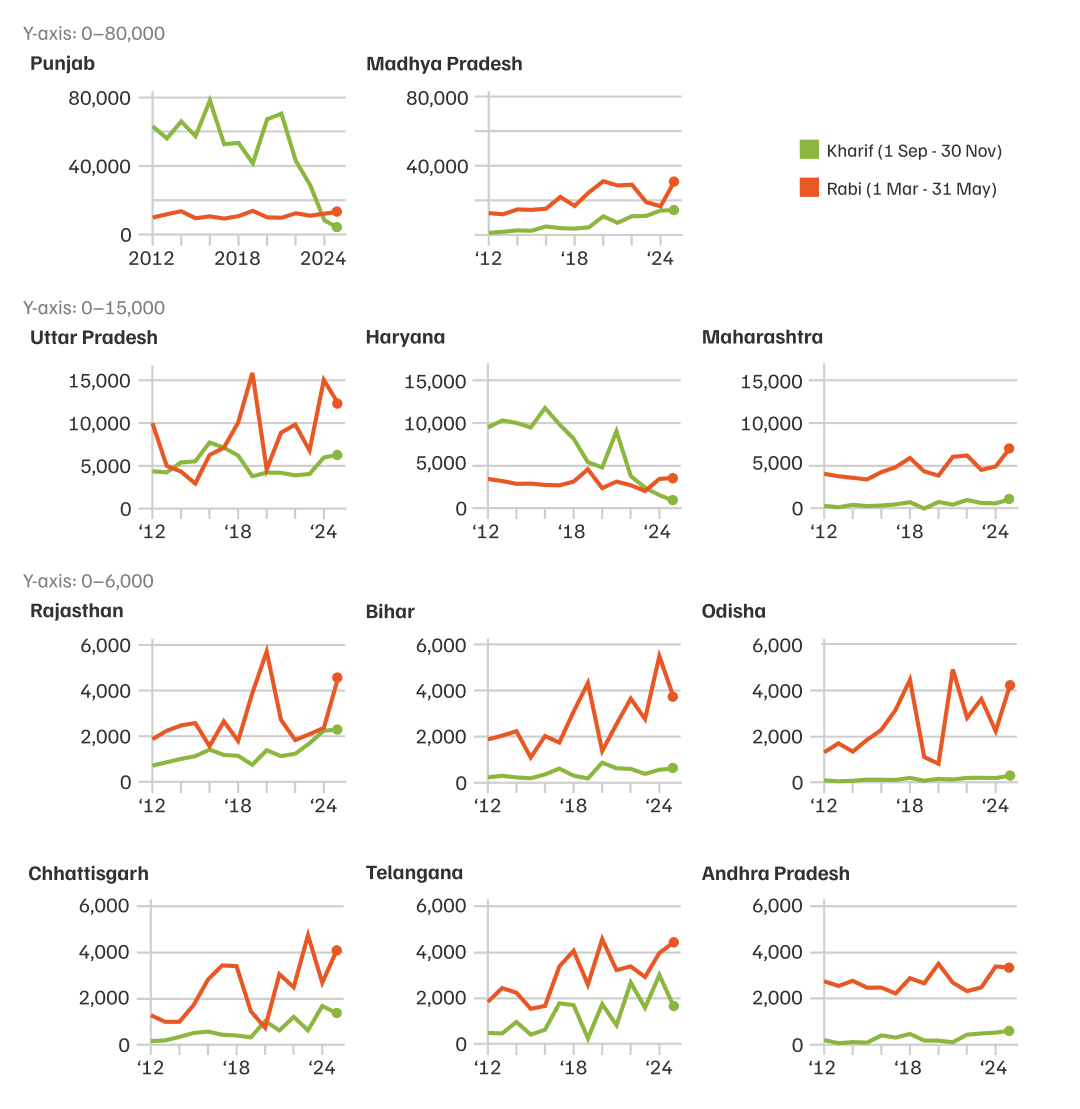
Source: CEEW analysis; Open fires detected by Suomi NPP - VIIRS satellite. Kharif burning represents the period between 01 Sep and 30 Nov, while rabi burning represents the period between 01 Mar and 31 May.
Note: The VIIRS satellite captures all thermal anomalies, so we used the National Remote Sensing Centre’s Land Use Land Cover (250k) crop layer to include only fires on agricultural land and remove forest fires. Suomi NPP detects fires only during its overpass (around 1:30 pm and 1:30 am local time), so it may miss fires outside these windows. Given growing evidence of these limitations, treat fire counts as indicative and interpret them with caution.
India produces ~903 million tonnes (MMT) of gross agricultural residue annually, of which 206 MMT is surplus and available for biofuel production and material creation, as well as other alternative uses. However, most of it is burnt for three reasons. First, the rice-wheat system, promoted for food security through assured procurement and subsidised power and fertiliser, leaves about a month between crops, which is insufficient to manage the residue. Second, combine harvesters leave stalks 10 to 15 inches tall, and uprooting them requires more expensive labour. Third, market demand for straw is low. Though national evidence on the ex-situ market is limited, evidence from wheat-paddy cropping regions such as Punjab indicates that farmers receive low payments for baled paddy straw. Only three per cent of ex-situ farmers in Punjab were paid (in Kharif 2022), while 69 per cent gave it away for free, and 28 per cent paid about INR 1,200 per acre to have their fields cleared. Whereas in Haryana, only seven per cent of baling farmers were paid, while 62 per cent gave it away, and 31 per cent paid, on average, INR 1,000 per acre to have it removed.
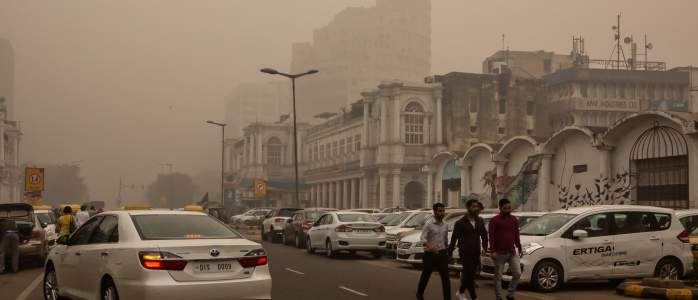
Stubble burning imposes severe ecological and public health costs. Every tonne of paddy straw burnt releases three kg of particulate matter, 60 kg of carbon monoxide, 1,460 kg of carbon dioxide, 199 kg of ash, two kg of sulphur dioxide, and 0.58 kg of black carbon into the atmosphere. Trapped under winter inversion layers in the Indo-Gangetic plains, these pollutants form toxic smog across regional air sheds, deteriorating air quality far beyond the rural source. Black carbon and fine particulate matter also accelerate the melting of Himalayan glaciers. Nationally, residue burning accounts for ~13 per cent of India’s PM2.5 emissions and living in districts with high stubble burning is associated with a threefold increase in the risk of respiratory infection.
The impact on soil health is equally critical: a tonne of straw contains 5.5 kg of nitrogen, 2.3 kg of phosphorus, 25 kg of potassium, 1.2 kg of sulphur, besides organic carbon – some of it is lost when burnt.
Image 1: CEEW’s Khushi and Navjot in conversation with farmers in Moga district of Punjab, assessing the emerging trends on the use of in-situ straw management machines like Super Seeders.
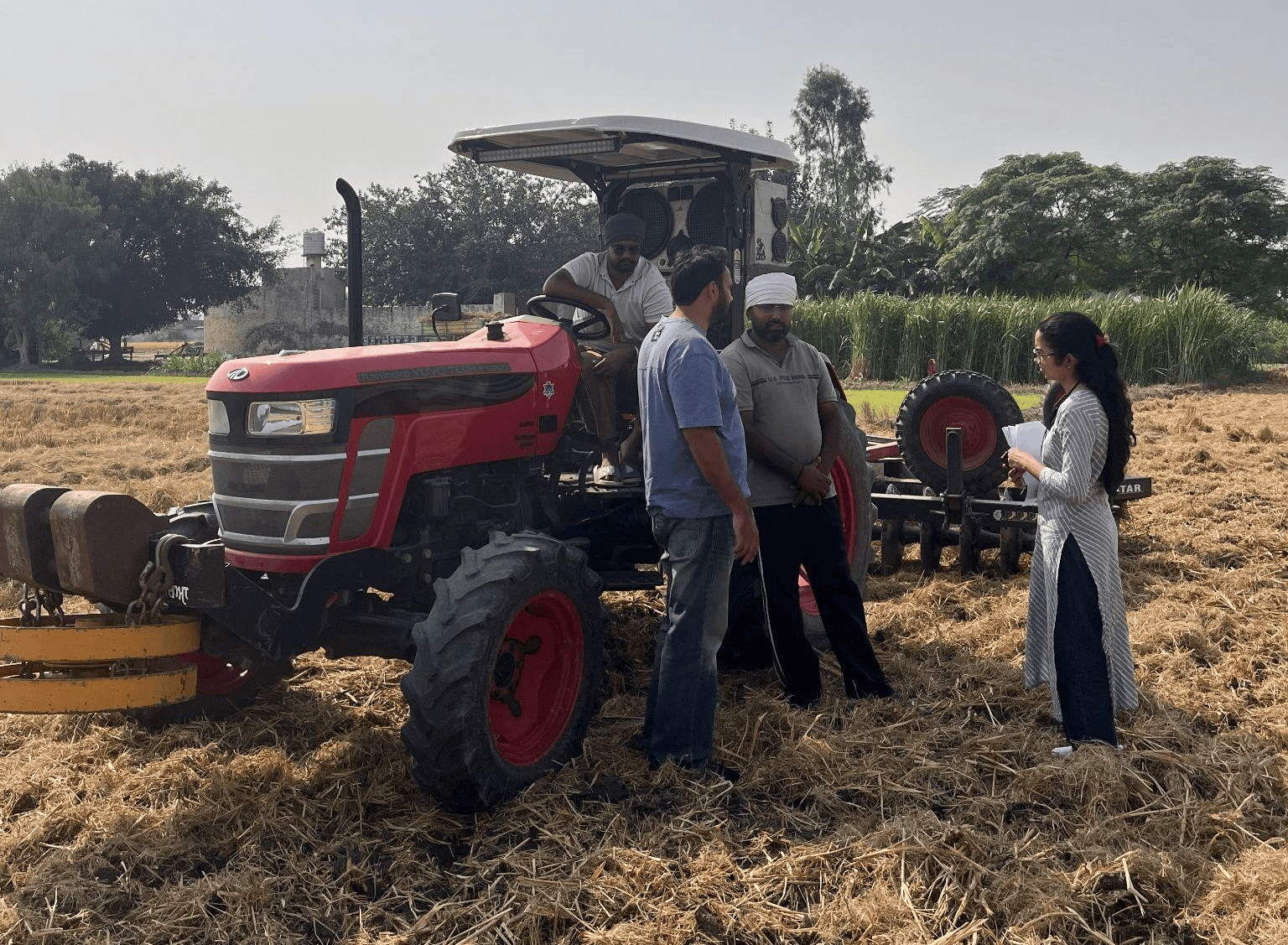
Source: CEEW
Existing strategies to control stubble burning fall short because of monitoring gaps, low machinery adoption, and limited industrial uptake of straw for bioenergy and material production.
Official reports record a ~90 per cent fall in farm fires over five years. Yet, field findings suggest that peak stubble burning has slowly shifted from afternoons to evenings, a change that polar-orbiting satellites do not capture. In CEEW’s latest state-level survey of 1,588 Haryana farmers, only 6 per cent admitted to burning stubble, but 26 per cent reported observing stubble burning in their village. Among those who admitted to burning in their village, 77 per cent said it occurs between 4 pm and 10 pm. The dip may therefore be less drastic than reported. Latest CEEW research recommends revising the current monitoring protocol to include burnt-area estimates alongside fire counts and to adopt a hybrid approach that combines Sentinel-2 imagery with commercial imagery.
Meanwhile, subsidies have yielded mixed results. Between 2018 and 2026, the Centre released over INR 4,500 crore under the CRM scheme, supplying over 3.54 lakh crop residue management machines and establishing over 43,500 custom hiring centres. But the scheme covers only Punjab, Haryana, Uttar Pradesh and Delhi, with Madhya Pradesh included only in 2023. Even where machines exist, burning continues. Nearly half of Punjab’s farmers using in-situ CRM machines still burn loose straw first to save diesel and control pests.
Industrial offtake also faced bottlenecks. Straw must be collected within a tight 15- to 20-day window, then stored year-round, with companies reportedly receiving bales with moisture above the required 20 per cent threshold. CEEW research finds that biomass companies in Punjab lose 15–25 per cent of stored bales to moisture, degradation and fire.
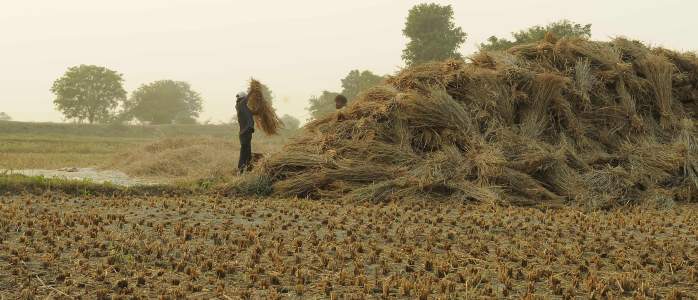
Image 2: Burnt char on a combine-harvested field in Madhya Pradesh, underscoring the spread of stubble burning to central India.
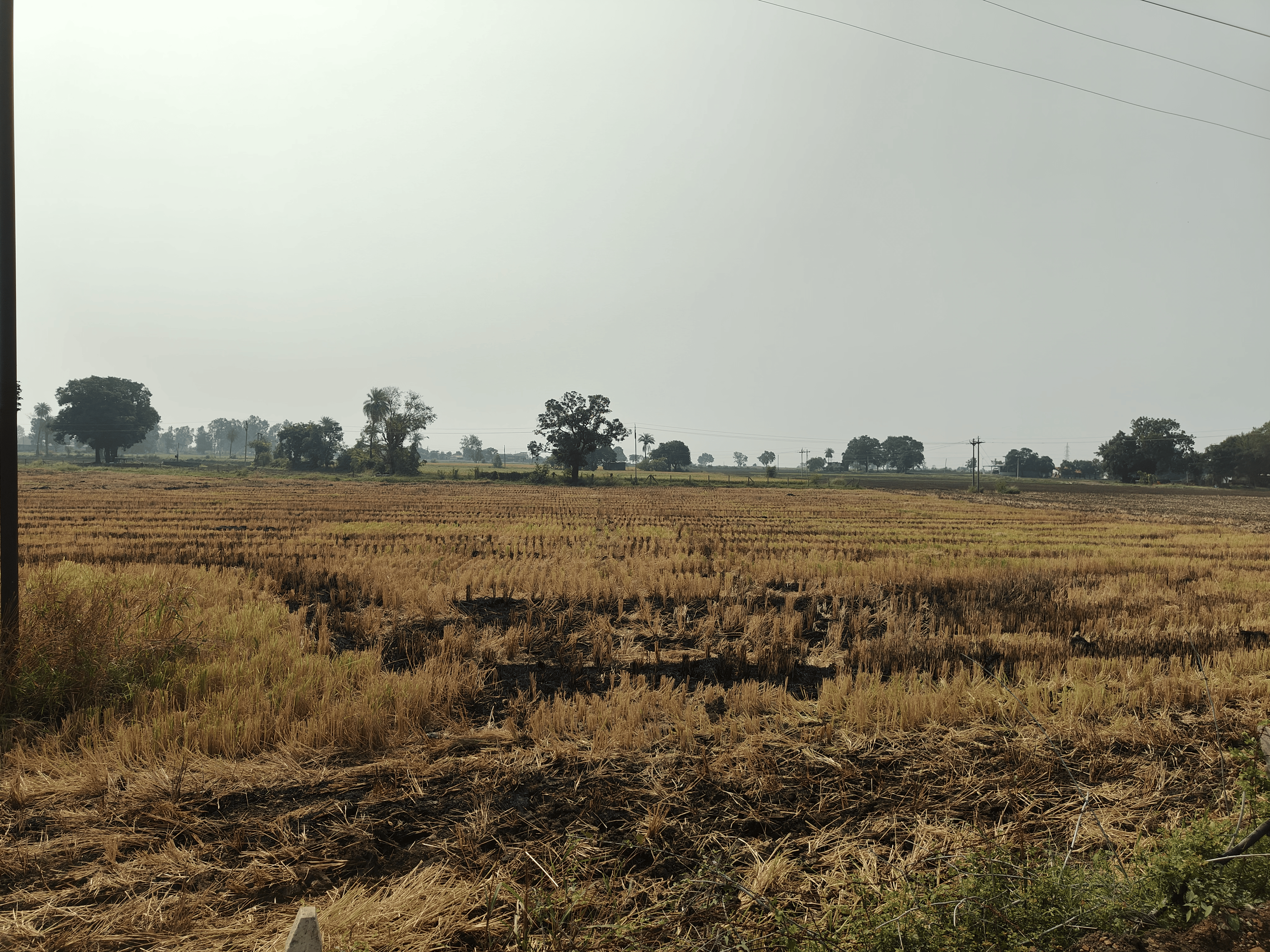
Source: CEEW
State agriculture departments can take several structural and strategic measures to curb stubble burning.
First, tailor solutions to each district’s cropping profile. For instance, Haryana’s paddy landscape is almost equally split between basmati and non-basmati. Haryana’s basmati belts require formalising unorganised fodder markets and developing fodder banks, whereas non-basmati clusters need Super Seeders, balers and storage infrastructure. The Centre should also extend the CRM scheme to states and crops that are increasingly being burnt.
Second, set up rental models in line with Punjab and Haryana. Establish custom hiring centres (CHCs) for prudent access to CRM machines. At rents of INR 1,800-2,500 per acre for the complete CRM service (including a Super Seeder, tractor and driver), renting remains more economical than buying for farmers with holdings under 45 acres in Punjab.
Third, build plants, storage and supply chains only where industrial demand for straw is viable. The Centre’s new INR 23,731 crore GOBARdhan scheme, running from 2026-27 to 2035-36, could create steady demand for agricultural biomass. But residue should go to companies only after fodder and soil health needs are met, so that ex-situ demand does not strip farms of straw that animals and soils depend on. This needs to be complemented by a fodder supply chain ecosystem that connects surplus to deficit areas.
Finally, include behavioural change communication in their Information, Education and Communication (IEC) efforts to move farmers from knowing about cleaner alternatives, such as residue incorporation using super seeders, to trusting and actively choosing them for sustained adoption.
Agricultural fires are human-made and preventable. Treating the fires spreading across Indian states with the same seriousness as Delhi’s smog is how states can stay ahead of a national crisis.
Kurinji Kemanth is Programme Lead; Srishti Jain and Khushi Sharma are Research Analysts at the Council on Energy, Environment and Water (CEEW). Send your comments to [email protected]





Add new comment