Executive summary
Agricultural residue burning has evolved from a regional issue into a pan-India crisis amid rising cultivation costs, declining land productivity, and climate-induced stress. While historical hotspots like Punjab and Haryana remain central to the discourse, states including Madhya Pradesh, Uttar Pradesh, Telangana, and Rajasthan experienced a surge in farm fires during 2025 and 2026. Nationally, agricultural residue burning is responsible for an estimated 13 per cent of India’s PM2.5 emissions (TERI 2021).
Recognising this, the Centre and several state governments launched circularity initiatives such as the Crop Residue Management (CRM) Scheme, the GOBARdhan scheme, 5–7 per cent mandated biomass pellet co-firing in thermal power plants, 20–50 per cent Image: Kurinji Kemanth / CEEW CEEW researchers interviewing farmers on their crop residue management practices in Haryana (January, 2026). mandated biomass co-firing in brick kilns, and others. The CRM scheme released INR 4,266.47 crore between 2018 and 2025 to key states, establishing over 43,500 Custom Hiring Centres (CHCs) and supplying more than 3.54 lakh CRM machines (PIB 2026a). Concurrently, state-led initiatives like Haryana’s Parali Protsahan Yojana (PPY) offer direct cash incentives to farmers practising no-burn methods (DoAFW Haryana n.d.). While Haryana reported an ~90 per cent reduction in farm fires over the last five years, emerging evidence suggests a temporal shift in farmers’ burning behaviour to late afternoon (~17:00 IST), to evade detection by polar-orbiting satellites (Singh et al. 2025, CAQM 2026a). This infers that the dip in fire numbers might be comparatively less drastic than reported.
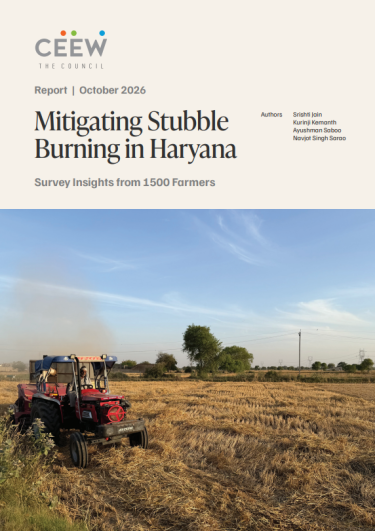
To decode Haryana’s CRM model and evaluate the onground efficacy of policy interventions, we conducted a state-level representative survey between January and March 2026. We employed stratified random sampling to sample 1,588 farmers across 12 districts— Ambala, Fatehabad, Hisar, Jhajjar, Jind, Kaithal, Karnal, Kurukshetra, Panchkula, Rohtak, Sirsa, and Yamuna Nagar, which accounted for ~92 per cent of the total kharif fires between 2018 and 2024. Readers should note that our analysis provides for weighted percentages, while the corresponding totals (in brackets) remain unweighted unless stated otherwise.
Through this study, we seek to understand how CRM has evolved over the eight years of the scheme’s existence, current trends, farmers’ perspectives, and the state’s future outlook, going beyond kharif to also include the growing concern over rabi residue management—of paddy and wheat residue, respectively.
Key findings
How do crop choices dictate farmers’ residue management methods?
- Comparable adoption across the three common CRM pathways in Haryana, with farmers often practising more than one. 32 per cent of surveyed farmers use in-situ CRM machinery such as super seeders; 38 per cent opt for ex-situ management (baling); and 39 per cent use residue as fodder (n = 1,588). As farmers report more than one harvesting or management practice, shares do not sum up to 100 per cent. About 6 per cent also acknowledged complete or partial burning, though this figure is likely underestimated, as fear of penalties and social stigma introduces a degree of social-desirability bias into self-reported burning. A larger share—26 per cent of all farmers—reported burning incidents in their village, with ~77 per cent of them citing that burning is prevalent between 4 pm and 10 pm, corroborating the recently observed temporal shift in fire incidents (Singh et al. 2025, CAQM 2026a).
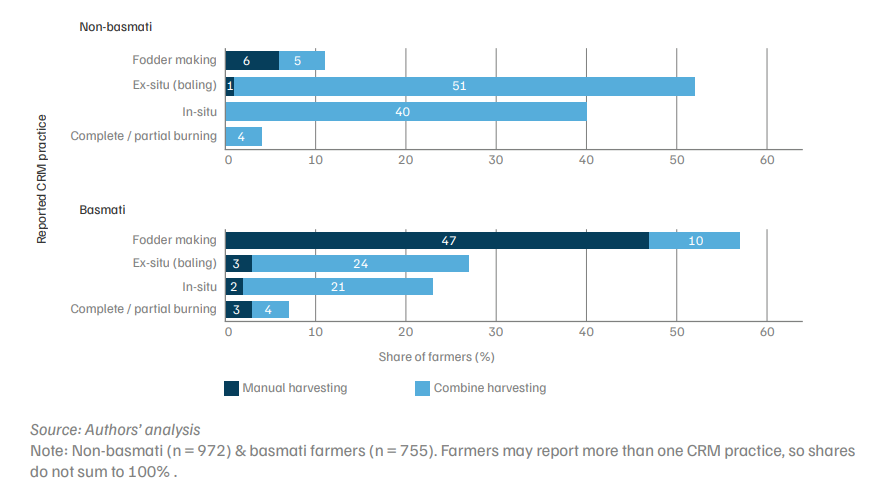
- Non-basmati residue is baled or managed insitu, while basmati residue serves as fodder. Haryana’s paddy landscape is split between basmati and non-basmati. According to our survey, 50 per cent of farmers grew basmati, 40 per cent grew non-basmati paddy, and 10 per cent grew both. While the decision to grow basmati is driven by soil and water suitability, along with its potential for export revenue, non-basmati paddy is chosen for its perceived price security through the minimum support price.
- While non-basmati growers use combine harvesters, basmati farmers continue with manual harvesting for better grain recovery. The majority of non-basmati farmers (93 per cent) use combine harvesters, while the straw is managed via baling (52 per cent) and in-situ management (41 per cent) (n = 972). On the other hand, more than half of basmati growers (57 per cent) follow manual harvesting, with the basmati straw used as cattle fodder (57 per cent) due to its lower silica content (n = 755), and for baling activities (27 per cent). Manual harvesting is common among basmati growers for its efficient straw collection and suitability for chaff cutters common in households, while combine harvesters consume less time and help avert labour shortages and high manpower costs.
Figure ES1. Non-basmati residue is mostly baled or managed in-situ, while basmati residue primarily serves as fodder
Source: Authors’ analysis
Note: Non-basmati (n = 972) & basmati farmers (n = 755). Farmers may report more than one CRM practice, so shares do not sum to 100% .
What are the emerging trends and cost drivers in in-situ CRM machine usage?
- Super seeders have evolved from niche CRM machinery to the default wheat sowing machine. 82 per cent of all in-situ CRM farmers (n = 587) rely on super seeders for residue management and wheat sowing. Interestingly, ~75 per cent of ex-situ farmers (n = 1,103) who removed residue through baling or for fodder use also used super seeders for wheat sowing, with seed drills relatively less common. Therefore, any disruption to super seeder availability through supply bottlenecks, price spikes, or breakdowns during peak rabi sowing season would affect the CRM practices of both insitu and ex-situ farmers.
- Cultural preference for visually ‘clean’ and smooth fields is changing the machinery use patterns. 71 per cent of super seeder users (n = 475) and 62 per cent of Rotavator users (n = 77) run the machinery two or more times, with irrigation in between, for optimal residue decomposition and wheat germination, which ends up doubling the operational costs to INR 4,000-4,500 per acre. The ideal way is to operate combine harvesters fitted with Super Straw Management Systems, followed by a single pass of super seeders.
- CRM rental behaviour is dominant among farmers. 82 per cent of in-situ farmers rent machines, with 99 per cent of these rentals occurring through individual farmer networks rather than government-backed CHCs. This is because the state’s priority has shifted to individual farmers in recent years, with no new CHCs set up since 2021–22. Given the Commission for Air Quality Management’s (CAQM) Direction No. 90, which mandates CHCs to provide free machines to small and marginal farmers, incentivising the ecosystem is crucial to develop the service delivery mechanism and to improve affordable access to machines for farmers.
How is Haryana faring against its ex-situ CRM targets?
- Haryana has doubled its ex-situ CRM capacity targets from 1.1 to 2.3 million metric tonnes (MMT), but supply chain bottlenecks persist. Meeting this target hinges on improving processing technology, preserving the feedstock during storage, and meeting feedstock quality standards. The CAQM recently ordered three power plants (in Panipat, Yamuna Nagar, and Hisar) to pay INR 21.22 crore in environmental compensation for missing the 5 per cent biomass co-firing mandate. Infrastructure rollout also lags, with only three out of seven proposed agri-residue-based CBG plants currently operational.
- Ex-situ payment ecosystem is nascent and fragmented. While biomass aggregators handled 87 per cent of baled residue (n = 583), only 7 per cent of farmers received payments; 62 per cent of farmers gave this straw away for free, and 31 per cent actually paid out-of-pocket (~INR 1,000 per acre) to have their fields cleared. In contrast, 67 per cent of farmers selling their residue as fodder were paid, though they also incurred higher manual harvesting costs (mainly basmati growers).
Figure ES2. Ex-situ industries’ paddy straw utilisation potential has almost doubled in the last 5 years
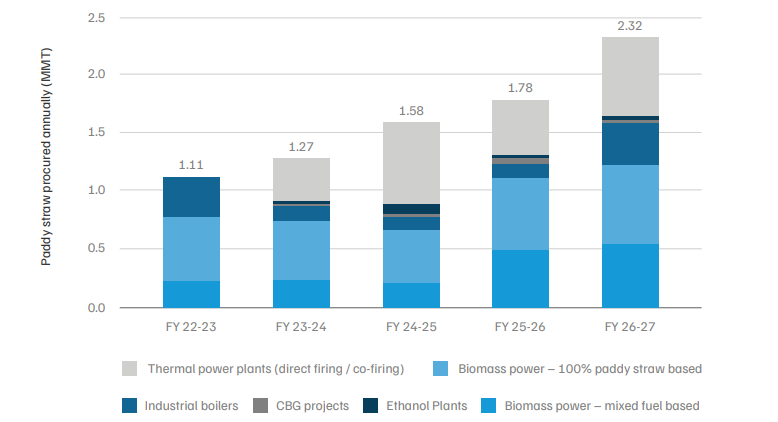
Source: Authors’ compilation based on data procured from HAREDA 2025–26
- In the fodder market, basmati residue commands a premium of INR 3,000 per tonne, reflecting its preference as animal feed, against INR 2,250 per tonne for non-basmati residue. In the biomass-aggregator channel, non-basmati farmers receive INR 1,200 per tonne (~INR 3,000 per acre).
- Despite the varying remunerative benefits, exsitu CRM farmers reported satisfaction. 80 per cent of ex-situ CRM farmers (baling and fodder, n = 1,109) reported that they would continue with the same method in 2026 with shares fairly similar across pathways as it ensures timely field clearance, provides fodder for livestock consumption or sale, and is perceived to be cheaper than bearing the operational expenses of running in-situ machines. However, of the dissatisfied lot, collection delays and absence of monetary compensation were the most common complaints we observed.
What drives Haryana’s wheat stubble fires?
- Wheat stubble fires are rising with dwindling market demand for wheat residue. Almost all surveyed farmers (~98 per cent) reported using wheat residue as fodder due to its low silica content, with ~94 per cent using it for selfconsumption and 22 per cent giving it away. Asked about the status of wheat fodder prices five years back, surveyed farmers in nine out of twelve districts reported a decline in the median fodder prices (from INR 500 to INR 350 per quintal, n = 1,091). Price volatility and falling wheat fodder demand, with livestock reduction in the state, drive wheat stubble burning.
How are farmers responding to government zero-burn incentives?
- The Parali Protsahan Yojana, Haryana’s special initiative that provides INR 1,200 per acre for zero-burn CRM, is popular. Awareness about the scheme is high, at ~80 per cent. With regard to the completed PPY cycle for the FY 24–25 burning season, nearly 42 per cent applied for the benefit, with more than half of them (57 per cent) receiving benefits. The remaining share either received compensation from residue buyers, withdrew the application midway, or were disqualified for non-compliance. The CRM subsidy scheme also achieved significant outreach, with ~70 per cent of respondents aware of it.
- The risk of behavioural regression toward burning is reportedly low if PPY were to be phased out. When asked if farmers would switch to burning if the incentives are discontinued, nearly two-thirds of farmers who received PPY benefits (n = 415) indicated that they would not burn despite the withdrawal, although this share was lower for medium and large farmers compared to small and marginal farmers. This is likely driven by larger residue volumes and greater bargaining power relative to peers.
Figure ES3. Parali Protsahan Yojana has been instrumental in driving no-burn CRM practices in Haryana

Source: Authors’ analysis
Note: Total farmers (n = 1,588). Percentages inside each band are stage-to-stage conversion; header shares are of the group total.
- Despite high adoption rates of no-burn CRM, there is no clear consensus among farmers on the long-term benefits of no-burn agriculture. While 48 per cent of in-situ farmers reported an increase in wheat yields (n = 571), 52 per cent reported no impact on wheat productivity post the in-situ intervention. In fact, 94 per cent of farmers who transitioned away from burning towards in-situ and ex-situ CRM practices (n = 1,579) reported no reduction in chemical fertiliser use, including urea and diammonium phosphate (DAP) requirements.
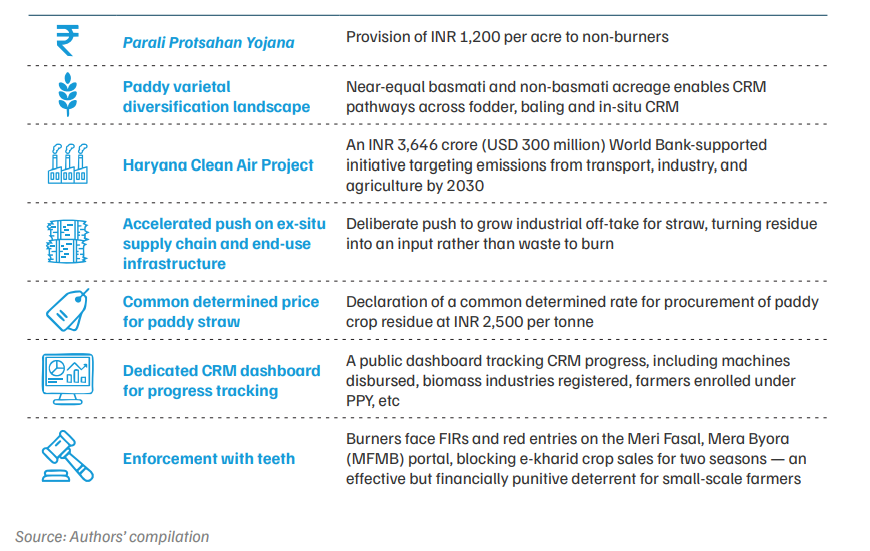
7 ways Haryana’s institutional and incentive structure is outperforming other states for crop stubble management
Policy recommendations
- The Haryana Agriculture Department should rationalise the allocation of CRM equipment in line with basmati and non-basmati area needs. Haryana’s state action plan estimates a requirement of an additional 13,633 and 1,297 machines for paddy and wheat residue management, respectively (CAQM 2026b). To ensure optimal use, the state should focus on targeted, cluster-specific machinery deployment in line with the district’s needs, deployed through the setting up of CHCs and promotion of village-level entrepreneurs (VLEs). Non-basmati clusters should scale ex-situ management by deploying balers and boost industrial-scale biomass aggregation, supplemented by in-situ machinery where end-use demand is low. In contrast, basmati clusters should prioritise formalising unorganised fodder markets, and establishing fodder banks and supply chains for fodder logistics.
- State departments should allocate biomass storage capacity to match the state’s ex-situ targets and ensure a smooth supply chain. In line with CAQM’s Direction No. 99, which calls for planning adequate storage facilities for bales to safeguard from moisture, decomposition, and fires, Haryana should scale up its storage infrastructure to match its growing ex-situ ambitions (2.3 MMT target capacity)(CAQM 2026c). This requires identifying and earmarking 1,610–2,300 acres of land, with a projected storage infrastructure investment of INR 58–92 crore in accordance with the bale size. The state should prioritise government/panchayat land close to aggregation points and incorporate moisture control and fire-safety measures into storage design to pre-emptively reduce feedstock losses and preserve bale quality.
- Fast-track the commissioning of proposed ex-situ biomass projects while strategically siting the new plants. To meet Haryana’s ex-situ CRM target, the state should enforce strict commissioning timelines for approved biomass projects, while maximising the capacity of existing facilities. Currently, with only three out of seven commissioned compressed biogas (CBG) plants operational, expediting pending projects is critical to generate feedstock demand. Additionally, with biomass power dominating current utilisation (52 per cent), Haryana should actively diversify its end-use ecosystem by promoting industrial boilers, pellets/briquettes, and brick kilns. To ensure accountability, the State Action Plan must transparently track and document how residue is being distributed and managed across these varied industries.
Additionally, states should use satellite imagery, groundwater data, supply chain logistics, and enduser availability to algorithmically cluster agricultural blocks and identify where ex- situ projects are viable. Public capital support for balers, storage, and transport should be concentrated in areas where industrial demand exists. High stubble areas without nearby buyers should instead prioritise in-situ management, while water-stressed regions should pursue crop diversification. Such precise allocation will ensure new biomass projects are commissioned only where feedstock supply is inherently viable, preventing stranded assets.
- Phase out incentives under Parali Protsahan Yojana as ex-situ market matures. To make zeroburn agriculture financially self-sustaining, Haryana should gradually shift the cost burden from the state to industrial stakeholders. The state should phase out PPY incentives for ex-situ practices as the biomass market matures in the coming years, to directly compensate farmers and transform residue into a commodity. However, the state should continue supporting in-situ CRM with incentives compensating for its high operational costs due to its proven soil moisture and health benefits (Keil et al. 2021). By strategically restricting these payments to in-situ CRM practising farmers in the long run, Haryana can slash its total estimated PPY budget of INR 495 crore per annum by half (assuming the current PPY incentive of INR 1,200 per acre). Limiting this support to small and marginal farmers would further improve savings — a crucial requirement for the state’s longterm fiscal prudence (Annexure A5).
- Expand the scope of CRM initiatives and state action plans for stubble management operational year-round. With rising rabi fires, the Union government should expand the scope of CRM initiatives to include both kharif and rabi crops, in line with CAQM Direction No. 96. Implementing this year-round mandate requires (including wheat straw) specific machinery like straw reapers in the subsidised equipment list for CHCs and individual farmers, launching dedicated IEC and behaviour change communication campaigns for rabi residue management, and establishing robust supply chains to transport surplus wheat fodder to deficit regions.
- Develop a dedicated compliance monitoring and progress tracking portal for CAQM directions on stubble management. The Haryana CRM Dashboard—a tracking architecture providing data on machines disbursed and crop biomass-using industries—should be upgraded for better usability. Additionally, having such a standardised platform should be mandated across other states to ensure uniform reporting standards.
- To effectively enforce its statutory directives, the CAQM itself should also develop a portal for tracking the compliance status of its directions, such as No. 99 and No. 96, calling for the complete elimination of crop residue fires for both kharif and rabi, respectively. At a minimum, the portal should include:
- A central, dated record of every CAQM directions issued, with its specific compliance deadline.
- Automated consistency checks on submitted data for instance, flagging any pathway-level target to prevent errors and imprecise reporting.
- Integration of satellite fire-count data/burnt area with ground-level administrative actions.
- A public-facing view of which states and which directions are compliant, pending, or overdue.