Council on Energy, Environment and Water Integrated | International | Independent

Seaweeds are macroscopic algae growing in marine and shallow coastal waters and brackish water habitats. A renewable marine resource, seaweed has been underutilised essentially due to the lack of realisation of its economic potential. India needs to start farming and not just forage to unleash the true potential of seaweed. Seaweed cultivation does not require scarce resources such as fertile land, freshwater, and inputs like fertiliser. Furthermore, seaweed cultivation can mitigate ocean acidification and eutrophication, and aid in atmospheric CO2 removal. The resulting biomass offers valuable commercial products in industries such as packaging, pharmaceuticals, cosmetics, bio-inputs and processed foods through value addition.
Odisha's extensive coastline and favourable conditions for seaweed farming make it an ideal location for large-scale cultivation. By investing in seaweed farming, Odisha can contribute significantly to the nation's economic growth, create green jobs, and support sustainable development.
Jobs, market and investment opportunity
By 2030, cultivating approximately 26,000 hectares of Kappaphycus alvarezii and Gracillaria seaweed could create around 108,300 full-time jobs. 26,000 hectares of area in Odisha will be able to produce ~254,000 dry tons of seaweed yearly, which would translate into a market opportunity of USD 95 million. An investment of USD 128 million would be needed to realise this opportunity.
Balasore, Jagatsinghpur, Puri, and Ganjam have the highest potential for cultivating seaweed.
Provides better return on investment: Seaweed farming offers short production cycles, quick returns on investment, and minimal entry barriers due to low capital and material needs. This is crucial for Odisha, where 48,601 of the 92,569 traditional fisherfolk families (52.5 per cent) live below the poverty line. Fisherfolk livelihoods are at risk from frequent cyclones and the seasonal nature of fishing, with no fishing allowed during the breeding season for conservation. Seaweed farming can improve living standards by providing additional income and livelihood opportunities. Women fisherfolk in India have been early adopters of seaweed farming, benefiting from income within a safe environment (Krishnan & Narayanakumar 2013). Connecting seaweed farms to tourism can further unlock economic and social gains for coastal communities (Hussin et al. 2015).
Ecological benefits: Seaweeds provide forage and refuge habitats for commercially important marine species and play a critical role in mitigating coastal risks by reducing the impact of advancing waves, preventing shoreline erosion, and curbing flooding (Duarte et al. 2013). Seaweeds also remove heavy metals from water by acting as excellent nutrient scrubbers.
Nutritional benefits: Bioactive compounds found in seaweeds have led to the development of nutraceuticals, functional foods, and other value-added products. These products can help address malnutrition in our country's young children and pregnant women (Lomartire & Gonçalves 2022). For example, the ICAR-Central Marine Fisheries Research Institute (ICAR-CMFRI) has created a seaweed-based nutraceutical called Cadalmin to enhance innate immunity against post-COVID complications (ICAR 2024).
Industrial applications: Seaweed-based hydrocolloids from commercially important seaweeds, such as alginate, agar, and carrageenan, have several valuable applications as stabilisers in food, pharmaceutical, cosmetic, biotechnology, and other industries (Khalil et al. 2018).
Climate mitigation potential: Seaweed absorbs carbon dioxide and converts it into solid biomass. It is harvested for further utilisation as seaweed-based packaging materials, seaweed-enhanced livestock feed, seaweed-based biostimulants, and intentional deep ocean sinking of seaweed to reduce GHG emissions (Fujita et al. 2022).
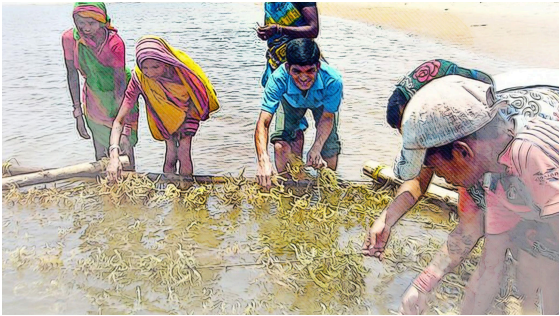
In Chilika Lake, approximately 100 trained individuals, particularly women, are involved in cultivating Gracilaria seaweed, which is indigenous to the area near Balugaon. Seaweed matures for harvesting within just 45 days of planting, enabling cultivators to earn up to INR 10,000 per month from a 10-acre underwater area. Besides providing a reliable source of income, this initiative has empowered the local community while restoring water's capacity for carbon absorption and improving overall water quality1.
1. Role of departments:
Odisha has a 480 km long coastline, 25,000 km of continental shelf area, and the largest brackish water lagoon, Chilika Lake in Asia. Effective collaboration among government departments and agencies is vital to harnessing the economic benefits of seaweed farming for sustainable large-scale seaweed production.
a. Fisheries & Animal Resources Development Department: The Fisheries & Animal Resources Development Department should collaborate with the Enhancing Climate Resilience of India's Coastal Communities (ECRICC) project and the Odisha Coastal Zone Management Authority to introduce seaweed farming technology as an alternative employment option for coastal fisherfolk by raising awareness and discouraging unsustainable collection of wild seaweed. Working with the Odisha Space Application Centre (ORSAC), the department can facilitate marine spatial planning to identify suitable areas for seaweed cultivation and minimise environmental and social impacts by promoting Integrated Multi-Trophic Aquaculture (IMTA).
i. The department could support industry-driven incubation entrepreneurial models, including contract farming-based business models, to enhance engagement between entrepreneurs and fisherfolk. The department should establish a seaweed park under the Pradhan Mantri Matsya Sampada Yojana (PMMSY) scheme to serve as a hub for entrepreneurs to encourage value addition in seaweed.
ii. To address the natural vulnerability of commercial seaweed farming to cyclones, disease, and heavy rain (Mantri et al. 2022), the department should assess the potential of including seaweed under the Aquaculture Crop Insurance scheme under PMMSY. The department should also support research on integrated seaweed farming systems utilising nutrient-rich wastewater from aquaculture ponds to fertilise seaweed crops. Finally, the department should draft leasing policies and guidelines for allotting sea areas for seaweed cultivation (NFDB 2020).
b. Science and Technology Department: The Science and Technology Department could invest in researching the species richness of seaweed along Odisha's coast, developing high-yielding and disease-resistant seaweed varieties, and exploring new applications for seaweed products such as hydrocolloid and liquid biofertiliser production. Additionally, the development of technologies like offshore seaweed farming systems, seaweed growth monitoring systems, and efficient processing technologies can optimise cultivation techniques and enhance productivity within the seaweed industry.
i. The department should establish dedicated seaweed research centres with laboratories and field stations, particularly at Chilika, to conduct applied research on issues such as the effect of pollution on seaweed and seaweed diversity, and to tackle local challenges like integrated marine cultivation. Moreover, the department should facilitate grants and incubate start-ups focused on seaweed to boost production and develop a seedling production strategy in Odisha.
c. Science and Technology Department: The Science and Technology Department could facilitate grants and incubate start-ups focused on seaweed by investing in research and development. This includes establishing dedicated seaweed research centres to address issues such as the impact of pollution on seaweed and seaweed diversity, as well as developing high-yielding and disease-resistant seaweed varieties suitable for Odisha's coast. The department could also support the development of offshore seaweed farming systems, growth monitoring methods, and efficient processing techniques to optimise cultivation and enhance productivity.
d. Chilika Development Board (CDB): Chilika Development Board (CDB) could play a crucial role in scaling seaweed cultivation in Odisha by preventing the introduction of exotic seaweed species that pose risks such as invasive pathogens, parasites, and potential ecosystem disruption. To manage these risks effectively, the CDB should develop a robust policy and risk assessment plan in collaboration with ICAR to leverage their expertise. This would include establishing stringent testing and certification procedures and conducting at least three years of research and development—both in the lab and field—to ensure ecological safety before introducing exotic seaweed species into open waters. Additionally, the CDB should continuously monitor the growth of various seaweed species and devise risk mitigation strategies to ensure sustainable cultivation practices.
e. Odisha Skill Development Authority: The Odisha Skill Development Authority (OSDA) should collaborate with CSIR-CSMCRI to provide seaweed cultivation training to people. This training programme could facilitate easy learning and offer participants the chance to engage with experienced seaweed cultivators in the field. Additionally, the program would provide opportunities for participants to explore seaweed-driven industries and gain insight into industrial utilisation of seaweed.
f. Odisha State Pollution Control Board: The Odisha State Pollution Control Board (OSPCB) must tackle the environmental risks linked to unsustainable seaweed cultivation and processing by enforcing stringent quarantine measures and regularly inspecting aquaculture facilities to prevent alien species from entering natural habitats. It should also regulate nutrient and antibiotic use and ensure proper treatment and disposal of aquaculture waste to safeguard water bodies from pollution.
2. Role of the private sector:
Private players can play a crucial role in expanding commercial seaweed cultivation in Odisha by focusing on several key areas.
Assured buyback agreements: Companies can provide fishermen with assured buyback agreements for cultivated seaweed, creating a stable market and reducing reliance on cheap imported raw materials. This approach encourages local cultivation and offers fishermen a reliable income source (Lawrence 2023).
Training and capacity building: Private players can deliver training and capacity-building programs by collaborating with government agencies and civil society organisations (CSOs). These initiatives can teach farmers modern cultivation techniques, sustainable farming practices, and efficient processing methods, improving both productivity and product quality (Ecoideaz 2023).
Investment in research and development: Private companies can help develop high-yield, disease-resistant seaweed varieties and refine cultivation practices (Lawrence 2023).
Supporting government initiatives: Private sector efforts can align with government programmes like the PMMSY by implementing marine spatial plans and leasing policies that facilitate seaweed farming (Vijayan & Micheal 2023).
3. Role of local administration and civil society organisations (CSOs):
CSOs could play a crucial role in scaling up the seaweed cultivation value chains in Odisha:
Awareness and education: Conducting workshops to educate fisherfolks about sustainable seaweed farming (Bermejo et al. 2022).
Training and capacity building: Partnering with research institutions to provide training on modern cultivation techniques and processing methods like drying and grinding (NIFA 2023).
Community engagement: Building trust and encouraging participation by demonstrating the benefits of seaweed farming, primarily through supporting women's groups (Hofmann et al. 2022).
Creating market linkages: Establishing connections with buyers and processors, and forming cooperatives to ensure fair trade practices and stable markets (Vijayan and Michael 2023).
1. Lack of investment in commercial cultivation: There are very few commercial seaweed cultivation sites in India, owing to inadequate infrastructure and a lack of policy support (NAAS 2023). Most seaweed processing industries in India are small-scale and rely on wild-harvested seaweeds (TIFAC 2022). While companies manufacture essential products like agar, alginate, and carrageenan domestically, they rely heavily on imported raw materials. Companies also depend on semi-state bodies like CSIR-CSMCRI to train seaweed farmers and establish cultivation plots to meet some of their demands.
Way forward: To tackle these issues, we need to streamline regulations and minimise entry barriers to support local cultivation and processing among fisherfolks. Financial incentives and ease of technology transfer can boost domestic production and reduce reliance on imported seaweed. We should prioritise research and development to improve cultivation techniques and yields. Raising awareness through training programmes, educational campaigns, and community engagement that aims to highlight the profitability and sustainability of seaweed farming can attract younger individuals to seaweed farming. There is a need for marine spatial plans and leasing policies for seaweed cultivation.
2. Quality of seedlings: Ensuring the quality of seedlings has become increasingly crucial as farming environments deteriorate due to rising seawater temperatures and more frequent and severe disease outbreaks, such as ice-ice. Smallholder farmers cultivate seaweeds like Kappaphycus through vegetative propagation from their harvest. India faces recurrent shortages of seedlings (germplasm), which are necessary to restart extensive commercial seaweed activities post-monsoon. Insufficient seed availability and a lack of viable germplasm maintenance techniques severely limit the potential for scaling up seaweed production (Anilkumar 2022).
Way forward: To address these challenges, research institutions, government bodies, and industry stakeholders should collaborate with industry and other international research institutes to develop seaweed seed banks and explore more novel and effective methods of seaweed cultivation to propagate climate-resilient varieties.
3. Unregulated wild harvesting of seaweed: Global reliance on wild seaweed harvesting is decreasing due to concerns that wild resources will not meet future demand despite effective management strategies in many regions (FAO 2021). However, India's seaweed industries rely heavily on wild harvesting for domestic hydrocolloid production (Ganesan et al. 2019). Indiscriminate harvesting of wildly available seaweed depletes natural stocks and reduces biodiversity. Sellers offering wild seaweed at low prices through unsustainable harvests creates inequities in market distribution.
Way forward: Policymakers should remove export restrictions on seaweed, as regulating the market can help reduce reliance on wild harvests and promote traceability. Implementing strict export regulations that require proof of cultivation sources or imposing higher prices for cultivated varieties can discourage wild harvesting. However, the lift should only apply to cultivated materials to promote farming over wild harvested seaweed (Mantri et al. 2022). Raising awareness among fisherfolk and local entrepreneurs about seaweed cultivation through training, providing access to technology, and financial assistance is essential.
4. Human-induced pollution: Untamed shrimp operations pollute the waters, especially near seaweed communities like Chilika. Their waste floods ecosystems with nutrients and chemicals, suffocating seaweed and triggering harmful algal blooms. Shrimp farm structures and debris (nets, etc.) further strangle seaweed, causing economic losses and hindering the vital industry (Bull et al. 2021).
Way forward2 : Implementing comprehensive coastal management plans that balance various coastal activities. Zoning areas for specific purposes and enforcing regulations can minimise conflicts, such as preventing incompatible operations like shrimp farming near seaweed cultivation areas. Community engagement and awareness initiatives aim to educate shrimp farmers and coastal communities about the impact of their activities on seaweed cultivation. Incentives, such as biomass buy-back guarantees, can make seaweed farming as appealing and profitable as shrimp farming.
While promising, seaweed farming faces several significant risks that must be addressed to ensure sustainable development and protect the environment.
1. Competition with native species: Extensive seaweed farms can compete with natural habitats for resources like nutrients and sunlight, potentially outcompeting native species and disrupting delicate ecological balances (UNEP 2023).
Mitigation: To mitigate this, site-specific management practices and environmental impact assessments (EIAs) should be implemented to ensure that seaweed farms are located in areas with minimal competition with native species. Continuous monitoring and adaptive management can help mitigate negative impacts on biodiversity and ecosystems (Markowitz et al. 2004; Watsoncapps & Mann 2005).
2. Threat to biodiversity: Small marine animals like turtles can get entangled in farm structures like nets causing significant harm. Improper management of seaweed farms can spread diseases, which, if left unchecked, can lead to production failures, further jeopardising biodiversity.
Mitigation: Wildlife-friendly farming designs, like biodegradable materials and escape routes for marine animals, along with regular monitoring and debris removal, can reduce the risk of entanglement (PLOS 2023). Implementing biosecurity measures, such as regular health checks and quarantine protocols for new stock, and using local species for cultivation can minimise the risk of introducing non-native species (UNEP 2023; Watsoncapps & Mann 2005).
3. Threat from climate change: Due to climate change, events like El Niño, cyclones, and monsoon deluges are becoming more frequent and intense. They can damage seaweed farms. Climate change also threatens seaweed cultivation, as rising temperature and salinity levels can shorten growing seasons and reduce yields.
Mitigation: Entrepreneurs should deploy farm designs that withstand extreme weather conditions, such as flexible, modular farming systems that can be easily dismantled and reassembled after disasters (UNEP 2023). Establishing early warning systems and disaster preparedness plans and training fisherfolks on emergency response could help reduce losses during extreme weather events (Safdar et al. 2023). Researchers should focus on developing climate-resilient seaweed species and cultivation techniques; meanwhile, farmers should adopt adaptive management practices, such as adjusting planting schedules and using shade nets to regulate water temperature (NAAS 2003; UNEP 2023).
Annexure
Seaweed cultivation usually consists of the following stages: seaweed production, harvesting, processing, and distribution. The scope of this value chain is limited only to seaweed cultivation, and jobs generated in further processing of seaweed to form finished products such as hydrocolloids, etc., have not been included in our current analysis.
Market sizing (in units):
If Odisha cultivates Kappaphycus alvarezii and Gracillaria species of seaweed in ~26,000 hec (1,475 hec along the coast and 25,000 hec in Chilika), ~108,000 full-time jobs can be created. This area 3 will be able to produce ~254,000 dry tons of seaweed yearly.
The following area in hectares were taken into consideration while calculating the job, market, and investment numbers for seaweed cultivation in Odisha
Potential cultivation area along Odisha Coast: As per ICAR-CMFRI, 1,475 hectares along the coast are suitable for cultivating Kappaphycus alvarezii.
Cultivable area in Chilika Lake: Based on stakeholder consultations, Gracillaria can be cultivated in 25,000 hectares of Chilika Lake by 2030. This involves cooperative cultivation in small patches to avoid hindering boat transportation and fishing activities.
Multiple methods exist for seaweed cultivation, including floating bamboo and net methods. The tubeline method was selected for this estimation due to its superior safety, longevity, and adaptability to Indian coastal conditions based on stakeholder consultation. Kindly note that the number of jobs created will vary depending on the method of cultivation. Average dry seaweed (Kappaphycus alvarezii and Gracillaria) produced per plot of cultivation is 1200 kg and there are eight plots established per hectare, which translates to 9600 Kg of dried seaweed produced per hectare.
Jobs estimation:
To calculate the full-time equivalent (FTE)/job multiplier, the total number of working days considered per annum was based on the average number of working days in the industry gathered through key informant interviews (KIIs).
KIIs were conducted with seven players cultivating seaweed to capture information such as the number of people employed per hectare of cultivation, the investment required to scale up seaweed production, and the market price of dried seaweed per kg.
Due to differences in the number of cultivation cycles for one year for Gracillaria and Kappaphycus alvarezii, the FTE/hectare of seaweed production is different for both species. The FTE/hectare of Kappaphycus alvarezii production and FTE/hectare of Gracillaria production was calculated separately based on hectare of cultivation.
Key assumptions-
1. The ratio of fresh seaweed to dried seaweed is 10:1 for both Kappaphycus alvarezii and Gracillaria.
2. We have considered the tube line method of seaweed cultivation as per stakeholder consultations. Kindly note that the number of jobs created will vary depending on the method of cultivation.
3. On average, per plot, five cycles of cultivation have been considered for Gracilaria for one year.
Note: Gracilaria generally lasts longer than Kappaphycus because it is native to India and can grow throughout the year as long as the temperature stays below 28 degrees Celsius. If the water temperature exceeds 30 degrees Celsius, Gracilaria breaks and falls into the water, but it does not die. Gracilaria is a spore-based seaweed, meaning it grows from spores and has high resilience. It can survive multiple cycles, with some cases achieving up to six cycles. For Chilika, five cycles are feasible, as the water temperature ranges between 17.5 and 32.5 degrees Celsius. Kappaphycus, on the other hand, relies on seedlings for growth.
On average, per plot, four cycles of cultivation have been considered for Kappaphycus alvarezii for one year.
4. As per stakeholder consultations, eight plots can be established for one hectare of seaweed cultivation.
As per stakeholder consultations, the market price of 1 kg of dried Kappaphycus alvarezii seaweed ranged between INR 100 and 150. The average of the two values, which is 125, was taken to calculate the market opportunity. Similarly, the market price of 1 kg dried Gracilaria was taken as INR 60 as per stakeholder consultations. This translates to ~ USD 95 million of market opportunity for the year 2030.
The market potential for seaweed is subject to significant variability, requiring cautious evaluation. Seaweed cultivation is currently expensive, necessitating either the justification of a higher price by positioning seaweed as a premium product or the reduction of costs through greater efficiencies, improved processing technology, or subsidies.
From an economic standpoint, seaweed purchasers should prioritise better farming practices. Poor environmental, social, or economic practices can jeopardise long-term business viability. Additionally, the global seaweed market has experienced price volatility, further emphasising the need for careful consideration and strategic planning in this sector.
To calculate the total investment required to realise the projected market opportunity, we only considered capital expenditure (CAPEX) costs. When the total number of units/facilities needed by 2030 resulted in decimal places, the number was rounded off to the nearest whole number.
Total Investment Opportunity = (Total number of units required by 2030) x (CAPEX required to set up one unit)
Total plots to be established for a total of ~26,000 hec (1475 hec along the coast and 25,000 hec in Chilika), considering eight plots per hectare is 211,800. The capital expenditure required to establish one plot is INR 50,000, including ropes, anchors, floats, and fishing nets. This translates to a total investment opportunity of ~USD 128 million.
Krishnan, M., and R. Narayanakumar. 2013. "Social and economic dimensions of carrageenan seaweed farming." FAO Fisheries and Aquaculture Technical Paper 580: 163-184.
Hussin, Rosazman, Suhaimi Md Yasir, and Velan Kunjuraman. 2015. "Potential of seaweed cultivation as a community-based rural tourism product: a stakeholders' perspectives." Advances in Environmental Biology: 154-157.
Duarte, Carlos M., Iñigo J. Losada, Iris E. Hendriks, Inés Mazarrasa, and Núria Marbà. 2013. "The role of coastal plant communities for climate change mitigation and adaptation." Nature climate change 3, no. 11: 961-968.
Lomartire, Silvia, and Ana MM Gonçalves. 2022. "An overview of potential seaweed-derived bioactive compounds for pharmaceutical applications." Marine Drugs 20, no. 2: 141. ICAR. 2018. "ICAR News July-Sep 2023." https://icar.org.in/sites/default/files/2023-11/ICAR%20News%20July%20Sep%202023%2021%20Nov %20%281%29.pdf. Accessed Feb2024.
Khalil, H. P. S., T. K. Lai, Y. Y. Tye, S. Rizal, E. W. N. Chong, S. W. Yap, A. A. Hamzah, M. R. Fazita, and Mt T. Paridah. 2018. "A review of extractions of seaweed hydrocolloids: Properties and applications." Express Polymer Letters 12, no. 4.
United Nations Environment Programme. 2023. "Seaweed Farming for Climate Change Mitigation and Adaptation." Accessed [Insert Access Date]. https://wedocs.unep.org/bitstream/handle/20.500.11822/42642/seaweed_farming_climate.pdf?seq uence=3&isAllowed=y.
Queen's University Belfast. "Seaweed supplements: reducing methane emissions." Accessed Feb 2024.https://www.qub.ac.uk/Research/case-studies/seaweed-supplements-reducing-methane-emiss ions.html#:~:text=Adding%20seaweed%20supplements%20to%20animal,cattle's%20feed%20in%20s mall%20quantities.
Mantri, Vaibhav A., Arup Ghosh, K. Eswaran, and M. Ganesan. 2022. "Notes on Recommendations for Enabling Policy Interventions in the Seaweed Cultivation and Processing Domain in India" Sustainability 14, no. 16: 10416. https://doi.org/10.3390/su141610416
National Fisheries Development Board. "PMMSY Guidelines." Accessed Nov 2023. https://nfdb.gov.in/PDF/PMMSY-Guidelines24-June2020.pdf.
National Academy of Agricultural Sciences. "Policy Paper 22." Accessed Oct 2023. https://naas.org.in/Policy%20Papers/policy%2022.pdf
Anilkumar P. K. 2002. “Mapping of technologies for value addition of seaweeds in India.” Technology Information, Forecasting and Assessment Council, New Delhi, India.
Food and Agriculture Organization of the United Nations. "Seaweeds and microalgae: An overview for unlocking their potential in global aquaculture development." Accessed Nov 2023. https://openknowledge.fao.org/server/api/core/bitstreams/43da43ad-be75-4...
Ganesan, M., Trivedi, N., Gupta, V., Madhav, S. V., Radhakrishna Reddy, C., & Levine, I. A. (2019). Seaweed resources in India–current status of diversity and cultivation: prospects and challenges. Botanica Marina, 62(5), 463-482.
Mantri, Vaibhav A., Arup Ghosh, K. Eswaran, and M. Ganesan. 2022. "Notes on recommendations for enabling policy interventions in the seaweed cultivation and processing domain in India." Sustainability 14, no. 16: 10416.
Bull, E. G., C. de L. da N. Cunha, and A. C. Scudelari. 2021. "Water quality impact from shrimp farming effluents in a tropical estuary." Water Science and Technology 83, no. 1: 123-136.
Vijayan, M. and Michael, J., 2023. Seaweed: The Next Big Thing in Indian Agriculture Set to Come from the Eastern Coast. Down To Earth. Available at: https://www.downtoearth.org.in/environment/seaweed-the-next-big-thing-in... 11 June 2024].
Lawrence, M., 2023. Research Expanding Opportunities for Commercial Seaweed Production. National Institute of Food and Agriculture. Available at: https://www.nifa.usda.gov/about-nifa/impacts/research-expanding-opportun... 11 June 2024].
Ecoideaz, 2023. Chilika Seaweed Cultivation - A Blue Revolution. Ecoideaz. Available at: https://www.ecoideaz.com/eco-news-india/chilika-seaweed-cultivation-a-blue-revolution [Accessed 11 June 2024].
Bermejo, R., et al., 2022. State of knowledge regarding the potential of macroalgae cultivation in providing climate-related and other ecosystem services. EPIC. Available at: https://epic.awi.de/id/eprint/56382/ [Accessed 11 June 2024].
JMSE, 2022. Review of the Status and Developments in Seaweed Farming Infrastructure. MDPI. Available at: https://mdpi-res.com/d_attachment/jmse/jmse-10-01447/article_deploy/jmse-10-01447.pdf [Accessed 11 June 2024].
Hofmann, L.C., et al., 2022. State of knowledge regarding the potential of macroalgae cultivation in providing climate-related and other ecosystem services. EPIC. Available at: https://epic.awi.de/id/eprint/56382/ [Accessed 11 June 2024].
Markowitz, T., Harlin, A., & Wursig, B., 2004. Dusky Dolphin Habitat Exploitation in Shark Bay, New Zealand. Aquatic Mammals, 30(1), pp. 116-127.
Safdar, Muhammad Ehsan, Xiukang Wang, Mudasar Abbas, Cumali Ozaslan, Muhammad Asif, Muhammad Adnan, Ali Tan Kee Zuan et al. 2021. "The impact of aqueous and N-hexane extracts of three Fabaceae species on seed germination and seedling growth of some broadleaved weed species." PloS one 16, no. 11: e0258920.
UNEP. 2023. “Seaweed Farming: Assessment on the Potential of Sustainable Upscaling for Climate, Communities and the Planet.” United Nations Environment Programme.
Watson-Capps, Jana J., and Janet Mann. 2005. "The effects of aquaculture on bottlenose dolphin (Tursiops sp.) ranging in Shark Bay, Western Australia." Biological conservation 124, no. 4: 519-526
NAAS. 2003. "Seaweed cultivation and Utilisation” Policy Paper 22." National Academy of Agricultural Sciences.
Fujita, R. M., Collins, J. R., Kleisner, K. M., Rader, D. N., Augyte, S., and Brittingham, P. A. 2022. “Carbon sequestration by seaweed: background paper for the Bezos Earth Fund - EDF workshop on seaweed carbon sequestration.” Environmental Defense Fund, New York, NY.