Council on Energy, Environment and Water Integrated | International | Independent

~ PM Surya Ghar nearly doubled residential rooftop solar growth rate from 45% to 85% CAGR
~ Over 93% of adopters satisfied with bill savings; 87% willing to recommend their solar vendor
~ Study highlights trusted guidance, simpler processes, and financing literacy as key to scaling adoption
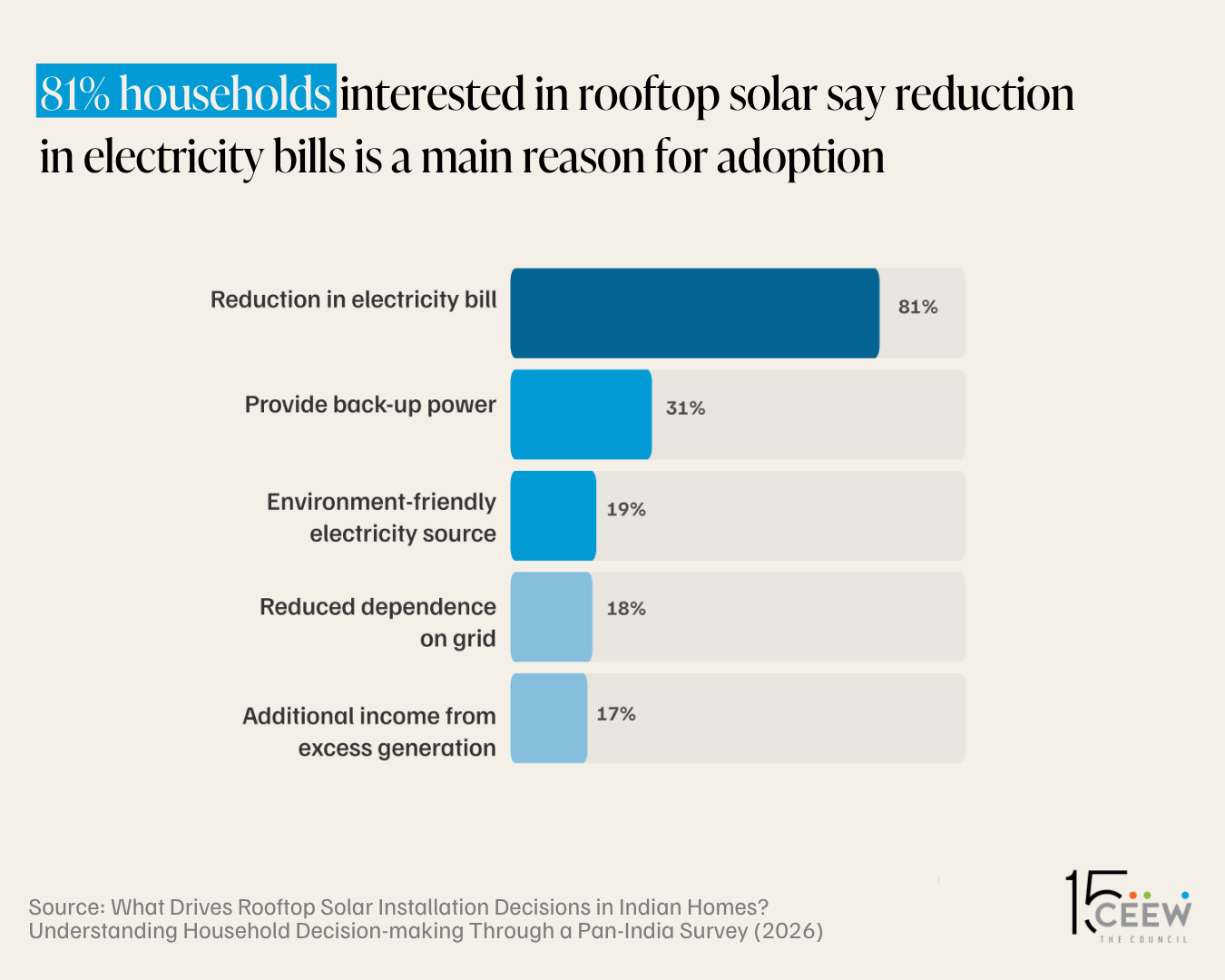
New Delhi, 4 June 2026: As India’s peak power demand reaches a record high of ~270 GW this summer, distributed renewables such as rooftop solar (RTS) are becoming increasingly important for households and the power system. 81 per cent of households who are willing to install RTS cited a reduction in electricity bills as the primary motivation for adoption, according to a new study by the Council on Energy, Environment and Water (CEEW). For adopters surveyed by the study, RTS translated into substantial savings, with households reporting an average 71 per cent reduction in electricity bills. The study suggests that India has built strong rooftop solar momentum, and the next phase will depend on converting awareness into adoption through trust, financing literacy, simpler processes and local champions.
CEEW’s study is the first-ever national consumer-side survey on residential RTS since the launch of the Pradhan Mantri Surya Ghar: Muft Bijli Yojana (PMSGY). It is based on a pan-India survey of over 17,000 households across 22 states* covering 308 districts, and examines how households understand, evaluate and navigate RTS adoption. The study was released at Two years of PM-Surya Ghar Muft Bijli Yojana: Scaling the solar home to One crore rooftops, an event organised by MNRE. It notes that since the launch of PMSGY, residential RTS growth has accelerated from 45 per cent CAGR during 2017–2023 to 85 per cent CAGR during 2024–2026.
Speaking at the launch, Shri Pralhad Venkatesh Joshi, Hon’ble Minister, MNRE, said, “India is blessed with more than 300 sunny days a year and we are turning this potential into a national clean-energy movement. PM Surya Ghar enables households to generate electricity on their own rooftops, reduce bills, and contribute to an Aatmanirbhar Bharat. More than 41 lakh households that are availing the benefits under the programme are our strongest ambassadors, and their experience will help build confidence among many more families.”
57 per cent of households surveyed in the CEEW study were aware of the potential of RTS to generate electricity for homes in both rural and urban areas. However, the study suggests that India’s next rooftop solar challenge is not awareness alone, but conversion: helping interested households move confidently from curiosity to application, financing, vendor selection and installation.
Rishabh Jain, Fellow, CEEW, said, “India’s rooftop solar programme has created strong momentum. The next step is to convert awareness into confident action by simplifying the adoption journey through clearer process support, better financing awareness and evidence-based communication. The experience of adopters shows that the value proposition is clear; now the task is to make it easier for many more households to access it.”
The study also highlights that PMSGY performs strongly once households enter the formal process, with nearly two-thirds of applicants proceeding to installation. RTS deployment is currently led by five states — Gujarat, Maharashtra, Rajasthan, Uttar Pradesh, and Kerala — which together account for more than 70 per cent of national installed capacity, highlighting the opportunity to deepen adoption in other states through targeted outreach, implementation support, and stronger local ecosystems.
Financing awareness remains one of the strongest second-order barriers to household adoption. Among households surveyed that perceived RTS as expensive, almost three out of four were unaware of available financing options. Further, 26 per cent of households surveyed that were aware but not interested said they would reconsider adoption if offered easier loan terms, such as concessional interest rates, longer tenures, and collateral-free loans. CEEW estimates that improving awareness through trusted communication and preferred outreach channels could unlock theoretical convertible demand of up to 66 GW.
Adopter experiences reinforce the value proposition of RTS. Over 93 per cent of adopters surveyed by CEEW were satisfied with bill savings, while 87 per cent were willing to recommend their solar vendor. This indicates that satisfied adopters can become one of the most credible channels for scaling RTS adoption locally.
To accelerate adoption, CEEW recommends targeted, stage-wise interventions: trusted outreach through local institutions; simple communication on how to apply under PMSGY; stronger support on vendor selection and approvals; financing literacy on collateral-free loans, EMI structures, payback periods and expected net savings; and adopter-led engagement through resident welfare associations, gram sabhas, community meetings and solar open-house sessions to help prospective consumers navigate the installation journey through peer experiences.
Read the full study, What Drives Rooftop Solar Installation Decisions in Indian Homes? Understanding Household Decision-making Through a Pan-India Survey, by Megha Chaudhary, Saakshi Purohit, Manas Vijayan, and Bhawna Tyagi here.
*Note: The survey was conducted in January–April 2026 through computer-assisted telephonic interviews across urban and rural areas in 22 states covering 308 districts. It covered self-owned dwellings and primary household decision-makers, including both RTS adopters and non-adopters. The sample was designed to be state-wise urban-rural representative; “households” refers to surveyed residential electricity consumers/households within the study sample.
For media queries and interviews, contact:
Tulshe Agnihotri – [email protected]
About CEEW
The Council on Energy, Environment and Water (CEEW) —a homegrown institution with headquarters in New Delhi — is among the world’s leading climate think tanks. The Council is also often ranked among the world’s best-managed and independent think tanks. It uses data, integrated analysis, and strategic outreach to explain — and change — the use, reuse, and misuse of resources. It prides itself on the independence of its high-quality research and strives to impact sustainable development at scale in India and the Global South. In over 14 years of operation, CEEW has impacted over 400 million lives and engaged with over 20 state governments. Follow us on X (formerly Twitter) @CEEWIndia or on LinkedIn for the latest updates.