Council on Energy, Environment and Water Integrated | International | Independent

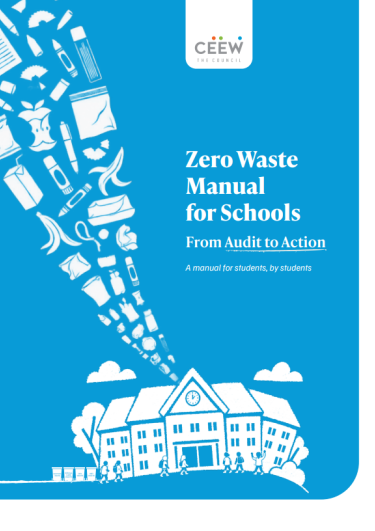
Suggested Citation: Mishra, Srishti, Shailja Singla, and Priyanka Singh. 2026. Zero Waste Manual for Schools: From Audit to Action. New Delhi: Council on Energy, Environment and Water.
India’s educational network spans over 1.47 million schools and educates more than 250 million students, representing a powerful yet frequently overlooked driver for advancing circularity and environmental sustainability. As urban waste becomes less a question of infrastructure and more one of everyday behaviour—littering, open burning, poor segregation, and single-use plastics—schools are where new habits can take root and travel home to families and communities.
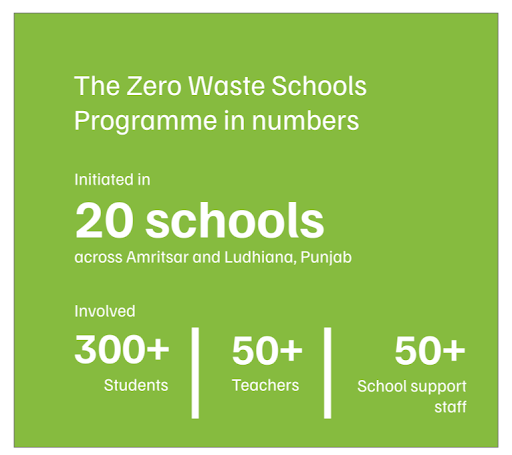
To drive this shift at the grassroots, the Council on Energy, Environment and Water (CEEW), in collaboration with the Municipal Corporations of Ludhiana and Amritsar, launched the Zero Waste Schools Programme (ZWSP). Guided by the core philosophy "what gets measured, gets managed," this student-driven initiative has engaged 300+ students, 50+ teachers, and 50+ school support staff across 20 pilot schools.
The programme responds to the national policy push through the National Education Policy (NEP) 2020 that lists environmental awareness among the essential skills every student should develop and the Swachh Bharat Mission that has worked since 2014 to embed cleanliness and hygiene into everyday school life. The programme's approach begins with building awareness before moving into hands-on learning through a school waste audit, guided by the principle that what gets measured gets managed. Waste audit is a structured exercise in which students measure, sort, and record the waste their school generates and plan for its proper management. Students lead the process in teams, with teachers and school support staff facilitating each stage, and the findings feed directly into an action plan for reducing, reusing, recycling, and composting.
To support this, the programme brings together a musical video, a practical audit manual, and a set of ready-to-use reference materials.
Environmental sustainability is becoming an increasingly important issue. Schools play an important role in shaping environmentally responsible behaviour. The teachers, staff, and community members contribute to guiding students by educating them about waste management.
The National Education Policy (NEP) 2020 makes this an explicit national commitment. It lists ‘environmental awareness including water and resource conservation, sanitation and hygiene’ among the essential skills every student should acquire, alongside scientific temper, digital literacy, and ethical reasoning (MHRD 2020).
Since 2014, the Swachh Bharat: Swachh Vidyalaya campaign has worked to embed cleanliness and hygienic practices in school life, treating schools as sites for both infrastructure improvement and behaviour change among children (PIB 2016).
When the Swachh Bharat Mission evolved into the Swachh Bharat Mission – Urban 2.0, its information, education, and communication (IEC) strategy explicitly named schools and colleges as sites for promoting good waste-related practices (MoHUA 2021).
While the NEP 2020 asks schools to include environmental awareness and a waste-conscious ethic in what they teach every student, the Swachh Bharat Mission encourages schools to turn that awareness into everyday practice. This is where you come in.
The music video Zero Waste Ke Heroes captures this transformation on the ground. Filmed across pilot schools in Ludhiana and Amritsar, the video puts students at the centre of change—following young "waste auditors" as they collect, segregate, weigh, record, and analyse school waste, turning everyday waste management into a source of pride and leadership.
Cercle X. 2025. “Waste Management for Kids: A Guide.” Cercle X. Accessed July 22, 2026. https://cerclex.com/blog/waste-management-for-kids/.
Central Pollution Control Board (CPCB). 2023. Annual Report 2021-23 on Implementation of Solid Waste Management Rules, 2016. Delhi: Ministry of Environment, Forest & Climate Change, 2023. https://cpcb.nic.in/uploads/MSW/MSW_AnnualReport_2022-23.pdf.
CEEW. 2026. “What on Earth!®” Council on Energy, Environment and Water. March 11. https://www.ceew.in/what-on-earth-zero-counts.
EcoSchools Canada. 2022. Best Practices for Waste Management: A Guide for School Communities in Canada. EcoSchools Canada. https://ecoschools.ca/wp-content/uploads/2024/09/Best-Practices-for-Waste-Management-Guide.pdf.
Enviroschools. 2020. Waste Audit. Enviroschools. Accessed July 22, 2026. https://enviroschools.org.nz/wp-content/uploads/2020/10/ZWpg54-57-waste-audit.pdf.
MHRD (Ministry of Human Resource Development). 2020. National Education Policy 2020. Ministry of Human Resource Development, Government of India. https://static.pib.gov.in/WriteReadData/userfiles/NEP_Final_English_0.pdf.
MoHUA (Ministry of Housing and Urban Affairs). 2021. Swachh Bharat Mission – Urban 2.0: Making Cities Garbage Free. Operational Guidelines for October 2021. Ministry of Housing and Urban Affairs, Government of India. https://swmindia.info/sbm/Assets/User-manual/SBM-2.0-Guidelines.pdf.
Moňok, Bronislav, Iskra Stoykova, Ruta Bendere, Balazs Tömöri, and Jiřina Popelková. 2006. Zero Waste as Best Environmental Practice for Waste Management in CEE Countries. International POPs Elimination Network (IPEN). https://doi.org/10.13140/RG.2.2.34195.09762.
Nestlé Philippines. 2021. Be an Ace at Reducing Waste: A Parent Resource for Teaching Young Children about Solid Waste Management. Nestlé Philippines. https://www.nestle.ph/sites/g/files/pydnoa366/files/2021-05/Solid%20Waste%20Management%20-%20Guide%20for%20Parents%202.3.pdf.
Ogunkunle, Oyetola, Adewemimo Oluwakunmi Popoola, Lukuman Adekilekun Jimoda, and Michael Olusoji Olusanya. 2026. “Municipal Solid Waste Open Burning: An Overview of Inventory and Dispersion Modelling of Emerging Pollutant Emissions.” Waste Disposal and Sustainable Energy 8: 179–208. https://doi.org/10.1007/s42768-026-00280-7.
PIB (Press Information Bureau). 2016. “Swachhta Vidyalaya Initiative by Department of School Education & Literacy.” Press Information Bureau, Government of India, October 1. https://www.pib.gov.in/newsite/printrelease.aspx?relid=151323®=48&lang=2.
Rajalakshmi, S., Amzad Basha Kolar, and Asif Jamal, eds. 2023. A Manual on Waste Management Audit. Nature Science Foundation. https://www.nsfonline.org.in/wp-content/uploads/2023/04/A-Manual-of-Waste-Management-Audit-by-Nature-Science-Foundation-2023-1.pdf.
Rethink Waste. 2022. Waste Audit Toolkit for Schools. Rethink Waste. https://rethinkwaste.com.au/wp-content/uploads/2022/05/INTERACTIVE-Rethink-Waste-Audit-Toolkit.pdf.
Seven Generations Ahead. 2022. Lunchroom Waste Audit Guide. Seven Generations Ahead. https://sevengenerationsahead.org/wp-content/uploads/2023/01/SGA-Lunchroom-Waste-Audit-Guide-updated-Dec.-2022.pdf.
SPREP (Secretariat of the Pacific Regional Environment Programme). 2020. Waste Audit Methodology: A Common Approach. Secretariat of the Pacific Regional Environment Programme. https://www.sprep.org/sites/default/files/POLP/waste-audit-methodology-common-approach.pdf.
Sustainability and Stories. n.d. “Conducting a School Waste Audit.” Sustainability and Stories. Accessed July 22, 2026. https://sustainability-and-stories.org/conducting-a-school-waste-audit/.
Sustainable Futures Global. 2021. Reduce – Reuse – Recycle: A Fun Toolkit For Waste Management & Recycling in Primary Schools. Sustainable Futures Global. https://sustainablefuturesglobal.org/wp-content/uploads/2021/02/Waste-Manual-finaledit.pdf.
The Green School. 2024. Learning Module for Students: Advancing a Step towards Sustainable Behaviour (Water and Waste). The Energy and Resources Institute. https://teriin.org/files/LM_Water_&_Waste.pdf.
Waste Authority Western Australia. 2026. Waste Audit Toolkit. Waste Authority Western Australia. https://www.wasteauthority.wa.gov.au/images/resources/wss/Files/Waste_Audit_Toolkit.pdf.
West Lothian Council. n.d. Waste Audit Guide. West Lothian Council. Accessed July 22, 2026. https://www.westlothian.gov.uk/media/26770/Waste-Audit-Guide/pdf/Waste_Audit_and_Action_Plan_Print_Copy_A9151275.pdf.
Wollondilly Shire Council. 2020. School Waste Audit Guide. Wollondilly Shire Council. https://www.wsc.nsw.gov.au/files/assets/public/v1/environment/waste-education/school-waste-audit-guide.pdf.
It is a CEEW initiative, launched with the Municipal Corporations of Ludhiana and Amritsar in 2024, that helps schools measure and improve how they manage waste. Born from an idea by student innovators, it is designed for students, by students.
Schools move from building awareness to running a hands-on waste audit, where student teams measure, sort, and record the waste generated across their campus, then use the findings to build an action plan for reducing, reusing, recycling, and composting.
As defined by the Zero Waste International Alliance, zero waste means conserving resources through responsible production, consumption, reuse, and recovery, without burning or discharging materials in ways that harm the environment or human health. It does not mean eliminating waste altogether, but making sure nothing useful is dumped or burnt.
Schools generate waste across classrooms, canteens, playgrounds, washrooms, laboratories, and gardens, ranging from paper and packaging to food scraps, e-waste, and sanitary waste. The manual helps students map exactly where and how this waste is produced on their own campus.
Waste placed in the wrong bin can contaminate other waste streams. For example, food waste mixed into paper waste can spoil the paper and prevent it from being recycled, which is why the manual sets out clear segregation categories for wet, dry, special care, and sanitary waste.
Schools build a tailored waste management action plan based on their own audit findings, guided by the 3Rs (reduce, reuse, recycle), and are encouraged to repeat the audit periodically to track their progress towards becoming a zero waste school.
Unlocking Finance for India’s Textile Waste Management
Organic Waste Circular Economy for Viksit Bharat
Roadmap of the methodology to assess the climate co-benefits of the SUP ban in Maharashtra
Building a Green Economy for Viksit Bharat
Financing for Treated Used Water Reuse in India