Council on Energy, Environment and Water Integrated | International | Independent

Suggested Citation: Mishra, Srishti, Viraj Joshi, and Priyanka Singh. 2026. Unlocking Finance for India’s Textile Waste Management: An Analysis of the Pre-Consumer Textile Waste Sorting, Aggregation and Recycling Ecosystem. New Delhi: Council on Energy, Environment and Water.
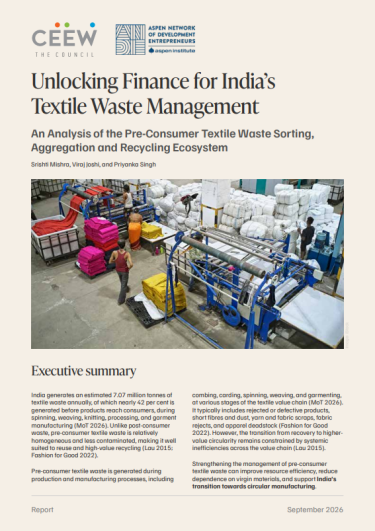
India generates an estimated 7.07 million tonnes of textile waste annually, of which nearly 42 per cent is generated before products reach consumers, during processes such as spinning, weaving, knitting, processing, and garment manufacturing. Pre-consumer textile waste is relatively homogeneous and less contaminated than post-consumer waste, making it well suited for reuse and higher-value recycling.
Yet India’s pre-consumer textile waste ecosystem remains fragmented. Collection and aggregation depend substantially on decentralised networks of brokers, traders, and informal intermediaries, while recycling infrastructure is concentrated in a few established clusters. This fragmentation increases logistics costs, limits traceability, and constrains the movement of textile waste towards higher-value circular applications.
This study examines the aggregation, sorting, and recycling stages of India’s pre-consumer textile waste value chain. It combines secondary research with primary research involving 12 entities across India, including field visits to five textile recovery facilities (TRFs) and surveys of seven textile recycling enterprises, innovators, and solution providers. It applies the SGB Segmentation Framework to understand how differences in enterprise growth potential, innovation profile, and entrepreneur behaviour translate into different financing needs.
The study finds that enterprises face interconnected market, technology, operations, policy and systemic, infrastructure, and finance barriers. It argues that financing solutions need to move beyond one-size-fits-all approaches and align capital with the characteristics and growth trajectories of different small and growing businesses.
India generates an estimated 7.07 million tonnes of textile waste annually, of which nearly 42 per cent is generated before products reach consumers, during spinning, weaving, knitting, processing, and garment manufacturing (MoT 2026). Unlike post-consumer waste, pre-consumer textile waste is relatively homogeneous and less contaminated, making it well suited to reuse and high-value recycling (Lau 2015; Fashion for Good 2022).
Pre-consumer textile waste is generated during production and manufacturing processes, including combing, carding, spinning, weaving, and garmenting, at various stages of the textile value chain (MoT 2026). It typically includes rejected or defective products, short fibres and dust, yarn and fabric scraps, fabric rejects, and apparel deadstock (Fashion for Good 2022). However, the transition from recovery to highervalue circularity remains constrained by systemic inefficiencies across the value chain (Lau 2015).
Strengthening the management of pre-consumer textile waste can improve resource efficiency, reduce dependence on virgin materials, and support India’s transition towards circular manufacturing.
India’s textile recycling sector is projected to reach a market value of USD 3.5 billion by 2030, with the potential to generate approximately one lakh green jobs by 2030 (MoT 2026).
Globally, approximately one lakh tonnes of textile waste is generated annually, although this estimate covers all textile waste rather than pre-consumer waste specifically (UNEP 2025). Only around 12–15 per cent of textile waste enters recycling systems, while less than 1 per cent is recycled into new clothing (Taneja et al. 2025). Global policy responses are increasingly focusing on producer responsibility, circular design, and markets for recycled content. Regulations such as the European Union’s Ecodesign for Sustainable Products Regulation, alongside emerging producer responsibility frameworks, are accelerating the transition towards circular textile value chains (European Commission 2026). These developments highlight the importance of establishing enabling policy and market conditions alongside driving investments in the recycling ecosystem.
In India, however, the pre-consumer textile waste ecosystem remains fragmented. Collection and aggregation rely substantially on decentralised networks of brokers, traders, and informal intermediaries, while recycling infrastructure is concentrated in established clusters such as Panipat in Haryana, Tiruppur in Tamil Nadu and Amroha in Uttar Pradesh. The resulting fragmentation and multiple handovers of material increase logistics costs. This makes it difficult to track waste flows, material quality, and final destinations, limiting transparency and constraining higher-value circularity (Fashion For Good 2022; GIZ 2023; MoT 2026). Financial constraints further limit the growth of enterprises across the textile recovery and recycling value chain, particularly for small and growing businesses (SGBs) occupying the ‘missing middle’1 of enterprise finance (Hornberger et al. 2018).
Against this backdrop, this study examines India’s pre-consumer textile waste ecosystem across the aggregation, sorting, and recycling stages of the value chain. The analysis combines secondary research with primary research involving 12 entities across India, comprising field visits to five textile recovery facilities (TRFs) and surveys of seven recycling enterprises, innovators, and solution providers across India. It also applies the Dalberg SGB Segmentation Framework to classify enterprises based on their market growth and scale potential, product or service innovation profile, and entrepreneur behavioural attributes. Based on this classification, it identifies financing pathways suitable for different enterprise types (Hornberger et al. 2018).
India’s textile sorting, aggregation, and recycling ecosystem faces six overarching barrier themes
The study engaged with five textile recovery facilities (TRFs) and seven textile recycling enterprises, innovators, and solution providers across India. Across the TRFs engaged in the study, common barriers included fragmented waste-sourcing systems, fully manual sorting and grading, and inadequate storage and infrastructure. TRFs also face irregular offtake and high transportation and operating costs, which constrain their profitability and ability to scale. These barriers also limit investment in technology and infrastructure.
Barriers across India’s pre-consumer textile recycling ecosystem cluster into six themes. Technology (23 per cent) and finance (22 per cent) together account for nearly half of identified barriers, driven by challenges in separating fibre blends, manual sorting bottlenecks, high capital requirements and limited access to affordable and green finance. Infrastructure (16 per cent) and market (15 per cent) barriers follow, including limited shared facilities and infrastructure needed to support textile recycling at scale. Operational and policy/systemic barriers (13 per cent each) include high energy and logistics costs and absence of an enabling regulatory framework for textile circularity.
Financial barriers cut across these constraints. The surveyed enterprises highlighted high upfront capital requirements, working-capital shortages, volatile feedstock prices, and limited access to affordable bank credit and green finance. These financing constraints limit enterprises’ ability to invest in infrastructure and machinery, adopt new technologies, expand operations, and respond to market opportunities. Addressing the six barriers therefore requires an enabling policy environment and coordinated support across policy, infrastructure, technology, market, finance, and operations.
The ecosystem is heterogeneous and requires differentiated financing pathways based on enterprise characteristics
The 12 entities surveyed vary substantially in scale, business model, technology, and market orientation, as well as in their degree of automation, machinery requirements, digitalisation, and product markets. This heterogeneity creates distinct financing needs. Design-led enterprises may require smaller-ticket capital and market-development support, while Image: CEEW 4 established mechanical recyclers require working capital, machinery finance, and credit enhancement. Technology-led ventures require patient risk capital to develop and commercialise new technologies. Conventional MSME classifications based primarily on turnover or enterprise size therefore do not adequately capture these differences.
The study applies the SGB Segmentation Framework to classify enterprises based on their market growth and scale potential, product or service innovation profile, and entrepreneur behavioural attributes, and link these characteristics to more appropriate financing pathways. This provides a basis for differentiated financing rather than a single financing solution for textile recycling enterprises, with financial instruments aligned with enterprise characteristics and growth trajectories rather than enterprise size alone.
India’s transition towards a circular textile economy will require an enabling policy environment and differentiated financing pathways. Targeted ecosystem support from policymakers and private financial institutions can further accelerate investment and strengthen India’s pre-consumer textile waste recycling ecosystem (MoT 2025a, MoT 2026).
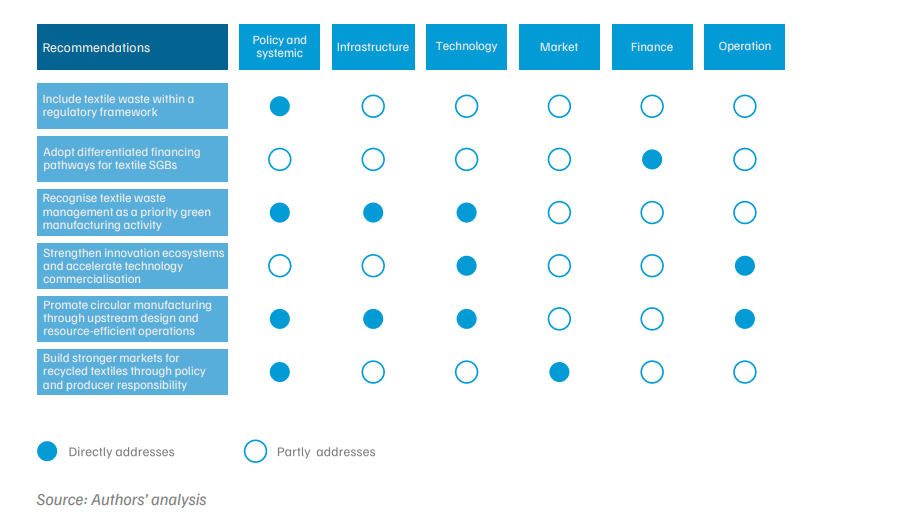
The recommendations address six interconnected barrier themes across the textile sorting, aggregation, and recycling ecosystem: policy and systemic, infrastructure, technology, market, finance, and operations. The mapping below shows how individual recommendations respond to multiple barriers identified through consultations with TRFs, recycling businesses, innovators, and solution providers, highlighting the need for coordinated action across the ecosystem.
Figure ES1. Six recommendations mapped against interconnected barriers across the textile sorting, aggregation, and recycling ecosystem
The study recommends the following actions
Pre-consumer textile waste is generated during textile production and manufacturing, before products reach consumers. It includes short fibres and dust, yarn and fabric scraps, production rejects, defective products, and apparel deadstock. In India, an estimated 42 per cent of the country’s textile waste is generated at the pre-consumer stage.
Enterprises operating across textile sorting, aggregation, and recycling face high upfront capital requirements, working-capital shortages, volatile feedstock prices, and limited access to affordable credit and green finance. These constraints limit their ability to invest in machinery and infrastructure, adopt new technologies, expand operations, and respond to market opportunities.
TRFs are infrastructure hubs that aggregate, sort, and store textile waste and direct it towards appropriate end destinations such as reuse, recycling, and upcycling. They bridge the gap between collection and recycling by creating more traceable and transparent material flows. However, the study finds that limited storage infrastructure, inconsistent feedstock, high transportation costs, and limited downstream recycling options constrain their growth.
The study identifies six broad barrier themes: market, technology, operations, policy and systemic, infrastructure, and finance. These include uncertain demand for recycled products, challenges in fibre separation and blended-textile processing, high labour and logistics costs, limited regulatory frameworks, concentration of recycling infrastructure in a few clusters, and inadequate access to appropriate finance.
The study finds that small and growing businesses are not a homogeneous group. Their financing requirements differ according to their growth ambitions, innovation profile, business model, stage of development, and capital requirements. High-growth ventures, dynamic enterprises and niche ventures therefore require different combinations of risk capital, debt, working capital, grants and credit enhancement.
The study recommends six areas of action: establishing a regulatory framework for textile waste; adopting differentiated financing pathways; recognising textile waste management as a priority green manufacturing activity; strengthening innovation and technology commercialisation; improving circular manufacturing and resource efficiency; and creating stronger markets for recycled textiles through policy and producer responsibility mechanisms.
Organic Waste Circular Economy for Viksit Bharat
Roadmap of the methodology to assess the climate co-benefits of the SUP ban in Maharashtra
Building a Green Economy for Viksit Bharat
Financing for Treated Used Water Reuse in India