Council on Energy, Environment and Water Integrated | International | Independent

Suggested citation: Doraiswamy, Tishya Sheel, Sanjita Singha, Divya Gaur, Naveen Kumar, and Pooja Ravindra. 2026. Affordable Financing for Decentralised Renewable Energy Technologies: Scaling Institutional Credit for Clean-Energy Powered Livelihoods.
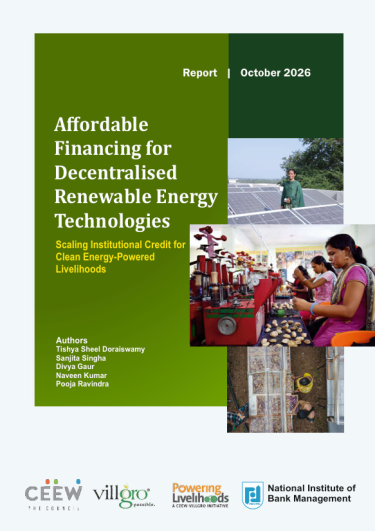
Decentralised renewable energy (DRE)-powered livelihood technologies offer significant opportunities to enhance rural incomes, improve productivity, and strengthen India’s rural enterprise ecosystem. However, despite their demonstrated economic viability and potential to support millions of livelihoods, limited access to affordable institutional credit continues to constrain their widespread adoption.
This joint white paper examines the financing landscape for DRE livelihood technologies in India. It assesses the economic viability of these technologies, identifies structural barriers to institutional lending, and estimates the financing requirements for five high-potential technologies. The analysis estimates a financing requirement of USD 1.1 - 5.7 billion across different scenarios for solar dryers, solar refrigerators, solar food processors, vertical fodder grow units, and solar cold storage.
Drawing on market assessments, ground-level evidence, and learnings from financing models, the white paper examines the role of banks and other financial institutions in expanding access to credit for farmers and rural microenterprises. It highlights opportunities to strengthen lending through tailored financial products, standardised credit appraisal frameworks, risk-sharing mechanisms, last-mile partnerships, and better convergence of existing government schemes. The report offers actionable recommendations to integrate DRE livelihood technologies into mainstream institutional lending and unlock their potential to support inclusive rural economic growth and India’s clean energy transition.
India's rural economy stands at an inflection point. Agriculture employs 46.1 per cent of the country's workforce, yet contributes only 17.8 per cent to gross domestic product (GDP), highlighting a persistent gap between employment and productivity (MoSPI 2024; National Accounts Statistics 2025). Among the country's 93.1 million agricultural households, the average monthly household income is INR 19,696, underscoring the need to improve the productivity and profitability of rural livelihoods (NSSO 2019; ICRIER 2024). This productivity and income is constrained for two reasons: Low mechanisation and high farm losses. At the production stage, low levels of mechanisation further constrain agricultural productivity. Only around 45 per cent of farm operations are mechanised, despite evidence that mechanisation can reduce labour costs by 20–30 per cent and increase productivity by 10–15 per cent (Tiwari et al. 2019). Post harvest food loss also forms a significant share, exacerbating the decline in farmers’ income and productivity. In 2022, a study commissioned by the Ministry of Food Processing Industries and conducted by National Bank for Agriculture and Rural Development (NABARD) Consultancy Services estimated annual post-harvest losses of INR 1.53 lakh crore across major crop categories. These losses stem not only from inadequate storage, cooling and processing infrastructure, but also from unreliable electricity supply in rural areas, which limits the viability of energy-dependent post-harvest technologies (Kabiraj and Smridhi 2023). This makes it increasingly important to improve the efficiency of farm operations through mechanisation and adequate infrastructure at the farm gate, while enabling higher-value activities such as processing, storage and aggregation that generate greater returns from agricultural produce. Beyond the farm gate, improving agricultural productivity while expanding rural enterprises is also central to India's employment challenge. India is projected to require 90 million non-farm jobs by 2030, with rural enterprises expected to play a critical role in generating them (Sankhe et al. 2020). Rural India is already home to 51 per cent of the country's 63 million micro, small and medium enterprises (MSMEs), making enterprise-led growth an important pathway for income diversification and local economic development (Nagpal 2025; FICCI n.d.).
Reliable, appropriately scaled energy and greater mechanisation can help address these constraints by enabling increased productivity, local value addition and enterprise. Decentralised renewable energy (DRE) livelihood technologies represent one such opportunity. Across applications ranging from irrigation and spraying to food processing, cold storage, dairy and fisheries, these technologies can enable reliable energy access, support mechanisation, reduce operating costs, and facilitate value addition. As a result, they offer a practical pathway to strengthening rural livelihoods while advancing India's clean energy transition.
DRE-powered technologies are small-scale, modular energy systems that use renewable sources (solar, biomass, small wind, or micro-hydro) and are deployed close to the point of livelihood or energy use. DRE systems generate and use energy locally, reducing dependence on unreliable grid supply and volatile diesel prices while providing affordable and reliable energy for productive activities. Applications of DRE livelihood technologies span several farm and non-farm value chains, ranging from pre-harvest mechanisation through solar pumps and sprayers, to food processing and value addition through solar drying, processing, and milling, to cold chain, animal husbandry and dairying, livestock and fisheries, and textiles and enterprise creation. These assets have the potential to impact over 37 million livelihoods and unlock a market opportunity of nearly USD 50 billion (Waray, Patnaik, and Jain 2018). Currently, DRE adoption stands at approximately 0.56 million deployments, led by solar irrigation pumps under Pradhan Mantri Kisan Urja Suraksha evam Utthaan Mahabhiyaan (PM-KUSUM), followed by solar dryers, cold rooms, milk chillers, and food processing equipment; yet this remains well below the sector's potential of over 20 million deployments (Jain, Khalid, and Jindal 2023).
Achieving commercial scale depends not only on technology or manufacturing capability, but also on an ecosystem in which grassroots organisations drive awareness, distributors extend market reach, financiers enable ownership through credit, and policymakers create enabling conditions—together underpinning five interdependent levers: customer awareness, last-mile service capacity, product standardisation, market linkages, and financing. Of these, financing remains particularly critical given the high upfront cost of these technologies and low awareness about the viability of these innovations. For farmers, microentrepreneurs, self-help groups (SHGs) and small retailers who can benefit from such assets, affordable credit access can determine whether adoption happens at all.
In its market viability report (Jain, Khalid and Jindal 2023), the Council on Energy, Environment and Water (CEEW) assesses technologies spanning agriculture, livestock, food processing, cold chain, and textiles, and demonstrates strong economic viability of various DRE assets. Asset values range from approximately INR 19,000 for a solar sprayer to more than INR 20 lakh for a cold storage unit (20 metric tonnes (MT)), with discounted payback periods ranging from five months to around 52 months depending on the technology and financing terms.
This viability translates into measurable impact on the ground: evidence from CEEW and Villgro’s Powering Livelihoods programme shows that 87 per cent of 660 surveyed users experienced income gains after adoption, with median increases of up to INR 40,000 (or 33 per cent) annually, driven by more earning days, lower input and energy costs, and improved productivity and product quality. Among users who experienced income gains and made some upfront contribution towards the technology, 46 per cent could repay their initial loan using their increased incomes alone; this share rises to 68 per cent if loan tenures are extended, indicating that better-structured financing and increased access to credit could make repayment viable for a large share of users (Yasaswi, Gaur, and Jain 2025). Beyond income, users report reduced physical drudgery, greater financial resilience and confidence in building assets, and reduced migration pressures, with benefits particularly pronounced for women through greater mobility, skill-building, and decision-making agency. Together, this evidence points to DRE livelihood technologies as both financially viable investments and a meaningful driver of economic and social empowerment in rural India.
Despite growing evidence of commercial viability, financing remains a key constraint to scale. DRE livelihood assets are capital-intensive, requiring high upfront investment relative to end-users' incomes, despite comparatively lower operating costs over the asset's life. Ticket sizes vary widely across technologies, and financing therefore needs a tailored approach: lower-ticket assets impose disproportionately high origination, appraisal, and monitoring costs relative to loan size, while higher-ticket assets require stronger evidence of utilisation and successful deployment before lenders will finance them at scale. This is compounded by limited lender familiarity with DRE technologies and the absence of standardised appraisal benchmarks, which make risk difficult to assess. Consequently, most deployments currently rely on philanthropic capital, or subsidies rather than commercial credit, keeping the sector dependent on concessional funding. Within the Powering Livelihoods programme's own experience, non-banking financial companies (NBFCs) and peer-to-peer (P2P) platforms have been the primary financing partners, helping build early evidence of the sector's commercial viability. However, scaling further requires the participation of commercial and institutional credit, particularly as many DRE technologies already qualify under government schemes involving subsidy-linked loans routed through banks. Leveraging commercial and institutional credit is therefore essential to unlocking the sector's full livelihood and economic potential.
This whitepaper aims to map the DRE livelihood financing ecosystem, diagnose the barriers limiting institutional credit flow, and propose practical recommendations to help banks and financial institutions (FIs) integrate DRE livelihood technologies into mainstream lending portfolios. In doing so, its objective is to equip the financing ecosystem with a clearer picture of the DRE livelihoods sector and technologies available, the policies and schemes that can be leveraged to support their uptake, learnings from the sector, and the key considerations involved in financing these assets.
| ES Table 1 | Comparative assessment of lender types for financing DRE livelihood technologies | ||||||||
|---|---|---|---|---|---|---|---|---|
| Parameter | PSBs | RRBs | SFBs | Cooperative Banks |
MFIs | NBFCs | Peer-to- Peer (P2P) |
Private Banks |
| Rural reach8 | Medium | Very High | Medium | High | High | Medium | Medium | Low |
| Agriculture & livelihood portfolio9 | High | Very High | Medium | High | Medium | Medium | Medium | Low |
| MSME lending capability10 | High | Medium | High | Low | Low | High | Medium | High |
| Sanction government subsidies/schemes11 | High | High | Medium | High | NA | NA | NA | Medium |
| Cash-flow / enterprise-based appraisal12 | Medium | Medium | High | Medium | High | High | High | High |
| Collateral-free lending13 | Low | Medium | High | Medium | Very High | High | Very High | Medium |
| Tolerance for thin/no CIBIL history14 | Low | Medium | High | High | Very High | High | High | Low |
| Women-focused lending15 | High | Very High | High | High | Very High | Medium | Medium | Medium |
| Digital origination & onboarding16 | Medium | Low | High | Low | High | Very High | Very High | Very High |
| Speed & flexibility of underwriting17▼ | Low | Medium | High | Medium | High | Very High | Very High | High |
Source: Authors' synthesis based on Abraham (2006); Ahmed, Casiraghi, and Ogawa (2023); Ahmed, S. (n.d.); Berger and Udell (2002); Business Standard (2025a, 2025b, 2026); Department of Financial Services (n.d., 2026); Kumar, Kaveri, and Shah (2024); KPMG (2024); MFIN (2024); NABARD (n.d., 2024); PIB (2025, 2026); Reserve Bank of India (2017, 2022 [updated 2025], 2025a, 2025b); Sa-Dhan (2025); Sarthak Law (2025); Sebastian (n.d.); Sudarshan and Hegade (2024); The New Indian Express (2019); and Vision IAS (2025).
Methodology note: This comparative assessment draws on a synthesis of secondary sources, authors' analysis and insights from the Powering Livelihoods programme's engagement with lenders, DRE enterprises, and end-users. Parameters were selected to reflect dimensions relevant to a lender's decision to finance DRE livelihood technologies, spanning outreach, risk appetite, operational capability, strategic alignment, and use of government subsidies/guarantees. Ratings are qualitative and relative, indicating how a lender category compares to other categories on a given parameter.
This paper proposes key recommendations to scale financing for the DRE sector moving forward:
Capacity building
Instrument design
Policy
The study estimates a financing requirement of USD 1.1 - 5.7 billion for five high-potential technologies: solar dryers, solar refrigerators, solar food processors, vertical fodder grow units and solar cold storage. The range reflects different assumptions about market demand, access to finance and upfront borrower contributions.
The white paper recommends specialised training for lenders, standardised credit appraisal frameworks, borrower aggregation, digital loan origination and dedicated credit guarantee mechanisms.
Local ecosystem partners and technology enterprises can help identify prospective borrowers, assess local demand, support technology installation and provide after-sales services. Their continued engagement with users can improve technology utilisation, strengthen repayment follow-up and help financial institutions build confidence in DRE livelihood lending.
The white paper recommends specialised training for lenders, standardised credit appraisal frameworks, borrower aggregation, digital loan origination and dedicated credit guarantee mechanisms. Stronger partnerships with technology enterprises and local ecosystem organisations can further support borrower screening, after-sales service and loan repayment.
Existing government schemes can support DRE adoption through subsidies, credit guarantees, refinance and enterprise development assistance. The study recommends better convergence across these mechanisms, clearer mapping of DRE technologies to Priority Sector Lending provisions and dedicated financing windows within existing programmes to improve access to institutional credit.
The DRE Livelihoods Financial Assessment Toolkit, developed under CEEW and Villgro’s Powering Livelihoods programme, is a decision-support tool that helps financial institutions assess the commercial viability and repayment potential of decentralised renewable energy (DRE)-powered livelihood technologies. It uses technology-specific and context-specific parameters such as asset utilisation, throughput, seasonality and others to estimate income and loan serviceability, complementing conventional credit appraisal frameworks and supporting more informed lending decisions.
Scaling Green Manufacturing in India
Assessing India’s Coal Mine Workers:

Roadmap of the methodology to assess the climate co-benefits of the SUP ban in Maharashtra