Council on Energy, Environment and Water Integrated | International | Independent

Suggested citation: Acharya, Pritish Kumar, Trisha Ravindranath, Ishleen Kaur, and Nitin Bassi. 2026. Financing Global Water Resilience: Unlocking Investments for Water Security. New Delhi, India: Council on Energy, Environment and Water.
Water is a superconnector: few resources affect as many facets of the economy and society at once, linking everything from food and energy to industry, health and education. Every dollar invested in water and sanitation can generate up to USD 4 in economic value. Yet, despite its central role in driving economic growth and social development, water remains significantly underfunded. Meeting SDG 6 in low- and middle-income countries alone requires an additional USD 500 billion a year. However, the current financing landscape remains heavily skewed towards public funding, with public sources providing nearly 91 per cent of water sector spending, while private investment accounting for less than 2 per cent. This persistent financing gap is not simply a question of capital availability. Fragmented institutions, long payback periods, tariffs set below cost recovery, unclear regulation and growing climate risks all hold investment back.
Drawing on case studies from India and around the world, this policy brief demonstrates how strategic project design, stronger institutions, and innovative financing approaches can transform water infrastructure from an underfunded public service into a more investable and financially sustainable asset. These approaches show how capital can be structured to align with the distinct risks, hydrological functions, and investment profiles of the water sector. It sets out three mutually reinforcing levers: building the enabling governance environment, deploying financial instruments more strategically, and improving the bankability of projects. Collectively, these actions can help move the sector beyond financing water towards making water investable.
Water is a superconnector: Few resources influence as many dimensions of the economy and society, from food and energy to industry, health, and education. Investments in water can yield substantial returns, with every dollar invested in water and sanitation generating up to USD 4 in economic value (OECD 2026). Yet, the sector remains significantly underfunded relative to its importance. This disconnect between investment priorities and the scale of water-related needs is reflected in the persistent and worsening global water crisis. Billions of people continue to lack access to safely managed water and sanitation: About 2.2 billion lack safely managed drinking water and 3.5 billion lack safely managed sanitation (Madani 2026), while disruptions to the global hydrological cycle intensify. More than threequarters of the world’s population now lives in waterinsecure countries, amid growing concerns about the possibility of global water bankruptcy (Madani 2026). The costs of delayed action are significant. Finance is needed not only to build and run water supply and sanitation infrastructure, but also treat used water and its reuse, cut leakage and other utility losses, manage floods and droughts, and protect the catchments, wetlands, and soils that sustain water sources. Yet, the sector remains significantly underfunded relative to its importance. An estimated 45 per cent of the world’s GDP might be at risk from water scarcity by 2050 if this growing instability is not addressed, endangering food systems, public health, and economic prosperity (WEF 2025a).
Bridging this financing gap will require a substantial increase in capital flows, with an additional USD 500 billion needed annually to meet Sustainable Development Goal (SDG) 6 targets in low- and middleincome countries (LMICs) alone (GCEW 2024). However, the challenge extends beyond insufficient funding. Institutional fragmentation across the water value chain and catchments, high investment risks due to long payback periods, tariffs set below cost-recovery levels, and unclear or inconsistently enforced regulatory frameworks constrain water financing. Together, these factors create considerable uncertainty for investors. Climate-related risks further compound these challenges; by 2050, droughts, floods, and storms are expected to result in cumulative economic losses of about USD 5.6 trillion across seven major economies (GHD 2022).
These constraints are reflected in the sector’s highly disproportionate investment profile: Public sources account for nearly 91 per cent of water sector spending, while private investment accounts for less than 2 per cent (Joseph et al. 2024). This imbalance reflects both the public-good character of water security and the barriers that deter private capital.
Closing this financing gap offers substantial benefits beyond water infrastructure and service delivery. Investments in water have the potential to improve public health, advance gender equality, strengthen food security, alleviate poverty, and build climate resilience and adaptation capacity. This policy brief draws on case studies from India and around the world to demonstrate how strategic project design, stronger institutions, and innovative financing approaches can transform water infrastructure from an underfunded public service into a more investable and financially sustainable asset. It also outlines emerging financing mechanisms and instruments, including resource-recovery revenue models, municipal and outcome-based bonds, payments for ecosystem services, and blended and catalytic financing. These approaches show how capital can be structured to align with the distinct risks, hydrological functions, and investment profiles of the water sector.
The case studies highlight three mutually reinforcing levers for unlocking investment in the water sector, as summarised in Table ES1.
Figure ES1. Recommendations and interventions for scaling water finance
| Recommendation | Intervention | Evidence in practice |
|---|---|---|
| Creating an enabling environment for investment through governance reforms |
|
Egypt’s programme for the Nexus of Water, Food and Energy (NWFE+) Singapore’s Green Financing Framework China’s Sponge City Programme |
| Diversifying investment avenues and strategically deploying financial instruments |
|
Peru’s Mechanisms of Compensation for Ecosystem Services (MERESE) Australia’s Murray–Darling Basin water market India’s Tulsiwadi community toilets UK’s NbS by Anglian Water |
| Improving bankability through effective project design and management |
|
India’s Muzaffarpur faecal sludge treatment plant (FSTP) The Philippines’ East Zone Concession by Manila Water Company |
Source: Authors’ compilation based on the case studies in Sections 3-5: Egypt NWFE (OECD 2025a; Ministry of Planning, Economic Development, and International Cooperation 2024); Singapore PUB (PUB 2025); China Sponge City Programme (Liang 2018; Chan et al. 2022); Peru MERESE (OECD 2021; OECD 2022a); Murray-Darling Basin (Grafton and Horne 2014); Tulsiwadi and Muzaffarpur (Water for People); Anglian Water (Anglian Water Group 2024a, 2024b; CISL 2019); Manila East Zone (IFC 2014).
Together, these levers can help mobilise the right blend of public, concessional, and private finance tailored to different water-system functions. Governments can establish enabling regulatory frameworks, fund essential public functions, provide targeted risk capital, and support project preparation, thereby creating the conditions for predictable revenues and private investment where appropriate. Financial institutions can structure and scale suitable financing instruments, while utilities and project developers can design financially and operationally viable projects. Collectively, these actions can help move the sector beyond financing water towards making water investable.
Water investments often have long payback periods and high upfront costs, while tariffs frequently fall below cost-recovery levels. Responsibilities are fragmented across the water value chain, regulation can be unclear, and much of the social and environmental value water creates is not reflected in financial returns. Together, these factors increase perceived risk and make water less attractive than sectors with faster or more predictable returns.
Water investments differ in what they deliver and who benefits. A utility that recovers and sells treated water can earn its own revenue and attract commercial capital, while protecting a watershed benefits many people who do not pay for it and usually needs public or concessional support. The brief proposes matching financing to each investment’s scale, maturity, revenue, and social and ecological value, beginning with identifying the hydrological function being financed.
Bankability needs to be built into project design from the outset, with credible revenue models, clearly defined risk allocation, predictable cash flows and measurable outcomes. However, since water is largely treated as a public good, financial viability is often considered secondary rather than an integral part of project planning. This needs to change. At the same time, bankability cannot be the only measure of a project's success. Projects must also demonstrate hydrological viability: their ability to improve water availability and quality, strengthen resilience, promote equitable access and protect ecological integrity at the relevant spatial scale and over time.

From Gujarat to IndiaWater Lessons for the World
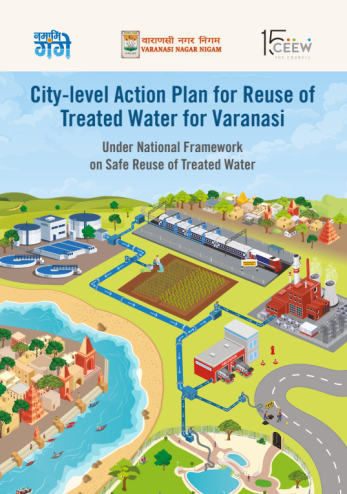
City-level Action Plan for Reuse of Treated Water for Varanasi
The Indian Subcontinent and the Water CycleFrom Monsoon to Ocean

Water, Nature, Progress: Solutions for a New India