Council on Energy, Environment and Water Integrated | International | Independent

– Nearly half of cooperative climate initiatives launched since Paris Agreement remain active or have accomplished goals
– Experts call for stronger South–South collaboration in climate action
– India has mobilised ~47 countries per initiative, on par with countries that have hosted COP
New Delhi, 7 October 2025: In the ten years since the Paris Agreement, about half of the several cooperative climate initiatives launched have either achieved their goals or continue to see active engagement, according to a new independent study launched today by the Council on Energy, Environment and Water (CEEW). At the same time, more than one-fifth of such initiatives have stalled or seen no updates since their launch. Cooperative climate initiatives are voluntary, multi-actor collaborations that bring together governments, international organisations, and non-state actors to accelerate climate action. The study found that South–South collaboration remains limited in these initiatives. This underscores the need for the Global South to harness regional cooperation to create impactful and targeted initiatives.
The CEEW study, Ten Years of the Paris Agreement: A Stocktake of Cooperative Climate Initiatives, finds that progress has been strongest in energy, industry, and transport sectors, with initiatives such as the Just Energy Transition Partnerships (JET-P), Global Cooling Pledge, 2030 Breakthroughs, and the International Solar Alliance (ISA) emerging as models that combine ambition with measurable delivery. Further, initiatives with clear targets, monitoring systems, and organisational arrangements have performed best. However, only 28 per cent of initiatives assessed have defined budgets, indicating the need for stronger financial planning and governance.
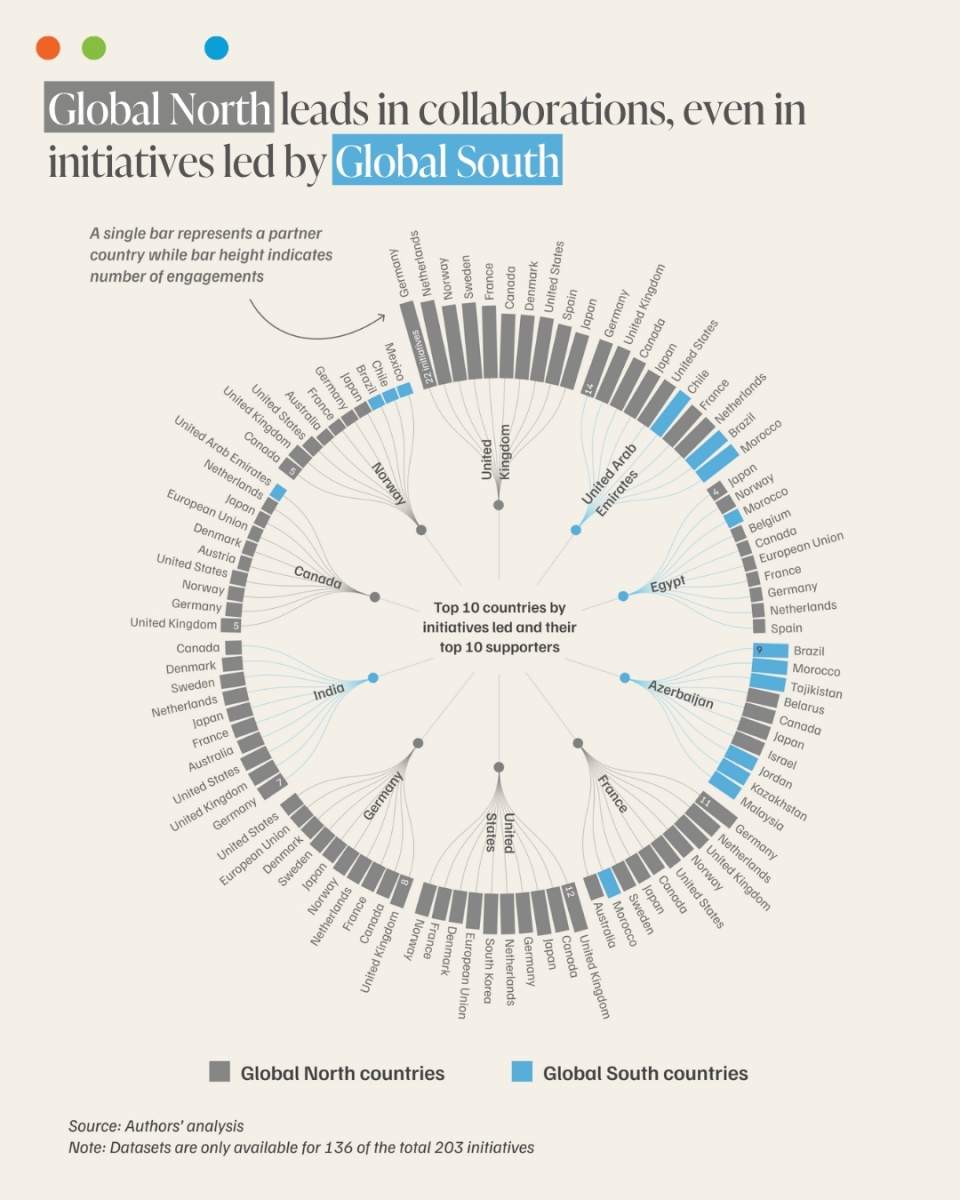
CEEW analysis shows that among the top 10 countries leading cooperative climate initiatives, most are from the Global North or have hosted COPs in the last decade—such as the United Kingdom, UAE, Egypt, Azerbaijan, and France. The notable exception in the top ten is India, having co-led at least eight major international initiatives, including the Coalition for Disaster Resilient Infrastructure (CDRI), Leadership Group for Industry Transition (LEAD-IT), Mission Innovation, and ISA. Together, through these initiatives India has mobilised an average of 47 countries per initiative, matching the mobilisation potential of COP Presidencies.
Simon Stiell, Executive Secretary, UNFCCC, said in a video address, “Ten years ago in Paris, the world changed course. For the first time, every country agreed to act—to limit global warming, build resilience, and forge a fairer, safer world. Since then, clean energy investment has multiplied tenfold, with over USD two trillion flowing into renewables last year alone. Major economies, including China and India, are now investing at unprecedented scales. The task now is to bring our process closer to the real economy, connect cabinet rooms to boardrooms and living rooms, and move from plans to projects and commitments to real-world impact.”
Shyam Saran, President, India International Centre, and Former Special Envoy and Chief Negotiator for Climate Change (2007-2010), India, added, “From Rio and Kyoto to Paris, the climate journey has shown both how far we have come and how much we have drifted from the spirit of shared responsibility. Paris was meant to turn global consensus into global action, but ambition must now be matched by accountability. COP30 must confront the reality of a climate emergency and mark a shift from lowest-common-denominator diplomacy to genuine collaboration that delivers results.”
Dr Arunabha Ghosh, CEO, CEEW, said, “In the decade since Paris, we’ve written the rules, set new goals, and created new mechanisms, but the gap between ambition and implementation has only widened. If we keep depositing commitments without delivering outcomes, the climate architecture risks a run on its own bank. For South Asia, where the costs of inaction are already visible in lives and livelihoods, delivery cannot wait. This must be the decade when we turn promises into performance and intent into impact—time is of the essence, and time is what we make of it.”
Ravi Shankar Prasad, Distinguished Fellow, CEEW, and Former Chief Negotiator for Climate Change, India (2013-2021), said, “The Paris Agreement gave us a living framework built on responsibility, direction, and solidarity. The task now is to close the ambition gap, move finance from billions to trillions, and make adaptation and just transitions central to every plan. The strength of Paris has never been in its text but in its structure—because history will not ask who signed it, but who delivered it.”
The CEEW study was launched at ‘Paris@10: From Rule-Making to Delivery’, a dialogue that brought together senior policymakers, diplomats, and experts from India and international institutions. These included Abhishek Acharya, Director (Economic Division), Ministry of Environment, Forest and Climate Change (MoEF&CC); Sujata Mehta, former Secretary, Ministry of External Affairs; A.N. Jha, former Secretary, MoEF&CC; Damien Syed, Minister-Counsellor and Deputy Chief of Mission, Embassy of France; Ashish Khanna, Director-General, ISA; Amit Prothi, Director-General, CDRI; R.R. Rashmi, Distinguished Fellow, The Energy and Resources Institute; and Amitabh Sinha, Deputy Editor, The Indian Express.
Read the full study, Ten Years of the Paris Agreement: A Stocktake of Cooperative Climate Initiatives by Mohana Bharathi Manimaran, Sumit Prasad, and Aanvi Sharma here.
For media queries and interviews, contact:
Tulshe Agnihotri – [email protected]
The Council on Energy, Environment and Water (CEEW) — a homegrown institution with headquarters in New Delhi — is among the world’s leading climate think tanks. The Council is also often ranked among the world’s best-managed and independent think tanks. It uses data, integrated analysis, and strategic outreach to explain — and change — the use, reuse, and misuse of resources. It prides itself on the independence of its high-quality research and strives to impact sustainable development at scale in India and the Global South. In over 14 years of operation, CEEW has impacted over 400 million lives and engaged with over 20 state governments. Follow us on X (formerly Twitter) @CEEWIndia for the latest updates.