Council on Energy, Environment and Water Integrated | International | Independent

~ Better management of organic waste could attract ~USD 24 billion in investments, create 26 lakh direct jobs
~ With enabling policies, wet-waste processing could enable ~68 MtCO₂e in net emissions offsets.~ Around 16 ministries and govt bodies already support organic waste management; stronger coordination key to scale.
~ Around 16 ministries and govt bodies already support organic waste management; stronger coordination
key to scale
New Delhi, 29 May 2026: India’s growing urban organic waste challenge could be converted into a major opportunity for jobs, clean energy, climate action, municipal finance, and urban infrastructure, according to a new independent study by the Council on Energy, Environment and Water (CEEW). The study finds that a circular economy for India’s organic waste could create 26 lakh direct jobs and unlock a ~USD 51 billion market opportunity by 2047, under an enabling policy scenario. Organic waste includes kitchen waste, market waste, horticulture waste, fruit and vegetable waste, meat, flowers, and other biodegradable waste.
The CEEW study, Organic Waste Circular Economy for Viksit Bharat: Jobs, Investment, and Emissions Pathways to 2047, uses scenario modelling to assess how different levels of waste collection, processing, and treatment could shape India’s jobs, investments, markets, and emissions pathways by 2047.
Shri Manjinder Singh Sirsa, Hon’ble Minister for Environment, Forest & Wildlife, Government of NCT of Delhi, said in a note addressed to the launch, “The Hon'ble Prime Minister's vision of Aatmanirbhar Bharat and energy self-reliance finds a powerful expression in waste-to-resource systems. Every kilo of bio-CNG produced from Delhi's organic waste is a kilo of imported fossil fuel we do not need. Every compost unit in a market or residential colony is a step toward closing the urban nutrient loop. I congratulate CEEW and all contributing partners on this report. Evidence of this quality - that links waste, energy, employment, and emissions in a single coherent framework - is exactly what our policy conversations need. Delhi's pursuit for clean air is inseparable from how we manage our waste.”
CEEW assesses three possible pathways for India’s urban organic waste sector: a business-as-usual scenario, an accelerated policy scenario, and an ambitious green transition scenario. Under the accelerated policy scenario — where India achieves full collection and processes 95 per cent of urban organic municipal waste through a balanced mix of composting and biomethanation — the country could reduce net emissions by ~68 million tonnes of carbon dioxide equivalent (MtCO₂e) by 2047. This would be achieved by diverting organic waste from dumpsites and using recovered products such as compost, manure, and bio-CNG. In contrast, under a business-as-usual pathway, waste-sector emissions could rise to ~120 MtCO₂e by 2047.
Prarthana Borah, Fellow, CEEW, said, “Waste management is clean-air infrastructure. Open waste burning contributes about 10 per cent of harmful PM2.5 emissions in Indian cities, while unmanaged organic waste adds methane, odour, fire risks, and contamination that reduces the recovery value of recyclable materials. As India’s cities grow, waste systems will shape air quality and liveability throughout the year, not only during seasonal pollution episodes. Cities need year-round, hyperlocal systems for segregation, collection, processing, monitoring and enforcement, especially for bulk generators, markets, hotels, restaurants, and large residential complexes.”
CEEW’s findings come as India’s Solid Waste Management Rules, 2026, which came into effect in April 2026, mandate source segregation and the composting or biomethanation of wet waste at the nearest facility.
Indian cities currently generate ~171,000 tonnes of municipal solid waste every day, of which nearly half is organic. Around 61 per cent of total municipal solid waste is currently treated. By 2047, urban organic municipal waste alone could reach ~208 million tonnes annually. If processed effectively, this waste can be converted into compost, biogas, and biomethane. This would help recover nutrients, reduce methane emissions, substitute chemical fertilisers, and support India’s clean energy transition.
CEEW projections show that, under the accelerated policy scenario, India would require ~USD 24 billion in cumulative investment by 2047 to scale up urban organic waste processing infrastructure. This could support markets for compost, compressed biogas or bio-CNG, fermented organic manure, and liquid fermented organic manure. It could also create direct jobs in feedstock management, plant operations, technical maintenance, and related services.
At present, composting accounts for ~96 per cent of India’s organic waste treatment capacity, while biomethanation accounts for only ~4 per cent. A stronger, city-specific, and context-sensitive push towards biomethanation could improve resource recovery, strengthen clean energy security, and support India’s climate goals.
Priyanka Singh, Programme Lead, CEEW, said, “India has already built a strong policy base for organic waste management. Our study finds that around 16 ministries and government bodies are involved through nine programmes, three policy guidelines, and seven schemes. The Swachh Bharat Mission–Urban, National Bioenergy Programme, and GOBARdhan have helped shift the conversation from waste disposal to resource recovery. The next challenge is coordination and execution. Cities need reliable waste data, contracts that reward quality rather than just quantity, assured source-segregated feedstock, and credible offtake markets for compost, fermented organic manure and bio-CNG.”
According to the CEEW study, India’s waste-sector emissions increased by 226 per cent between 1994 and 2020, making it one of the fastest-growing contributors to national emissions.
The most ambitious green transition pathway modelled by CEEW — where India reaches 100 per cent collection and 100 per cent processing of urban organic municipal waste, with a larger role for biomethanation — could unlock a higher ~USD 62 billion market opportunity and ~101 MtCO₂e in emissions reduction potential by 2047. However, this would require a larger shift towards mechanised and capital-intensive processing systems. Technology choices, feedstock quality, technical capacity, and assured end-product markets will therefore be critical to success.
CEEW recommends that India prioritise five actions to unlock the potential of organic waste.
First, cities must ensure high-quality, source-segregated feedstock. Second, they should regularly update waste generation and composition data. Third, procurement should move from lowest-cost selection to quality- and performance-based contracts. Fourth, city-level capacity and workforce training need to be strengthened. Finally, offtake markets for compost, fermented organic manure, liquid fermented organic manure, and bio-CNG must be developed and made more reliable.
The study also calls for innovative financing mechanisms such as hybrid annuity models, green bonds, stronger public–private partnerships, and the better integration of waste user charges into municipal revenue systems.
Read the full study, Organic Waste Circular Economy for Viksit Bharat: Jobs, Investment, and Emissions Pathways to 2047, by Adeel Khan, Srishti Mishra, Rahul Das, and Priyanka Singh here.
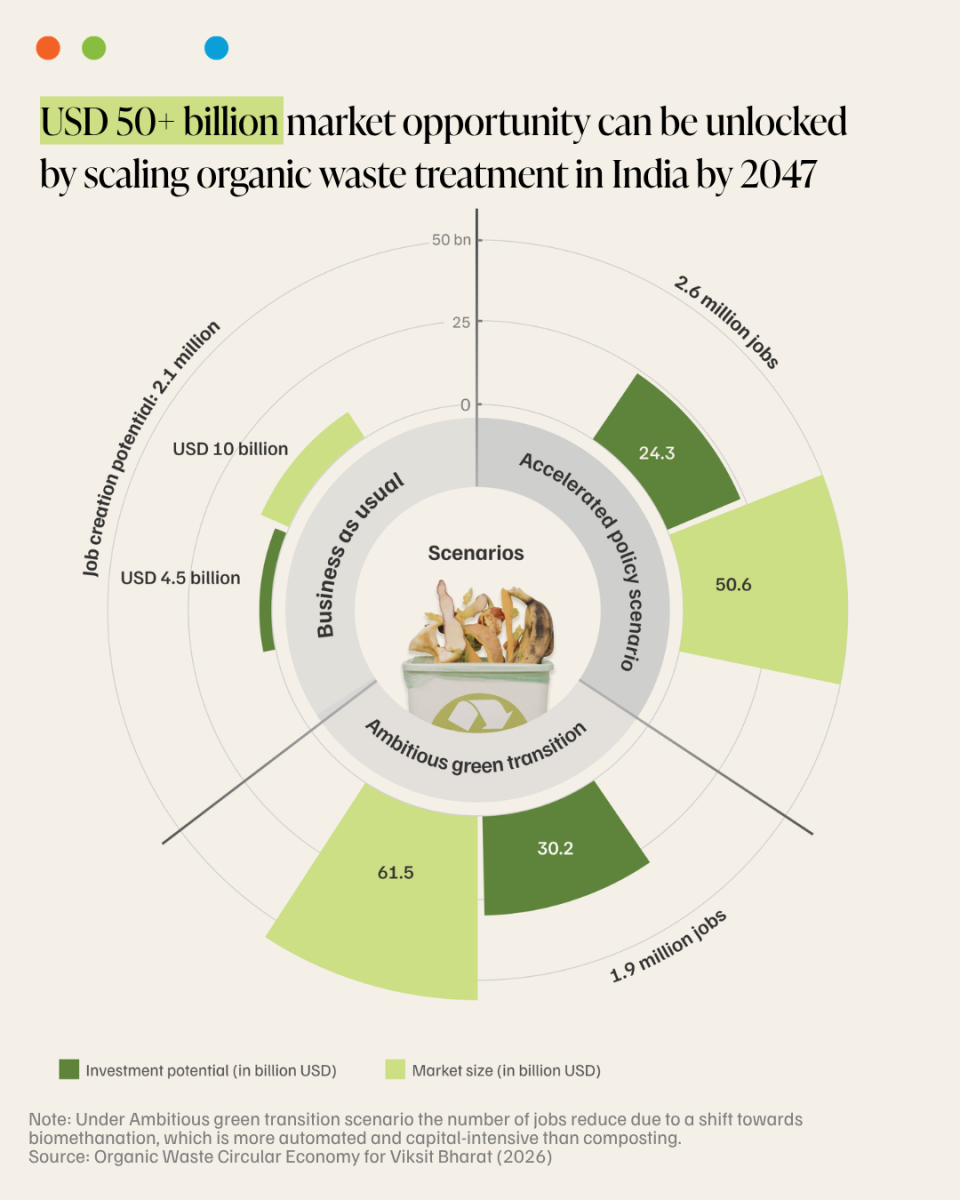
*Note: The study focuses only on the organic fraction of municipal solid waste and does not include rural, agricultural, industrial, hazardous, biomedical, e-waste, or construction and demolition waste streams. The investment and market estimates are calculated at current prices and do not account for inflation, operating expenditure, future technology improvements, or changes in maintenance costs.
For media queries and interviews, contact:
Tulshe Agnihotri – [email protected]
About CEEW
The Council on Energy, Environment and Water (CEEW) — a homegrown institution with headquarters in New Delhi — is among the world’s leading climate think tanks. The Council is also often ranked among the world’s best-managed and independent think tanks. It uses data, integrated analysis, and strategic outreach to explain — and change — the use, reuse, and misuse of resources. It prides itself on the independence of its high-quality research and strives to impact sustainable development at scale in India and the Global South. In over 15 years of operation, CEEW has impacted over 400 million lives and engaged with over 20 state governments. Follow us on X (formerly Twitter) @CEEWIndia or on LinkedIn for the latest updates.