Council on Energy, Environment and Water Integrated | International | Independent

- PMUY averted an estimated 834 kilotonnes of primary PM2.5 emissions from households in FY 2025–26
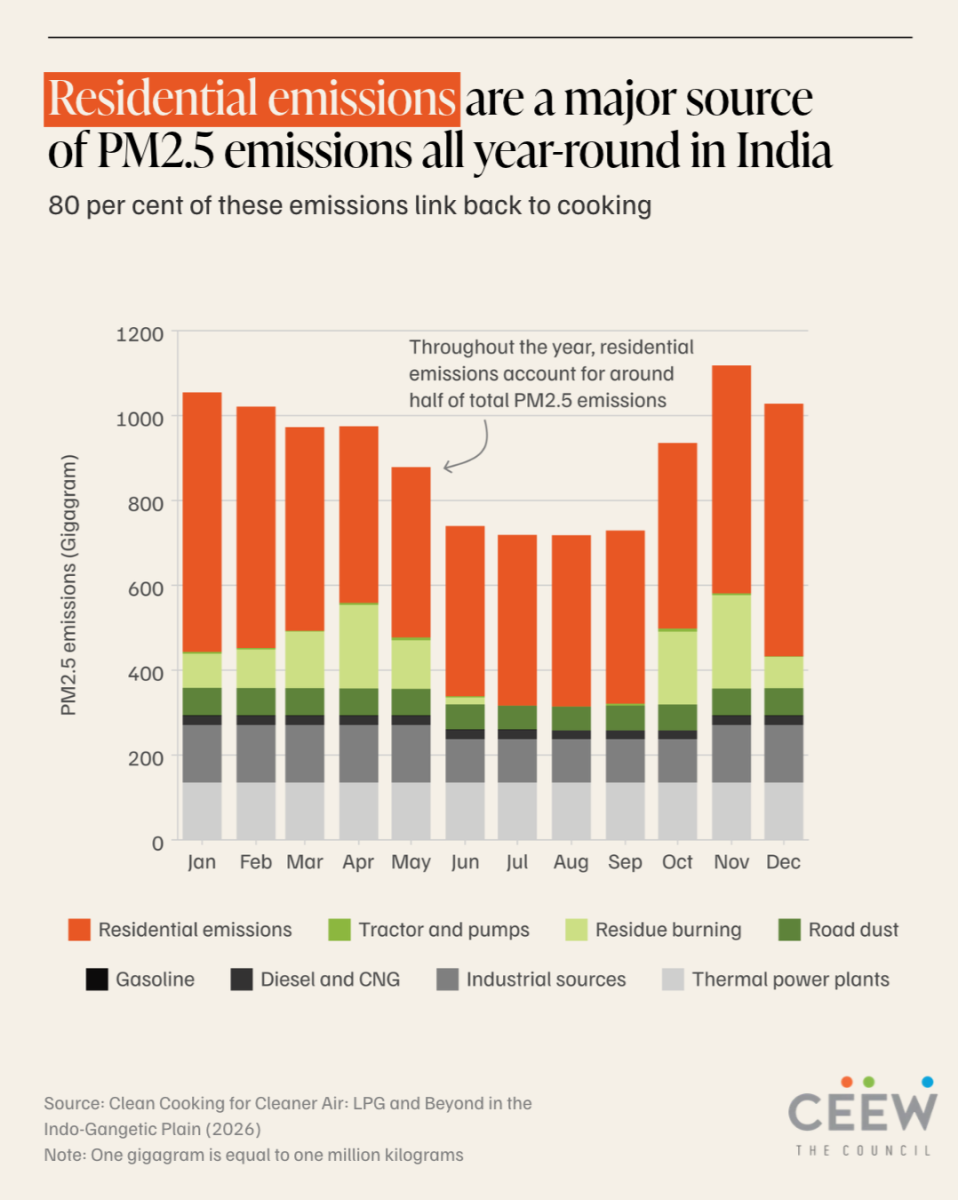
- In the most polluted parts of the Indo-Gangetic Plain, cooking is the single largest source, accounting for 36–49% of primary PM2.5 emissions
- A winter top-up of INR 200 per LPG refill for PMUY households in the IGP states would cost ~INR 4,000 crore a year
New Delhi, 26 November 2026: The Pradhan Mantri Ujjwala Yojana (PMUY) has made a significant dent in India’s air pollution, cutting household PM2.5 emissions by about 15 per cent in FY 2025-26, according to a new study by the Council on Energy, Environment and Water (CEEW). However, in the most polluted areas of the Indo-Gangetic Plain (IGP), cooking with firewood, dung cakes, crop residue, coal and kerosene is still the single largest source, accounting for 36–49 per cent of the total primary PM2.5 emissions. To extend the gains of PMUY, the study proposes a winter top-up on LPG refills and a capital subsidy on electric cooking devices for PMUY households in the IGP. This would be backed by a clean fuel stack of LPG, electric cooking, and biogas, so that cleaner air does not come at the price of a bigger import bill.
The CEEW study comes as winter smog settles over the plain, with Stages I and II of the Graded Response Action Plan in force across Delhi-NCR. While much of the focus is on how stubble burning and Diwali firecrackers drive spikes in pollution, residential combustion, by contrast, is the single largest source of PM2.5 emissions in the IGP’s most polluted areas. It burns year-round and increases every winter, as households also burn fuel for heating. Because polluted air ignores state borders, and the government itself treats the IGP as a ‘giant single airshed’, the study argues that city-by-city measures cannot clean it alone. Cooking accounts for about 80 per cent of household energy use, so the transition from polluting to cleaner cooking fuels is the only way to cut most of the residential emissions.
Abhishek Kar, Fellow, CEEW, said, “We can now put a number on what Ujjwala has done for India’s air. But many families still cook with firewood alongside LPG because the next refill is hard to afford, and in the Indo-Gangetic Plain’s most polluted areas, cooking is the single largest source of PM2.5 emissions. A winter top-up would make that next LPG refill affordable when pollution is at its worst. Where practical, electric cooking and biogas can reduce families’ reliance on a single, imported fuel. India needs both clean air and a manageable import bill, not one at the cost of the other.”
The CEEW study compares a decade of actual LPG sales with a scenario in which PMUY was never launched, and connections keep growing at their pre-2016 rate. By FY2025–26, actual sales stood at 28.7 million tonnes, against 22.9 million tonnes in that scenario. Over the decade, the extra LPG avoided about 4,963 kilotonnes of PM2.5 and 132 kilotonnes of black carbon. This includes 834 kilotonnes of PM2.5 in FY25-26 alone.
More than 105 million women now hold a PMUY connection. But progress across the plain is uneven. Government survey data for 2023–24 shows LPG is the primary cooking fuel for 90 per cent of households in Punjab, but only 61 per cent in Uttar Pradesh, 47 per cent in Bihar and 40 per cent in Jharkhand. CEEW’s own survey of rural households in Uttar Pradesh and Jharkhand found that 44 per cent and 66 per cent, respectively, still cooked only on solid fuels. Fewer than one in ten cooked exclusively on clean fuel in these two states. Refill costs were the main barrier, followed by patchy home delivery. In cities, the gap is in enrolment. Only about 4 per cent of LPG-using migrant workers surveyed across ten Indian cities were PMUY beneficiaries. PMUY 2.0 now lets migrants self-declare their address, so the study suggests the barrier is awareness rather than paperwork.
PMUY households pay about INR 642 for a cylinder in Delhi, after a subsidy of INR 300 that has covered up to four cylinders a year since June 2026. The study proposes an extra INR 200 on each of the four cylinders between October and March, when pollution levels peak across the plain, in Delhi, Punjab, Haryana, Uttar Pradesh, Bihar, Jharkhand and West Bengal. That would bring a refill down to about INR 442 at today’s price, at an estimated up to INR 4,000 crore a year. INR 400 is the price at which four in five surveyed households said they would cook only on LPG, though those answers were self-reported. The top-up would be a fixed INR 200 per cylinder, with refills at least 25 days apart to keep costs predictable and prevent misuse. If the Centre’s subsidy remains limited to four cylinders a year, the CEEW study recommends that IGP state governments offer an additional INR 300 subsidy on at least two cylinders during the non-winter months (April–September). This would cost the state governments about INR 2,400 crore a year if 80 per cent of PMUY households take it up, equivalent to less than 0.1 per cent of their combined budgets.
Beyond the top-up, the CEEW study recommends that India’s 25,000-plus LPG distributors sell certified induction cooktops and electric pressure cookers at a discount to households that give up two of their four subsidised cylinders. For the poorest households, who use fewer cylinders, the cooktop replaces the chulha. While it saves little LPG, the study argues the government should fund the gap as a public good towards securing air quality gains. India has around 40 million households with three or more cattle, yet fewer than one per cent of rural households use biogas as their primary fuel, even though the INR 24,000 in LPG subsidies and under-recoveries for a PMUY household over ten years could cover half the cost of a small biogas unit.
Rahul Das, Programme Associate, CEEW, and lead author of the study, added, “The households we surveyed most often told us the high cost of the next refill keeps them burning firewood alongside LPG. A winter top-up would ease that, but only for those already enrolled, and only while LPG is available. Enrolment drives and a second clean option, such as electric cooktops in the kitchen, matter just as much.”
The CEEW study recommends reimagining the PMUY subsidy as a fuel- and technology-neutral clean cooking subsidy, so that households can build a clean fuel stack of LPG, electric cooking, or biogas according to local supply and their own needs. Although written for the IGP, the recommendations would apply to any airshed region with worsening air quality where average PM2.5 concentrations exceed NAAQS by 1.5 times or more (>=60 µg/m³).
Read the full study, Clean Cooking for Cleaner Air: LPG and Beyond in the Indo-Gangetic Plain’, by Rahul Das, Surya Shekhar Auddy and Abhishek Kar here.
Note: The 15 per cent figure is a modelled estimate of emissions avoided, not a measured change in air quality. It compares actual LPG sales with a scenario in which connections kept growing at their pre-PMUY rate. Cooking’s share of primary PM2.5 emissions (36–49 per cent) reflects CEEW’s analysis of data underlying Venkataraman et al. (2024), shared by the authors, for areas of India with annual mean PM2.5 concentrations of 80–140 µg/m³, including most of the IGP. State-level cooking fuel shares are from the Household Consumption Expenditure Survey 2023–24 (MoSPI). Household findings draw on earlier CEEW surveys of about 4,000 rural, migrant and informal-settlement households, conducted between November 2024 and January 2025; willingness to pay is self-reported. Cost and savings estimates are indicative and depend on uptake and LPG prices. IGP findings draw on the Uttar Pradesh and Jharkhand rural samples (762 households; 745 responded to the willingness-to-pay question) and on Delhi, Lucknow, Ranchi, and Kolkata (837 households; 790 responded to the willingness-to-pay question).
For media queries and interviews, contact:
Tulshe Agnihotri – [email protected]
The Council on Energy, Environment and Water (CEEW) — a homegrown institution with headquarters in New Delhi — is among the world’s leading climate think tanks. The Council is also often ranked among the world’s best-managed and independent think tanks. It uses data, integrated analysis, and strategic outreach to explain — and change — the use, reuse, and misuse of resources. It prides itself on the independence of its high-quality research and strives to impact sustainable development at scale in India and the Global South. In over 15 years of operation, CEEW has impacted over 400 million lives and engaged with over 20 state governments. Follow us on X (formerly Twitter) @CEEWIndia or on LinkedIn for the latest updates.