Council on Energy, Environment and Water Integrated | International | Independent

Suggested citation: Das, Rahul, Surya Shekhar Auddy, and Abhishek Kar. 2026. Clean Cooking for Cleaner Air: LPG and Beyond in the Indo-Gangetic Plain. New Delhi: Council on Energy, Environment and Water.
The Indo-Gangetic Plain (IGP) is India’s most polluted region and home to about 40 per cent of the country’s population. In the highly polluted parts of the IGP, stretching from Punjab in the west through Haryana, Delhi, Uttar Pradesh and Bihar to West Bengal, cooking is one of the single largest contributors to primary PM2.5 emissions, accounting for an estimated 36–49 per cent of annual average PM2.5 levels. Yet cooking has remained largely absent from mainstream discussions on air quality in India. PM2.5 does not respect state, municipal or panchayat boundaries, so the challenge needs an airshed-level response.
Since 2016, the Pradhan Mantri Ujjwala Yojana (PMUY) has given free LPG connections to more than 10.5 crore women from economically weaker households. However, access has not translated into sustained use. In 2026, the conflict in West Asia and the disruption at the Strait of Hormuz exposed how heavily India’s clean cooking transition rests on imported LPG. A scarcer and costlier fuel risks pushing low-income households back to firewood.
This policy brief estimates the emission reductions attributable to PMUY over the first decade since May 2016. It also draws on CEEW willingness-to-pay (WTP) surveys of around 4,000 rural, urban informal settlement and migrant households. On that basis, it proposes a phased, airshed-level package that moves kitchens from LPG access to sustained clean cooking. The package combines LPG with electric cooking, biogas and other clean fuels to displace biomass.
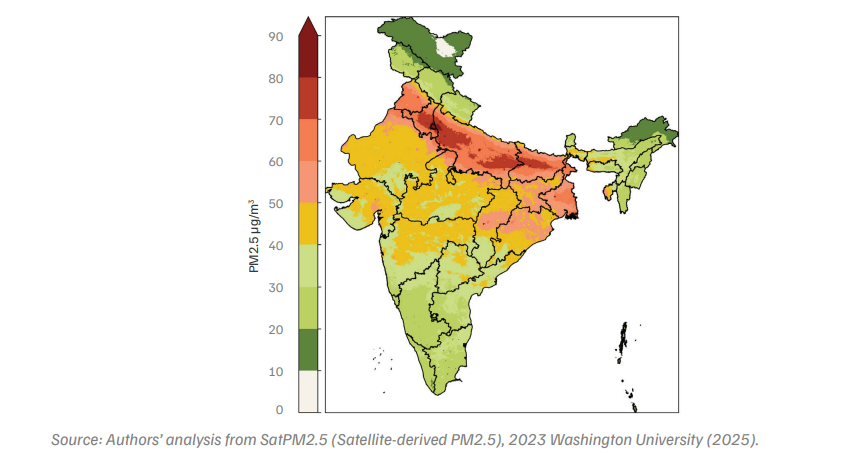
The Indo-Gangetic Plain (IGP) is India’s most polluted region. Large parts of the IGP had annual mean PM2.5 levels above 80 µg/m³ in 2019 (Venkataraman et al. 2024), more than twice India’s annual National Ambient Air Quality Standard (NAAQS) of 40 µg/m³ (CPCB 2009) and more than 16 times the World Health Organization (WHO) annual guideline of 5 µg/m³ (WHO 2021). Figure ES1 illustrates the spatial distribution of annual mean PM2.5 concentrations across India in 2023, highlighting the concentration of pollution in the IGP. Against this backdrop of persistently high pollution around the year, hourly PM2.5 levels have exceeded 500 µg/m³ during extreme episodes (Agarwal et al. 2024). Household burning of firewood and other solid fuels for cooking, heating and lighting is a major source of these PM2.5 emissions in the IGP, particularly in winter (Venkataraman et al. 2024). It also contributes to household air pollution (HAP), exposing household members directly to harmful smoke (Chowdhury et al. 2019; Chatterjee et al. 2023).
Figure ES1. The IGP region had the highest annual PM2.5 concentration in India in 2023
Because PM2.5 emissions are not limited to administrative boundaries such as state, municipal, or panchayat, city- or state-level interventions are insufficient: the challenge is regional and it requires a broader, airshed-level intervention to move kitchens to sustained clean cooking fuel use.
The Government of India (GoI) introduced the Pradhan Mantri Ujjwala Yojana (PMUY) in May 2016 to provide economically weaker households with free LPG connections. Access to LPG has expanded, but it has not translated into sustained use. The IGP, home to about 9 per cent of global and 40 per cent of India’s population (Centre for Science and Environment 2025), is one of the poorest regions in the country. Financial, supply, and behavioural barriers continue to limit the sustained use of LPG and other clean fuels such as electric cooking and biogas (Kar et al. 2024; Auddy and Das 2026; Das et al. 2026; Kar and Gill 2026). High population, deep socio-economic deprivation, and poor air quality are a triple burden, making air quality improvement not merely beneficial but imperative. Solving the clean cooking problem is not only a health and economic imperative but also an environmental one as cooking fuel decisions in millions of Indian kitchens shape air quality at the national scale.
Also, while PMUY has anchored India’s clean cooking transition over the past decade (Box 1), this progress has rested on an imported fuel. LPG consumption fell by about 8 per cent in January–June 2026 compared with the same period in 2025 (PPAC 2026b). A scarce and costlier LPG makes low-income households, including PMUY beneficiaries, more likely to revert to polluting fuels such as firewood and kerosene, reversing a decade of progress. Households outside the PMUY are even more exposed because they pay the full or higher informalmarket price for LPG: in a CEEW survey across ten cities, only about 4 per cent of LPG-using migrant workers were PMUY beneficiaries, and 79 per cent relied on informal connections (Auddy et al. 2026). Extending PMUY to these groups is therefore the first step towards protecting and building on these gains.
At the same time, India faces a genuine dilemma: greater LPG use by PMUY beneficiaries, in place of firewood, would improve air quality and health outcomes but raise import bills and risk supply exposure to conflict zone.
Figure ES2. At an all-India level, the residential sector accounts for a large share of the total PM2.5 emissions throughout the year
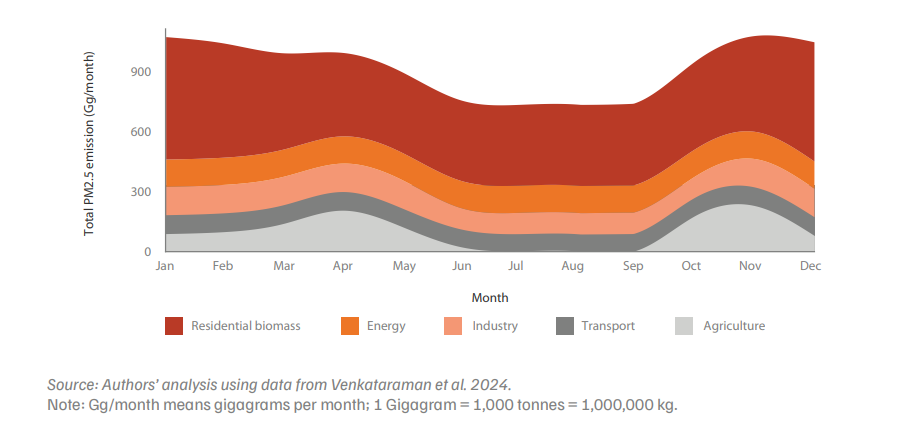
This research proposes a supplementary policy to directly target and reduce the PM2.5 contributions from the residential sector across the IGP in a phased approach. The recommendations are listed below:
Expand the PMUY to include vulnerable population groups
First, oil marketing companies (OMCs) and the Ministry of Petroleum and Natural Gas (MoPNG) should undertake targeted identification and PMUY enrolment drives in urban informal settlements, where households use biomass for cooking or purchase LPG cylinders from the informal market. The PMUY connection would allow them access to LPG refills at a lower cost and help them transition towards exclusive usage.
For rural regions, OMC-level data or local distributor networks can provide information about villages with low penetration or low LPG refills. The drive would identify eligible households for priority enrolment or conversion into PMUY.
The enrolment should proceed in phases, beginning with the urban poor in million-plus cities (MPCs) in the National Capital Region (NCR), expanding to other major urban regions in the IGP, and finally extending to all rural regions of the IGP.
Provide PMUY beneficiaries a winter subsidy
To use LPG exclusively, a typical household needs 7-8 LPG cylinders per year (Kar et al. 2019; Mani et al. 2021). Accordingly, over the six winter months (October–March), when pollution levels are elevated across the IGP, a household would need at least four cylinders. Currently, the MoPNG provides a subsidy of INR 300 per cylinder to PMUY consumers1 capped at four cylinders annually. We recommend an air quality improvement–linked top-up subsidy of INR 200 per cylinder for 4 cylinders during these six winter months for the IGP states.
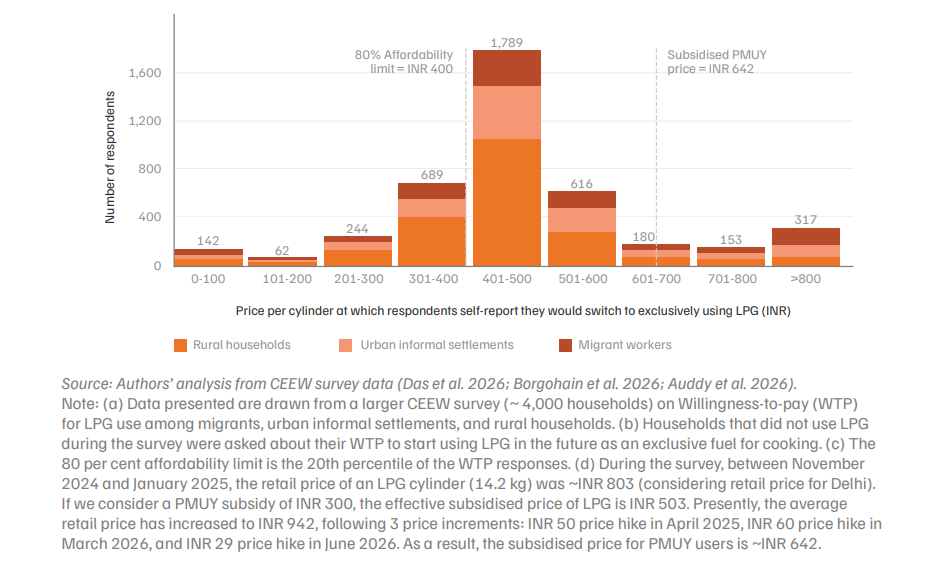
We assume INR 600 as a reference price for a PMUYsubsidised LPG cylinder, reflecting price fluctuations between INR 553 and INR 642 over the past year. The proposed additional winter subsidy of INR 200 would bring this illustrative price to INR 400 per cylinder. A CEEW survey found that 80 per cent of respondents selfreported willingness to use LPG exclusively at this price (Figure ES3) (Das et al. 2026; Borgohain et al. 2026; Auddy et al. 2026). At the present retail price of INR 942 in New Delhi (as of 30 September 2026), however, the effective price, after the PMUY and the additional subsidy, would be INR 442.
Field interactions have also consistently shown prices at or below INR 500 as an informal affordability threshold among PMUY households.
Figure ES3. At a price of INR 400, 80% of respondents self-report that they would move to exclusively using LPG for their cooking needs
If the GoI continues to restrict the PMUY subsidy to four cylinders, imposed during the West Asia crisis, we recommend that the state governments in the IGP provide a subsidy equivalent to the present PMUY subsidy of INR 300 per cylinder for at least two cylinders during the six non-winter months (April to September). This would make primary use of LPG affordable, while also delivering health and environment gains.
As a pan-India policy, this subsidy can be geographyneutral, and any airshed where the annual average of PM2.5 breaches a specific standard, for example, 60 µg/m³ (i.e., 1.5 times India’s annual NAAQS of 40 µg/ m³), the winter subsidy would be applicable.
Additionally, to manage fiscal risk from global price volatility, the winter top-up should be fixed at INR 200 per cylinder and not linked to changes in the retail price. This keeps the fiscal outlay predictable even if the retail price of LPG rises further.
Make provision for a capital subsidy for the purchase of e-cooking devices
The 2026 crisis in West Asia underscores the urgent need to diversify India’s cooking energy mix. As the higher use of LPG–to encourage a lower use of firewood in the winter months–raises the import bill, efforts should be made to introduce electric cooking and other clean cooking fuels.
We recommend that the MoPNG take the initiative to transition the 25,000+ LPG distributors into clean cooking hubs. OMCs should procure BIS-certified e-cooking devices in bulk and supply them to distributors, who would stock and sell them to consumers.
At the household level, any PMUY household can opt to purchase an e-cooking device from its LPG distributor at a discounted cost, conditional on permanently giving up two of its MoPNG-subsidised cylinders a year. At the current MoPNG entitlement of four cylinders a year, the household would receive two subsidised cylinders a year. In the IGP states, if these households buy their two subsidised cylinders during the winter months (October–March), they will also be eligible for the INR 200 top-up per cylinder, and they remain eligible for any state government-funded cylinder schemes on the same terms as other PMUY households. If 20 per cent of all PMUY households that use four or more cylinders a year opt in2 , the subsidy saved and under-recoveries avoided would total about INR 2,500 crore a year, which would be net savings for the OMCs and the exchequer, once the device cost is recovered.
Reimagine the LPG subsidy as a fuel- and technology-neutral subsidy for clean cooking
While LPG remains the mainstay for India’s clean cooking fuel journey (Kar et al. 2023), high reliance on a single fuel exposes vulnerable populations to price volatility, supply shocks, and possible rebound to solid fuels (Ali 2025; Shukla 2026).
The conflict in West Asia triggered temporary and localised LPG shortages across India and highlighted the fragility of its clean cooking transition because, historically, almost two-thirds of the country’s LPG demand has relied on imports from West Asia, routed through the vulnerable chokepoint of the Strait of Hormuz (Lok Sabha 2026, Kar and Auddy 2026).
Several consumers have already shifted to electric cooking amid the LPG shortage. However, electric cooking has its own set of scale-up challenges: deliberate investments are required in household electric wiring and kitchen infrastructure, induction-compatible cookware, and targeted financial support for low-income households (Auddy and Das 2026). India’s clean cooking mix must, therefore, diversify and government financial support should in principle be technology neutral. The GoI has fast-tracked PNG installations - installing connections for 5.8 lakh new households in March 2026 alone (Economic Times 2026). However, PNG will not offer the most relevant transition pathway from LPG, especially for socially and economically marginalised urban informal settlements and rural areas.
Here, biogas offers a third pathway, especially in the IGP, similar to India’s dairy-dense corridors like Gujarat, Punjab, Rajasthan, Maharashtra, Tamil Nadu, and Uttar Pradesh. There are approximately 40 million cattlerearing households in India with three or more animals, which are well-suited for a transition to biogas (Jain et al. 2026); yet, adoption remains below 1 per cent, held back by high upfront capital costs of INR 35,000–50,000 per biodigester. Shifting only 25 per cent of these households (10 million households) could save up to INR 2,000 crore annually in LPG under-recovery (Kar and Gill 2026).
The current PMUY subsidy is fuel-specific and traditionally tied to LPG. India should now reimagine a technology-neutral clean cooking subsidy that enables beneficiaries to choose between the various available fuel pathways based on local resource and infrastructure availability and household preferences. For the IGP in particular, such a redesign would not only ensure better air quality and health, but also reduce imports, and improve energy security.
Since the IGP is the most polluted airshed in India, this Policy Brief is directly targeted at it. In principle, however, the recommendations are largely airshed-neutral - they would apply equally to any airshed experiencing worsening air quality.
The brief looks at how household cooking with solid fuels drives air pollution in the IGP, India’s most polluted airshed. It estimates the emission reductions attributable to PMUY over its first decade. Using CEEW survey data on willingness to pay for LPG, it proposes a phased package of policy measures to move households from LPG access to sustained clean cooking, while reducing India’s dependence on imported LPG.
PM2.5 travels across state, municipal and panchayat boundaries, so city- or state-level measures alone cannot solve the problem. Because of its geography, the IGP behaves like a giant valley that traps particulate matter. The government recognises that the region acts as a single airshed during parts of the year. A model of regional coordination already exists in the Commission for Air Quality Management (CAQM) for the NCR and adjoining areas. The brief argues for a similar approach to residential emissions across the IGP.
At least 36 per cent of primary PM2.5 emissions in the most polluted airsheds that span the IGP can be traced to cooking. The highly polluted parts of the IGP, stretching from Punjab in the west through Haryana, Delhi, Uttar Pradesh and Bihar to West Bengal in the east, fall into the two highest bands (80–110 and 110–140 µg/m³). In these bands, cooking is the single largest individual source of primary PM2.5 emissions, accounting for up to 49 per cent (analysis of data shared by Venkataraman et al.). Cooking accounts for about 80 per cent of residential energy use, with heating and lighting making up the rest. As a result, residential emissions largely reflect cooking emissions. These emissions occur year-round and rise in the winter months.
The brief compares actual LPG sales with a counterfactual scenario in which PMUY was never introduced. Without the scheme, India’s LPG sales would have been about 34 million tonnes lower over ten years, and about 510 million tonnes more firewood would have been used for cooking. As a result, India avoided cumulatively around 4,963 kilotonnes of PM2.5 and 132 kilotonnes of black carbon emissions between FY 2016–17 and FY 2025–26. For FY 2025–26, our analysis estimates that PMUY avoided approximately 834 kt of PM₂.₅ emissions and 22 kt of black carbon (BC) emissions from cooking. For context, the PAVITRA dashboard of the Center for Study of Science, Technology and Policy (CSTEP) estimates residential emissions in 2025 at approximately 4,800 kt for PM₂.₅ and 600 kt for BC (CSTEP 2026). Using these estimates as reference benchmarks, our scenario-based analysis suggests that PMUY reduced residential PM₂.₅ emissions by approximately 15 per cent and BC emissions by approximately 4 per cent relative to a counterfactual scenario without the programme.
Methods for Long-Term Particulate Matter Trend Assessment
Mitigating Stubble Burning in Haryana
Unlocking Finance for India’s Textile Waste Management