Council on Energy, Environment and Water Integrated | International | Independent


Suggested Citation: Abbud, João, Luisa Bianchet, Hugo Bolognesi, Thibault Deletombe, Sabarish Elango, Maude Gibbins, Simone Klein, Antonia Kurz, Lin Ziyue, Hemant Mallya, Joe Morrisroe, Prof. Karsten Neuhoff, Stefania Relva, Simon Sharpe, and Prof. Wang Pu. 2026. Enabling Investment in Clean Primary Steel: The Case for Subsidy-and-Recharge Policies. A report of the Breakthrough Agenda Policy Network.
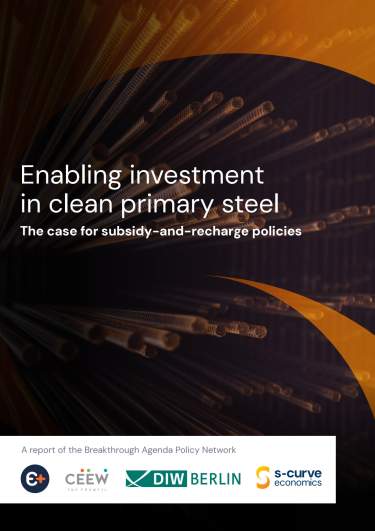
Producing primary steel with near-zero emissions is technologically possible, but it costs around 25–50 per cent more than conventional coal-based production in India, Brazil, China, the European Union (EU), and the United Kingdom (UK). This cost gap makes it too risky for companies to invest in clean plants without policy support. The challenge is acute for India, the world’s second-largest steel producer, with 152 million tonnes (Mt) of crude steel produced in 2024–25. The National Steel Policy 2017 targets capacity of 300 million tonnes per annum (Mtpa) by 2030, and much of the planned addition is coal-based. No near-zero-emission primary steel plant operates in India today, so investment choices made in the next few years could lock in high-emission capacity for two to three decades.
This report of the Breakthrough Agenda Policy Network (BAPN) examines a ‘subsidy-and-recharge’ approach: targeted, long-term subsidies for near-zero-emission primary steel, funded by a small ‘recharge’ on steel. The policy is designed to be revenue-neutral for governments. Chapters on China, India, the EU, Brazil, and the UK adapt the approach to each country’s industry, resources, and institutions. Carbon pricing remains useful, but on its own it is unlikely to enable these investments. In India, the Carbon Credit Trading Scheme (CCTS) sets emission-intensity targets without auctioned allowances, wherein effective carbon prices above USD 50 per tonne of carbon dioxide (CO₂) would be needed to make near-zero-emission steel viable, a level that would strain industrial competitiveness.
The India chapter, authored by CEEW’s Hemant Mallya and Sabarish Elango, proposes two variants of the subsidy and recharge mechanism. Both apply a small charge on the verified emission intensity of steel plants obligated under the CCTS, collected on sales and paid into a dedicated clean steel fund. In the first variant, the fund supports two streams: a sector-wide subsidy that rewards emission reductions and compliance with CCTS targets, and reverse auctions that support first-of-a-kind to nth-of-a-kind near-zero-emission plants, covering their extra cost so that their steel can sell at the price of conventional steel. The second variant replaces the first stream with a green public procurement programme based on contracts for difference.
The recharge would be small: about USD 10.5 per tonne of CO₂ (around 5 per cent of the cost of blast furnace–basic oxygen furnace steel) to support near-zero-emission steel equal to 10 per cent of India’s output at today’s green hydrogen costs, and as low as USD 1 per tonne of CO₂ by 2035 if green hydrogen costs fall to USD 2 per kilogram. Passed on to buyers, it would add less than 0.5 per cent to the cost of products and projects such as cars, refrigerators, apartments, and highways. Unlike the flat per-tonne recharges proposed for other countries, India’s charge would not apply to imports, leaving domestic producers with a small cost disadvantage. The chapter also identifies risks that need attention, particularly the governance of the fund, the quality of emissions data, and the legislative time needed for a new Act.
The 2026 report of the Breakthrough Agenda Policy Network finds that India's Carbon Credit Trading Scheme (CCTS) alone may be insufficient to catalyse new near-term investments in green steel production. The report recommends a parallel mechanism that charges a small fee on all steel consumption or emissions that can be utilised to bridge the green premium on clean steel production. Such a mechanism would minimise the risk of first-movers in establishing clean steel production capacity.
Carbon pricing can encourage smaller emission reductions, but it is unlikely to close the cost gap for near-zero-emission steel on its own. India’s Carbon Credit Trading Scheme (CCTS) is built around emission-intensity targets with no auctioned allowances. The report estimates that effective carbon prices above USD 50 per tonne of carbon dioxide (CO₂) would be needed to incentivise near-zero-emission steel, and that a price at this level would harm industrial competitiveness. The proposed mechanism therefore complements the CCTS rather than replacing it.
A subsidy-and-recharge policy has two parts. First, governments give long-term subsidies, ideally awarded through auctions, to plants that produce near-zero-emission primary steel. Second, the total cost of these subsidies is recovered each year through a ‘recharge’, a levy spread across the steel sector, which makes the policy revenue-neutral for governments. In most of the countries studied, the recharge is a flat rate per tonne on all domestic and imported steel and is waived on exports. India’s version differs, as explained below.
Each steel plant obligated under the CCTS would pay a recharge equal to a levy rate multiplied by its emission intensity and the steel it sells, so more carbon-intensive plants pay more. The revenue goes into a dedicated fund with two streams. Stream 1 is a performance-based subsidy that rewards emission reductions and compliance with CCTS targets, so every obligated plant receives some return. Stream 2 uses reverse auctions to support plants that use green hydrogen or carbon capture and storage, covering their extra cost so that their steel matches the price of conventional steel for a fixed period. An alternative variant replaces Stream 1 with a green public procurement programme.
At the 10 per cent stage, the estimated price increase is about 0.2 per cent for a compact car, 0.3 per cent for a 250-litre refrigerator, 0.4 per cent for a 1,000 sq ft residential apartment, and 0.3 per cent for a four-lane highway. At a flat recharge of USD 2 per tonne of CO₂, the increases fall to between 0.04 and 0.08 per cent. These estimates assume the recharge is passed on in full. The report notes that supply-chain margins could raise them, but finds that even a doubling or tripling would keep the increase below 1.5 per cent.
The recharge adds between USD 2 and USD 25 per tonne to steel costs, or 0.4 to 5.1 per cent of the cost of conventional steel, depending on the green premium and average emission intensity. Stream 1 returns part of this to plants that comply with CCTS targets. Because a flat import levy on an emissions-based charge would not be compatible with World Trade Organization rules, domestic producers face a small structural disadvantage, roughly 1 per cent of production costs at USD 2 per tonne of CO₂. Steel product prices changed by about 5 per cent a year on average during 2021–24. A border tax calibrated to the recharge is possible in principle but is unlikely to be cost-effective at current rates.
In the report, clean primary steel is made from iron ore with near-zero emissions, at least 90 per cent below a typical blast furnace–basic oxygen furnace (BF-BOF) plant. Primary steel accounts for around 85–90 per cent of the sector’s emissions worldwide. India’s steel sector emitted about 350 million tonnes of CO₂ equivalent in 2023–24, at an average of 2.40 tonnes of CO₂ per tonne of crude steel. With 26 Mtpa of blast furnace capacity under construction and about 166 Mtpa of capacity announced, the report warns of lock-in for two to three decades unless policy action diversifies the technology mix.
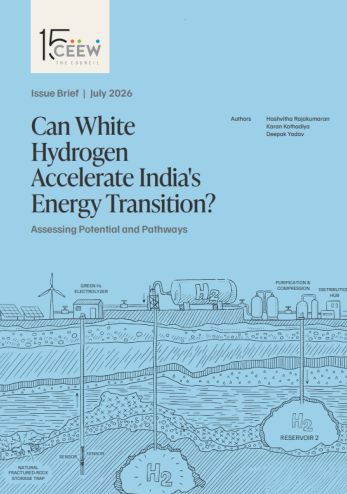
Can white hydrogen accelerate India’s energy transition?
How Secure is India’s Energy Future?
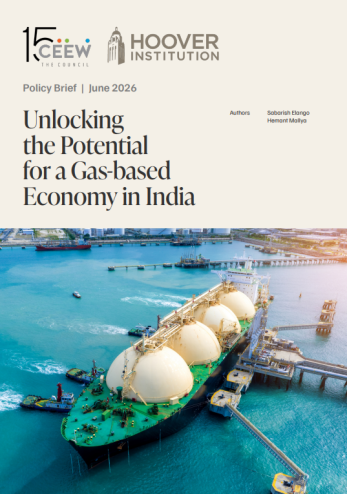
Unlocking the Potential for a Gas-Based Economy in India
Advancing India’s Green Steel Transition
CO₂ Pipeline Network for Carbon Capture and Storage in India