Council on Energy, Environment and Water Integrated | International | Independent

Suggested Citation: Maharashtra Institution for Transformation (MITRA), Government of Maharashtra, and Council on Energy, Environment and Water (CEEW). 2026. Maharashtra State Climate Finance Framework: From Risk to Resilience. Mumbai: Department of Environment and Climate Change, Government of Maharashtra.
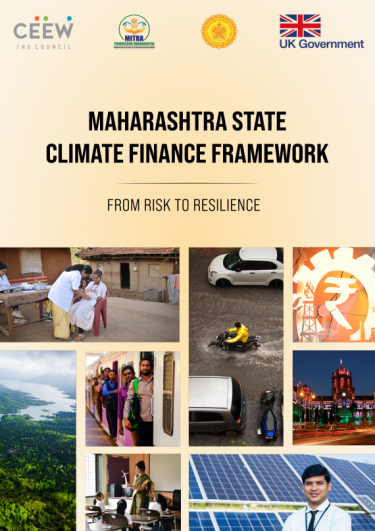
Maharashtra stands at a critical juncture. On the one hand, its economic growth is accelerating; on the other, climate risks are escalating, affecting livelihoods, public health, critical infrastructure, and economic output. The two are becoming increasingly intertwined. As one of India's most economically dynamic states, Maharashtra is simultaneously among the most exposed to climate-related hazards, including floods, droughts, heat stress, cyclones and coastal erosion.
Through the Viksit Maharashtra 2047 vision and the updated Maharashtra State Action Plan on Climate Change: Pathways for 2030 (MH SAPCC), the Government of Maharashtra has articulated a clear commitment to climate-resilient and low-carbon development. Translating these ambitions into measurable outcomes depends on the state's ability to systematically align public expenditure and private investment with targeted climate action. At present, climate-relevant investments remain dispersed across departments, schemes and budget lines, without a consistent method to assess their contribution — and without clear signals on eligible activities, investors and financial institutions struggle to identify and appraise climate-aligned opportunities.
The Maharashtra State Climate Finance Framework (MSCFF) responds by presenting a state-level climate finance taxonomy — a structured, science-based decision tool to identify, classify and screen climate-aligned interventions across mitigation, adaptation and cross-cutting action. It is designed as a living document that will be updated as India's Climate Finance Taxonomy is finalised and notified.
By operationalising the priorities of the MH SAPCC and aligning them with the Viksit Maharashtra 2047 vision, the MSCFF strengthens the link between risk-informed planning and the channelling of investment towards sustainability.
The framework was developed under the guidance of the Department of Environment and Climate Change, Government of Maharashtra, the Maharashtra State Climate Action Cell (MahaSCAC) and the Maharashtra Institution for Transformation (MITRA), with CEEW as knowledge partner, and with support from the Foreign, Commonwealth & Development Office (FCDO), British High Commission.
Maharashtra stands at a critical juncture. On the one hand, its economic growth is accelerating, while on the other, climate risks are escalating, impacting livelihoods, public health, critical infrastructure and economic output. And both are becoming increasingly intertwined. As one of India’s most economically dynamic states, Maharashtra is simultaneously among the most exposed to climate-related hazards, including floods, droughts, heat stress, cyclones, and coastal erosion.
These risks threaten infrastructure, livelihoods, fiscal stability, and long-term development outcomes, particularly in climate-sensitive sectors such as agriculture, manufacturing, and urban infrastructure. Addressing these challenges requires stronger policies, coupled with a decisive, forward-looking approach on how financial resources are mobilised and utilised.
Through the Viksit Maharashtra 2047 vision and the updated Maharashtra State Action Plan on Climate Change: Pathways for 2030 (MH SAPCC), the Government of Maharashtra has articulated a clear commitment to climate-resilient and lowcarbon development. Translating these ambitions into measurable outcomes depends on the state’s ability to systematically align public expenditure and private investment with targeted climate action. Mobilising domestic and international capital alongside streamlining public finance has emerged as a strategic priority for the Government of Maharashtra, as embedded in the MH SAPCC. However, the absence of a clear and credible framework to define what constitutes a climate-aligned activity limits investors and financial institutions from identifying eligible projects, assessing climate impact, and aligning investments with state priorities. Existing budget allocation for climate-focussed activities remains fragmented across departments, as they are often without a consistent methodology to assess their contribution to climate mitigation and adaptation or resilience.
The Maharashtra State Climate Finance Framework (MSCFF) responds to these challenges by presenting a state-level climate finance taxonomy that is aligned with Maharashtra’s sustainable developmental goals and climate risks. The framework serves as a decision-making tool to categorise climate change mitigation, adaptation, and cross-cutting activities, and links them with the sectoral strategies embedded under the MH SAPCC. Furthermore, it establishes a structured, sciencebased ‘common language’ to identify, classify, and screen climate-focussed interventions. The framework ensures that it is interoperable with Indian and global climate taxonomies, and enables decision-makers to move from reactive spending towards a more strategic, outcome-oriented deployment of capital. The framework will enable planners to move from fragmented spending to a structured, pipeline-driven approach, which signals investor-ready opportunities, and strengthens access to domestic and international climate finance.
By operationalising the priorities of the MH SAPCC and aligning them with the Viksit Maharashtra 2047 vision, the MSCFF strengthens the link between risk-informed planning and channelling investment towards sustainability. Ultimately, the framework supports Maharashtra’s transition towards a lowcarbon, climate-resilient development pathway; one that safeguards economic growth, protects vulnerable communities, and ensures long-term sustainability in the face of escalating climatic uncertainties.
The Maharashtra State Climate Finance Framework (MSCFF) is a state-level climate finance taxonomy developed by MITRA, the Government of Maharashtra and CEEW. It helps government departments, investors, and financial institutions identify, classify, and screen climate-aligned investments across mitigation, adaptation, and cross-cutting activities. Aligned with the Maharashtra State Action Plan on Climate Change and India's Draft Climate Finance Taxonomy, it applies four screening criteria to ensure credible, measurable climate outcomes.
Four user groups. Governments can identify climate-aligned interventions, develop project pipelines, structure green and sustainability-linked bonds, and conduct climate-responsive budgeting. Financial institutions can design lending products, concessional loans, and blended instruments. Companies can align ESG metrics and identify climate-aligned projects. Asset managers can identify transition activities and investment opportunities in climate and resilience, and strengthen the link between financial flows and decarbonisation.
Every activity is screened against four technical criteria. Substantial contribution requires a demonstrable causal link to emissions reduced or climate risk lowered, rather than an incidental co-benefit. Intentionality and additionality require the climate outcome to be an explicit objective delivering benefits beyond business-as-usual. Do no significant harm screens for maladaptation and negative spillovers. Equity and inclusion assess distributional impacts on vulnerable and high-risk populations.
They are complementary. India's draft national taxonomy sets overarching principles, definitions, and screening logic. The MSCFF translates these to the state level as sector-specific classifications, activity-level screening criteria and investment pathways that reflect Maharashtra's own climate risks, development priorities and institutional arrangements. It is designed to be reviewed and updated once the national taxonomy is formally notified, keeping state and national definitions coherent.
Adaptation accounts for nearly 80 per cent of Maharashtra's proposed climate budget, but attracts the least private capital of any category of climate finance — benefits are hard to quantify, gestation periods are long, and stable revenue streams are rare. The MSCFF gives adaptation a dedicated four-step screening pathway, with explicit safeguards against maladaptation, so that adaptation investments can be assessed with the same rigour as mitigation.
No. It is explicitly designed as a living document. It will be periodically reviewed and updated to reflect India's Climate Finance Taxonomy once notified, as well as emerging evidence, lessons from implementation and evolving international best practice. Governance arrangements for operationalising the framework will be determined in consultation with departments of the Government of Maharashtra, MITRA and technical partners.

Living with Heat in Bangladesh