Council on Energy, Environment and Water Integrated | International | Independent


Suggested Citation: Sudan, Mehak, Kritika Patwal, and Vishwas Chitale. 2026. Thriving in a Warming World: Improving Climate Intelligence for Resilient Global Cities. New Delhi: Council on Energy, Environment and Water.
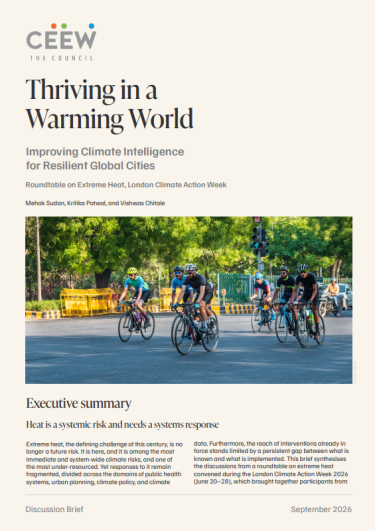
Extreme heat is a systemic risk, and among the most under-resourced climate risks. Over half of India's districts face high or very high heat risk, home to about 76 per cent of the population, and heat stress cost India an estimated 247 billion potential labour hours in 2024, associated with around USD 194 billion in potential income loss. This discussion brief synthesises a roundtable on extreme heat convened during London Climate Action Week 2026, which brought together city networks, climate finance institutions, philanthropies, non-governmental organisations, subnational governments and the private sector.
Its purpose is to have continuity in conversations and build on the common ground which was established: the binding constraint on heat resilience is not recognition of the problem or the lack of workable solutions, but the gap between evidence and implementation. Closing this gap requires building connections between departments that plan separately, between climate data and the decisions it should inform, and between pilots that work and the finance to scale them.
Extreme heat, the defining challenge of this century, is no longer a future risk. It is here, and it is among the most immediate and system-wide climate risks, and one of the most under-resourced. Yet responses to it remain fragmented, divided across the domains of public health systems, urban planning, climate policy, and climate data. Furthermore, the reach of interventions already in force stands limited by a persistent gap between what is known and what is implemented. This brief synthesises the discussions from a roundtable on extreme heat convened during the London Climate Action Week 2026 (June 20–28), which brought together participants from city networks, climate finance institutions, philanthropies, non-governmental organisations, subnational governments, and the private sector. We document what participants discussed about practical solutions, the intelligence needed to target them, and the institutional and financial conditions that will carry them to scale.
The physical signal is unambiguous, and the burden is unevenly distributed. Over 50 per cent of India’s districts face high or very high heat risk (Prabhu et al. 2025). Heat stress has cost India an estimated 247 billion potential labour hours in 2024, associated with around USD 194 billion in potential income loss (Romanello et al. 2025; Lancet Countdown 2025). Heat therefore reaches well beyond health into livelihoods, labour productivity, water security, ecosystems, and urban infrastructure, and threatens hard-won gains in poverty reduction and gender equality. This underscores the need for integrated planning, stronger climate intelligence, and coordinated governance backed by multi-stakeholder partnerships.
Three strands ran through the conversation. First, practical solutions exist and work best when locally grounded. Cool roofs, efficient fans, shading, green cover, and cooling spaces reduce exposure while limiting reliance on energyintensive cooling, and traditional building practices and nature-based approaches can complement technological interventions while strengthening community ownership. The effectiveness of these measures depends on delivering them to informal workers, women, and other heat-vulnerable groups through cooling spaces, hydration and rest facilities, neighbourhood communication, and workplace initiatives. Second, climate intelligence bridges knowledge and action. Heat-health information systems, early warning systems, and neighbourhood-scale climate services are increasingly informing preparedness. Estimates suggest a global scale-up of heat-health warning systems across just 57 countries could save an estimated 98,314 lives a year (World Meteorological Organization 2025). Third, finance is the binding constraint on scale. Anticipatory instruments already work at the household level, but the longer-term capital that builds cooling infrastructure remains thin, and cities need project preparation capacity as much as they need money.
Heat does not sit with a single department, so the first requirement is standing arrangements rather than seasonal ones: a shared view of where risk concentrates within a city, agreement on who acts at which threshold, joint budgeting across departments, and a review after each summer that shapes the following year’s plan.
The second is to channel finance to implementation and monitor what it delivers. Heatwaves are now on India’s notified disaster list in its operational guidelines for 2026–31, and the next step from moving heat onto a budget line is to ensure that money reaches the ground and that outcomes are recorded. Systematic documentation of what was funded, what was delivered, and what changed is what facilitates informed discussions at the next round of allocation.
The third requirement is to move demonstrated solutions from pilots to scale, using grant and philanthropic capital to absorb the early risk that commercial investment will not, so that the economic case for adaptation can rest on observed rather than modelled benefits. That case also needs reframing, from the costs of climate impacts towards the benefits of resilience investment.
The binding constraint on building heat resilience is no longer recognition of the problem, nor the absence of workable solutions. It is the gap between what is known and what is implemented, and the pace at which that gap is closing. Closing it depends less on generating new knowledge than on building connections: between departments that currently plan separately, between climate data and the decisions it should inform, and between solutions that work in a pilot and the finance that will carry them to scale. Heat-related illness and death are largely preventable, and the measures that prevent them are already known. Strengthening political commitment, financial inclusion, and multi-stakeholder partnerships will be essential to delivering practical, equitable, and scalable heat-resilience solutions.
Living with heat is becoming the defining urban challenge of the 21st century. The year 2024 remains the hottest on record, and the 10 years from 2015 to 2025 mark the warmest decade in the 176-year observational record. The consolidated three-year average for 2023 to 2025 stands at about 1.48°C above the pre-industrial baseline, marking the first three-year period in which average global temperature soared alarmingly close to the critical threshold of 1.5°C outlined in the Paris Agreement (World Meteorological Organization 2026). The world is entering a period of climate overshoot characterised by intensifying physical impacts and rising volatility.
Extreme heat sits at the centre of this shift. It is among the most immediate and system-wide climate risks, and among the most under-resourced. In South Asia, dense populations, high exposure, compounding hazards, and uneven adaptive capacity converge to amplify its impacts. Heat is intensifying in temperate cities too: in South East England, which includes London, warm spells lengthened from around six days a year on average in 1961–90 to over 18 days a year on average in 2008– 2017 (Met Office n.d.). Heat is a shared and escalating global risk, albeit one with uneven consequences.
The impacts extend well beyond direct health effects to livelihoods, labour productivity, and wider economic activity, with vulnerability shaped by differences in exposure, socioeconomic conditions, and adaptive capacity. Vulnerable populations bear disproportionate impacts, and extreme heat threatens to reverse hardwon gains in poverty reduction, gender equality, and sustainable development. The UN Secretary-General’s 2024 Call to Action on Extreme Heat placed protecting vulnerable populations and workers, strengthening economic and social resilience through data and science, and enhancing international cooperation at the centre of the global response (United Nations 2024).
Despite this urgency, responses remain fragmented, split across the domains of public health systems, urban planning, climate policy, and climate data. A persistent gap between knowledge and implementation limits the scale and effectiveness of current interventions.
Closing that gap requires stronger connections between collective learning and coordinated action, and access to climate intelligence that can support decisions on planning, investment, and service delivery. Technology has a crucial role in making climate information more accessible and usable, while cooperation and knowledge exchange can connect experience across cities, countries, and sectors.
Platforms are emerging at both ends of this chain. The Global Heat Health Information Network (GHHIN), an initiative of the World Meteorological Organization, the World Health Organization, and the US’ National Oceanic and Atmospheric Administration, provides an enabling layer for knowledge exchange and collaboration on heathealth resilience across South Asia. By bringing together experience across countries and sectors, it can support learning on heat preparedness and resilience, and strengthen connections between practitioners, researchers, and policymakers. At the city and national level, systems such as CRAVIS (Climate Resilience Analytics and Visualisation Intelligence System), CEEW’s AI-integrated climate research platform, can help transform fragmented climate data into actionable intelligence. By integrating historical trends, future projections, and sectoral vulnerabilities, CRAVIS can help governments and practitioners identify heat-risk hotspots and anticipate impacts, supporting more risk-informed planning across public health, infrastructure, and labour systems.
South Asia is particularly relevant to this conversation, both because of the scale and uneven distribution of heat risk and the experience being witnessed across its cities and communities. The challenge is to connect locally grounded approaches and practical experience with the wider knowledge, data, cooperation, and financing needed to support implementation.
The roundtable brought these strands together. It considered how collective learning, climate intelligence, and stronger cooperation can support more effective responses to extreme heat, and examined the institutional and financial conditions needed to translate knowledge and experience into action.
The discussion focused on practical approaches to strengthening heat resilience, and on the enabling factors needed to implement and scale them. These included passive cooling, heat-health systems, nature-based and locally led adaptation, climate information, financing, institutional coordination, and last-mile delivery.
Passive cooling, heat-health systems, and nature-based solutions offer practical options for strengthening urban heat resilience. Cool roofs, brushless direct current (BLDC) fans, shading, green cover, and cooling spaces can reduce heat exposure while limiting reliance on energy-intensive cooling. Integrating these measures into planning, housing, and public health systems will be particularly important where access to conventional cooling remains limited. Around 90 per cent of Indian households use ceiling fans, but only about 3 per cent use energy-efficient BLDC fans, pointing to considerable scope for more efficient cooling (Aggarwal and Agrawal 2022). According to the International Energy Agency’s 2018 assessment, global energy demand from air conditioning is projected to triple by 2050 in the absence of stronger efficiency policy, so combining growing access to cooling with efficiency and passive design will be increasingly important (International Energy Agency 2018).
Solutions also need to respond to local conditions. Traditional building practices, passive cooling, indigenous knowledge, and nature-based solutions from the Indian Himalayan Region, alongside examples from Nepal and Bhutan, have demonstrated how locally adapted approaches can complement technological interventions and strengthen community ownership. Participants at the roundtable also pointed to the role of local conservationists and community institutions in taking these approaches forward.
Heat needs to be understood beyond direct exposure, with its cascading effects not always captured in conventional risk assessments. An assessment of 734 Indian districts in 2025 found that 417, or 57 per cent, faced high or very high heat risk, with marked differences in exposure and vulnerability across locations; these districts are home to about 76 per cent of the population (Prabhu et al. 2025). Heat-related productivity losses carry wider economic implications: an estimated 247 billion potential labour hours were lost in India in 2024, associated with around USD 194 billion in potential income losses (Romanello et al. 2025; Lancet Countdown 2025). This reinforces the need for integrated physical climate risk assessments to inform planning and investment.
to decisions on the ground. Heat-health information systems, neighbourhood-scale climate services, and early warning systems are increasingly informing preparedness across the health, labour, and urban sectors. The health burden of extreme heat is already substantial, with impacts across cardiovascular, respiratory, and mental health, underlining the importance of coordinated public health and multisectoral action (World Health Organization 2024). A global scale-up of heat-health warning systems across 57 countries alone has the potential to save an estimated 98,314 lives a year (World Meteorological Organization 2025).
For cities, moving heat action plans beyond risk For cities, moving heat action plans beyond risk assessment and preparedness towards implementation and investment is key. Project preparation, institutional capacity, and investment-ready, bankable pipelines matter alongside financing itself. The discussion considered blended finance, catalytic capital, philanthropy, public finance, and multilateral funding as potential routes, alongside the need to strengthen the capacity of cities to develop projects that can actually be financed. The Thane Heat Action Plan provides one example of linking heat-risk assessment with municipal responsibilities and financing (Thane Municipal Corporation and Council on Energy, Environment and Water 2024).
Risk financing can complement these longer-term investments. The parametric heat insurance programme run by the Self-Employed Women’s Association (SEWA), anchored in Ahmedabad, has demonstrated how predefined temperature thresholds can trigger rapid payouts for informal women workers without conventional post-event damage assessment. The programme expanded from 21,000 women across five districts of Gujarat in 2023 to 50,000 women across 22 districts in Gujarat, Rajasthan, and Maharashtra in 2024, and over 225,000 women across eight states by March 2025. It illustrates the potential of anticipatory finance while also raising practical questions around affordability, risk data, trigger design, underwriting, and financial inclusion as such instruments scale (All India Disaster Mitigation Institute n.d.; Kara and Rotman Parker 2026).
These measures need to be embedded within governance structures. Participants pointed to Tamil Nadu’s experience with early warning, risk communication, and forest-fire preparedness as an illustration of the value of coordination across health, water, disaster risk management, and urban governance. Tamil Nadu’s action plan on climate change and human health establishes a state governing body chaired by the health minister, and a task force spanning revenue and disaster management, water and sanitation, urban development, and other departments. It also sets out colour-coded heat alerts, daily dissemination of temperature forecasts during the summer, and daily reporting of heatrelated illness from March 1 to July 31 (National Centre for Disease Control and Government of Tamil Nadu n.d.). The linkages with water availability, forest fires, and other environmental risks also emphasise the need to plan for heat alongside other hazards rather than through standalone responses. This cross-sectoral approach can help connect heat action with existing disaster management and urban planning systems.
Last-mile delivery remains critical for reaching those most exposed. Cooling spaces, hydration and rest facilities, neighbourhood communication, and locally led outreach can support informal workers, women, and other heatvulnerable groups. Workplace measures, including adjusted working hours and access to basic services, matter where heat exposure is part of everyday working conditions. Cooling-shelter models that combine passive cooling, solar power, drinking water, and basic health support offer a practical example of how these measures can be delivered at the community level (Pillai and Jacob 2025).
The priorities listed below build directly on the key messages set out earlier. Each takes one of those messages and asks what it will require in practice: who needs to be in the room, how finance reaches implementation, and what it will take to move from demonstration to scale. They are directions for continued work rather than commitments made by the participants.
Heat does not sit with a single department. It is neither the sole responsibility of health systems, nor the exclusive domain of disaster management or urban administration. Treating it as though it belongs to any one of them leaves the response partial and fragmented. The impacts recorded in this discussion regarding health, water security, labour productivity, ecosystems, and urban infrastructure cut across the mandates of several agencies at once, and so do the measures needed to address them. Cool roofs and green cover sit with urban planning; heat-health thresholds and surveillance with public health; early warning and emergency response with disaster management; and working-hour protections with labour departments.
This means these actors need to come together for joint discussions and planning at the city or subnational level, rather than coordinating only once a heatwave has been declared. In practice, this translates to standing arrangements rather than seasonal ones, a shared view of where risk is concentrated within a city, agreement on who acts at which threshold, joint budgeting across departments, and a review after each summer that feeds into the following year’s plan. Tamil Nadu’s experience of coordination across health, water, disaster risk management, and urban governance, discussed earlier in the brief, offers an illustration of what such an arrangement can look like.
In India, heat has only recently acquired a dedicated place in disaster finance. For years, states could draw on the State Disaster Response Fund for heatwaves only by notifying heat as a local disaster, which capped the amount available at 10 per cent of the annual allocation. However, in a major win, the 16th Finance Commission recommended the inclusion of heatwaves in the list of nationally notified disasters, and the Ministry of Home Affairs added heatwaves and lightning to the notified list in its operational guidelines for the State and National Disaster Response Funds for 2026–31 (Choudhary 2026; Nature India 2026). This followed the roundtable; we record it here because it changes the financing picture the discussion described. This recognition is a milestone, because it moves heat from a concern to a line in the budget. The questions that are now evolving are on how that finance is channelled to implementation on the ground, and how the impact of the solutions it funds is monitored once they are in place.
Documentation is key here, and not only from India. Experience from other countries that have opened up public finance for heat will strengthen the evidence base on what works, at what cost, and under what institutional conditions. Without systematic records of what was funded, what was delivered, and what changed as a result, it becomes difficult to make the case for the next round of allocation, or to learn from what did not work.
Alongside public finance, innovative financial mechanisms and private-sector finance have a role in enhancing the heat-resilience landscape. The instruments discussed in this brief, namely blended finance, catalytic capital, parametric insurance, and resilience bonds, draw on different sources and carry different risks, and the practical work lies in matching each to the kind of intervention it suits. Anticipatory instruments can protect incomes during a heatwave, but longer-term capital is what builds the cooling infrastructure that reduces exposure in the first place, and ultimately builds long-term resilience.
Making a solid economic case for adaptation to extreme heat depends on demonstrating solutions at scale rather than in isolated pilots. A pilot establishes that something works; it does not establish that it can be delivered at cost, at volume, and through the supply chains and delivery channels that reach the households and workers most exposed. Until that is shown, the economic case for adaptation rests on modelled benefits rather than observed ones.
Two examples raised in the discussion illustrate a route forward. The HCL ClimaForce Fund, an INR 250 million (INR 25 crore) philanthropic initiative launched in 2025 with the India Climate Collaborative, provides grant capital to more than 20 market-ready solutions at technology readiness level 7 (solution ready for demonstration in operational environment) and above across cooling, buildings, and freight mobility, with cooling and buildings prioritised in the first phase (HCL Group and India Climate Collaborative 2025; India Climate Collaborative n.d.a). The HT Parekh Foundation’s ReVIVE initiative is another example, directing independent philanthropic capital towards heat as an emerging and still under-funded area of climate action in India, with a stated focus on sustainable cooling, data systems, research, and grassroots innovation in tier-2 and tier-3 cities (HT Parekh Foundation n.d.; India Climate Collaborative n.d.b).
Both use grant and philanthropic capital to absorb early risk and generate the evidence commercial investment requires. This allows market-ready solutions to be established at a faster rate than public procurement alone would achieve. Several participants suggested that much more of this approach is needed if solutions are to achieve genuine market uptake, and if the pace of adaptation is to increase, rather than relying on public finance mechanisms alone.
Extreme heat is no longer an emerging risk to be planned for. It is a present condition that cities and communities are already living with. August 2026 was India’s warmest August since 1901, driven by unusually warm nights (Singh 2026, reporting India Meteorological Department figures). The UN Secretary-General in 2024 called for concerted international action on extreme heat in four areas: caring for the vulnerable, protecting workers, boosting the resilience of economies and societies through data and science, and limiting temperature rise by phasing out fossil fuels (United Nations 2024).
The roundtable during London Climate Action Week spoke directly to the first three, suggesting that the binding constraint is no longer recognition of the problem, nor the absence of workable solutions. It is the gap between what is known and what is implemented, and the pace at which that gap is closing. Closing that gap is less a matter of generating new knowledge than of building connections: between departments that currently plan separately, between climate data and the decisions it should inform, between solutions that work in a pilot and the finance that will carry them to scale, and between the experience being generated across South Asian cities and the wider networks that can learn from it. None of these connections forms on their own. Each depends on durable institutional arrangements, sustained finance, and honest documentation of what has and has not worked. Each also depends on the range of actors represented in this room continuing to work across the boundaries that currently divide the response to heat.
For city and subnational governments, it means convening health, disaster management, urban planning, labour, and water authorities around a single plan rather than parallel ones, and moving heat action plans from preparedness documents to funded programmes of work with named departments and monitored outcomes. For funders across public, philanthropic, multilateral, and private capital, it means absorbing the early risk that keeps proven solutions stuck at the pilot stage, and then tracking whether the finance reaches the households and workers most exposed. For the research and knowledge community, it means producing the granular risk information that local decisions require, and documenting implementation honestly enough that others can learn from what did not work as well as what did.
The case for acting now is that heat-related illness and death are largely preventable, and that the measures that prevent them are already known, and in several of the examples discussed here, already working (World Meteorological Organization n.d.). What they lack is scale, finance, and institutional ownership. Each of those is within reach of the actors who took part in this discussion. The next heat season is the deadline that matters.
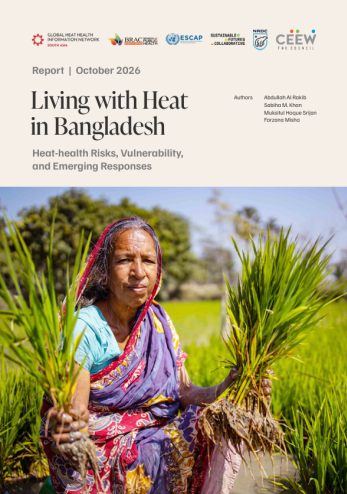
Living with Heat in Bangladesh
Unlocking Finance for Nature-based Solutions (NbS) in Indian Cities