Council on Energy, Environment and Water Integrated | International | Independent


87%: of surveyed households in informal settlements in Indian cities use LPG (CEEW's 2024–25 survey)
78%: of households that don’t use LPG say it is too expensive
~95%: of India's LPG supply depends on imports, either directly or indirectly (FY 2023-24)
The energy transition enters most of our daily lives through our kitchen.
What a family cooks on decides the air it breathes, the hours it spends on sourcing fuel, and what ends up on the plate. A new CEEW study surveyed an indicative sample of more than 1,100 households in informal settlements across ten Indian cities such as Delhi, Mumbai, Bengaluru, and Hyderabad, to see how far the energy transition has reached the urban poor. Three numbers tell their story.
of surveyed households in informal settlements in Indian cities use LPG, as per CEEW's 2024–25 survey
LPG has reached more Indian homes than ever before, with nearly nine in 10 surveyed households in urban informal settlements now having a cylinder. But having a connection is not the same as switching fuels. Seven in ten households use clean fuel exclusively, and the rest still burn firewood, alongside gas or instead of it.
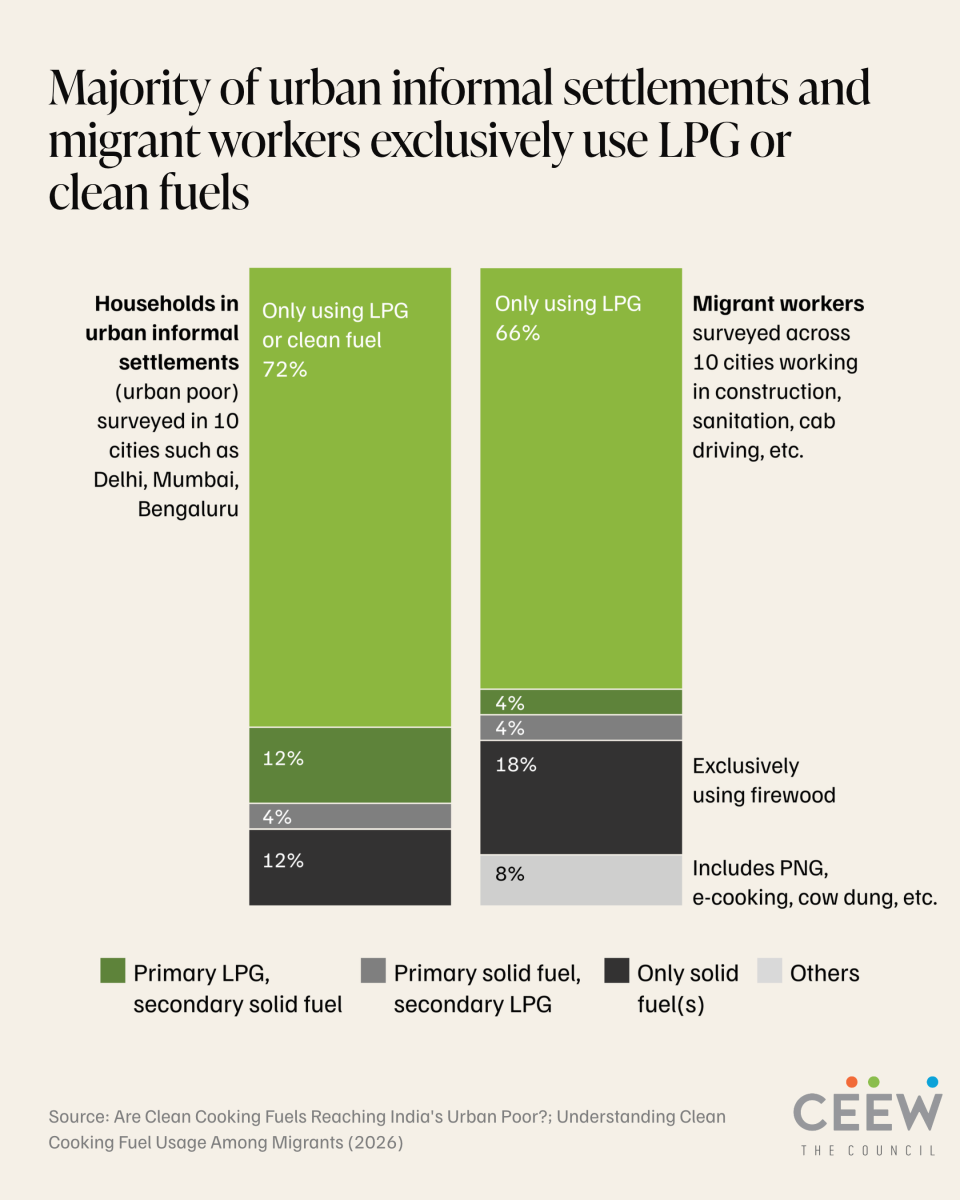
This matters for the air in and around these homes, well beyond the kitchen. Smoke from solid fuels doesn't stay indoors; in dense settlements, it spreads into shared lanes and neighbouring homes. The next step is exclusive LPG use. And for that, we need to understand why solid fuel is still burning in so many of these kitchens.
of households not using LPG call it too expensive
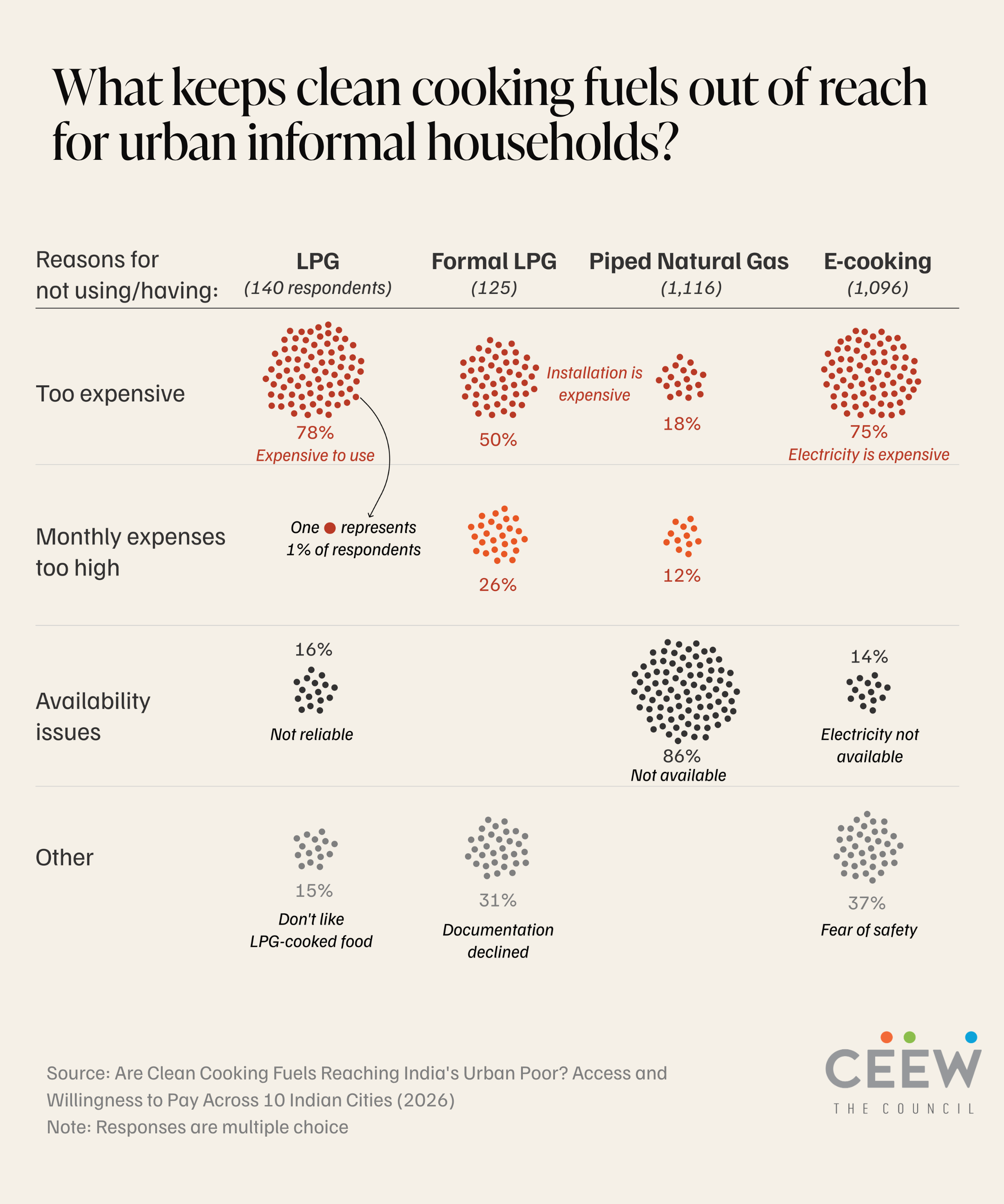
A stove and LPG connection are one-time costs. What brings the chulha or kerosene stove back is the price of an LPG refill, which households must pay in full every few months before the subsidy reaches their bank account (for PMUY consumers). When money runs short, households return to firewood, which they can gather or buy in small amounts.
We asked households across the survey what a cylinder would need to cost for families to cook on LPG alone. At INR 400 (stated preference), 80 per cent said they would switch to exclusive use. Ujjwala (PMUY) households in Delhi pay about INR 642 on their first four refills of the year, and the full INR 942 after that, same as general consumers. Subsidy recipients were far likelier to cook only on clean fuel. The survey ran before three price hikes, when the subsidised price was about INR 503.
The households furthest from that support are the roughly one in ten in the survey that buy LPG without a formal connection. They pay more per cylinder, and most do not get doorstep delivery. The cost of installing a formal connection is the biggest barrier, followed by being turned away for missing documents such as proof of an address in the city. Our study recommends that oil marketing companies and distributors help these households with the documentation and run enrolment drives in informal settlements.
of India's LPG supply depended on imports either directly or indirectly, in FY 2023-24
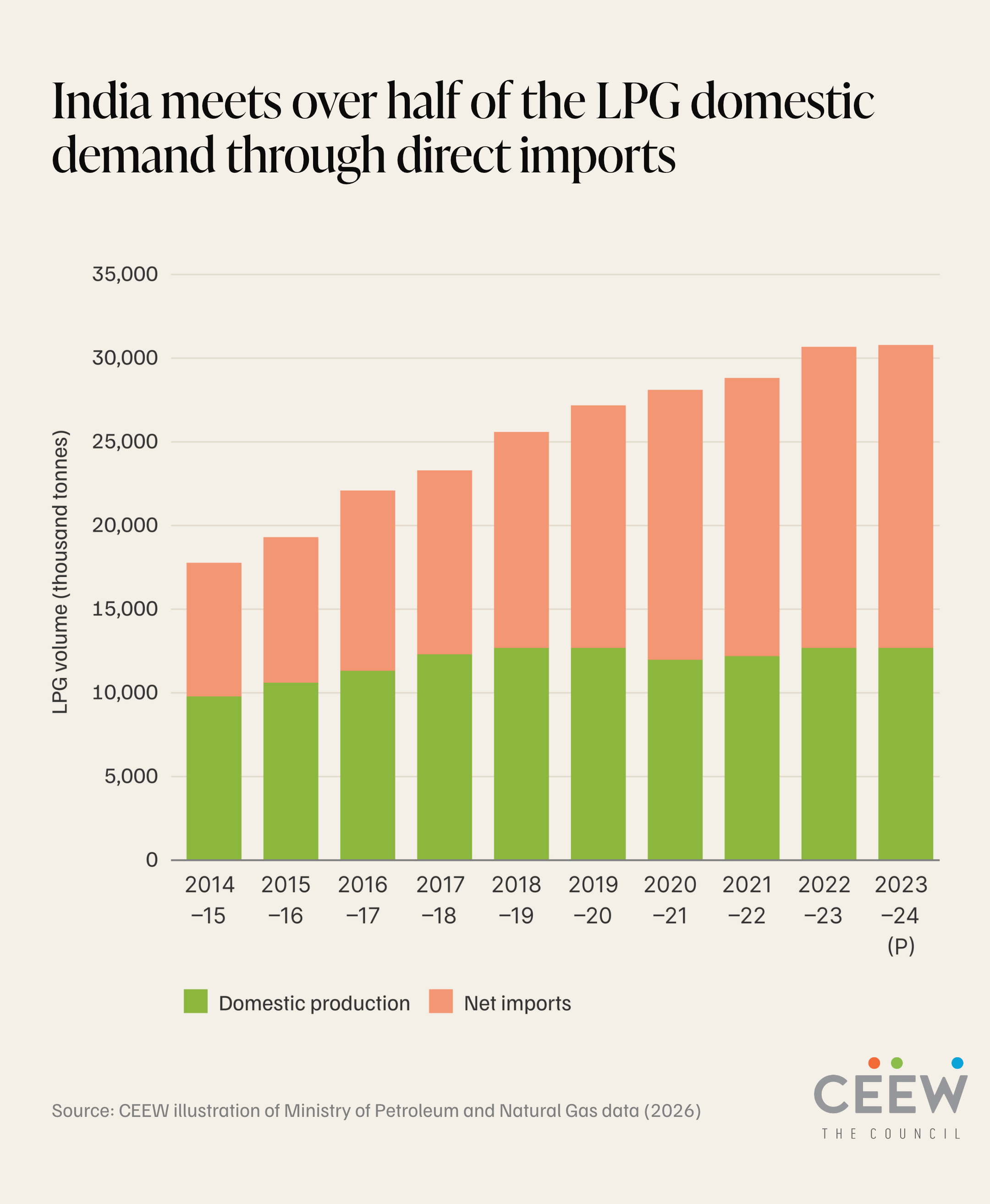
CEEW’s energy security assessment finds that India directly imports more than half of its LPG. The rest is produced domestically, but mostly from imported crude oil. Taken together, imports account for nearly 95 per cent of the LPG reaching Indian kitchens. Further, domestic production of LPG has plateaued since 2018–19, meaning that India’s increased LPG demand has been largely met through imports.
This dependence becomes visible when shipping through the Strait of Hormuz is disrupted or international tariff regimes change. Gas agencies had queues earlier this year, booking gaps between refills became longer, and cylinders started turning up on the black market, reportedly, at two to three times the listed price.
When that happens, households already stretching to afford a refill have the least room to absorb the shock, and they fall back on solid fuel. Keeping the cylinder in use depends on decisions made outside the kitchen, each with a different actor. Bringing a refill within reach of these families depends on how the subsidy is designed, while making a formal connection easier to get is work oil marketing companies and distributors can take on in the settlements themselves. A steadier supply, in turn, depends on India's energy-security planning, including how much LPG it can hold in reserve when shipping routes are disrupted. All three need to move together.
Which would help a household most: a cheaper refill, an easier connection process, or a steadier supply?
Written by: Shreya Kapoor
Charts by: Poojil Tiwari, Dhruv Korula Joseph
Research by: Hladinee Borgohain, Adya Sharma, Rahul Das, Abhishek Kar, Dharshan Siddarth Mohan, Karthik Shetty, Hemant Prakash Singh, Sabarish Elango, and Hemant Mallya












Add new comment