Council on Energy, Environment and Water Integrated | International | Independent


Context: Road dust is a major contributor to Delhi’s year-round air pollution, prompting large-scale investment in mechanical road sweeping machines (MRSMs).
Challenge: Current MRSM deployment is accessible to a limited population and is poorly aligned with dust hotspots, leading to operational waste and high costs that could make fleet expansions less beneficial.
CEEW’s recommendation: Delhi should align MRSM deployment with pollution hotspots, improve road conditions, and ensure scientific disposal of debris to maximise air quality gains.
According to a January 2026 analysis by the Commission for Air Quality Management in the National Capital Region and Adjoining Areas (CAQM) on sources affecting Delhi’s air quality, road dust is a major year-round contributor to poor air quality. During the summer months (March–June), it is the largest source of particulate matter (PM), accounting for 27 per cent of PM2.5 concentrations. This has been addressed in Delhi’s 2025 Air Pollution Mitigation Plan, which, among other dust mitigation technologies such as anti-smog guns and water sprinklers, also includes deploying mechanical road sweeping machines (MRSMs), with a new significant investment from the Delhi government to bring the total fleet up to 230.
Building on existing deployment efforts, in February 2026, the CAQM released technical and operational norms for MRSMs across NCR, providing a standardised framework for acquiring and deploying these machines. International evidence is encouraging: South Korea’s road-cleaning programme, using comparable machines, recorded a 37 per cent reduction in PM10. However, similar findings on the effectiveness of MRSMs are limited in the Indian context, making it difficult to project outcomes without dedicated monitoring of operations. The question for Delhi is whether the conditions exist to replicate South Korea’s performance. This blog suggests that aligning sweeping routes with dust hotspots, pairing deployment with basic road maintenance, and ensuring debris is properly disposed of could pave the way to more holistic dust control measures.
Mechanical road sweeping machines (MRSMs) are heavy trucks equipped with rotating side brooms that channel dust and debris towards a central broom, which collects material onto a conveyor and stores it in an onboard hopper (storage container). They are designed to remove coarse particles (PM10 and larger), dry vegetation, and road aggregates (gravel, sand, and stones. Their contribution to addressing PM2.5 (a prominent health concern in Delhi) is indirect and limited. They are expected to improve air quality by reducing dust resuspension.
Municipal Corporation of Delhi (MCD) currently operates around 52 MRSMs on Public Works Department (PWD) roads that are wider than 60 feet. These machines were first introduced by the MCD in September 2011 to curb dust on roads. Other Indian cities, including Bengaluru, Chandigarh, and Ludhiana, have also deployed or plan to deploy similar machines, though fleet sizes remain small relative to their road networks.
The CAQM norms represent a meaningful step towards standardising MRSM deployment across Delhi NCR. They address several long-standing gaps:
The norms also set right-of-way (RoW) thresholds to determine which machine categories are deployed on which roads. RoW refers to the width of the road available for vehicles to ply on, excluding sidewalks and medians in the middle. Mechanical road sweepers are currently deployed according to the RoW criteria of roads, with large-sized machines being deployed on roads with an RoW greater than 60 feet and medium-sized machines being deployed on roads with an RoW between 30 and 60 feet.
While there is currently no Delhi-specific data on the standard operations of MRSMs and their spending through the National Clean Air Programme (NCAP) or other available urban development funds, non-attainment cities (cities exceeding National Ambient Air Quality Standards consecutively for five years) primarily spend a large share of the available NCAP funds (68 per cent) on road-dust mitigation strategies. In Delhi, as of March 2026, only INR 16.36 crore (~20 per cent) of the NCAP fund has been utilised. Out of this amount, INR 13.41 crore was utilised solely for dust mitigation measures such as water sprinklers. This reflects a broader pattern in which a disproportionate share of clean air budgets is directed towards mitigation measures that do not address the problem at its source.
Continuing this trend, the Delhi government has announced plans to expand its MRSM fleet from 52 to 230 machines, with an investment of INR 888 crore for procurement and operations over the next 10 years. Current machines are operated by the road-owning urban local bodies, including the Municipal Corporation of Delhi and the Public Works Department, under either a capital expenditure (CAPEX) model, where the machine is purchased upfront, or an operational expenditure (OPEX) model, where costs are paid over time for operation or service use. Under the CAPEX model, the Urban Local Bodies (ULBs) themselves own these machines and maintain them, whereas under an OPEX model, the MRSMs are rented for a fixed time period with a pre-determined rental agreement. Given the large financial allocation, it would be worthwhile to analyse the returns on investment by analysing the efficiency of the current MRSMs.
This analysis by the Council on Energy, Environment and Water (CEEW) used route data for geospatial analysis and population datasets to assess the impact of MRSMs. We studied upstream implications, referring to implications before sweeping, such as capital expenditure and resource intensity, and downstream implications, referring to implications post sweeping, such as the amount of waste generated. Here’s what we found:
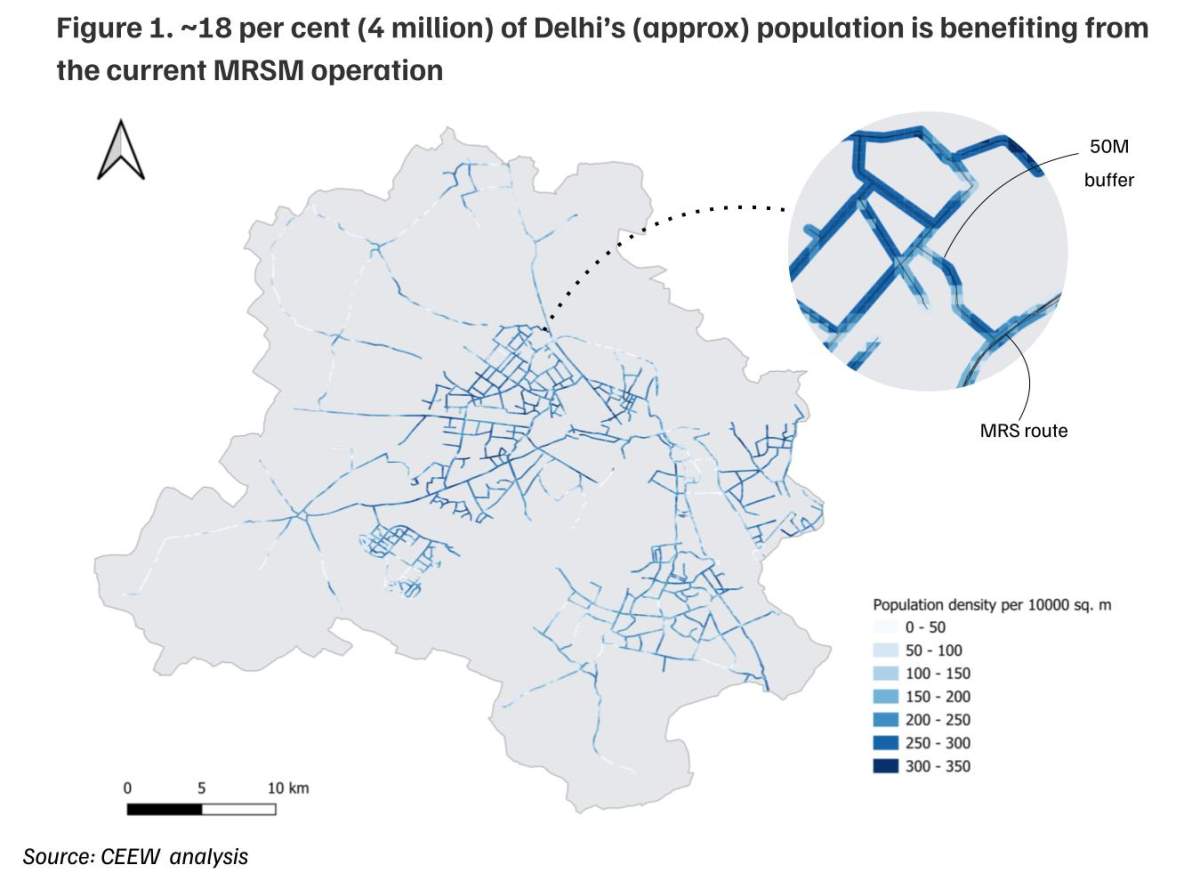
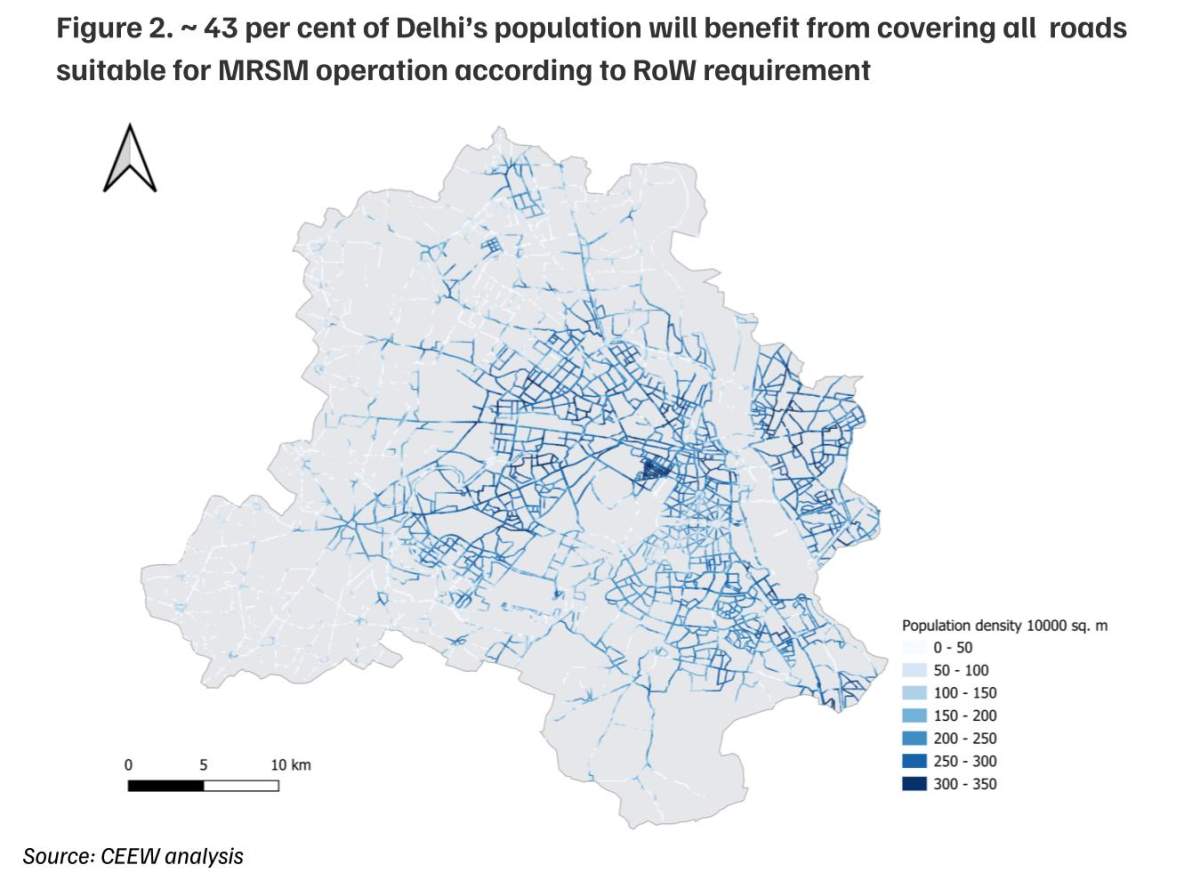
While this expansion can bring the population coverage of the sweeping drive up to ~43 per cent (as shown in Figure 2), this raises important operational considerations, particularly regarding the waste-handling capacity and the availability of adequate processing infrastructure.
Delhi already produces a surplus of 1,000 TPD of construction and demolition (C&D) waste against a total processing capacity of 4,500 TPD across four facilities. Road-sweeping debris, classified as C&D waste, would further strain this infrastructure. Currently, waste from only ten MCD’s mechanical sweepers is directed to a formal C&D processing facility in Shastri Park; the rest is disposed of in landfills or low-lying areas. This defeats the purpose of the collection, as improperly disposed debris re-enters the ambient air as dust. While the CAQM mandate on scientific disposal is commendable, without a clear definition of what that entails could defeat the mandate’s purpose.
According to CEEW’s total cost of operation (TCO) analysis, the current sweeping operation costs approximately INR 4,600 per tonne of debris collected. Rental rates enquiry from four original equipment manufacturers (OEMs) indicate a cost of roughly INR 3 lakh per machine per month, inclusive of operator and service charges and exclusive of GST. Over 10 years under an OPEX model, operating a 230-machine fleet would cost INR 828 crore, excluding water costs. The projected estimate for service outsourcing of 70 MRSM (25 large and 45 small/medium) by the MCD is INR 888 crore spread over 10 years.
An MRSM requires one cubic meter of water per shift, resulting in a water intensity of nearly five million gallons over 365 days under the current deployment of 52 MRSMs, assuming one shift per MRSM per day. The planned expansion to 230 machines would increase it to around 22 million gallons per year. While this number is not particularly significant (less than one per cent of Delhi’s annual water demand), it represents the daily domestic water demand of around 440,000 individuals, according to the revised estimate of 50 gallons per capita per day. During the summer, this could be significant in places with water-scarce conditions.Our analysis, applying CAQM norms to Delhi’s road network, identified and suitable for sweeping, finds that the city would need a total of 161 MRSMs to cover all roads technically suitable for deployment: 73 large-category machines to sweep 1,450 km of roads with an RoW greater than 60 feet daily, and 88 medium-category machines to sweep 3,500 km of roads with an RoW between 30 and 60 feet on alternate days. Delhi’s action plan figure of 230 MRSMs exceeds this estimate, suggesting that without a corresponding expansion of route coverage and hotspot-aligned deployment, some of the planned fleet may be redundant, duplicating coverage on already-swept roads rather than extending reach.
| Priority | What needs to change | Recommendation |
|---|---|---|
| Define and enforce scientific waste disposal | CAQM should release a supplementary SOP defining the scientific disposal of road-sweeping debris. Third-party operators should be monitored on waste volumes collected and disposal compliance. |
|
| Pair sweeping with road improvement | MRSM deployment on roads with unpaved shoulders, potholes, and construction waste should be preceded by basic road maintenance. Evidence from Barcelona and London confirms MRSMs perform best on well-maintained surfaces. In Delhi, dust concentrates along road edges and medians, worsened by poor road conditions. Sweeping alone cannot address dust generated by road surface deterioration. |
|
| Deploy against dust hotspots, not only RoW | Route planning should be overlaid with DPCC dust hotspot data and population exposure maps. Sweeping frequency on hotspot roads should be increased regardless of RoW classification. |
|
Delhi's planned MRSM expansion reflects a genuine commitment to tackling one of the city's most persistent air quality challenges, and the CAQM norms are technically sound. However, an expanded fleet operating under the same logic as the current 52 machines may not deliver optimum improvement. The success of this expansion hinges on how routes are planned, how waste is handled, and how road conditions are maintained.
As Delhi scales and outsources these operations, getting the governance details right becomes as important as the machines themselves. Done well, this programme could set a replicable standard for dust adaptation in dense urban environments across India's non-attainment cities.
V V Nandagopan is a Consultant and Arpan Patra is a Programme Associate at the Council on Energy, Environment and Water (CEEW). Send your comments to [email protected].




Add new comment