In brief
-
Context: LPG disruption due to the West Asia conflict put PM POSHAN’s dependence on LPG as the primary cooking fuel under stress, risking meal continuity.
-
Analysis: PM POSHAN’s operational model is built around centralised cooking and fuel systems, leaving limited room for adaptive responses during periods of supply volatility.
-
CEEW’s recommendation: The scheme can become more resilient through low-fuel nutrition options, diversified cooking technologies, and expanded school nutrition gardens supported by local institutional convergence.
Every school day, the Pradhan Mantri Poshan Shakti Nirman (PM POSHAN) scheme serves hot, cooked meals to over 11 crore children in government and government-aided schools, making it the world’s largest school feeding programme and a cornerstone of India’s efforts to improve child nutrition and educational outcomes. For many children, especially in low-income households, this meal is the most reliable source of daily nutrition they receive. However, the disruption in LPG supply due to the conflict in West Asia briefly put the functioning of this scheme under strain, providing an opportunity to make it more robust.
How can PM POSHAN build resilience into its cooking systems?
PM POSHAN guidelines treat fuel as a generic component of cooking costs and do not prescribe or differentiate between specific fuel types. In practice, however, the scheme predominantly relies on LPG, with 74.8 per cent of PM POSHAN schools using it. This operational dependence on LPG creates a potential vulnerability during supply disruptions. Given the increasing frequency of supply-side shocks, from geopolitical tensions to commodity price volatility, this is an issue that needs to be resolved by design. Three interventions, spanning immediate response to long-term reform, would significantly strengthen the scheme’s resilience.
- Institutionalise low-fuel contingency menus within PM POSHAN menu planning: The most immediate and easily implementable intervention is menu adaptation. The nodal authority for menu design rests with State or UT governments through district and block-level agencies, with District Collectors having the flexibility to adapt menus within prescribed nutrition norms and based on local and seasonal availability. This provides a ready pathway for incorporating fuel-efficient meal options into PM POSHAN menu cycles.
A range of nutritious, low-preparation options already exist in India’s diverse food traditions, with many of them actively used in PM POSHAN schools. No-cook or minimally processed beverages such as ragi java (ragi-jaggery-milk mix) is already served in schools in Telangana. Sattu (roasted gram beverage) and kanji (fermented carrot/beetroot beverage) are widely available across North India. Karnataka’s inclusion of ragi malt in school meals demonstrates how locally available recipes, rich in calcium and iron, can provide energy, protein, and micronutrients while reducing dependence on cooking fuel.
Apart from beverages, sprouted pulse mixes, seasonal fruit and vegetable salads, and chickpea and leafy vegetable-peanut chaats require minimal or no heat processing. Meghalaya is already diversifying school meals with indigenous ingredients such as fish mint and water celery served as fresh salads. Ragi-based laddoos, made with ragi, jaggery, and peanuts by village women’s self-help groups In Chhattisgarh's Korea district, is a nutritionally dense and cost-effective option that requires no on-site cooking and can be prepared in advance.
Milk, already included as a supplementary component in school meals in 11 Indian states, including Karnataka, Haryana, and Uttarakhand, is another avenue. Expanding its regular inclusion across more states can strengthen protein intake without increasing fuel dependence. These low-fuel, local options could become a standard component of PM-POSHAN to ensure children stay nourished long after the fuel crisis.
- Diversify cooking infrastructure away from single-fuel dependence: Over the medium term, it would benefit to explore alternative cooking technologies. The scheme’s cost framework, which covers cooking costs, kitchen infrastructure, and devices, should also include alternative cooking technologies as an eligible expenditure. Several models already demonstrate what is possible at the school level.
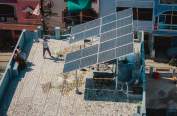
In Kolkata, Krishnapur Adarsha Vidyamandir uses solar-powered induction cookers under the state education department’s Green Cooking Initiative. In Gujarat, the Shrimati Manekba Vinay Vihar Educational Complex operates a government-supported biogas plant that is used to cook and serve nearly 500 meals daily for 250 students. The Akshaya Patra Foundation, in partnership with HDFC Bank, has equipped nine Akshaya Patra school kitchens across five states and one Union Territory with solar power infrastructure under a Corporate Social Responsibility arrangement, demonstrating that non-government financing can accelerate adoption of sustainable cooking models at scale. Explicit mention of these alternative fuel options in cost provisions and PM POSHAN guidelines can enable higher awareness and adoption.
What these models share is a combination of local and institutional partnerships. Replicating them more broadly will require the Ministry of New and Renewable Energy and the Ministry of Education to jointly designate PM POSHAN school kitchen as priority sites for solar and biogas deployments. Additionally, PM POSHAN guidelines have to be updated to recognise these technologies explicitly alongside LPG.
- Strengthen local food sourcing through nutrition gardens and better storage in the long term: PM POSHAN’s flexi fund for innovative interventions allocates INR 5,000 per school for seeds, equipment, and compost to support nutrition gardens. Several state initiatives have demonstrated that well-managed school gardens can meaningfully supplement meals with seasonal fruits and vegetables, improving children’s food intake and their overall dietary diversity.
Project Suposhan in Jharkhand, spanning over 1,886 school gardens, and the North East Society for Agroecology (NESFAS) supported gardens in Meghalaya illustrate how nutrition gardens can be effectively scaled through a combination of institutional backing and community ownership. In Meghalaya, families maintain nutritional gardens on a rotational basis and often contribute additional produce from their own farms, significantly lowering the operational burden on schools.
Sustaining garden output requires basic storage infrastructure. This limitation can be overcome without significant additional cost by adopting economic technologies such as the Pusa Zero Energy Cool Chamber (ZECC). It is built from locally available materials using evaporative cooling and can maintain lower temperatures and high humidity to reduce post-harvest losses without electricity. Complementary Pusa bins (~INR 700 each) provide affordable decentralised storage and help ensure that garden produce can be regularly utilised in school meals. Both the cooling chamber and the bin can be accommodated within the existing ~INR 5,000 per school for kitchen device provision.
Convergence with government systems could further lower costs: technical support from the Department of Horticulture, and labour provision through schemes such as Viksit Bharat—Guarantee for Rozgar and Ajeevika Mission (Gramin) (VB-G RAM G) could make nutrition gardens a cost-effective and sustainable intervention.
PM POSHAN is central to India's human capital strategy, linking nutrition, attendance, and learning from early childhood through adolescence. In times of disruption, a fallback low-LPG menu that is smaller, simpler, more local, and nutrition-focused will strengthen PM POSHAN’s ability to deliver nutrition consistently. Building adaptability into the system through flexible menus, cleaner, alternative cooking infrastructure that is less vulnerable to supply disruptions, and stronger local sourcing will help secure India’s nutrition in the long run.
Tanmoy Bose is a Consultant and Suhani Gupta is a Program Associate at the Council on Energy, Environment and Water (CEEW). Send your comments to [email protected]






Add new comment