Council on Energy, Environment and Water Integrated | International | Independent

Suggested citation: Tiwari, Aishwarya, Priyanka Singh, Srish Prakash, Chirag Bhimani, and Supriya Nayak. 2025. How are India’s State Pollution Boards Adapting to Evolving Workloads and Roles?. New Delhi: Council on Energy, Environment and Water.
India’s State Pollution Control Boards (SPCBs) are at the frontline of environmental regulation. Over the past two decades, their mandate has expanded significantly with the introduction of 11 new environmental legislations since 2000. Beyond their original responsibilities under the Water Act, Air Act, and Environment Protection Act, SPCBs today also monitor noise, manage hazardous and plastic waste, maintain inventories, set standards, and ensure compliance across an expanding industrial base. This surge in responsibilities has coincided with long-standing challenges of limited staff, financial constraints, and operational gaps.
Despite these pressures, SPCBs are increasingly adopting innovative approaches to manage their rising workloads. This study documents multiple such practices drawn from 27 annual reports of nine SPCBs across India, supplemented by insights from retired officials. These innovations are grouped into six categories: information technology (IT) tools, process optimisation, administrative reform, financial mechanisms, public engagement, and research and development. For example, Maharashtra introduced industry-specific consent templates to streamline approvals, Tripura used financial incentives to shift kilns to cleaner technologies, Madhya Pradesh developed a public-facing air quality app, and Goa partnered with IIT Goa to apply machine learning in air quality forecasting.
The study also proposes short, medium, and long term recommendations for scaling these practices nationwide. These include establishing a CPCB-led knowledge-sharing platform, automating compliance processes, rationalising consent procedures, strengthening delegation through partnerships, and creating an innovation risk framework.
By capturing and promoting these positive strides, the study highlights SPCBs’ capacity to adapt, innovate, and improve governance. Strengthening these efforts will be critical for India’s transition towards cleaner air and more sustainable environmental management.
The state pollution control boards (SPCBs) of India are key regulatory bodies responsible for controlling environmental pollution. Over the years, their role has been expanded significantly with the evolution of environmental legislation and compliance requirements.
This issue brief examines how SPCBs are responding to their increasing workload, resource constraints, and operational challenges by adopting innovative practices. The findings highlight the positive impact of these innovations on workload management, financial efficiency, and overall performance, laying the foundation for improved governance in environmental management.
The study adopts a qualitative approach, combining both primary and secondary research. A total of 21 retired officials from SPCBs and the Central Pollution Control Board (CPCB) were invited to participate in semi-structured interviews, of whom 9 agreed. They provided valuable insights into the functioning of SPCBs, focusing on challenges and areas for improvement. In parallel, as part of the study, an extensive review of legislative frameworks, including the Water (Prevention and Control of Pollution) Act, 1974 and the Air (Prevention and Control of Pollution) Act, 1981, was conducted to understand the legally mandated responsibilities of SPCBs.
Moreover, 27 annual reports published by 9 selected SPCBs (Goa, Gujarat, Himachal Pradesh, Karnataka, Madhya Pradesh, Maharashtra, Tamil Nadu, Tripura, and West Bengal) were comprehensively analysed to identify innovative practices in workload management. These SPCBs were selected through purposive sampling, with the criterion being that they should have published annual reports for at least three consecutive years, starting 2018 or later.
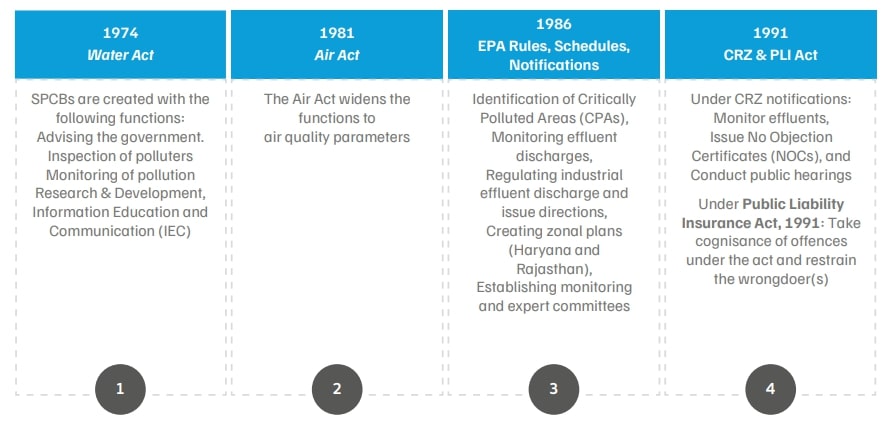
Before 2000, their workload primarily included duties and responsibilities defined by three major laws, namely the Air Act, Water Act, and the Environment (Protection) Act, 1986. Since 2000, starting with the Noise Pollution (Regulation and Control) Rules, 2000, 11 new legislations (including acts and rules) have been formulated. Each of these legislations has expanded SPCBs’ range of functions to include monitoring, implementation, maintenance of inventories, and standards setting. To address the substantial increase in their workload–and other challenges such as limited human resources, financial constraints, and limited enforcement powers–SPCBs have adopted myriad innovative practices. These practices are discussed in this study and are grouped under the following categories:
While this study primarily focuses on documenting and promoting the positive strides made by SPCBs in terms of governance innovations with a view to promote their uptake, it also provides recommendations to further support their efforts:
This study also has certain limitations, which are listed below:
SPCBs are central to India’s pollution control efforts. The innovative practices documented in this study highlight the capacity of SPCBs to adapt and optimise their operations in the face of significant challenges, including rising workloads and resource constraints. By embracing technological advancements, streamlining processes, and enhancing public engagement, SPCBs are setting a strong precedent for improved environmental governance in India. Through continued cross-learning, resource augmentation, and a commitment to innovation, SPCBs are well-positioned to drive India towards a cleaner, more sustainable future.
The genesis of pollution control boards in India can be traced back to the United Nations (UN) Conference on the Human Environment convened in Stockholm in 1972. The conference led to the enactment of the Water Act, 1974; (MoLJ 1974), under which pollution control boards were established in India. In the following decades, pollution control boards have been assigned additional responsibilities through the Air Act, 1981; and the Environment (Protection) Act, 1986 (hereinafter the EPA) (MoLJ 1981; 1986). These laws position state pollution control boards (SPCBs) as the guardians of a healthy environment in India.
SPCBs operate as state-level entities, nested within the administrative and regulatory control of the Central Pollution Control Board (CPCB) and the Ministry of Environment, Forests and Climate Change (MoEFCC) and execute their statutory responsibilities at a provincial level. The CPCB was established in 1974 with the enactment of the Water Act, 1974, with a mandate to coordinate pollution control interventions across India by establishing pollution standards, conducting research, and providing programmatic and technical guidance to the SPCBs. The MoEFCC was established in 1985 to oversee the formulation and implementation of programmes and policies that advance broader environmental conservation and pollution control imperatives.
Thus, the current regulatory architecture for pollution control in India is marked by interdependence and collaboration among these institutions. While SPCBs function as stand-alone bodies for monitoring and regulating pollution within their respective jurisdictions, their effectiveness is intrinsically tied to the coordination and guidance provided by the CPCB as well as the larger policy frameworks that the MoEFCC and/or the government sets out from time to time like the National Clean Air Programme (NCAP), Ease of Doing Business regulations, Environmental Impact Assessment (EIA) notifications, etc.
Given the importance of SPCBs in India’s pollution control ecosystem, there is extensive literature on their functioning. The earliest such research was the Bhattacharya Committee Report (1984), followed by the Administrative Staff College of India (1994), the report submitted by the Sub-Group (1994), and the report submitted by the Planning Commission on the functioning of SPCBs (2001) (these reports can be found in CPR (2022)). Recent literature includes an analysis of India’s environmental policy and legal framework by the Organisation for Economic Cooperation and Development (OECD 2006), the United States Environmental Protection Agency’s (USEPA’s) Environmental Compliance and Enforcement Training Institutions in India (USEPA 2005), the Indian Institute of Management, Lucknow’s (IIM (L) 2010) evaluation of the CPCB, the CPCB’s audit reports of SPCBs, the Centre for Science and Environment’s (CSE’s) Transparency Index: Rating of Pollution Control Boards on Public Disclosure (Verma 2021), the Centre for Chronic Disease Control’s (2020) analysis of pollution control boards, and the Centre for Policy Research’s (CPR’s) The State of India’s Pollution Control Boards – A Series of Papers (CPR 2022).
Multiple assessments of the pollution control board ecosystem have been carried out. Although the time periods over which these assessments were conducted differ, significant commonalities emerge in the findings. The most common challenges associated with pollution control boards are listed below:
While limitations have been identified, the existing literature does not examine in detail the burden that the rapidly changing Indian environmental governance scenario has placed on SPCBs. As such, there has been little research on the innovative measures and practices that SPCBs have developed to cope with their increasing responsibilities while operating with a persistent paucity of resources.
This issue brief provides an overview of the innovative practices adopted by SPCBs in India to cope with growing environmental challenges and regulatory demands. For this, we analysed existing legislation to identify the functions performed by SPCBs and provided an overview of the innovative measures they routinely employ to manage their workload. Further, we identified areas of improvement and opportunities to enhance the capacity and performance of SPCBs in fulfilling their mandate and included recommendations to address them.
We employed a qualitative approach for this study and invited 21 retired SPCB/CPCB officials to participate in semi-structured interviews. The interviews were held virtually as well as in person. The interviews aimed to obtain perspectives and expert opinions on the functioning of SPCBs, the challenges encountered, and potential areas of improvement. Of the 21 officials invited, 9 agreed to be interviewed. Among these nine interviewees, three had worked at the CPCB previously, while six had worked at SPCBs in Maharashtra, Odisha, and West Bengal. The officials were selected through snowball sampling.
This was followed by secondary research. First, we conducted a longitudinal analysis of environmental laws, rules, and notifications to identify the legally mandated workload of SPCBs.1 This was done by reviewing the seventh edition of the CPCB’s compendium on Pollution Control Acts, Rules, and Notifications (CPCB 2021b).
Following this, we captured the innovative measures adopted by the nine SPCBs based on their annual reports. These reports capture innovations in workload management as they offer a consolidated account of the activities undertaken by an SPCB in a financial year.
Official websites, which are the other predominant source of information, are relevant but are updated only sporadically, and hence, do not offer current information on the activities of SPCBs. Hence, websites were not used to collect data; they were used only to identify publicly available annual reports.
We used purposive sampling to select the SPCBs based on the following criteria:
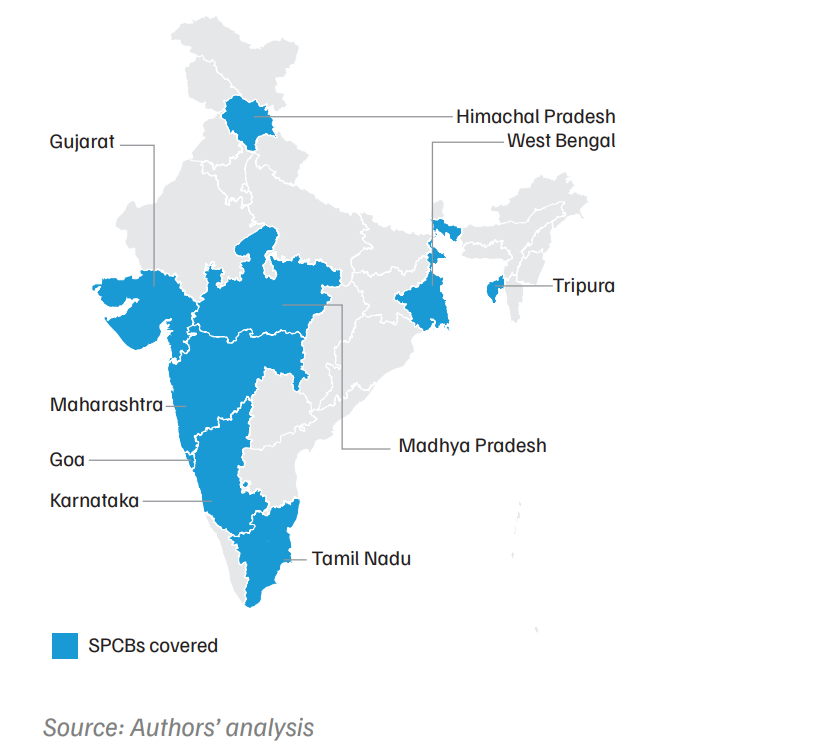
Thus, nine SPCBs were selected, which have jurisdictions in the states shown in Figure 1. A total of 27 annual reports published by these SPCBs were covered under this study.
Figure 1. Nine State Pollution Control Boards (SPCBs) have been covered in this study
Finally, we conducted a case study to understand the need for innovation in SPCBs. The Maharashtra Pollution Control Board (MPCB) was selected for this due to the availability of legislation- and applicationwise data on the board’s services. We reviewed the MPCB’s consent and authorisation disposal compliance dashboard to understand the board’s workload and drew linkages between the increasing workload and the human resources available.
The Water Act enacted in 1974 (MoLJ 1974) provided the legal foundation for creating SPCBs. The act enjoined SPCBs to carry out a range of functions pertaining to water pollution, including the following:
The Environment (Protection) Act, 1986 (hereinafter EPA), was enacted following the Bhopal Gas Tragedy (Abraham and Abraham 1991). As an umbrella act, the EPA is supplemented by several subordinate legislations that govern a range of functions from environmental protection and prevention of hazards and pollution to the handling and management of different types of waste (MoLJ 1986). The Environment Protection Rules (hereinafter EPR), enacted in furtherance of the EPA, assign the following functions to SPCBs:
A study of the schedules under the EPR (provided in Table 1) reveals further significant additions to the SPCBs’ workload.
Since 2000, starting with the Noise Pollution Rules, 11 new legislations have expanded SPCBs’ role in monitoring, implementation, inventory upkeep, and standards setting.
Table 1. Schedules under the Extended Producer Responsibility (EPR) that add to SPCB workloads
| Schedule | Function |
|---|---|
| Schedule I | Specifies standards to be met by industries that discharge effluents and mandates SPCBs to monitor the discharge of effluents from note to self industries |
| Schedule III | Specifies ambient air quality standards with respect to noise and mandates SPCBs to monitor noise levels |
| Schedule IV | Specifies standards for the emission of smoke, vapour, etc. from motor vehicles |
| Schedule VI | Specifies general standards for the discharge of environmental pollutants and mandates SPCBs to enforce and monitor the discharge of specified effluents |
| Schedule VII | Specifies ambient air quality standards and mandates SPCBs to monitor air quality |
Source: CPCB. 2021b. Pollution Control Acts, Rules and Notifications Issued Thereunder. New Delhi: Central Pollution Control Board.
Notifications under the EPA have also led to a significant increase in the workload of SPCBs. The EIA Notification of 2006 requires SPCBs to conduct field visits for projects which have requested environmental clearance as well as public hearings to evaluate the impact on local communities (MoEFCC 2006). Similarly, the Coastal Regulation Zone
(CRZ) Notifications2 lay down stringent effluent discharge standards and consent-seeking provisions for projects in CRZ-notified areas, increasing the inspection and monitoring workload of SPCBs in coastal states (CPCB 2021b). These have been highlighted in Table 2.
Table 2. Notifications under the EPR that increased SPCB workloads
| Notification | Function |
|---|---|
| EIA 2006 | Conduct public hearings Inspect project sites |
| CRZ notifications | Conduct public hearings for projects requesting environmental clearance in coastal zones Set or modify effluent discharge standards for coastal zones |
| Environment (Protection) Amendment Rules, 2017 | Monitor sewage treatment plants (STPs) based on prescribed effluent discharge standards |
Source: CPCB. 2021b. Pollution Control Acts, Rules and Notifications Issued Thereunder. New Delhi: Central Pollution Control Board.
Furthermore, different notifications released periodically to address specific environmental concerns across states contribute to sporadic additions to the workload of the concerned SPCBs. Some examples include the following:
As highlighted previously, the EPA is the parent act of various subordinate legislations. These include several rules related to the management and handling of different types of waste, which aim to regulate the generation, collection, storage, transportation, and disposal of waste in an environmentally sustainable manner. The first of these rules was introduced in the form of the Hazardous Waste (Management and Handling) Rules, 1989. This grew to six sets of rules, each governing specific types of waste.
Table 3. Introduction of waste management rules
| Year | Waste management rules |
|---|---|
| 1989 | Manufacture, Storage and Import of Hazardous Chemicals Rules |
| 1989 | Hazardous Waste (Management and Handling) Rules |
| 1998 | Biomedical Waste (Management & Handling) Rules (hereinafter BWM Rules) |
| 2000 | Municipal Solid Wastes (Management & Handling) Rules |
| 2001 | Batteries (Management and Handling) Rules (hereinafter Batteries Rules) |
| 2008 | Hazardous Waste (Management, Handling and Transboundary Movement) Rules |
| 2009 | Plastics (Manufacture, Usage and Waste Management) Rules (hereinafter Plastic Rules) |
| 2011 | E-waste (Management and Handling) Rules (hereinafter E-waste Rules) |
Source: CPCB. 2021b. Pollution Control Acts, Rules and Notifications Issued Thereunder. New Delhi: Central Pollution Control Board.
The year 2016 saw the introduction of new waste management rules by the Indian government, which were enacted in supersession to the earlier regulations mentioned in Table 3. These new rules included the following:
While each set of waste management rules pertains to a specific kind of waste, the associated workloads are similar and can be grouped as follows:
However, other than the major functions assigned to SPCBs under these rules and the aforementioned legislations and subordinate legislations, various other laws related to the increasing diversity of waste types have amplified their workload. The Manufacture, Use/Import/Export and Storage of Hazardous Microorganisms/Genetically Engineered Organisms or Cells (Rules, 1989) enjoins upon the member secretaries of SPCBs to be ex officio members of the state committees on biotechnology (CPCB 2021b). Similarly, the Chemical Accidents Rules, 1996, makes chairpersons of SPCBs a part of state crisis groups and requires every local crisis group to have an SPCB representative (CPCB 2021b). Furthermore, the Wetlands (Conservation and Management) Rules, 2017, require member secretaries of SPCBs to serve as ex officio members of the state committee on biodiversity. Finally, the Public Liability Insurance Act, 1991, requires SPCBs to take cognisance of chemical-heavy industries in the state that fail to avail insurance under the act (MoEFCC 2015).
Although such requirements do not contribute to the core functions of SPCBs – which our interviewees identified as being related to consenting, inspection, and monitoring – they do add to the tasks expected to be performed by officials.
“Outsiders cannot know what the SPCBs do. It is very different from the inside. The functions performed by SPCBs derive from the various Rules, Regulations, etc. that have been drafted under the Air Act, Water Act, and the Environmental Protection Act. But the functions are not limited to those things alone, and PCB officials are often involved in responding to queries by the courts, NGT, and responding to questions raised in the Assemblies and the Parliament, RTI queries, etc.”
— ex-official, CPCB
Figure 2. Ever since their inception, the responsibilities of SPCBs have increased substantially

Source: CPCB. 2021b. Pollution Control Acts, Rules and Notifications Issued Thereunder. New Delhi: Central Pollution Control Board.
“RTIs and parliamentary/assembly questions and engagement also take time as the questions are data intensive. We are often asked to share data in formats we don’t internally maintain. We spend time formatting data for these things. This is more so for lower and mid-level officials. Such requests are considered high priority.”
— ex-official, Odisha SPCB
Apart from environmental laws, the Right to Information Act, 2005 (hereinafter RTI Act), has also added to the workload of SPCBs (MoLJ 2005). One of the interviewees pointed out, “the range of questions we receive as RTIs is wide. Some can be answered instantly like providing documents. Elaborate RTIs seeking data can take a lot of time because old data has not been digitised. We are trying to put all our documents online to reduce the burden of RTI.”
Similarly, the National Green Tribunal (NGT) Act, 2010 (hereinafter NGT Act), also adds to the workload of SPCBs (MoLJ 2010). While the act does not prescribe functions for SPCBs, the creation of a dedicated environmental tribunal has led to an increase in cases filed before the NGT where SPCBs are key litigants. Our interviewees pointed out that attending NGT hearings and complying with the tribunal’s orders also add to their workload.
Innovation is usually associated with the private sector due to its entrepreneurial work culture, while public-sector organisations tend to prefer conventional practices when fulfilling their mandates (Teofilovic 2002). As a consequence, most literature on organisational innovations is contextualised in the private-sector setting (Demircioglu and Audretsch 2017). Although public-sector innovations can generate a higher impact when compared to innovations in the private sector, there is limited literature on this (Edler and Yeow 2016).
Our analysis of the existing literature on public-sector innovations identifies several drivers of innovation in public-sector organisations, including economic changes, the emergence of new technologies, and learnings from processes or Doing, Using, and Interacting (DUI) techniques (Hartley, Sørensen, and Torfing 2013; Nählinder and Eriksson 2019). It is not just the emerging new technologies and processes that compel the public sector to innovate. A paucity of resources has also been identified as a key antecedent in the innovation process (Demircioglu and Audretsch 2017; Bekkers, Tummers, and Hanna De Vries 2015). Apart from this, result-focused management in public organisations is also leading to innovative use of resources and facilitating better management of workloads (Teofilovic 2002).
Several of the conditions mentioned above are applicable to SPCBs. Increasing workload – as demonstrated through the analysis of legislation – and the paucity of human resources identified in the existing literature, among other factors, creates the necessary conditions for innovative measures to proliferate (Bhargav Krishna et al 2022). The emergence of information and communication technology tools has further enabled SPCBs to adopt innovations for managing their workload. We have identified several innovations in the annual reports of SPCBs.
However, before delving into the findings, we focus on what constitutes an innovation. Several descriptions of organisational innovations exist in the literature on innovations in the public sector. The most commonly accepted accepted definition of innovation includes the adoption of an idea perceived as new, the first-time adoption of an existing idea, and discontinuity of past processes (Borins 2001; Rogers 2003; Brown 2010). For the purpose of this exercise, we defined innovation as the adoption of new technologies or practices that lead to improved delivery of legally ascribed functions of SPCBs.
With this definition in mind, we scrutinised SPCBs’ annual reports to identify innovations in workload management. However, cataloguing the innovations required categorising innovations based on their types. This had already been done by Bekkers, Tummers, and De Vries (2015), who reviewed 181 academic publications on innovation in the public sector to provide a pliable template for such categorisation. These were published in leading journals on public administration around the world between 1990 and 2014. Based on their assessment of the literature, innovation in public-sector settings can be categorised into the types seen in Table 4.
Table 4. Categories of innovations
| Type of innovation | Possible characteristics/Outcomes |
|---|---|
| 1. Process innovations | Enhancement in the standards and efficacy of organisational functioning |
| 1A. Administrative process innovations | New management techniques for better resources management |
| 1B. Technological process innovations | Harnessing technological progress to improve service delivery capacity for citizens and other stakeholders |
| 2. Product/Service innovations | Developing new public services or products for better governance and outreach |
| 3. Governance innovations | Addressing civic issues through self-regulation or by enacting regulations |
| 4. Conceptual innovations | New terms of reference for assessing the feasibility of proposed interventions |
Source: Bekkers, V., de Vries, H., & Tummers, L. (2015). Innovation in the public sector: A systematic review and future research agenda. Public Administration, 94(1), 146–166
While the categorisation by Bekkers, Tummers, and De Vries (2015) was useful, we found it necessary to adapt and refine their categories to better suit the context and objectives of this study. Modifications were necessary because of the need to create a framework that not only captured the essence of innovation categories, but also provided scope for inclusion of the challenges and opportunities specific to the SPCBs. We used findings from informational interviews, environmental legislations, and annual reports to remodel the innovation categorisation framework. Categories such as information technology innovation, financial innovation, and information, education, and communication (IEC) innovation, all aim to bridge gaps and enable a more precise analysis of the innovations happening within SPCBs. This remodelling allowed us to align the framework more closely with the unique characteristics and priorities of SPCBs, thereby enhancing the relevance of our study and its applicability to the specific challenges faced by these organisations.
This led us to identify remodelled categories of innovations shown in Figure 3.
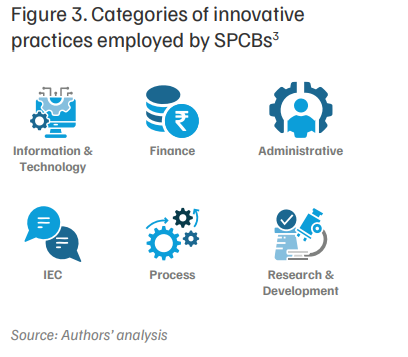
While we have used the Bekkers, Tummers, and De Vries (2015) framework to guide our classification of innovations in public-sector organisations, these categories are wunique to the Indian pollution regulation ecosystem and are not universally applicable to all public-sector organisations. We created this classification to help in shortlisting innovative practices from annual reports of SPCBs.
In the following chapter, we present categorywise catalogues of innovations adopted by SPCBs along with their ostensible outcomes on the legally ascribed workload of SPCBs. That is, we provide the anticipated outcomes, namely, the outcomes that may be anticipated from the adoption of each innovative measure. This is because our findings merely suggest the potential impact of these innovations, rather than providing verified and quantifiable outcomes that may have occurred from their adoption.
4.1 SPCBs are altering their procedures to improve performance
Bekkers, Tummers, and De Vries (2015) understand process innovations as enhancements in organisational functioning through the adoption of new management techniques and technologies. Bingham and McNaught (1976) define process innovation as an “alteration in the modus operandi of a public organisation.” Management techniques often pertain to changes in the way tasks are organised, coordinated, or supervised, whereas technologies refer to new tools, systems, or equipment. Here, we have chosen to differentiate between management techniques (processes) and technologies because while both management techniques and technologies can lead to process improvements, distinguishing between them allows for a more nuanced identification of the innovations observed in SPCBs’ annual reports. This differentiation enables us to explore not only the adoption of new technologies, but also the innovative ways in which SPCBs optimise their internal processes and management practices. Building on these ideas, we have identified process innovations as those decisions that alter existing processes in the organisation in a bid to improve efficiency. The process innovations identified across selected SPCBs are listed in Table 5.
Table 5. Process innovations at SPCBs
| State | Process innovation | Anticipated outcome |
|---|---|---|
| Maharashtra | Industry- & application-specific templates designed to facilitate online consent issuance | Improved consent management under Air & Water Act |
| A Uniform Integrated Enforcement Policy established for consent management (first time by any SPCB) | Improved consent management under Air & Water Act | |
| Auto-renewal of consent based on self-certification for red-, orange-, & green-category industries, thereby incentivising compliance | Improved consent management under Air & Water Act | |
| Unmanned aerial vehicles (UAVs) used to monitor ambient air quality at line sources | Improved monitoring under Air Act | |
| Standard bidding document developed to help local bodies in awarding STP contracts | Reduced documentation & enhanced clarity for stakeholders under Waste Management Rules | |
| Visit scheduler developed to allocate visits to department officers | Improved inspections under Air & Water Act | |
| Gujarat | Seven-year consent & fast-tracked fee payment granted to applicants accredited with Responsible Care Management System | Improved consent management under Air & Water Act |
| Industrial associations encouraged to provide waste exchange banks/collection centres and pre-processing facilities for effective waste supply chain management & to promote co-processing | Improved compliance under Waste Management Rules | |
| Third-party certification for orange-category industries & self-certification for green-category industries to enhance facilitation | Improved compliance under Air & Water Act | |
| West Bengal | Minimum documents mandated for project proponents to obtain consent & other authorisations | Improved consent management under Air & Water Act |
| Central inspection system (CIS) integrated online with labour commissioner, factory directorate, boiler inspector, & legal metrology for red-category establishments – inspections scheduled randomly | Improved inspections under Air & Water Act | |
| The option of self-certification may be introduced in cases of CTO renewal for green-category establishments | Improved consent management under Air & Water Act | |
| Tripura | Established a panel of third-party evaluators/inspectors in online consent management & monitoring system (OCMMS) portal | Improved consent management under Air & Water Act |
| Validity period of CTE certificate (up to 3 years) for different industry categories to be based on capital investment | Improved consent management under Air & Water Act |
| State | Process innovation | Anticipated outcome |
|---|---|---|
| Tamil Nadu | Consent for red (small), orange-, and green-category industries can be auto-renewed on OCMMS portal within 7 days of self-certification without prior inspection | Improved consent management under Air & Water Act |
| Green-category industries in industrial use zone/industrial estate need not get CTE – they can apply directly for CTO upon establishment | Improved consent management under Air & Water Act | |
| CTE issued with 7-year validity for projects that require EIA & 5 years for those that do not | Improved consent management under Air & Water Act | |
| For eligible cases, CTO issued with validity of 5, 10, & 14 years for red-, orange-, & green-category industries | Improved consent management under Air & Water Act | |
| Madhya Pradesh | Provision of deemed consents | Improved consent management under Air & Water Act |
| STP module prepared to assess the capacity of functional STPs in the state | Improved compliance under EP Rules & EIA Notification | |
| Integration of the Central Inspection System (CIS) with extended green node (XGN) portal | Improved inspections under Air & Water Act | |
| Automated warning messages sent to non-compliant industries by the Environment Surveillance Centre | Improved compliance under Air & Water Act | |
| Karnataka | Remote calibration check technique introduced to ensure air quality data accuracy & instrument reliability without access to physical equipment | Improved monitoring under Air Act |
| Online consent fee collection through XGN portal made mandatory | Improved consent management under Air & Water Act | |
| Drones procured for conducting aerial surveys of polluted areas | Improved monitoring under various Acts | |
| Installing sensors to STPs made mandatory for BWSSB & other ULBs | Improved compliance under EP Rules & EIA Notification | |
| Big industries urged to install continuous ambient air quality monitoring stations (CAAQMS) & disclose air quality data on their websites | Improved monitoring under Air Act |
Source: Authors’ compilation using data from annual reports of selected SPCBs5
4.2 SPCBs are recalibrating financial levers to improve environmental outcomes
The existing literature on SPCBs shows that financial constraints can hinder their functionality. The Organisation for Economic Co-operation and Development (OECD 2006) found vast financial disparities across SPCBs – even boards with surplus finances faced constraints in expenditure. Another recent study on the finances of SPCBs by the CPR indicated that most boards were unable to utilise the funds they generated due to limited fiscal expertise, conservative expenditure patterns, low absorptive capacity, and a revenue-focused structure prioritising consent management over other considerations. (CPCB 2020). This prompted us to include financial innovations as a distinct category. These include practices and strategies that alleviate budgetary constraints faced by SPCBs, invite private-sector investment, and enhance financial management and reporting. It is crucial to note that the financial innovations identified by us are mainly of two kinds:
‘‘Earlier SPCBs charged water cess and used this money. The GST regime has subsumed the water cess, which has stopped an important stream of revenue. At present, the consent fee is the only source of income for SPCBs, and it has increased manifold to make up for the lost funding of the water cess.’’
— ex-official, Uttar Pradesh SPCB
Table 6. Financial innovations by SPCBs
| State | Financial innovation | Anticipated outcome |
|---|---|---|
| Goa | Enforcement & training cell established to generate additional revenue | Improved compliance under various acts and rules |
| CPCB’s methodology for assessing environmental compensation and action plan adopted to utilise PPP funds | Improved compliance under various acts and rules | |
| Consent fee relaxed on an annual basis due to COVID-19 | Improved consent management under Air & Water Act | |
| Madhya Pradesh | Registration charge reduced under HWM, PW, & BMW Rules | Improved compliance under HWM, PW, & BMW Rules |
| Fee towards 5-yearly CTOs & CTEs reduced to promote long-term consents | Improved consent management under Air & Water Act | |
| Reduction in consent fee under Water & Air Act | Improved consent management under Air & Water Act | |
| Extension of Vivaad Se Vishwaas Yojna for issuing consents to industries which did not have/renew their CTE/CTO | Improved consent management under Air & Water Act | |
| Collecting bank guarantees from proponents towards pollution control arrangements discontinued | Improved consent management under Air & Water Act | |
| Gujarat | CAAQMS monitoring via public–private partnerships (PPPs) with help from CPCB | Improved monitoring under Air Act |
| To cover administrative costs & generate revenue, the board charges INR 100/2 per cent of consent fee as processing fee for any alterations made to CTE/CTO that require re-issuance with acceptable changes | Improved consent management under Air Act | |
| Tripura | INR 1 lakh incentive for brick kiln owners who convert from conventional to zig-zag kiln technology | Improved compliance under Air Act |
| Additional consent fee waiving for brick kilns proposed | Improved consent management under Air Act | |
| Consent fee halved for red-, orange-, and green-category industries to encourage waste recycling & reduce establishment costs for recyclers | Improved consent management under Air Act | |
| Registration fee reduced & renewal fee waived for recyclers/recycling units/re-processors to promote plastic waste recycling | Improved compliance under PWM Rules |
Source: Authors’ compilation using data from annual reports of selected SPCBs
4.3 Information technology tools are revolutionising SPCBs
The operational efficiency of several public-sector organisations have become more efficient by widely adopting through the wider adoption of information and technology (IT) tools, which IT tools are razing down obstacles to information exchange and promote faster, more inclusive, and sustainable growth. They also improve governance and accountability, leading to better management of resources and more sustainable development (Bajpai et al. 2021). However, this can be a complex and time-consuming process, often requiring significant changes to organisational infrastructure (Ebrahim and Irani 2005).
Our analysis of annual reports reveals that SPCBs have enormously supplemented their capacity using IT tools, enhancing the functionality of SPCBs in the following ways:
Wider IT adoption boosts publicsector efficiency, governance, and accountability, enabling faster, inclusive, sustainable growth.
‘‘How many people are attached to a particular function at SPCBs varies from state to state and even district to district. Most of an SPCB’s day-to-day goes into processing consent applications. There is no rocket science in it, and it can be automated. If an SPCB accepts the form, consent to operate is automatically generated as soon as the fee is submitted. The problem is that all officials are disposing more clerical duties than technical, and automation can help the situation. Lack of funds is not the issue; the lack of understanding and initiative creates problems.’’
— ex-official, West Bengal SPCB
‘‘We are trying to put all our documents online to reduce the burden of RTI. Elaborate RTIs seeking data can take a lot of time because old data has not been digitised. It is the same for parliamentary and assembly questions.’’
— ex-official, Odisha SPCB
Table 7. IT innovations at SPCBs
| State | IT innovation | Anticipated outcome |
|---|---|---|
| Gujarat | Re-engineered & strengthened online manifest system for waste transportation as per Hazardous Waste Rules, 2016, ensuring a closed-loop system that follows the cradle-to-grave principle | Improved monitoring under HWM Rules |
| Launched an integrated grievance management system to monitor grievances | Improved compliance under various acts and rules | |
| West Bengal | West Bengal’s OCMMS integrated with Silpa Sathi for all services | Ease of doing business |
| Developed a geographic information system (GIS) for air quality management, identification of water body encroachments, legacy dumpsites, & polluted river stretches in the state | Improved monitoring under Air and Water Act | |
| Launched a court case monitoring system | Improved internal management of the board | |
| Created an online portal for biomedical waste authorisation applications | Improved consent management under BMW Rules | |
| Tripura | All state environment impact assessment authority & state-level expert appraisal committee meeting proceedings & clearances uploaded on PARIVESH portal | Improved IEC under various acts and rules |
| PARIVESH portal to enable online interaction between public & board, including filing complaints & viewing upcoming events | Improved IEC under various acts and rules | |
| Registration, authorisation certificates, & grants of units dealing in hazardous wastes shifted online | Improved consent management under HWM Rules | |
| OCMMS portal linked to state government’s SWAGAT portal | Ease of doing business | |
| Tamil Nadu | Plans to introduce online inspections for small-scale industries with capital investments of INR 10 lakh or less | Improved inspections under Air and Water Act, ease of doing business |
| OCMMS issues authorisations & registrations for all 7 Waste Management (WM) Rules | Improved consenting under all WM Rules | |
| Developed a hazardous waste manifest app for transporting hazardous waste | Improved compliance under HWM Rules | |
| Goa | Online grievance redressal system for public complaints | Improved compliance under various acts and rules |
| Maharashtra | Office automation system implemented by SAP enterprise resource planning for paperless office | Improved internal management of the board |
| Implemented document storage in blockchain and e-signature in PFX format | Improved consent management under Air and Water Act | |
| Laboratory inventory management module developed & integrated with existing IMIS for seamless sample registration & processing | Improved monitoring under Air & Water Act | |
| Joint visit sample payments module developed to collect sampling & analysis charges & generate bills – it is integrated with IMIS & LIMS | Improved monitoring under Air & Water Act | |
| E-catalyst app developed for spreading environmental awareness | Improved IEC under various acts and rules | |
| Himachal Pradesh | Biomedical waste transporters linked with GPS for improved coordination & tracking | Improved monitoring under BMW Rules |
| Online real-time surveillance & monitoring of cement plants | Improved monitoring under Air and Water Act |
| State | IT innovation | Anticipated outcome |
|---|---|---|
| Madhya Pradesh | Dealer registration under Battery Rules shifted online | Improved consenting under Battery Rules |
| Online continuous emission monitoring systems (OCEMS) data integrated with MIS | Improved monitoring under Air and Water Act | |
| Grievance redressal system embedded into the EnvAlert app | Improved compliance under various acts and rules | |
| Centralised faceless scrutiny system embedded into the XGN portal for swift consent processing – this reduces travel & workload of field officers | Improved consent management under Air and Water Act | |
| E-office software for internal managerial updates & board officials’ leaves | Improved internal management of the board | |
| E-signature system for online consent/registration processes to facilitate ease of doing business | Ease of doing business | |
| Complaints addressed to departments other than the MPPCB automatically redirected to the concerned department | Improved internal management of the board | |
| GPS used to track movement of hazardous waste | Improved monitoring under HWM Rules | |
| EnvAlert App to improve citizens’ access to CAAQMS data | Improved IEC under various acts and rules | |
| Karnataka | Online portal for registration under PWM Rules | Improved consenting under PWM Rules |
| In-house software to monitor status of court cases pertaining to the board | Improved internal management of the board | |
| E-office software used at Head Office to encourage paperless transactions | Improved internal management of the board | |
| In-house software to monitor COVID-19 waste disposal | Improved monitoring under BMW Rules | |
| App to connect governance with stakeholders & public to boost ease of doing business | Ease of doing business | |
| Applications for various authorisations including green, orange, and red categories of establishment, operation, expansion, HWM, e-waste, and plastic waste shifted online | Improved consenting under various acts | |
| In-house software for monitoring public complaints received by the board on pollution & waste management | Improved compliance under various acts |
Source: Authors’ compilation using data from annual reports of selected SPCBs
4.4 SPCBs are undertaking administrative innovations
The existing literature on innovations in public-sector organisations defines administrative innovations as a subset of management innovations. Birkinshaw, Hamel, and Mol (2008) define management innovations as management practices and tools that advance organisational objectives.
We found conceptual overlaps between the definitions of management innovation and process innovation. Hence, to more precisely identify innovative practices by SPCBs, administrative innovations were considered as a separate category. This category includes practices that attempt to alter the organisational structures and internal management in organisations to make the work of managing more effective (Chen, Walker, and Sawhney 2019). All such practices adopted by SPCBs are listed in Table 8.
Table 8. Administrative innovations at SPCBs
| State | Administrative innovation | Anticipated outcome |
|---|---|---|
| Maharashtra | Extended producer responsibility scrutiny committee constituted to list criteria/parameters & scrutinise submitted plans | Improved compliance under E-Waste Rules |
| District-level committees headed by the District Magistrates established to instruct stakeholders against releasing untreated effluent into neighbouring areas | Improved compliance under Water Act | |
| Procurement of SODAR systems | Improved monitoring under Air Act | |
| Gujarat | Two vigilance teams at Gandhinagar functioning directly under MS & chairperson to monitor independent inspections | Improved inspections under the Air and Water Act |
| Regulatory forum constituted under GPCB MS & other boards, including MoEFCC, CPCB, Indian Institute of Packaging representatives, to boost waste co-processing in cement plants | Improved compliance under WM Rules | |
| Scientific committee constituted in 2020 for streamlining purchase of scientific instruments/equipment/glassware/chemicals for the board and its ROs | Improved internal management of the board | |
| West Bengal | Gujarat Environment Management Institute appointed to maintain inventory of state’s e-waste generation | Improved compliance under E-Waste Rules |
| Pollution Awareness & Assistant Centre raises awareness & handles complaints received at Head Office | Improved IEC under various acts and rules | |
| Public grievance cell registers complaints through 24/7 telephone helpline, social media, physical letters, WBPCE app, email without disclosing complainant’s identity | Improved compliance & monitoring under various acts and rules | |
| Tamil Nadu | Committee constituted to help State Public Information Officer implement RTI Act, 2005 | Improved compliance under RTI Act |
| Separate section in the head office to take immediate action on petitions received via CM Cell & Amma Call Centre | Improved compliance under various acts | |
| Goa | Separate grievance redressal centre constituted to guide entrepreneurs & project proponents in obtaining consents, pollution prevention & control, cleaner technologies | Improved consent management under Air & Water Act |
| Madhya Pradesh | Committee constituted to empanel vendors to install, operate, & maintain STPs & ETPs | Improved compliance under the Water Act |
| Environment surveillance centre set up to analyse data on different environmental parameters received from CAAQMS, continuous emissions monitoring system (CEMS), CEQMS, & IP cameras | Improved monitoring under various acts | |
| Care centres established in all district offices to encourage industries to use OCMMS | Improved consent & authorisations management under Air & Water Act | |
| Establishing Environmental Response Centre | Improved compliance under various acts | |
| Karnataka | GPS-enabled command control centre established to address & track public complaints | Improved compliance under various acts |
| Consent mela organised for hassle-free MSME registration operating without consent | Improved consenting under Air & Water Act | |
| Limited phosphate content in soaps & detergents by collaborating with Bureau of Indian Standards to reduce lake eutrophication (first time in India) | Improved compliance under Water Act |
Source: Authors’ compilation using data from annual reports of selected SPCBs
4.5 SPCBs are adopting innovative ways to perform IEC functions
SPCBs have a legal obligation to conduct IEC activities (MoLJ 1974, 1981). The annual reports indicate that each SPCB has been undertaking significant IEC work through awareness campaigns, webinars, and competitions. Innovations which have enhanced their capacity to perform IEC functions are listed in Table 9.
4.6 Research and development innovations at SPCBs
One of the functions of SPCBs under Section 17 (1) (d) of the Water Act is “to encourage, conduct and participate in investigations and research relating to problems of water pollution and prevention, control or abatement of water pollution” (MoLJ 1974). While this is explicitly mentioned in the act, annual reports indicate that research conducted by the boards extends beyond the legal mandate and such endeavours of SPCBs have been provided in Table 10.
Table 9. IEC Innovations at SPCBs
| State | IEC innovation | Anticipated outcome |
|---|---|---|
| Maharashtra | Launched E-Bulletin – a knowledge-sharing platform which publishes the latest developments related to the board | Improved compliance under various acts |
| Organised environmental clinics & open houses for efficient & better environmental management | Improved compliance under various acts | |
| Gujarat | Contacted FICCI & other industry associations to raise awareness on E-Waste Rules through articles, seminars, & training programmes – board is working with GVL as well | Improved compliance under various acts |
| Advised manufacturers to publish biannual local newspaper ads to raise public awareness on lead-acid batteries & statutory requirements under Battery Rules, 2001 | Improved compliance under various acts | |
| Madhya Pradesh | Prepared citizen reporter module to ensure that their complaints/suggestions reach the administration quickly | Improved compliance under various acts |
| Introduced ENVAlert App to improve citizens’ access to CAAQMS data | Improved compliance under various acts |
Source: Authors’ compilation using data from annual reports of selected SPCBs
Table 10. Research and development innovations at SPCBs
| State | R&D innovation | Anticipated outcome |
|---|---|---|
| West Bengal | Engaged IIT Kharagpur to study mitigation of solid waste open burning in active dump sites | Improved compliance under Air Act |
| Engaged Jadavpur University to survey plastic product manufacturing inventorisation | Improved compliance under PWM Rules | |
| Audited e-waste material flow & value chain with assistance from National Institute of Electronics & Information Technology | Improved compliance under E-Waste Rules | |
| Engaged Indian Institute of Social Welfare and Business Management for a study on the development of environmental benchmarks, formulating action for HWM and evolution of software programs for inventorisation of wastes | Improved compliance under HWM Rules | |
| Tamil Nadu | Engaged CSIR – Central Leather Research Institute – to fix inlet quality standards for 13 CETPs in the tannery sector | Improved compliance under EPA and Water Act |
| Engaged South India Textile Research Association to fix inlet quality standards for all 20 CETPs in the textile sector | Improved compliance under Water Act | |
| Awarded e-waste inventorisation project to National Productivity Council | Improved compliance under E-Waste Rules | |
| Goa | Approved IIT Goa’s proposal on developing a machine learning & sensor-based network for continuous air quality monitoring & prediction | Improved monitoring under Air Act |
| Maharashtra | Granted post facto approval to long-term field validation of low-cost air quality sensor-based monitoring network in Mumbai | Improved monitoring under Air Act |
| MPCB & NEERI conducting a noise mapping research study as directed by Bombay High Court – proposals in Mumbai & Nagpur include a GIS-based noise information system, Noise ATM, and assessing heterogeneous traffic noise | Improved monitoring under Noise Rules | |
| Gujarat | Entrusted R&D professionals & PhD candidates with developing solutions for environmental issues & pollution control | Augmenting human resources |
| Institutionalised internship scheme for engineering & science students | Augmenting human resources | |
| Launched India’s first Emission Trading Scheme pilot in Surat with Yale University & J-PAL to improve air quality – GPCB monitors PM emissions from industrial units in the scheme with CEMS | Improved compliance under Air Act | |
| Employed Paradigm Environmental Strategies Pvt. Ltd. to study hazardous waste inventorisation | Improved consenting under HWM Rules | |
| Accepted industrial use of multiple effect evaporators for treating concentrated effluent streams – this has reduced the load on common effluent treatment plants | Improved compliance under EPA and Water Act |
Source: Authors’ compilation using data from annual reports of selected SPCBs
Our analysis reveals that SPCBs adopt myriad innovative practices which could result in improved workload management. These innovations were tied with the different workload components of SPCBs to understand the types of innovations being undertaken to execute their expanding mandate.
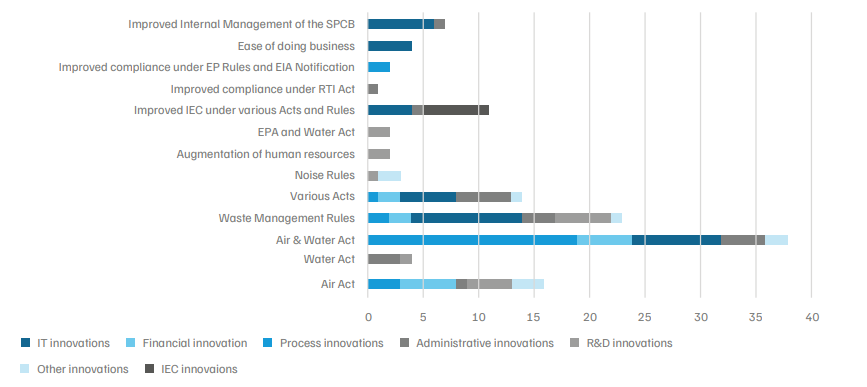
We found that of the 127 innovations identified through this exercise (including those under the “Other Innovations” category provided in Annexure 5),
In terms of innovation categories, SPCBs have adopted IT and process innovations with the highest frequency – 37 and 27 innovations, respectively. IT and process innovations were identified to be 64 cumulatively, which makes up more than half of all innovative practices that we identified under this study. Of the 37 IT innovations, those associated with managing the workload arising from the Waste Management Rules constitute the highest number (10). In the case of process innovations, the highest number (15) is associated with managing the workload arising from the Water Act and/or the Air Act.
While these innovations are compiled from the annual reports of SPCBs, they may not all have been perfectly executed. However, they provide a glimpse of the intended targets as well as the types of innovations being undertaken by SPCBs to execute their mandates (Figure 4).
Figure 4. Categories of innovations and their anticipated outcomes
Source: Authors’ compilation using data from annual reports of SPCBs
An analysis of the existing legislation and subordinate legislations reveals that over 45 years, the workload of SPCBs has grown drastically from just regulating water quality to environmental protection and waste management. To manage their increased workload and improve operational efficiency, SPCBs have adopted several innovative measures. Examples of such innovations include outsourcing specialised work to external agencies and creating enforcement cells to increase financial resource availability.
However, to truly understand the workload–innovation relationship, an analysis of the actual workload, that is, activities undertaken by SPCBs, and the resources available to perform these activities is needed. Here, we cover a case study of the MPCB to understand how the increased workload for SPCBs has expanded the scope of services provided by them and whether this expansion has been met with graded increments in resource availability.
We analysed MPCB’s Online Consent Management & Monitoring System (OCMMS) portal. We selected MPCB due to the availability of legislation and application-wise data on the services provided by the board. While all SPCBs maintain this data on their own portals or on the MoEFCC’s OCMMS portal, the granularity provided by the MPCB allowed greater scrutiny (MPCB 2023; MoEFCC 2023a).
The MPCB’s OCMMS portal currently provides 20 services across nine different legislations and subordinate legislations. These are listed in Table 11. However, it is important to note that this is just a subset of the entire spectrum of the SPCB workload.
Table 11. Services provided by the Maharashtra State Pollution Control Board (MPCB)
| S. No. | Legislation | Associated service/workload |
|---|---|---|
| 1. | Water Act | CTE, CTO, CTO renewals, CTO auto-renewals |
| 2. | Air Act | CTE, CTO, CTO renewals, CTO auto-renewals |
| 3. | Battery Rules | Dealer registrations |
| 4. | Hazardous WM Rules | Authorisations, Trader registrations |
| 5. | Biomedical WM Rules | Authorisations |
| 6. | Plastic Waste Rules | Producer registrations, Brand owner registrations, Recycler registration, Registration for raw material manufacturer |
| 7. | SWM Rules | Authorisations for municipal solid waste |
| 8. | E-Waste Rules | Authorisations |
| 9. | C&D Rules | Authorisations, Authorisations for dismantlers and recyclers |
Source: MPCB. 2023. “Maharashtra Pollution Control Board Dashboard.”
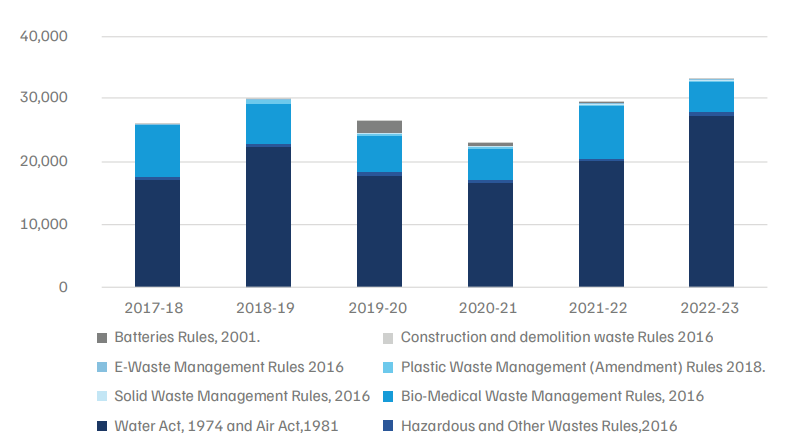
Between 2017 and 2022, the MPCB saw a nearly 28 per cent increase in total consents, authorisations, and applications, from 26,151 to 33,426 (MPCB 2023). During the same period, applications under the Water Act and the Air Act increased from 17,272 to 27,394 and those under the Hazardous Waste Rules increased from 416 to 566. Applications under the Biomedical Waste Rules decreased from 8,205 to 4,983 after peaking at 8,320 during 2021–22, and those under the Plastic Waste Rules also declined from 89 to 55. In contrast, applications under the Solid Waste Rules, E-Waste Rules, Batteries Rules, and C&D Rules increased from 62 to 112, 89 to 155, 12 to 133, and 6 to 28, respectively (MPCB 2023). Although there is a general increasing trend, it can be seen from Figure 5 that there is a decrease between 2019 and 2021, which may be attributable to the COVID-19 pandemic.
“Additional responsibilities, such as responding to queries from the CPCB and preparing official correspondence, add to daily workloads. Routine activities also include drafting project reports and attending to administrative tasks involving interactions with other departments and ministries.”
– ex-official, West Bengal Pollution Control Board
Figure 5. Maharashtra State Pollution Control Board registered a 28% increase in applications made between 2017 and 202212
Source: MPCB. 2023. “Maharashtra Pollution Control Board Dashboard.”
Processing applications for consenting, authorising, and registering is a crucial aspect of SPCBs’ workload, but only a part of it. Interviews with experts revealed that inspection is an equally vital task. As one interviewee mentioned, “Processing consent applications and doing inspections are the top priorities of SPCB leadership.”
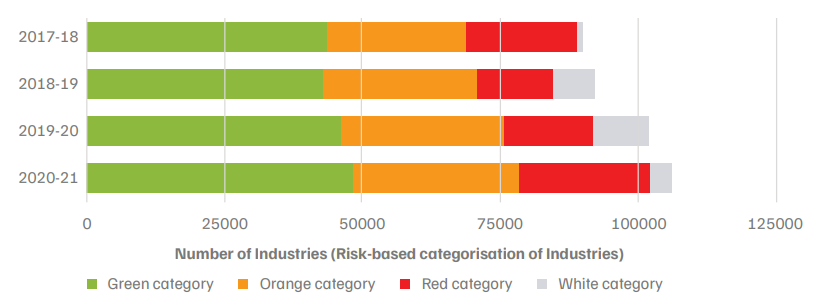
SPCBs carry out inspections under the Water Act and the Air Act. As per the MPCB’s inspection policy, industries are inspected monthly, once in six months, quarterly, or annually, depending on their riskbased categorisation (GoM 2017). 13 The MPCB’s annual reports indicate that a steady increase in the number of industries also implies an increase in the number of inspections the board is required to carry out. (Figure 6)
Figure 6. Number of industries under Maharashtra State Pollution Control Board’s purview increased by 18% between 2017-18 to 2020-2114
Source: Authors’ compilation using data from the MPCB’s annual reports
Note: Industries are classified into Red, Orange, Green, and White categories by the Pollution Control Boards based on their pollution potential, with Red being the most polluting and White the least.
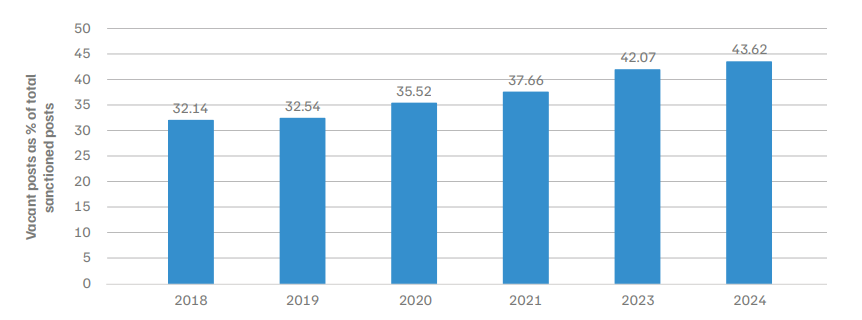
Although innovations in workload management are necessary to handle the increasing workload of SPCBs, it is the persistent understaffing that makes such innovations critical. Recent data presented by CPCB indicates that of the 839 posts sanctioned at the MPCB, 366–that is, 43.62 per cent of them–were vacant, highlighting a long-standing problem across SPCBs (CPCB 2024). The vacancy rates have also witnessed an increasing trend over the years (Figure 7).
Figure 7. Vacancy percentage in MPCB has increased by over 11% between 2018 and 2024
Source: MPCB. 2021. “Annual Report of Maharashtra Pollution Control Board 2020-21.” Mumbai: Maharashtra Pollution Control Board. and CPCB. 2024. Report of Central Pollution Control Board (CPCB) in OA No. 693 of 2023. National Green Tribunal.
Note: Data for the year 2022 could not be retrieved.
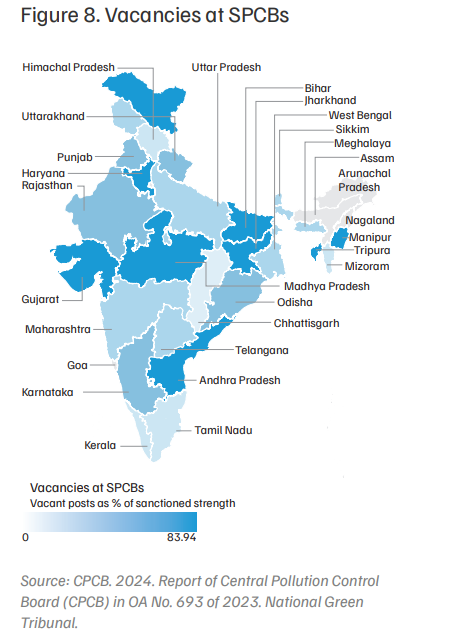
It is worth noting that high levels of vacancies are not exclusive to the MPCB. The CPCB’s report tabled before the National Green Tribunal indicates that 26 of 28 SPCBs have vacancies. Bihar SPCB has the highest rate of vacancy at 83.94 per cent of its total sanctioned strength, whereas Arunachal Pradesh and Nagaland have no vacancies (CPCB 2024). The response also shows that the CPCB’s vacancies stand at 33.44 per cent. This reinforces the literature findings, which highlight understaffing as a persistent issue in pollution control boards. Figure 8 illustrates the vacancy rates across India’s SPCBs as well as Pollution Control Committees (PCCs).
Between 2018 and 2021, the MPCB’s consent and industrial data showed an increase in workload. Simultaneously, there was also an increase in the percentage of vacant positions in the board. During one of the interviews, an ex-official from Odisha SPCB explained, “The number of people we require depends on the number of industries under consent administration. Initially, hotels did not need consenting provisions. The NGT added them to the consenting framework. We had to monitor a few hundred industries and suddenly had thousands of hotels. By the time we recruit one batch, the need for the next lot is already there as the workload increases. There is a constant catch-up game in terms of workload and human resources.”
“While the manpower of the SPCBs is as per the functions under the Air and Water Act, the scope of their functions has expanded significantly over time. However, staffing levels have not kept pace with these growing mandates. This is a glaring gap in India’s pollution governance and warrants urgent attention.”
— ex-official, CPCB
Limitations
This study identifies the legally ascribed workload of SPCBs, the conditions that necessitate innovations, and the innovations that enable SPCBs to improve their workload management. However, it has a few limitations due to its methodological approach and data availability. We have identified the following limitations to our approach -
These limitations are stated here to underscore that we have created innovation categories specific to SPCBs, based on their functions and the obstacles faced by them. These categories are not universally applicable to public-sector organisations and are unique to the Indian pollution regulation ecosystem.
Recommendations
Our review of the annual reports of the selected SPCBs led to the discovery of several innovative practices that can be adopted by SPCBs across the country. These innovations can be categorised as short-term innovations, which can be adopted immediately due to the availability of required technologies, mediumterm innovations, which require input from external organisations or further desk research, and long-term innovations, which will require the creation of new platforms and processes. In this chapter, we highlight key recommendations that SPCBs can incorporate within the course of their functioning to ensure efficacious workload management.
7.1 Short-term recommendations
Creating a knowledge-sharing platform: Crosslearning and knowledge sharing among SPCBs can catalyse the adoption of innovations. A platform to facilitate the exchange of innovations and best practices across states could be anchored by the CPCB and/or a group of officers from a few SPCBs. Such exchanges should be organised periodically to ensure that information is constantly shared and up to date.
- Automation: We understand automation as innovations that reduce human intervention in a particular task. This is particularly relevant due to the scarcity of human resources in SPCBs. Many examples of automation-based innovations were found among the six types of innovations discussed in the annual reports. Those that can be adopted in the short term include the following:
- Harnessing modern monitoring technologies: SPCBs are entrusted with the responsibility of monitoring polluters, pollution levels, and areas with pollution. These are human resource–intensive activities. However, several technologies to facilitate monitoring have emerged, and some, such as OCEMS and video surveillance cameras, have already been adopted by most states. Our review of annual reports found several instances of modern technologies being used to reduce the physical workload associated with monitoring. Monitoring technologies that can be implemented in the short term are as follows:
7.2 Medium-term recommendations
Rationalising processes: SPCBs can use these processes to identify areas of inefficiency, reduce duplication of efforts, and optimise resource allocation, thus resulting in better workload management. Seven out of the nine selected SPCBs have made significant alterations to their processes using technology, communication, and new protocols. Examples of such rationalisation measures include
Delegating functions: Annual reports show that SPCBs often leverage the expertise of third parties, which include not just the private sector, but also other government departments and research institutions. Such engagements have been proven to cut costs and enhance output. Furthermore, the human resource deficits that several SPCBs experience can be met via such engagements. Delegation efforts that are replicable across SPCBs in the medium term include
One of the interviewees highlighted that the delegation of functions had been a major success during his tenure. He observed, “During my time we hired 150 new people. But it will never increase proportionately to workload. We outsourced lots of our work to consulting labs. So, the burden of monitoring was reduced. Because consenting is the only thing we could not outsource, so we tried outsourcing everything else. This ensured that no technical staff is engaged in non-technical work. We essentially re-arranged the human resources available to us. We increased the revenue and used it to outsource. We put a lot of effort to make sure those we outsourced our work to were responsible.”
7.3 Long-term recommendations
SPCBs have been the subject of frequent and systematic research, given their important role in the pollution regulation ecosystem. The existing research on the performance of SPCBs focuses on the scarcity of human resources as well as their limited financial resources.
Our review of the literature suggests that while these limitations are prevalent across states, they must be contextualised with respect to the expanding workload that SPCBs are entrusted with. We identify a significant increase in workload due to the increasing number of legislations and subordinate legislations aimed at regulating pollutants, preserving the environment, and handling waste. In addition, it has been found that SPCBs are constantly juggling their increasing workload with persistent and often increasing resource constraints.
Given these constraints, we focused on what boards can do to better manage their workload. We analysed 27 annual reports of nine SPCBs and identified several innovative practices to improve workload management. Of the 127 innovations identified, 27 were related to the alteration of processes, 14 instances were of financial levers being utilised to enhance capacity, 37 were associated with the use of IT tools, 19 were related to administrative changes, 6 were related to innovations in IEC, 15 were associated with research and development, while there being 9 that could not be fitted in any of the chosen categories.
Our analysis and consultations indicate that several of these innovations have the potential to be replicated across states. In the short term, SPCBs can create a platform to facilitate cross-learning of innovative practices, use automation to reduce human intervention in processes, and use new and emerging technologies to reduce monitoring. This issue brief is an initial step towards identifying and cataloguing the innovative practices of SPCBs. However, we recommend that, in the medium term, SPCBs and the CPCB collaborate on creating a repository of innovations and institutionalise annual reporting in a consistent format. Delegating responsibilities and rationalising internal processes will also improve workload management in the medium term. In the long term, SPCBs should focus on developing a system that promotes continuous innovations in workload management. This will require the development of an innovation framework that balances the risks and potential benefits of innovations and promotes a culture of risk awareness and learning.
Well-functioning SPCBs are indispensable for pollution control in India. Adopting innovative approaches and engaging in cross-learning can enhance the operational efficiency and promote a culture of collaboration amongst SPCBs. It will also help them address the increasingly complex nature of emergent environmental challenges. A continued commitment towards transparency, cross-learning, and innovation will enable SPCBs to engineer the transition towards a cleaner, healthier, and more sustainable India.
State Pollution Control Boards (SPCBs) were established following the 1972 UN Conference on the Human Environment, with the Water (Prevention and Control of Pollution) Act, 1974 providing the legal foundation. Their mandate expanded under the Air (Prevention and Control of Pollution) Act, 1981 and the Environment (Protection) Act, 1986. Today, SPCBs serve as the key state-level regulators for pollution control, responsible for monitoring and regulating air, water, and noise pollution, granting consents and authorisations, enforcing environmental laws, and ensuring compliance with multiple waste management and environmental standards.
SPCB annual reports typically summarise the entire range of annual activities of the Board. This includes their statutory role and governance, monitoring results (ambient air, water, and noise pollution levels in the state), consent/inspection/enforcement actions, hazardous/municipal/biomedical/e-waste management, major projects (e.g., activities undertaken under the National Clean Air Programme (NCAP)), capacity-building activities, IEC activities, finances/staffing and future plans.
Over time, SPCBs’ mandates have expanded from water and air regulation to a wide range of environmental and waste management laws, while staffing and resources have not kept pace. To address this, many boards are streamlining consent and monitoring processes, adopting advanced tools such as online continuous emission monitoring systems (OCEMS) and GPS-based tracking, reorganising internal functions, improving public communication, and collaborating with research institutions. These innovations can potentially help the boards manage rising workloads and strengthen regulatory effectiveness despite capacity constraints.
In Union Territories, the Central Pollution Control Board (CPCB) is empowered to exercise the functions of a State Pollution Control Board. The Central Government may delegate these functions to Pollution Control Committees (PCCs), which discharge equivalent consent and enforcement responsibilities. All Union Territories in India have constituted PCCs.
Unlocking Finance for India’s Textile Waste Management
Organic Waste Circular Economy for Viksit Bharat
Roadmap of the methodology to assess the climate co-benefits of the SUP ban in Maharashtra
Building a Green Economy for Viksit Bharat