Council on Energy, Environment and Water Integrated | International | Independent


Suggested Citation: Dalberg Global Development Advisors and Council on Energy, Environment and Water (CEEW). 2026. Recommendations Report of the Expert Engagement Group on AI and Climate. New Delhi.
Knowledge Partners
Council on Energy, Environment and Water (CEEW) and Dalberg Global Development Advisors
Authors
Dr Arunabha Ghosh, Mr Vaibhav Chugh, Mr Ganesh Dileep, Mr Kunal Walia, Mr Niranand Kumar, Ms Yashi Gupta, Ms Esha Rao, Ms Swati Singh, Ms Bhavya Nayak, Ms Cheryl Saju
Expert Engagement Group (EEG) Members
Dr Arunabha Ghosh (Chair of the EEG), Dr Amy Luers, Dr Catherine Nakalembe, Mr Gabriel Lazar, Mr Gadhu Sundaram, Mr Jerry Huang, Ms Lauren Smart, Dr Loïc Lannelongue, Prof. Manabendra Saharia, Mr Matt Gray, Dr Neha Kumar, Ms Pía Marchegiani, Dr Priya Donti, Mr Rajesh Jain, Mr Roy Ben Hayun, Dr Roxy Mathew Koll, Mr Sam Hsu, Mr Sanjay Podder, Mr Spencer Low, Mr Tasso Azevedo, Ms Therese Noorlander, Mr Vineet Mittal
The India AI Impact Summit 2026 is the first global AI summit held in the Global South, anchoring its agenda on three sutras or pillars: People, Planet, and Progress. Seven Working Groups, comprising over 100 countries and 25 International Organisations, guide the summit’s outcomes. To complement this, Expert Engagement Groups (EEGs) provide a platform for researchers, industry, and civil society to contribute evidence-based recommendations.
This report brings together a focused set of high-impact recommendations from the Expert Engagement Group (EEG) on AI and Climate, chaired by Dr Arunabha Ghosh, CEO, the Council on Energy, Environment and Water (CEEW), to advance two opportunity areas in parallel:
Deliberations amongst the EEG members helped articulate and elevate priorities for both tracks.
AI is becoming foundational infrastructure for economies, public services, and climate response. As it scales across sectors and geographies, its resource efficiency, sustainability, and governance will shape long-term development and climate action, particularly in the Global South.
AI’s growth raises a set of core challenges that markets alone are unlikely to resolve. First, there is a growing tension around scaling AI infrastructure responsibly: how to expand compute, data centres, and digital capacity in ways that respect ecological limits, without stifling innovation or undermining trust, transparency, and accountability. Second, there is an urgent need to ensure AI methods and applications are used to address priority societal problems, while being locally grounded and inclusive. Third, despite a growing volume of pilots, a persistent challenge remains moving from experimentation to scale.
Against this backdrop, the report advances four guiding principles to provide a shared, context-agnostic anchor for decision-making across diverse national circumstances. Together, these principles emphasise that AI must scale within ecological boundaries (planet), be directed toward high-value public and climate priorities (purpose), be governed through transparency and accountability (process), and be developed with local leadership, consent, and equitable collaboration (people).
The report addresses two core agendas at the heart of AI and Climate to further nuance these grand challenges and specify the application of these principles:
Deliberations amongst the EEG members helped articulate and elevate priorities for both tracks.
Chapter 2 focuses on building sustainable and resource-efficient AI systems and emphasizes the need to prioritise fit-for-purpose AI systems, embedding cost–benefit analysis and focusing on inference efficiency to reduce lifecycle resource demand. At the infrastructure level, priority actions include energy- and water-aware data centre siting, co-location with renewable energy and storage, and the adoption of advanced cooling, retrofits, waste heat recovery, and circular resource practices to improve operational efficiency. To support grid resilience, demand flexibility and temporal load shifting are critical near-term levers. Finally, across governance and ecosystem coordination, the EEG underscored the urgency of stronger transparency, disclosure, and interoperable reporting standards, supported by AI Energy Star-style rating systems, comprehensive water stewardship with community benefits, and deeper utility partnerships to ensure AI infrastructure growth aligns with broader energy, climate, and development objectives.
Chapter 3 studies how to leverage AI for climate action. At the outset, strengthening use-case prioritisation and data readiness will require public support for mission-critical climate AI models. Sustained investment in long-term R&D, and treating climate datasets as digital public infrastructure is critical for enhancing climate applications of AI. This will need to be supported by standardised data-sharing frameworks, data trusts, and regulatory sandboxes for responsible access. Moving from innovation to deployment at scale depends on institutional readiness, co-creation with end users, continuous learning during implementation, and rigorous performance-based validation, benchmarking, and independent evaluation. Finally, ensuring impact, equity, and accountability will require bottom-up, locally grounded AI development, strong community partnerships, clear communication of uncertainty, limits on enforcement-oriented uses, and maintaining meaningful human oversight in high-stakes climate and development decisions.
The report outlines a pathway to harness AI for climate action in ways that maximise real-world impact while proactively limiting downside risks, on sustainability, equity, and long-term resilience as AI scales.
Across the AI value chain, from model development and deployment choices to infrastructure, governance, and end-use applications, scaling AI in a sustainable manner and leveraging it for climate action requires stakeholders to grapple with three interconnected ‘grand challenges’ of responsibility, trust, and ownership.
Market forces alone are insufficient to address these complex challenges across varied contexts and sectors, further complicating them. Drawing on the latest research and independent expert advice, this report offers actionable solutions for decision-makers across government, industry, and finance to tackle these complex challenges, compounded by the climate crisis.
The solutions outlined in this report derive from a shared set of underlying guiding principles that provide a common directional anchor, supporting context-sensitive decision-making while remaining aligned with broader sustainability and climate objectives. These principles are organised around four dimensions that shape how AI systems are conceived, applied, governed, and experienced:
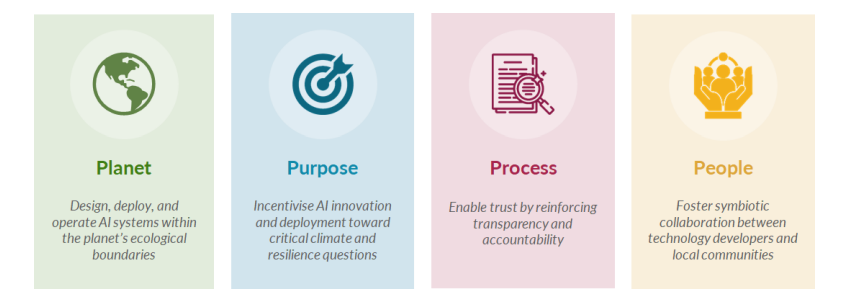
PLANET: Stakeholders should design, deploy, and operate AI systems within the planet’s ecological boundaries. AI growth must remain sustainable and resource efficient, while accounting for differing national resource constraints and development contexts.
PURPOSE: Governments and stakeholders should steer AI innovation and deployment toward clearly defined public priorities, particularly where societal benefits are high and market incentives alone are insufficient. AI should contribute meaningfully to sustainable development and climate action.
PROCESS: AI actors should promote transparency regarding the environmental footprint, performance, and broader impacts of AI systems. Shared expectations around disclosure and accountability are essential to enable informed decision-making, build trust, and support effective governance.
PEOPLE: AI systems should be developed and deployed with communities as active stakeholders, reflecting local context, consent, and lived realities. The benefits and burdens of AI should be distributed fairly, supporting inclusive development and a just transition in the context of climate change. Global collaboration should strengthen local capacity and ensure that AI serves people and societies equitably.
Taken together, these four principles offer a coherent framework to guide policymakers, developers, funders, and regulators as AI systems scale across sectors and geographies.
The advent of AI represents a pivotal opportunity for economic growth and innovation. The development and use of AI, however, can be resource intensive. According to IEA, a single hyperscale AI-focused data centre can consume as much electricity as power-intensive factories such as aluminium smelters. The largest facilities currently under construction are projected to consume up to 20 times that amount.
AI adoption is accelerating rapidly, placing pressure on existing data centre and computing infrastructure. As AI-focused facilities expand globally, electricity, land and water requirements also rise to fuel this new wave of demand for data processing. The footprint of this growth is highly concentrated, with data centres clustered in a limited number of locations. This concentration can create significant local impacts, depending on how infrastructure siting, resource use, and community engagement are managed. 43% of global data centres are operating in areas of high water-stress in the current decade.
The global expansion of AI has been matched by the emergence of powerful solutions that directly address many of these binding constraints. Modern AI accelerators, specialized hardware chips designed to run AI workloads much faster and more efficiently than general-purpose CPUs, such as Microsoft’s Maia 200, deliver roughly 30% higher performance-per-dollar and improved energy efficiency compared to previous generations of accelerators, while advanced hardware from Google and AWS show a similar trajectory. At the facility level, optimized cooling systems, including liquid and immersion technologies, are lowering both energy and water intensity per unit of compute. These improvements allow far more computation per watt than before, even though total AI workloads and overall electricity demand continue to grow rapidly.
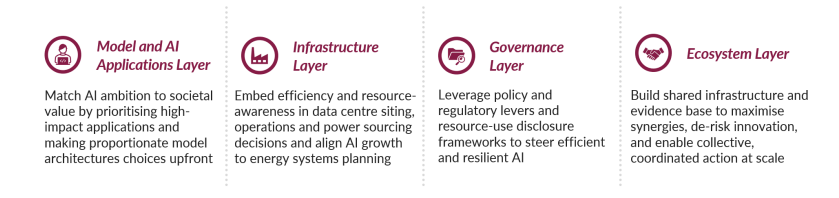
Realising the true potential of these solutions, however, requires a coordinated systems approach. Concurrent action across the AI stack, energy systems, and public policy is needed, with public-private partnerships for shared infrastructure rather than isolated investments. This integrated systems approach allows for sustainable design and resource-efficient deployment at each layer, creating positive cascading effects throughout the AI ecosystem. This interconnected relationship demands coordinated intervention across four critical layers:
AI deployment increasingly follows a 'build first, find uses later' driving adoption of large, general-purpose models even in contexts where simpler, task-specific approaches would be sufficient. This matters because the resource footprint of AI is shaped less by one-time model training and more by sustained, everyday use. Inference, the continuous compute required to run AI systems in real-world applications, accounts for an estimated 80–90% of an AI model’s lifetime carbon impact.6 As these systems scale across sectors, defaulting to oversized architectures can significantly increase energy, water, and material demand. Moreover, efficiency improvements alone are unlikely to curb total resource use. Rebound effects mean that gains in efficiency often lead to greater overall consumption as AI becomes cheaper and more pervasive. At the same time, many of these underlying resource costs remain largely invisible to users and developers, weakening incentives to right-size models and deploy AI more deliberately.
Addressing these challenges requires energy proportionality and responsible computing. It requires ensuring AI systems match actual applications through transparency, accountability, and consideration of compressed models and alternative hardware that can efficiently drive these models. Energy proportionality means that in practice AI systems should consume energy and resources in proportion to the social and economic benefit they deliver. Solutions must appropriately design and size models for specific tasks, make resource costs visible throughout theAI lifecycle, and mandate that deployment decisions ensure the benefits of the application outweigh resource costs.
AI applicationslayer recommendations
Solution #1: Prioritise fit-for-purpose models and embed cost-benefit analysis in AI deployment decisions. UNESCO’s research indicates that tailored, small models can reduce energy use by up to 90%. Governments can establish guidance that pushes developers and users to prioritise task-specific, domain-adapted models. It is essential to recognise that task-specific models can be more effective for many applications than general purpose models, especially where local context and domain understanding matter, and should be considered alongside general-purpose approaches.
Solution #2: Prioritise efficiency with separate training and inference strategies. Developers should use distinct strategies for training and inference while optimising for low latency and low-energy operation. Treat energy used per inference as the primary optimization target when designing deployments, recognising that inference currently accounts for 80-90% of lifetime costs and carbon footprint of existing LLMs. Implement custom silicon and architecture optimisations specifically for inference workloads, following approaches like Google's TPUs (Tensor Processing Units)-based infrastructure offering significantly higher power efficiency.
AI infrastructure deployment is resource intense. For instance, a medium-sized data centre consumes 110 million gallons of water annually. Infrastructure choices can lock in decades of carbon footprint through siting decisions, cooling technology selection, and power sourcing commitments. Lack of coordination between AI deployment and energy, water and land-use planning can further exacerbate localised climate impacts.
The path forward demands intentionality across spatial and temporal dimensions through better preemptive scenario planning, including assessments on how much development is needed. This ensures the build-out of AI infrastructure is aligned to societal needs and resource availability. By coordinating where, when and how AI infrastructure is built, it can be deployed correctly from the start rather than retrofitted to manage resource overconsumption or emissions problems later. For instance, co-locating data centres with clean energy sources, making intentional water-use choices by deploying low/zero-water cooling solutions, and appropriately phasing clean energy generation/storage and grid upgrades, infrastructural efficiency gains can be maximized
Solution #3: Integrate comprehensive water stress and climate risk assessments into siting decisions. Governments should proactively integrate water stress and climate risk considerations into strategic planning for data centre siting. Introduce “water-positive impact” incentives layered on top of energy-efficiency measures for achieving stringent low-Water Usage Effectiveness (WUE) performance and demonstrable watershed replenishment. Experts also suggest a bonus tax credit for projects with WUE ≤ 0.4 and offsetting ≥110% of water withdrawals through replenishment or reuse. By identifying and providing fast-track permitting for zones with underutilised renewable energy capacity, low water stress, and high climate resilience, such as repurposed industrial areas or existing infrastructure corridors, governments can significantly reduce approval timelines and regulatory uncertainty for investors.
Clear upfront guidance on acceptable design principles, including modular and flexible infrastructure that can adapt as conditions evolve and enabling co-location near municipal wastewater treatment facilities, can further streamline deploymentin proximity to resources. This approach shifts risk assessment upstream, cuts red tape in suitable locations, and prevents avoidable environmental and community impacts without creating additional layers of project-level bureaucracy.
Solution #4: Prioritise co-location of data centres with renewable energy sources and require battery storage. Incentivise data centre siting proximate to renewable projects through expedited permitting, development of "energy parks" combining generation and compute, and tax incentives for co-location. Require operators to demonstrate how facility design integrates with local grid conditions, renewable generation patterns, and temporal carbon intensity variations. Accelerate deployment of on-site or near-site small modular reactors (3–4-year timelines, compact footprints requiring only 3-4 acres), enhanced geothermal energy as a baseload renewable source, and battery storage paired with renewables.
Unlike traditional loads, AI data centres can ramp power up and down very quickly, with large spikes between idle and peak demand, ranging from several hundred watts to gigawatts. Battery storage can help smooth these fluctuations, absorbing sudden surges and supplying power during dips, reducing stress on the grid and supporting more stable integration of renewable energy.
Solution #5: Adopt AI-driven, advanced cooling techniques and thermal management as standard infrastructure. Cooling can account for 30-40% of total data centre energy consumption. However, solutions are emerging that employ innovative liquid cooling mechanisms like direct-to-chip cooling and immersion cooling where high rack densities and local climate conditions justify their use. Similarly, energy consumption for cooling can be further reduced by 40% by implementing machine learning and control systems through real-time thermal analysis, weather forecasting integration, and predictive load management.
Further, governments should require new facilities to implement efficient cooling alternatives capable of handling increasing thermal loads as AI models grow more complex. Direct-to-chip cooling removes 70–80% of heat at the source, 19 while immersion cooling enables even more effective liquid-based heat transfer and can significantly reduce overall cooling energy demand by eliminating fans and improving thermal management efficiency.Include explicit requirements for energy-efficient thermal management systems that can accommodate future GPU generations (and other compute hardware) that will need to be able to handle increasing temperatures without losing system reliability.
Solution #6: Prioritise targeted retrofits and maximise waste heat recovery and circular resource use. Data centre operators should prioritise incremental efficiency improvements in existing facilities through targeted retrofits rather than defaulting to greenfield development, as many retrofits can achieve PUE reductions from 1.20 to 1.15 or better (as seen in Google’s data centres where cooling system retrofits were implemented). Provide incentives for retrofitting existing facilities with advanced cooling while ensuring new facilities incorporate thermal management from the design stage.
Governments can incentivise and, where appropriate, mandate that waste heat from data centres with relatively constant workload profiles be reused. This prioritises year-round applications suited to warmer climates, such as water treatment and desalination, district cooling, absorption chiller systems, greenhouse heating, and industrial process heat, particularly in locations where there is sustained nearby demand for recovered heat and the infrastructure exists to distribute and use it effectively.
Lastly, governments can require new large-scale facilities to demonstrate feasible waste heat recovery pathways as part of the permitting and approval processes. Data centre operators should prioritise circular cooling approaches using AI-enabled, reclaimed water systems where utilities provide treated wastewater for data centre cooling, reducing freshwater demand while reliably and transparently supporting water reuse infrastructure.
Solution #7: Deploy demand flexibility and temporal load shifting. Encourage data centres to participate in demand response and load-shifting programmes by aligning grid incentives, market signals, and service-level flexibility. Non-critical workloads, particularly AI training and batch processing, can be shifted to periods or regions with high renewable availability without compromising performance. Even curtailing loads for just 0.25% of uptime would free up enough capacity to accommodate 76 GW of new load (a large nuclear plant produces approximately 1 GW on average). Transmission system operators (TSOs) and utilities can reinforce this flexibility through financial incentives, priority grid access, or streamlined interconnection and grid-upgrade arrangements for facilities that provide demand response services.
Inconsistent measurement and disclosure practices can constrain informed decision-making. Most major AI providers do not disclose sufficient information to estimate energy use or carbon footprint reliably, while fewer than one-third of data centre operators track water consumption. Regulators often lack technical expertise to evaluate efficiency claims, design effective policies, or enforce requirements, while rapid AI expansion and technology advances outpace policy and regulatory capacity.
Overcoming these gaps requires improving clarity through transparency frameworks and catalysing action through incentives. This means internationally agreed disclosure standards of energy, water, and environmental impacts and reforming procurement to reward efficiency.
Solution #8: Develop transparency and disclosure frameworks. Governments should implement disclosure requirements covering the full resource nexus: energy consumption per inference and training task, water usage and Water Usage Effectiveness (WUE), carbon footprint across the AI lifecycle, mineral efficiency, biodiversity impacts, and model efficiency metrics. Require site-level reporting using internationally standardised methodologies verified through independent third-party audits, rather than self-reporting.
Measurement metrics can be refined to better understand AI’s climate impact including location-specific contextual information such as water sources, carbon intensity of grids, local watershed stress classification, renewable procurement strategies, and heat reuse outcomes. Analogous to nutritional labelling in food systems or positive-impact taxonomies in green finance, better data and shared frameworks could help guide choices in model development, application design, and end-use, as well as steer investment toward more socially and environmentally beneficial pathways.
Solution #9: Create AI Energy Star-style rating systems. Governments can establish standardised, consumer-facing efficiency ratings (1-5 stars) for AI models and infrastructure, analogous to appliance Energy Star labels. There should be separate ratings for model efficiency, infrastructure performance, and systemlevel integration, prominently displayed in procurement portals and service interfaces. Governments should incentivise procurement from "lowest cost" to "highest accuracy and reliability" frameworks that give significant weight to sustainability as a percentage of total evaluation points alongside cost and performance, minimum efficiency thresholds, and performance-based contracting (tying payments to demonstrated results). Additionally, a renewed focus on emerging metrics like IT Equipment Energy Efficiency (ITEE) can help better capture equipment efficiency (including for GPUs) and move toward a fuller understanding of endto-end data centre performance.
Solution #10: Mandate comprehensive water stewardship standards with community benefits. Governments can establish water management frameworks requiring treatment infrastructure, discharge quality standards, and prioritisation of closed-loop cooling systems reducing freshwater use by up to 70%.
Require proof of WUE compliance, grid-interactive demand response, and 100% non-potable cooling in water-stressed basins. Introduce tiered WUE standards paired with PUE caps. Global recommendations include setting the standard at 1.0 L kWh-1 in 2027 and converging to ≤0.25 L kWh-1 by 2035 (aligned with ISO/IEC 30134-9 & EN 50600-4), paired with a PUE cap of 1.2.29 Water and energy requirements should be considered jointly: in humid or water-abundant locations, limited water use may be appropriate to reduce energy demand, while in highly water-stressed regions, cooling should minimise or avoid water use even if this leads to higher PUE.
Promote community benefit agreements ensuring AI infrastructure creates net-positive outcomes for host communities. For example, mandate water-positive operations that replenish more water than consumed, benefiting surrounding communities and ecosystems through treatment and reuse systems.
The digital supply chain (software, hardware, infrastructure) works in silos, preventing a clear understanding of resource impacts. Siloed governance where energy regulators, water authorities, and land use planners operate independently creates suboptimal outcomes, delays, and missed opportunities for synergy. Without clear systemic metrics and reporting, investments are not consistently directed toward applications with the highest social returns.
Solutions must prioritise equity and community impact by directing investments toward conscious, thoughtful approaches where AI delivers maximum societal value. This includes establishing shared infrastructure to reduce per-user resource usage, creating multi-stakeholder platforms ensuring community voices guide development, and developing impact metrics that prioritise applications with highest positive multiplier effects for society. Industry-led self-regulation and voluntary agreements with support from government and civil society are key to promoting sustainable practices.
Solution #11: Develop and promote interoperable reporting standards and data transparency systems. Develop internationally interoperable reporting standards through ISO, IEC, ISSB and industry consortia. This ensures that firms can compete globally while maintaining high accountability. Establish standardised metrics, common data schemas enabling automated aggregation and comparison, and digital infrastructure facilitating reporting and verification. For example, UK’s Department of Environment, Food and Rural Affairs formed the Government Digital Sustainability Alliance (GDSA) to develop measurement standards for the environmental impact of ICT. Require AI solutions to be built on open standards with documented APIs enabling interoperability, data portability, and competition, preventing dependency on single vendors and enabling local startups to participate.
Solution #12: Strengthen partnerships for integrated infrastructure. Facilitate partnerships between data centre operators, utilities, and communities to co-design integrated infrastructure. This includes reclaimed water systems where utilities provide treated wastewater for data centre cooling, reducing freshwater demand while supporting water infrastructure; district heating networks where data centres provide waste heat for residential, commercial, or industrial heating, monetising what would otherwise be waste.
Integrating GIS data about population, industry, agriculture, groundwater table data and surface water mapping into decision making processes allows utilities to forecast AI demand and allocate water resources. Low-interest loans and fast-track permits for purple-pipe (reclaimed water) networks can be a scalable solution for cluster-level circular water use.
The global climate crisis demands urgent transformation across every sector of the economy. AI could accelerate these transformations significantly, strengthening climate mitigation and adaptation efforts. It can be leveraged to optimise renewable energy grids, predict extreme weather events, enable precision agriculture, improve resource use efficiency, and accelerate the discovery of breakthrough materials for hard-to-abate sectors.
Yet, despite rapid growth in research, pilots, and technical capability, most climate-focused AI applications have not translated into sustained, large-scale impact. This gap reflects not a shortage of algorithms, but persistent weaknesses in data foundations, institutional capacity, and governance.
Unlocking AI’s value for climate action requires moving away from a technology-led approach and grounding AI development in clearly defined climate and decision needs. In practice, model development is often outpacing scientific validation, institutional readiness, and operational capacity, creating a disconnect between what AI systems can produce and what decision-makers can reliably use.
While AI's technical capability to transform climate action is proven, translating this potential into action faces several bottlenecks. The aggregate impact of AI-enabled climate solutions, even in the next decade, could be marginal if the necessary enabling conditions are not created. The challenge is particularly acute in developing countries, where climate vulnerability is highest, but the capacity to deploy AI is lowest. Many developing countries face limitations in installed digital infrastructure, including unreliable internet connectivity and inadequate computing power, compounded by a shortage of skilled professionals to develop and deploy AI systems.
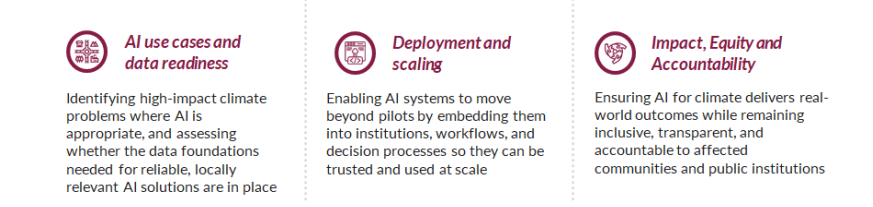
Successfully leveraging AI for climate action requires more than innovation; it demands answering key questions across three dimensions:
Finance and digital infrastructure are binding constraints on the development and scale-up of high-impact AI solutions for climate adaptation and mitigation. Many priority applications, such as disaster early-warning systems, emissions monitoring, and materials discovery for hard-to-abate sectors, generate substantial public value but face long payback periods, uncertain demand, and weak commercial incentives. As a result, private markets underinvest, leading to market failures that limit innovation and deployment. Data infrastructure further constrains progress across many high-impact applications, particularly in the Global South. Despite rapid growth in Earth-observation assets, many applications remain limited by gaps in historical data, sparse ground-based monitoring (e.g., weather stations), and weak digital infrastructure in sectors such as health and climate. These data constraints restrict model accuracy, local relevance, and scalability, even where AI capabilities exist.
Rather than treating AI as a predefined solution in search of applications, effective climate applications must be derived from clearly articulated, ground-level problems. The starting point is not model capability, but a rigorous understanding of where climate risks, system failures, and decision gaps actually exist—and which of these can be meaningfully addressed with AI.
Solution #1: Ensure the right problem articulation at the outset. Prioritisation of AI applications should be anchored in real-world problems caused or exacerbated by climate change, with AI treated as an enabling tool within a broader toolkit of solutions, rather than a standalone solution. Otherwise, there is a risk of developing 'solutions to chase problems'. Framing the problem around climate outcomes, rather than the technology itself, helps ensure AI deployment is targeted, trusted, and aligned with real climate needs across diverse contexts. Decision-makers can then prioritise between optional, essential, and urgent applications.
Solution #2: Mission-critical AI applications need targeted public finance. Public sector intervention is essential to advance AI solutions for climate challenges that markets alone are unlikely to address. For instance, while corporations may track emissions for ESG reporting, there is limited incentive to build transparent, global verification systems. The AI-driven analysis of satellite imagery and IoT data can support emissions monitoring and ‘truth-testing,’ including methane leak detection, illegal deforestation tracking, and verification of carbon sequestration in soils and forests. Similarly, while private insurers use AI for climate disaster risk modelling, these tools are often proprietary.
Further, governments need to incentivise and fund long-term, mission-driven research, including technologies like generative chemistry to accelerate materials discovery for hard-to-abate sectors, developing new catalysts for green hydrogen, low-carbon cement, and long-duration energy storage. Private R&D focuses on 5–10-year commercialisation horizons while deep decarbonisation requires 20–30-year breakthrough innovations. This can result in a structural investment gap for the high-risk, long-duration innovations needed to achieve net-zero transitions.
High-social-impact AI applications often face weak or delayed private returns despite delivering substantial public benefits. Governments and development finance institutions should proactively deploy public investment, de-risking instruments, and clear impact taxonomies to align private capital with public value, drawing on proven tools from climate finance and public health before market failures become entrenched. Simple, mission-oriented mechanisms such as revenue-based contributions, pooled implementation consortia, or advance market commitments, rather than complex blended finance structures, can enable scale, clarity, and long-term impact.
Solution #3: Invest in digital and IT infrastructure as a foundation for AI-led climate action. Stakeholders, particularly governments, must prioritise foundational digital infrastructure to enable AI-driven climate action. Data collection by government agencies, especially in the Global South, is often fragmented, manual, ad hoc and reactive to specific needs. Systematic investments in core digital and IT infrastructure are needed to enable the seamless integration of real-time data streams, transitioning from isolated datasets to interoperable "digital twins" of environmental ecosystems. By establishing robust cloud computing capabilities and high-speed connectivity, nations can move beyond reactive crisis management toward predictive modelling that informs sustainable policy, ensures equitable resource distribution, and scales localised climate solutions across borders.
Solution #4: Designate key climate data as Digital Public Infrastructure (DPIs), with standards, trusts, and sandboxes. Governments should make critical climate and environmental datasets non-excludable and interoperable, ensuring equal access across geographies. Enabling this would require public investment in standardised data collection, metadata, formats, and sharing protocols across agencies, utilities, and levels of government, particularly in the Global South. Stakeholders must prioritise expanding access to hyper-local “ground truth” data, such as soil moisture, wind patterns, extreme-event impacts, and methane emissions, that remain scarce despite abundant satellite coverage.
To enable responsible use at scale, such DPIs should be complemented by independent data trusts and regulatory sandboxes. Data trusts can steward sensitive datasets on infrastructure, energy, and transport and mobility, thereby enabling controlled access for verified climate-positive AI applications while safeguarding privacy and security. Regulatory sandboxes can enable AI-driven innovations—such as local climate forecasting, grid interoperability, and virtual power plants that manage EVs, home batteries, and distributed solar—to be tested and scaled without jeopardising existing systems and public interest.
Despite a growing volume of research and pilot projects across climate adaptation and mitigation, most AI applications remain confined to the proof-of-concept stage. Public-sector institutions—the primary offtakers for many climate AI applications—often lack the institutional capacity, governance frameworks, and system integration needed to operationalise AI tools. This gap creates a persistent trust and usability deficit, in which technically sound models are perceived as ‘black boxes,’ particularly when introduced without clear accountability, validation, or alignment with existing workflows. The challenge is further compounded by limited coordination among developers, domain experts, and decision-makers. As a result, many deployments remain research-ready rather than decision-ready, leading decision-makers, especially in high-stakes contexts, to rely on traditional experience and intuition over AI insights.
Solution #5: Build in-house interpretive capacity within public institutions. For AI to become part of routine planning and operations, interpretive capacity cannot be outsourced. While data and AI-generated insights are increasingly available, many public institutions lack the capabilities, processes, and incentives needed to integrate these insights into policy design, regulatory decisions, and operational workflows. Even in advanced economies, city administrations face a lack of AI literacy among staff across departments, including the climate team, hindering the deployment of AI for climate. This necessitates targeted capacity building through focused training, recruitment, and institutional learning programmes.
Solution #6: Embed climate AI in public institutions through performance-based validation and continuous evaluation. Effective deployment of AI for climate action requires continuous collaboration between AI developers, climate domain experts, and decision-makers throughout design, deployment, and use. Embedding feedback loops from field operations, evolving climate conditions, and new data ensures models remain locally relevant, decision-ready, and trusted over time, helping bridge the gap between technical performance and real-world climate operations.
Institutional confidence in climate AI must be grounded in demonstrated performance, not promise alone. Models should be rigorously validated against historical “ground truth” and physical observations in the specific local contexts where they are deployed. To operationalise trust at scale, governments and public institutions should institutionalise standards for confidence, benchmarking, and independent evaluation, clearly communicating uncertainty, failure modes, and conditions under which models may degrade.
Solution #7: Integrate AI into existing workflows and enable incremental operationalisation. AI systems must be embedded within existing user workflows and introduced through incremental shifts, from researchready to decision-ready and operational-ready tools. Once deployed, mechanisms are needed to ensure models are updated and maintained in line with evolving data and methods, preventing operational systems from lagging behind innovation. For example, instead of creating a separate AI dashboard, outage and loadforecasting models should plug directly into the utility’s existing SCADA and dispatch workflows that grid operators already use for daily planning.
The application of AI in regulatory and enforcement functions presents risks of bias and misalignment with local realities if not carefully designed and governed. Model performance and reliability vary widely across geographies due to uneven data availability and historical coverage. Many global climate models, for instance, perform more accurately in North America and Europe than in the Global South because weather stations were historically more available in those regions and are used as model inputs. As a result, AI-driven insights may misrepresent local risk profiles, overlook vulnerable populations, or produce recommendations that are poorly aligned with on-the-ground conditions.
The ‘success’ of solutions at the grassroots - how well they have scaled and sustained -follows certain basic sector- and technology-agnostic principles.CEEW’s research identifies community buy-in and championship as a critical factor for the scalability and success of sustainable agriculture interventions in India. Without enabling community ownership through measures such as local validation or co-creation, AI solutions risk missing context-specific hyperlocal data, amplifying biases, and ultimately losing trust where it matters most - where and for whom it is deployed. On average across eight countries, around 65% of the people surveyed by the Reuters Institute and the University of Oxford do not believe AI can meaningfully address climate challenges in their regions.
There is increasing demand for stronger oversight and guardrails to ensure accountability and transparency in the use of AI, particularly in crisis and high-stakes decision-making. For instance, in December 2025, the European Commission’s Chief Scientific Advisors recommended that AI must support, not substitute, human judgment in crises, recognising crisis management as a socio-technical process rather than a purely computational one. Many crisis decisions, from the COVID-19 pandemic to large-scale droughts, heatwaves, and wildfires, involve fundamental trade-offs between competing interests, rights, and societal values. Because such values are often abstract, contested, and difficult to formalise, AI systems cannot adequately represent them or engage in democratic deliberation. While AI can strengthen situational awareness and forecasting, ethical judgment, trust-building, and institutional coordination remain inherently human functions. Governance guardrails are therefore essential to ensure AI insights inform, rather than displace, human responsibility and democratic decision-making during crises.
Solution #8: Build climate AI models using local data for relevance and effectiveness. Climate AI models trained primarily on global or externally generated datasets often fail to reflect local climate patterns, infrastructure constraints, and policy realities. For high-stakes climate applications, such as disaster risk management, energy systems, or emissions monitoring, models must be built using locally relevant data and validated against local conditions to ensure accuracy, accountability, and sustained usability. Where appropriate, locally governed or sovereign climate AI models are essential to support public decision-making, safeguard data ownership, and align AI outputs with public value rather than commercial optimisation.
Solution #9: Embed co-creation and local partnerships. Effective and trustworthy AI solutions require designing with communities, not for them, through strong local partnerships that ensure relevance, inclusion, and long-term trust. For instance, in developing climate advisory chatbots for farmers, local and traditional knowledge should be incorporated alongside scientific research. Over-reliance on purely limited inputs can bias recommendations toward quick or chemical-based fixes, whereas traditional practices often offer more sustainable alternatives that can be embedded into AI-driven advisories.
Solution #10: Communicate uncertainty and ensure ‘human-in-the-loop’ systems for enforcement use. AI outputs should be clearly communicated as probabilistic and advisory, not treated as definitive evidence for enforcement. This requires standardised uncertainty reporting, explicit thresholds for when outputs are actionable, and a right to explanation, ensuring human review remains a meaningful safeguard against model overconfidence.
AI systems should inform, not replace, human judgment in decisions involving high-cost, long-life, or systemic risks, such as in disaster management, reservoir water management, and so on. For example, in climatestressed power systems, AI models may recommend actions based on forecasts of heatwaves, droughts, or extreme demand. However, grid operators and public authorities must retain responsibility for reviewing and approving AI-generated recommendations, such as curtailment strategies, reservoir release schedules, or long-term infrastructure investments to ensure decisions account for safety, equity, and broader climate and social considerations.
The report highlights that market forces alone are unlikely to prioritise sustainability, efficiency, or equitable outcomes in AI deployment. Public policy is required to set sustainability standards and ensure AI investments align with national climate priorities. Government leadership is also essential to correct market incentives and ensure AI delivers long-term public value.
The report recommends establishing clear regulatory frameworks for data centres and AI infrastructure, including standards for energy efficiency, renewable energy use, water stewardship, and environmental reporting. It also emphasises the need for coordinated planning between governments, utilities, and infrastructure providers while ensuring accountability.
Governments can enable large-scale climate impact by investing in public climate data infrastructure, supporting research and development, and strengthening institutional capacity to adopt AI solutions. The report also stresses the importance of embedding AI within public systems, aligning it with sectoral climate priorities, and supporting long-term deployment rather than isolated pilot projects.
The report emphasises that Global South countries will play a major role in future AI infrastructure expansion and climate response, yet they face disproportionate risks from both climate change and resource constraints. Proactive policy leadership is needed to ensure AI development aligns with national sustainability priorities, supports local climate needs, and avoids locking countries into resource-intensive and externally driven technology pathways.

Scaling Green Manufacturing in India