Council on Energy, Environment and Water Integrated | International | Independent

- Varanasi already treats ~76% of the ~465 million litres of sewage it generates daily
- Only 38% of households are connected to the centralised sewerage network
- Revenue-user tariffs could recover 77–93% of operation and maintenance costs
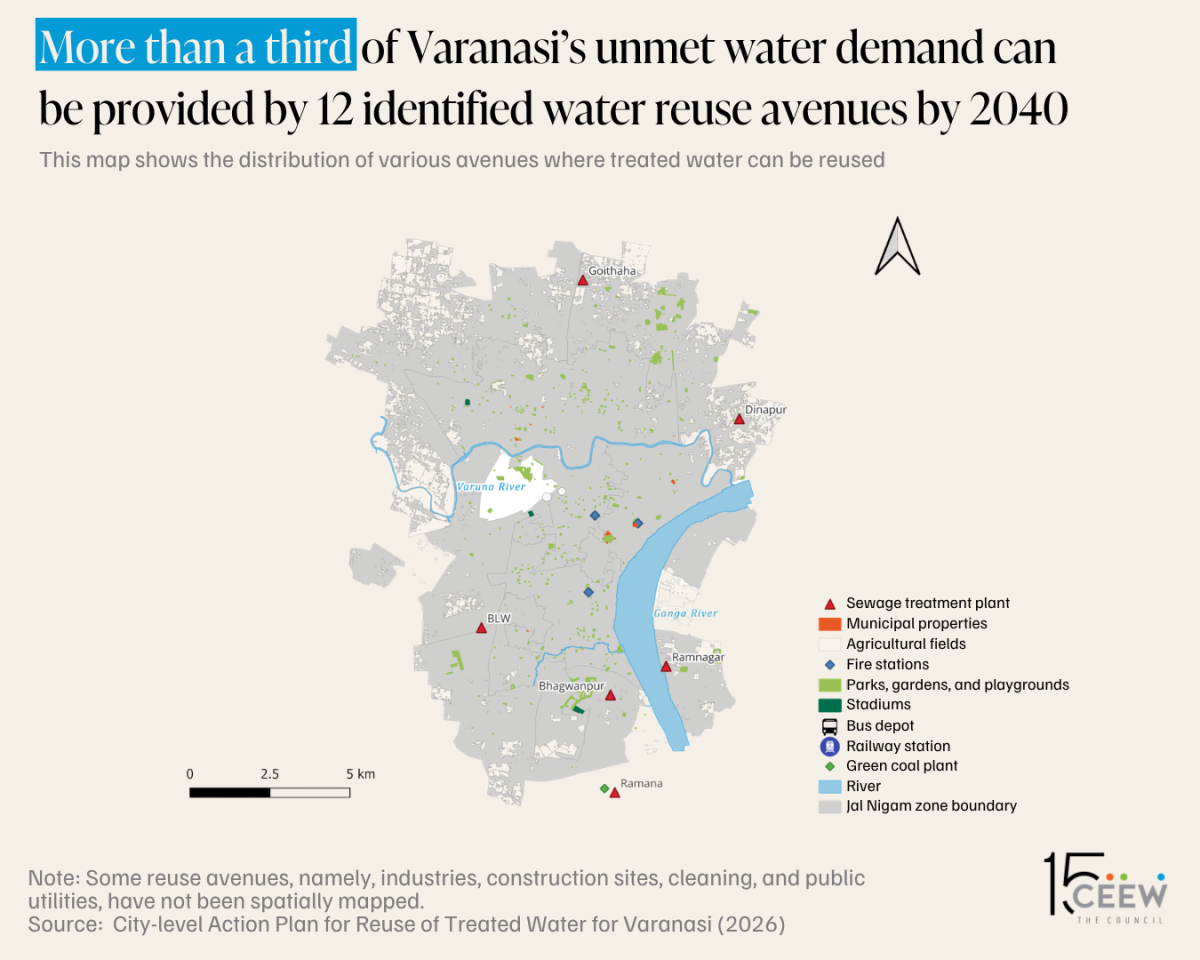
Varanasi, 13 July 2026: Varanasi has the potential to reuse up to 30 per cent of its currently available treated used water (TUW), according to the City-level Action Plan for Reuse of Treated Water for Varanasi, developed by the National Mission for Clean Ganga (NMCG), Varanasi Nagar Nigam (VNN), and the Council on Energy, Environment and Water (CEEW). The city already treats around 354 million litres per day (MLD) of the nearly 465 MLD sewage it generates daily, or about 76 per cent of the total, giving it a strong base to now scale safe reuse for non-potable purposes. The plan was launched today during the All India Water Resource Secretaries Conference by Hon’ble Minister of Jal Shakti Shri C.R. Patil in New Delhi. It identifies 12 avenues for reuse and estimates a reuse potential of 91–127 MLD, which could meet 35 per cent, or over one-third, of the city’s unmet water demand by 2040.
Shri C.R. Paatil, Hon’ble Minister of Jal Shakti, said, “The Government of India’s commitment to the Water Vision@2047 requires a paradigm shift to a circular economy, ensuring that every drop is valued. The Treated Used Water Reuse Plan for Varanasi exemplifies this vision, providing a robust framework to safeguard our precious water resources while supporting urban growth and protecting our sacred rivers.”
Dr Nitin Bassi, Fellow, CEEW, said, “Varanasi already has significant used water treatment infrastructure, but the next step is to improve collection, upgrade treatment quality where needed, and connect treated used water to real demand. Safe reuse can reduce freshwater dependence, improve local water quality, and create a financially viable model for urban water management. Pricing tertiary treated used water for revenue-generating users could help recover a major share of operation and maintenance costs, making reuse practical for both the city and end users.”
The plan comes as treated used water is emerging as a major economic and resilience opportunity for Indian cities. An earlier CEEW study found that India’s treated-used-water economy could unlock up to INR 3.04 lakh crore (USD 35 billion) in economic opportunity by 2047, including INR 72,597 crore (USD 8.35 billion) in potential annual revenue, INR 1.6–2.3 lakh crore (USD 18–27 billion) in infrastructure investment, and over one lakh new jobs. Varanasi currently generates nearly 465 MLD of sewage and has 422 MLD of installed treatment capacity. However, actual treatment stands at 354 MLD, or 76 per cent of sewage generation, as sewage treatment plants remain underutilised due to limited sewerage network coverage. Only 38 per cent of households are connected to the centralised sewerage network, resulting in untreated used water flowing into 43 identified drains and subsequently into the Varuna River.
The NMCG-VNN-CEEW water reuse plan sets out a city-specific roadmap to move Varanasi from a linear “use-treat-discharge” model to a circular “treat-and-reuse” approach. It recommends expanding sewerage network coverage, improving utilisation of existing treatment capacity, upgrading treatment infrastructure to meet fit-for-purpose quality standards, and creating dedicated reuse zones. Priority users include agriculture, railways, Banaras Locomotive Works, construction agencies, industries, landscaping, public utilities, IIT-BHU, and waterbody rejuvenation.
The reuse plan also outlines a financing pathway. It finds that pricing tertiary-treated used water at par with current groundwater extraction costs for revenue-generating sectors such as construction, green coal plants, and other industries could recover 77–93 per cent of the operation and maintenance expenses needed to upgrade existing treatment infrastructure to tertiary treatment. This could help VNN reduce dependence on public funding, ring-fence revenue for treatment and conveyance systems, and create a sustainable market for treated used water.
By mainstreaming safe reuse, Varanasi can reduce pressure on groundwater, improve the quality of local water bodies, and support the cleanliness and rejuvenation of the Ganga and its tributaries. The plan also offers a replicable model for other river cities in India seeking to convert used water from a municipal burden into a resource for resilience, revenue, and river health.
Read the full plan, City-level Action Plan for Reuse of Treated Water for Varanasi, by NMCG, VNN and CEEW here.
For media queries and interviews, contact:
Tulshe Agnihotri – [email protected]
About CEEW
The Council on Energy, Environment and Water (CEEW) — a homegrown institution with headquarters in New Delhi — is among the world’s leading climate think tanks. The Council is also often ranked among the world’s best-managed and independent think tanks. It uses data, integrated analysis, and strategic outreach to explain — and change — the use, reuse, and misuse of resources. It prides itself on the independence of its high-quality research and strives to impact sustainable development at scale in India and the Global South. In over 15 years of operation, CEEW has impacted over 400 million lives and engaged with over 20 state governments. Follow us on X (formerly Twitter) @CEEWIndia or on LinkedIn for the latest updates.