Council on Energy, Environment and Water Integrated | International | Independent

- Two-wheelers make up over 80% of Erode's vehicles and 45% of transport emissions; diesel trucks are just 1.4% of the fleet but cause 21% of emissions
- A 20–30% improvement in fuel efficiency could cut emissions by 17–23% by 2030; electrifying a third of the fleet could deliver similar reductions
Erode, 10 September 2026: Tamil Nadu's Erode has developed a data-backed roadmap to track transport emissions and plan cleaner, more efficient movement of people and goods, according to two new studies launched today by the Council on Energy, Environment and Water (CEEW), supported by UK PACT. The studies find that Erode's on-road transport emissions could nearly double from 0.61 million tonnes of carbon dioxide equivalent (MtCO₂e) in 2025 to 1.42 MtCO₂e by 2045 under high-growth conditions, underscoring the need for targeted, cost-effective mobility planning.
Erode, a textile and trading hub in western Tamil Nadu, is a fast-growing Tier-2 city of the kind India will depend on for much of its future urban and economic growth. Its transport challenges — a two-wheeler-heavy fleet, industrial freight corridors, and sparse public transport data — are common to hundreds of similar cities, making Erode's approach a useful template for how India's smaller, rapidly motorising cities can plan for cleaner mobility. The work also aligns with Tamil Nadu's Chief Minister's Integrated Urban Transformation Mission (CMIUTM), offering evidence that can help cities prioritise cleaner roads, safer access, efficient freight movement, and low-carbon mobility investments.
The CEEW studies were developed under the UK Partnering for Accelerated Climate Transitions (UK PACT)-supported Climate-Resilient, Sustainable and Inclusive Urban Mobility in Erode initiative. Together, they provide Erode with a transport emissions baseline, a GPC-compliant calculator to model future scenarios, and a diagnosis of how residents, workers, freight operators, and informal transport users move across the city.
Arpit Jain (IAS), Commissioner, Erode Municipal Corporation, said, “Erode is taking a data-first approach to cleaner and more efficient mobility. These studies will help the city identify where transport emissions come from, where mobility gaps remain, and which interventions can deliver the greatest benefit for residents, workers, and businesses. Erode's approach can also guide other growing cities in Tamil Nadu.”
Sam Kumar, Senior Advisor, British Deputy High Commission, Chennai, said, “The UK is pleased to partner with Erode Municipal Corporation in its journey to build a climate-resilient, inclusive, and low-carbon urban mobility system. This work shows how city-level evidence can inform policies, finances and governance on decarbonisation of passenger and freight mobility, while offering significant lessons for other tier-2 cities in Tamil Nadu and across India.”
Dr Seshadri Raghavan, Programme Lead, CEEW, said, “Erode's next steps should prioritise high-impact interventions: cleaner two-wheelers, better public transport and last-mile integration, safer walking access, and smarter freight management. These studies help the city act economically and effectively, while building a transition pathway that similar industrial and Tier-2 cities can adapt.”
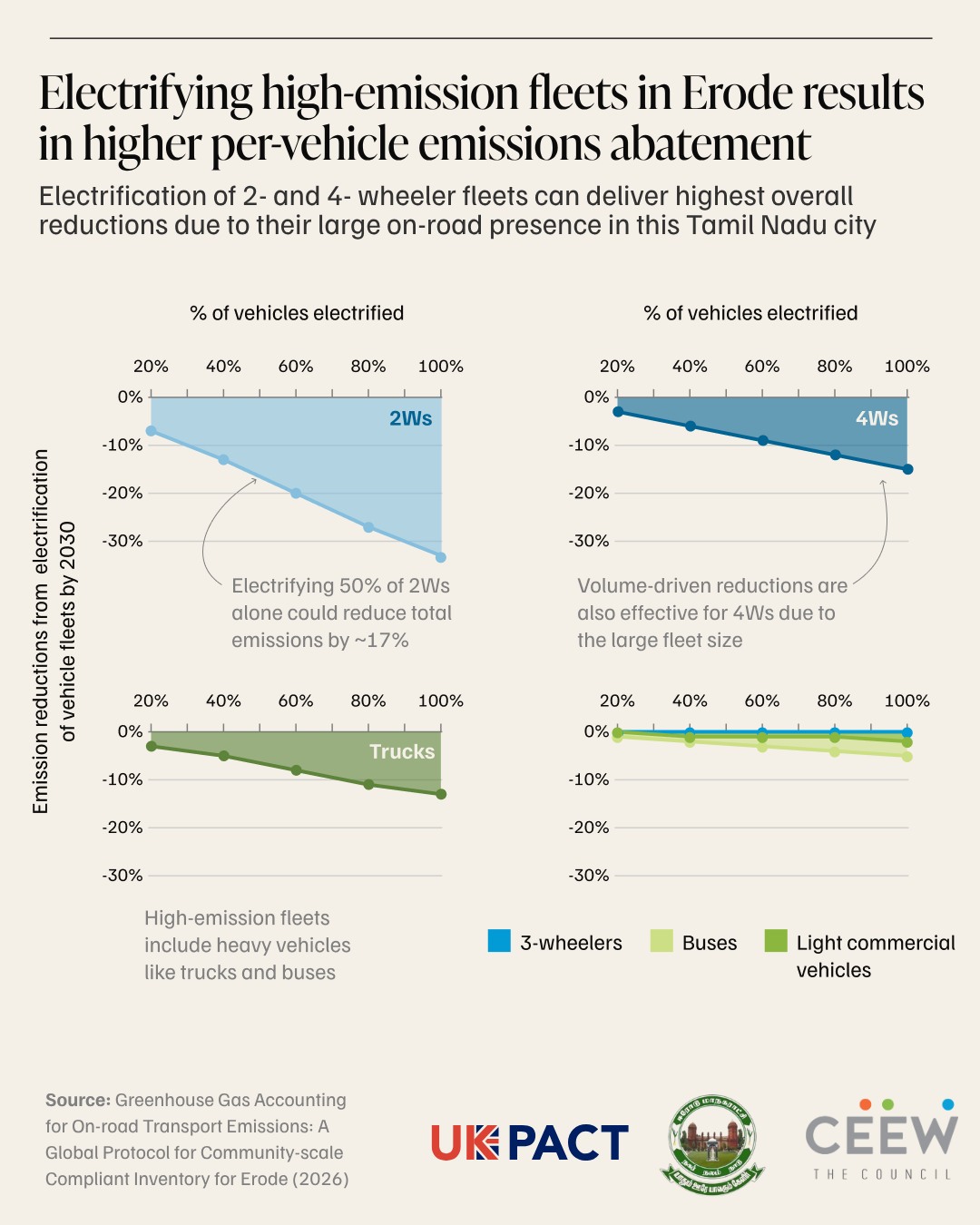
Erode's emissions problem sits in a few high-impact segments, not across the fleet evenly. Two-wheelers account for over 80 per cent of vehicle stock and 45 per cent of emissions. Diesel trucks make up just 1.4 per cent of the fleet but cause 21 per cent of emissions. Electric vehicles currently account for only around 2% of vehicle stock — leaving significant room for electrification to make a dent. A 20–30 per cent improvement in fleet fuel economy could cut emissions by 17–23 per cent by 2030; electrifying around a third of the fleet could achieve a comparable reduction. Both point in the same direction: targeted action on a handful of vehicle segments will do more than broad, generic measures.
Traffic on Erode's major corridors has grown 32% between 2015 and 2025, and two- and three-wheelers dominate short trips within the city, found the CEEW study. Buses remain central for work and education travel, shared autos and tempos fill in the last mile, and freight clusters along industrial and intercity corridors such as Erode–Salem and Erode–Perundurai/Tiruppur. Better public transport, safer walking access, off-peak services, women's safety on transit, and tighter freight corridor management would support cleaner mobility and smoother economic activity together.
The CEEW studies recommend Erode use its new emissions calculator and mobility baseline to track progress regularly, prioritise high-emission vehicle segments, strengthen public transport and last-mile connectivity, improve pedestrian infrastructure, and manage freight movement more efficiently. By combining emissions accounting with mobility planning, Erode can avoid locking in high-emission transport infrastructure and offer a template other Indian cities can adapt.
Access the GHG calculator here and read the full studies:
For media queries and interviews, contact:
Tulshe Agnihotri – [email protected]
The Council on Energy, Environment and Water (CEEW) — a home-grown institution with headquarters in New Delhi — is among the world's leading climate think tanks. The Council uses data, integrated analysis, and strategic outreach to support public policy, transform markets, shape technology, and nudge behaviour. It addresses pressing regional and global challenges through an integrated and internationally focused approach. The Council prides itself on the independence of its high-quality research and strives to impact sustainable development at scale.