Council on Energy, Environment and Water Integrated | International | Independent

Suggested Citation: Sen, Ritika, Shubhi Vaid, Kavya Muthukrishnan, Niharika Tyagi, and Seshadri Raghavan. 2026. Movement of People and Goods: Assessing Urban Transport in the City of Erode. New Delhi: Council on Energy, Environment and Water.
Erode's last comprehensive mobility assessment, the Comprehensive Mobility Plan (CMP) prepared by Tamil Nadu Urban Infrastructure Financial Services Limited (TNUIFSL), dates to 2015 and no longer reflects the city's travel realities. Over the past decade, Erode has seen substantial change in land use, economic activity, travel behaviour, vehicle ownership, and freight movement. Green cover fell by 26.5 per cent between 2017 and 2024, while built-up areas rose by 9.7 per cent, and annual electric vehicle registrations grew from 44 in 2020 to 4,090 in 2024.
This study establishes a contemporary, data-driven baseline for the movement of people and goods within, into, and through Erode across three systems: public transport, intermediate public transport (IPT), and urban freight. It draws on primary surveys of roughly 6,000 vehicles at fuel stations and parking locations, 1,360 bus users, 1,193 IPT users, more than 500 IPT operators, and over 1,000 freight drivers, alongside a one-day classified vehicle count at nine cordon locations.
The report recommends a two-track approach: immediate, low-cost measures for ECMC and medium-term measures requiring coordination with state agencies. It identifies five key intermediate public transport (IPT) -public transport (PT) locations and provides location-specific recommendations for each, including designated pick-up and drop-off points, pedestrian and universal-access improvements, and better passenger information. Other ECMC actions include regulating parking and street vending, managing bullock-cart movement, and introducing loading bays and designated freight areas. In coordination with state agencies, the report recommends supporting the regulation and integration of private bus services into city planning, piloting TNSTC service improvements, and strengthening emission and vehicle-fitness enforcement along priority corridors.
The UK Government and the Government of Tamil Nadu (GoTN) are collaborating under the UK Partnering for Accelerating Climate Transitions (UK PACT) programme to support climate-resilient urban transitions in Tamil Nadu. Under this partnership, the Climate-Resilient, Sustainable and Inclusive Urban Mobility in Erode initiative focuses on strengthening Erode’s long-term sustainable development trajectory by systemically integrating climate recommendations into urban planning, governance, and mobility systems through data-driven, institutionally grounded, and financially viable pathways.
Initial engagements, such as the kick-off meeting held at the District Collectorate on 2 May 2025, brought together municipal authorities, state agencies, and civil society stakeholders, discussing key structural challenges defining Erode’s mobility system. The momentum generated at the city level was then consolidated at the state level through an inception roundtable on 22 August 2025, which strengthened coordination and aligned direction across institutions. The main outcomes included the formalisation of collaboration through a series of letters exchanged between the Tamil Nadu Green Climate Company (TNGCC) and the UK government; high-level engagement between senior state officials, UK representatives, and technical partners; and focused discussions on the roles of digital tools, data-driven decision-making and planning, and climate finance in enabling climate-smart urban mobility in Tier-2 cities.
These deliberations aimed to present Erode as a potential model that might be scaled up for lowcarbon and inclusive urban mobility transitions across similar cities in Tamil Nadu. The Movement of People and Goods report is accordingly conceptualised as a data-driven and strategic framework to establish a contemporary baseline of travel patterns of people and goods in Erode.
The Movement of People and Goods (MPG) report was needed, as Erode’s most recent comprehensive mobility assessment–the Comprehensive Mobility Plan (CMP) by Tamil Nadu Urban Infrastructure Financial Services Limited (TNUIFSL)–was prepared in 2015, and thus no longer reflects current travel realities. Over the past decade, Erode has witnessed major changes in land use, economic activity, travel behaviours, vehicle ownership, and freight movement. The MPG report establishes a contemporary, data-driven baseline for the movement of people and goods within, into, and through Erode today, across public transport, intermediate public transport (IPT), and urban freight systems.
The report builds on earlier project outputs, including the Gap Assessment Report by the Institute for Transportation and Development Policy (ITDP) India (2025), which diagnosed policy, planning, and data gaps in Erode’s mobility ecosystem; the Budget Assessment Note by the Council on Energy, Environment and Water (2025), which mapped climate mitigation as well as gender equality, disability and social inclusion-aligned (GEDSI) services and expenditures; and the Public Transport and Pedestrian Infrastructure Assessment or People Near Transit (PNT) Analysis for Erode by ITDP India (2025), which evaluated access to public transport, the condition of bus stops, and pedestrian infrastructure in the city.
This report is organised as a consolidated yet modular assessment, comprising self-contained chapters that can be read independently while following a uniform analytical approach. The study adopted a mixed-methods approach, combining primary surveys, stakeholder consultations, and analysis of secondary datasets. The primary surveys examined demand patterns, operational realities, user perceptions, barriers, and expectations. As a whole, this report provides a grounded, evidence-based understanding of Erode’s current mobility system. Its findings will directly guide subsequent phases of the UK PACT project by identifying interventions and actionable pathways towards realising more resilient, inclusive, and sustainable mobility in Erode through evidencebased decision-making.
The findings presented in this section draw on primary surveys across multiple transport segments. Together, these findings establish a baseline understanding of existing mobility patterns, operational challenges, user perceptions, and infrastructure gaps, while highlighting opportunities for building a more connected, inclusive, and sustainable urban mobility system.
Figure ES1. Congestion points identified by the IPT operators overlapped with commuters’ origin and destination points
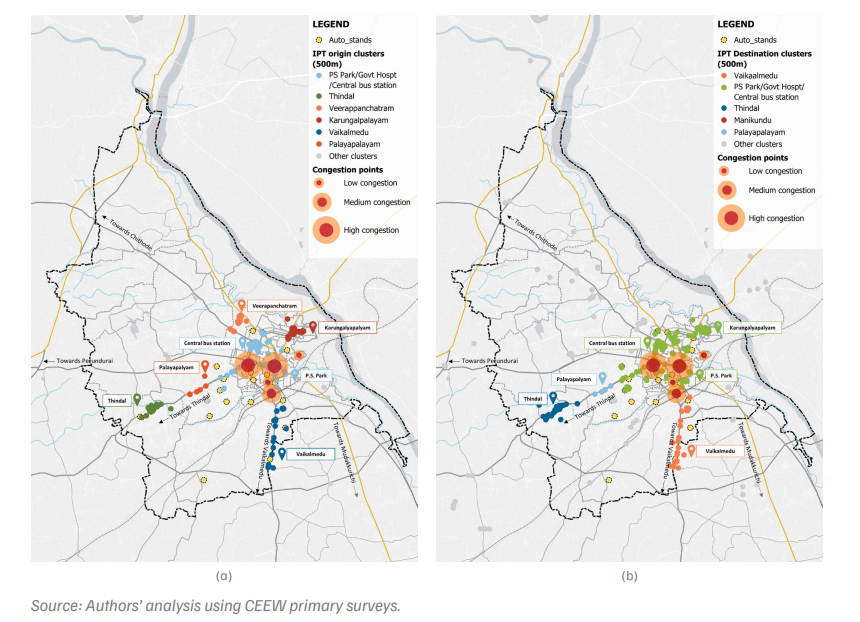
In a nutshell, the findings show crucial gaps in connectivity, infrastructure, reliability, and coordination of services across Erode’s mobility system. Some immediate operational improvements and medium-term institutional and infrastructure measures are required to address this. The following action items outline priority interventions for the Erode City Municipal Corporation (ECMC), along with measures requiring coordination with relevant state agencies.
Erode City Municipal Corporation (ECMC)
CEEW's Movement of People and Goods report establishes the first mobility baseline for Erode, Tamil Nadu, since 2015. The report serves as an analytical entry point for the city corporation and establishes a ground-level understanding of how mobility functions in the city at present. It captures user perceptions and expectations, accessibility, travel behaviours, preferences, and use cases across multiple transport segments.
Erode’s last Comprehensive Mobility Plan was prepared in 2015. Since then, the city has changed significantly, with shifts in land use, economic activity, travel patterns, vehicle ownership and freight movement. Between 2017 and 2024, for example, built-up area increased by 9.7 per cent while green cover declined by 26.5 per cent. Annual EV registrations also rose sharply, from 44 in 2020 to 4,090 in 2024. Meanwhile, corridor traffic grew by 32 per cent over the decade; around 1.8 times faster than the road expansion planned in the 2015 plan. The MPG report therefore establishes a contemporary, data-driven baseline for the movement of people and goods within, into, and through Erode across public transport, intermediate public transport, and urban freight.
ECMC can take immediate steps to formalise IPT pick-up and drop-off points, improve pedestrian access and passenger information, regulate parking and vending, manage bullock-cart movement, introduce time restrictions on LCVs in the core city, along with loading and unloading bays on freight corridors. At the state level, priorities include supporting the regulation and integration of private bus services through a centralised database of routes, schedules and fleet details, piloting service upgrades for TNSTC bus operations within approved fare and policy frameworks, and improving emission and vehicle fitness compliance through stringent enforcement.
The report positions Erode as a potential model that might be scaled for low-carbon and inclusive urban mobility transitions across similar cities in Tamil Nadu, and states that its findings should apply to comparable Tier-2 cities. It is explicit, however, that they cannot be extended to every user group or region: the study is descriptive, diagnostic, and prognostic in character rather than predictive or statistically exhaustive, and its value lies in straddling micro-, meso-, and macro-level views of how the mobility system is structured and how it performs.
Greenhouse Gas Accounting for On-road Transport Emissions
How Can Early Million-Plus Cities Address Parking Challenges?
Scaling Battery Swapping for India’s EV Ambitions
How States can Build Capacity for Urban Mobility Officials:
Can Indian Highways Support Zero-Emission Trucking?