Other Publications
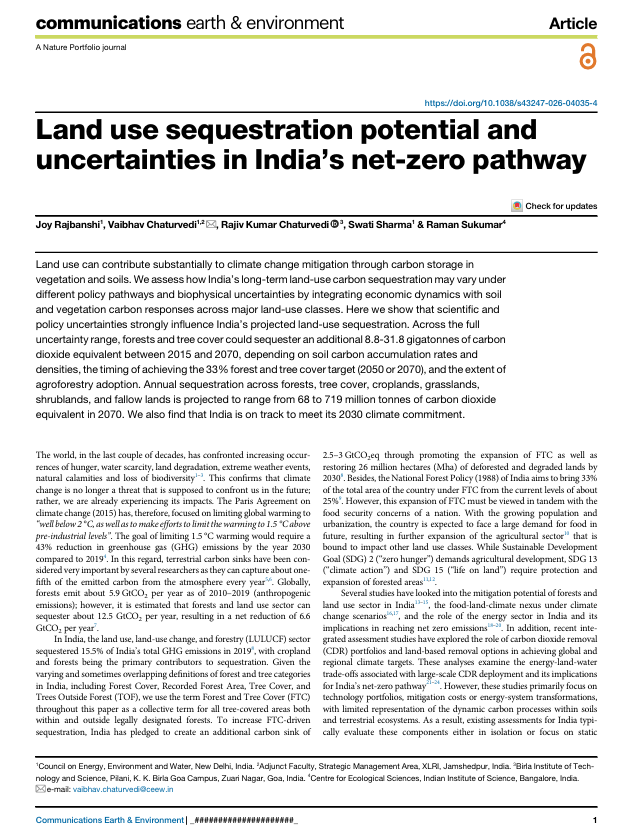
Land use sequestration potential and uncertainties in India’s net-zero pathway
Joy Rajbanshi, Vaibhav Chaturvedi, Rajiv Kumar Chaturvedi, Swati Sharma, Raman Sukumar
October 2026 | Low-carbon Economy
Suggested Citation: Rajbanshi, J., Chaturvedi, V., Chaturvedi, R. K., Sharma, S., & Sukumar, R. (2026). Land use sequestration potential and uncertainties in India’s net-zero pathway. Communications Earth & Environment.
Overview
Land-based carbon sequestration can make an important contribution to India’s transition to net-zero emissions. However, the scale and persistence of this contribution depend on how forests, croplands and agroforestry systems evolve over time, as well as on uncertainties in forest carbon density and soil carbon dynamics.
This study assesses India’s long-term land-use carbon sequestration potential under alternative forest policy, net-zero and agroforestry pathways. Using the Global Change Analysis Model (GCAM), complemented by India-specific modules for cropland soil organic carbon and rotational agroforestry, the study captures interactions between land-use change, agriculture, carbon dynamics and long-term climate policy.
The study finds that India’s land-based carbon sequestration potential varies substantially with policy choices and biophysical uncertainties. The timing of Forest and Tree Cover expansion, adoption of agroforestry, forest carbon density, and cropland soil carbon dynamics influence both the magnitude and persistence of the carbon sink. Accelerated forest expansion delivers higher near-term removals, while gradual expansion combined with agroforestry and rotational harvesting can sustain carbon sequestration over longer periods.
Key Highlights
- India’s land sector has substantial but highly uncertain carbon sequestration potential. Across the scientific and policy uncertainties assessed, forests and tree cover could sequester an additional 8.8-31.8 GtCO₂e between 2015 and 2070. Annual sequestration across forests, tree cover, croplands, grasslands, shrublands and fallow lands could range from 68 to 719 MtCO₂e by 2070.
- The timing of forest expansion is as important as the eventual forest area. Achieving the 33% Forest and Tree Cover target by 2050 could increase land-use sequestration to around 610 MtCO₂ per year by 2050. However, sequestration declines substantially after the target is reached as forests mature and their annual carbon uptake slows.
- A more gradual forest expansion pathway can sustain annual carbon removal for longer. Under a pathway that achieves the 33% Forest and Tree Cover target by 2070, annual land-use sequestration reaches 362 MtCO₂ in 2070, compared with 130 MtCO₂ under a pathway that achieves the same target by 2050. This shows that maximising near-term sequestration does not necessarily maximise the long-term contribution of forests to India’s net-zero pathway.
- Agroforestry can extend the duration of land-based carbon removal. The study finds that incorporating rotational agroforestry can sustain carbon uptake beyond the period when conventional forest expansion reaches its target. Under a pathway combining the 2070 Forest and Tree Cover target with net-zero energy transition and rotational agroforestry, annual sequestration reaches approximately 473 MtCO₂ in 2070.
- Cropland soil carbon is an important near-term sink, but its contribution declines over time. Croplands account for approximately 72% of total land-use sequestration until 2030, but their contribution falls sharply as soils progressively approach steady-state carbon levels. This decline substantially changes the composition of India’s land-based carbon sink over the long term.
- Scientific uncertainties can substantially change estimates of land-based mitigation. Differences in forest carbon densities and cropland soil-carbon maturation periods, combined with different forest expansion and agroforestry pathways, produce large differences in projected sequestration. The study therefore provides a range of potential outcomes rather than a single estimate of India’s future land-based carbon sink.
- India is on track to achieve its 2030 forest-based NDC target. Across the Forest and Tree Cover expansion pathways assessed, the current rate of expansion is sufficient to achieve India’s commitment to create an additional 2.5-3.0 GtCO₂ carbon sink by 2030 relative to the 2005 base year.
- Land-based removals complement, rather than replace, economy-wide emissions reductions. While forests, soils and agroforestry systems can provide significant carbon removals, their contribution is influenced by forest maturation, soil-carbon saturation, land competition and other biophysical factors. The study therefore highlights land-based mitigation as a complement to deep emissions reductions across the wider economy.
“India’s land-based carbon sink is substantial, but it is neither fixed nor permanent. The durability of sequestration will depend on how forests and agroforestry systems are managed over time, alongside the saturation of soil carbon and competing demands for land.”