Report
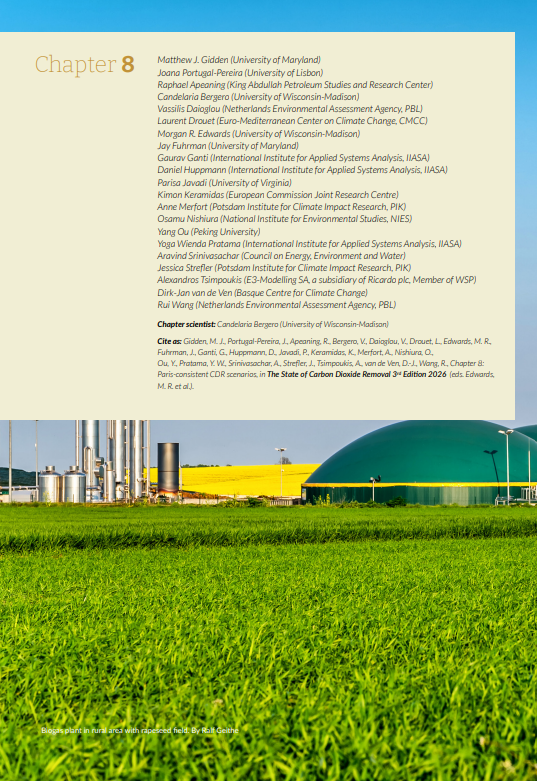
Chapter 8: Paris-consistent CDR scenarios
The State of Carbon Dioxide Removal 3rd Edition.
Aravind Srinivasachari
August 2026 | Low-carbon Economy
Citation: Gidden, M. J., Portugal-Pereira, J., Apeaning, R., Bergero, V., Daioglou, V., Drouet, L., Edwards, M. R., Fuhrman, J., Ganti, G., Huppmann, D., Javadi, P., Keramidas, K., Merfort, A., Nishiura, O., Ou, Y., Pratama, Y. W., Srinivasachar, A., Strefler, J., Tsimpoukis, A., van de Ven, D.-J., Wang, R., Chapter 8: Paris-consistent CDR scenarios, in The State of Carbon Dioxide Removal 3rd Edition 2026 (eds. Edwards, M. R. et al.).
Overview
As the world approaches the era of overshoot, carbon dioxide removal (CDR) is becoming increasingly central to the mitigation discourse. This study conducts a multi-model comparison of global and regional scenarios consistent with the Paris Agreement to evaluate the role of CDRs in mitigation pathways. Three pathways reflecting current ‘Targets & Pledges’, ‘Highest Ambition’, and ‘Delayed Ambition’ are compared to evaluate the scale, timing, composition, and feasibility of deploying CDRs with varying mitigation ambitions.
Key Highlights
- Direct emissions reductions must drive the vast majority of global climate mitigation. Under highest ambition pathways, CDR accounts for ~16% of the cumulative mitigation effort at the time when global net-zero is achieved, compared to 84% from direct emission reductions.
- Delaying ambitious climate action severely escalates late-century reliance on higher-risk novel CDR. Scenarios with a delayed mitigation ambition raises peak warming by approximately 0.15°C compared to highest ambition pathways and demands significantly higher post-2050 novel CDR deployment to draw temperatures back down to 1.5°C by the end of the century.
- Current national pledges already lock in gigatonne-scale carbon removal by mid-century. Even in scenarios that only follow current Targets & Pledges, novel CDR must reach gigatonne levels by 2050, accompanied by a major near-term expansion of conventional land-based carbon sinks.
- Developing sustainable CDR pathways requires an understanding of regional contexts. Regional pathways reflect country-specific priorities and capture localized feasibility constraints, which must be understood in tandem with global models highlighting cost-optimal, globally efficient trajectories. Reconciling these scales is critical: when regional constraints limit local deployment, it reveals exactly where other nations must increase their mitigation ambition to keep global climate targets within reach.
- Rapidly scaling carbon removal intensifies severe physical and socio-economic bottlenecks. Pushing CDR to massive scales raises deep sustainability concerns regarding land use, water demands, and ecosystem integrity, meaning that the co-benefits and adverse impacts of individual projects are heavily dictated by localized, real-world implementation.
Carbon dioxide removals (CDRs) will shape how the world navigates the overshoot era. Scenarios can help countries understand the scale, timing and composition of CDRs they would require, and better plan for their deployment to limit and reverse warming beyond 1.5°C.