Council on Energy, Environment and Water Integrated | International | Independent


Suggested Citation: Malik, Aman, Vaibhav Chaturvedi, and Rishabh Varma. 2026. Transition Risk Scenarios for India's Financial Sector: Adapting Global Frameworks to National Realities and Financial Stability Risks. New Delhi: Council on Energy, Environment and Water.
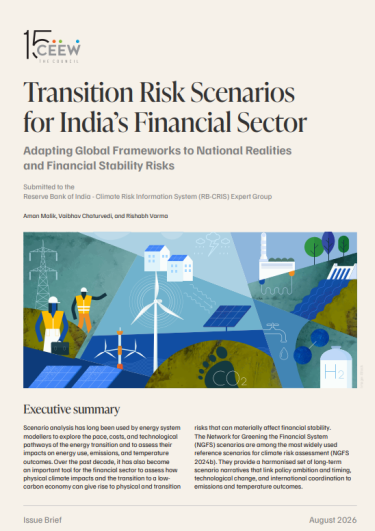
As climate-related financial risks become an increasingly important concern for central banks and financial regulators, scenario analysis has emerged as a key tool for assessing how the transition to a low-carbon economy could affect financial stability. While the Network for Greening the Financial System (NGFS) scenarios have become the global benchmark for climate risk assessment, they are designed as harmonised reference scenarios and may not adequately capture India's development priorities, energy system characteristics, or policy context.
This issue brief argues that India requires transition risk scenarios tailored to its own economic structure and financial system. Drawing on an extensive review of international climate stress- testing exercises, India-specific net-zero studies, and stakeholder consultations with financial sector experts, the study proposes a framework for designing India-specific transition scenarios. It identifies the key scenario drivers, modelling assumptions, and financial indicators needed to support climate stress testing by banks and financial institutions, while also illustrating how these elements can be translated into practical scenarios for the Indian context.
Scenario analysis has long been used by energy system modellers to explore the pace, costs, and technological pathways of the energy transition and to assess their impacts on energy use, emissions, and temperature outcomes. Over the past decade, it has also become an important tool for the financial sector to assess how physical climate impacts and the transition to a lowcarbon economy can give rise to physical and transition risks that can materially affect financial stability. The Network for Greening the Financial System (NGFS) scenarios are among the most widely used reference scenarios for climate risk assessment (NGFS 2024b). They provide a harmonised set of long-term scenario narratives that link policy ambition and timing, technological change, and international coordination to emissions and temperature outcomes.
While this standardisation is valuable for cross-country comparability, the limited contextual specificity of NGFS scenarios, as well as their inability to accurately capture national characteristics and development priorities, can constrain their usefulness for country-level risk assessments. NGFS itself notes that users may need to adapt scenarios to suit their needs (NGFS 2024b). Evidence suggests that a significant share of financial authorities already modify NGFS scenarios before applying them (NGFS 2024b). Supervisory exercises have similarly highlighted that while standardised scenarios improve comparability, they can obscure portfolio- and countryspecific risks, which reduces their relevance for nationallevel decision-making (NGFS 2024b). This study explores key design elements for constructing India-specific scenarios.
Beyond arguing for greater adaptation of existing national scenarios, this paper contends that transition risk scenarios developed for the financial sector should differ from traditional long-term decarbonisation scenarios. This is because financial-sector scenarios are intended to assess the resilience of financial institutions to transition-related risks, rather than to evaluate pathways for achieving decarbonisation goals. In particular, financial-sector scenarios should place greater emphasis on near-term shocks, geopolitical uncertainty, technology disruptions, policy uncertainty, and stranded assets that threaten financial stability. The paper, therefore, proposes a framework that links India-specific scenario drivers to financially relevant variables for climate stress testing and transition risk assessment. The proposed framework draws on two complementary sources of evidence. The scenario design elements are synthesised from the review of international transition risk exercises and Indiaspecific net-zero studies, while the financial indicators are informed by stakeholder consultations to reflect the variables considered most relevant for climate stress testing in the Indian financial sector.
This study reviews scenario frameworks used in transition risk assessments, including NGFS and a range of bespoke or modified scenario approaches used by central banks and financial institutions. It also reviews India-focused netzero and deep decarbonisation studies (see Annexure 1) to identify key drivers shaping India’s emissions and energy pathways. Across this literature, several India-relevant uncertainties emerge consistently. These include the ambition and timing of climate policy; macroeconomic growth trajectories (including the composition of growth); the availability and cost of critical technologies such as carbon capture and storage (CCS) and green hydrogen; and physical and resource constraints, including land, water, and critical minerals. While social and political constraints are frequently acknowledged, they are often not explicitly embedded in scenario design.
Based on this literature review as well as conversations with experts, the study outlines key design considerations for an India-specific scenario framework.
First, scenario narratives should include sufficiently divergent pathways, including the possibility of large shocks, particularly in the near term, given the role of scenario analysis in stress testing and the non-linear nature of climate and transition risks. Second, policy ambition and timing, along with technology availability and adoption, should remain core drivers of scenarios, but they should be tailored to India’s circumstances and aligned with national development objectives. Third, geopolitical developments and international policy coordination may be as important as domestic policy, particularly for exportoriented, emissions-intensive sectors that may be exposed to external policy shifts and trade-related transition risks.
The paper highlights that it is important for the financial sector to understand the impact of mitigation policies on (i) economic growth; (ii) revenue and operational costs (mediated through carbon prices); and (iii) stranded assets. It then proposes key aspects that could affect these three variables, identifies exogenous variables that could be varied in models and scenarios to reflect these aspects, and finally presents illustrative scenarios based on variations in the exogenous variables that could be relevant for the financial sector.
Overall, while the NGFS scenarios are a useful starting point and provide an important basis for standardisation, India’s climate risk assessment needs would be better served by a tailored scenario framework that reflects its domestic priorities, constraints, and near-term uncertainties. At the same time, given the widespread adoption and ongoing evolution of NGFS scenarios, India should also engage with NGFS to improve India-specific assumptions, sectoral representation, and policy coverage within global scenario frameworks. Finally, this study argues that the scenarios required for the financial sector should differ from those used in other exercises. Financialsector scenarios should centre on issues that could lead to direct shocks to the financial sector as well as affect it through various macroeconomic channels, such as investments and inflation, rather than issues that have traditionally been central to the broader India-specific scenario literature, which often focus on objectives such as equity, renewable energy deployment, or energy security.
Scenarios and scenario analyses were originally developed by energy system modellers and are widely used to gain insights into the pace, costs, technological choices, and impacts of the energy transition, particularly on energy consumption, production, emissions, and temperature outcomes. Since 2016, however, scenario analysis has increasingly been deployed across other disciplines, most notably in the financial sector, for climate risk assessment.
Two key factors led to this shift. First, there is growing recognition that both the physical impacts of climate change, as well as the policies and technological changes aimed at limiting warming, can have profound implications for financial system stability (NGFS 2020b). These risks, commonly referred to as physical and transition risks, can amplify traditional credit, market, and liquidity risks. Second, given the unprecedented scale and nature of these risks, and the inherent uncertainty about future trajectories assessing them using standard risk modelling methodologies and historical data is difficult (NGFS 2020a). As a result, forward-looking tools such as scenario analysis are increasingly viewed as better suited to understanding and assessing these emerging risks (NGFS 2024b).
One of the most widely used scenario sets developed for the financial community is by the Network for Greening the Financial System (NGFS). These long-term scenarios provide multiple narratives about key variables that affect the world’s emissions and temperature outcomes, thereby impacting physical and transition risks. Although NGFS scenarios provide a standard reference for crosscountry analysis, their limited contextual specificity and granularity may constrain their usefulness for countrylevel assessments (Dhandhania et al. 2026; NGFS 2024).
Despite these limitations, NGFS scenarios are widely used for various purposes. First, they provide a globally harmonised and publicly accessible framework. Second, they are developed in partnership with central banks, supervisory organisations, and academic modelling teams, which gives them institutional credibility. Finally, in many countries, especially where domestic climate scenario frameworks are still evolving, NGFS scenarios provide a practical starting point that institutions can adapt to their specific analytical needs.
In fact, NGFS acknowledges that users “may need to adapt the scenarios further to suit their particular needs” and “should seek to tailor their analyses” by adding risk assessment tools to address missing climate risk drivers (NGFS 2024b, p. 2). According to the NGFS Survey on Climate Scenarios, more than half of all financial authorities adjusted NGFS scenarios for their own use cases before utilising them (NGFS 2023). Furthermore, the Federal Reserve Bank of the United States of America conducted a pilot climate risk exercise with six banks in 2023 (which may not be captured in the NGFS survey). The authors noted that “while standardised scenarios may result in greater consistency and comparability across participants, standardisation limits participants’ ability to tailor scenarios to risks most material to their portfolios and could obscure idiosyncratic risks and stifle innovation as practices continue to evolve” (Sullivan and Cromwell LLP 2024, p. 3).
Using India as a case study, Dhandhania et al. (2026) demonstrate that NGFS scenarios, in their current form, only partially capture country-specific characteristics and inadequately reflect evolving policy priorities. Consequently, these scenarios may either overestimate or underestimate both the timing and magnitude of a country’s transition risk exposure. In the Indian context, the credibility of globally harmonised models may be determined by how well they capture country-specific transition dynamics and vulnerabilities. For example, India’s continued dependence on coal across multiple sectors, concentrated exposure of financial institutions to emissions-intensive industries, and existing financial patterns can influence both the pace and distribution of transition risks (Dhandhania et al. 2026; NGFS 2024). While all nations may experience some common global effects of climate change and the energy transition, each nation’s transition pathway will be shaped by the unique characteristics of its development trajectory, which should form the foundation of its transition scenarios (Chaturvedi 2021). Thus, there is a critical need to develop India-specific scenarios for transition risk assessment.
This study not only identifies key design considerations for developing an India-specific scenario framework, but it also proposes that transition risk scenarios designed for the financial sector may need to differ from conventional long-term decarbonisation scenarios. Section 2 reviews the literature on scenario frameworks used in global risk assessment exercises and on scenarios developed in India-focused net-zero studies. Section 3 presents a framework for designing India-specific scenarios. Section 4 synthesises the findings from Sections 2 and 3, and Section 5 summarises the key conclusions and outlines the way forward.
To understand how scenario frameworks and narratives have evolved in the context of transition risk assessment, we review (i) the scenario framework from the NGFS; (ii) transition risk assessments using bespoke scenarios and those adapted from NGFS scenarios; and (iii) scenarios from India-specific net-zero or deep decarbonisation studies. The latter are not transition risk assessment studies but rather India-specific literature that explores the key uncertainties in net-zero pathways.
The NGFS scenario framework
NGFS scenarios model a range of plausible outcomes based on assumptions about policy ambition, policy timing, policy coordination across regions, the pace and scale-up of technologies, and the availability of carbon dioxide removal methods (see Figure 1) (NGFS 2020). The figure maps key features of the scenario narratives and their macro-financial risk implications stemming from transition or physical risks. Green means “low risk”, teal means “medium risk”, and grey means “high risk”.
The assumptions underlying each driver form a scenario narrative. For example, an “Orderly” scenario (with low macro-financial risk) has two narratives: one in which the world reaches net zero in 2050 (Net Zero 2050), and another in which the global average temperature increases but below 2°C (Below 2°C). The overall risk of this scenario is low because the slightly higher near-term risks associated with immediate policy action and rapid technological change are partially offset by the much lower long-term risks associated with lower climate impacts and reduced reliance on carbon dioxide removal. The risks associated with each driver are also colourcoded in Table 1.
Table 1. Overview of Network for Greening the Financial Sector (NGFS) scenarios by key assumptions.
| Physical risk | Transition risk | ||||||||
|---|---|---|---|---|---|---|---|---|---|
| Quadrant | Scenario | End of century (peak) warming (model averages) | Policy reaction | Technology change | Carbon dioxide removal | Regional policy variation | |||
| Orderly | Low Demand | 1.1 °C (1.6 °C) | Immediate | Fast change | Medium use | Medium variation | |||
| Net Zero 2050 | 1.4 °C (1.7 °C) | Immediate | Fast change | Medium-high use | Medium variation | ||||
| Below 2 °C | 1.8 °C (1.8 °C) | Immediate and smooth | Moderate change | Medium use | Low variation | ||||
| Disorderly | Delayed Transition | 1.7 °C (1.8 °C) | Delayed | Slow/Fast change | Medium use | High variation | |||
| Hot house world | Nationally Determined Contributions (NDCs) | 2.3 °C (2.3 °C) | NDCs | Slow change | Low use | Medium variation | |||
| Current Policies | 3.0 °C (3.0 °C) | None – current policies | Slow change | Low use | Low variation | ||||
| Too-little-too-late | Fragmented World | 2.4 °C (2.4 °C) | Delayed and Fragmented | Slow/Fragmented change | Low-medium use | High variation | |||
Source: Network for Greening the Financial System. 2024a. “NGFS Climate Scenarios Technical Documentation v 5.0.”
Note: Colour coding indicates whether the characteristic makes the scenario more or less severe from a macro-financial risk perspective^
– The impact of CDR on transition risk is twofold: on the one hand, low levels of CDR imply an increase in transition costs, as reductions in gross emissions should be obtained in a different way; on the other hand, high reliance on CDR is also a risk if the technology does not become more widely available in the coming years.
+ Risks will be higher in the countries and regions that have stronger policy. For example, in Net Zero 2050, various countries and regions reach net zero GHG by 2050, while many others have emission of several Gt of CO₂eq.
^ This assessment is based on expert judgment based on how changing this assumption affects key drivers of physical and transition risk. For example, higher temperatures are correlated with higher impacts on physical assets and the economy. On the transition side economic and financial impacts increase with a) strong, sudden and/or divergent policy, b) fast technological change even if shadow carbon price changes are modest, c) limited availability of carbon dioxide removal meaning the transition must be more abrupt in other parts of the economy, and d) stronger policy in those countries and/or regions.
The scenarios can also be understood as a spectrum of “mitigation versus adaptation”. Higher physical risk means higher adaptation needs but lower mitigation needs, and vice versa. Conversely, scenarios based on Nationally Determined Contributions (NDCs) and current policies, while associated with low to medium transition risk, fall in the high physical risk category due to higher temperature outcomes, leading to a Hot-house world with high adaptation requirements. Table 2 provides a concise description of each category.
Table 2. Key drivers of uncertainty in Network for Greening the Financial Sector (NGFS) scenarios
| Types of shocks /drivers of uncertainty | Description |
|---|---|
| Policy ambition | Global temperature outcome resulting from the stringency or lack of policy ambition. For example, the long-term global temperature outcome will be 1.4°C if the world reaches net zero by 2050, but with current policies, it will be over 3°C |
| Policy timing and reaction | When, how, and with what stringency are the policies introduced? |
| Technological change and availability |
Includes two categories: The rate of technological change and adoption and the availability of carbon dioxide removal technologies |
| Policy coordination | Variations in regional policies among countries. How much do countries collaborate on climate action? |
Source: Authors' analysis
Scenario formulations used in transition risk exercises
While the NGFS scenarios provide a globally harmonised starting point for climate risk assessment, central banks and financial institutions frequently find it necessary to either use (i) alternative and proprietary scenarios for climate risk assessment; or (ii) build scenario narratives along the lines of the NGFS but use their own models to control for assumptions and data points. For these two broad classifications, we discuss the purpose of the exercise and the scenarios, along with their descriptions.
Alternative and proprietary bespoke scenarios in transition risk assessment
Several central banks and financial institutions have developed bespoke transition scenarios to complement or substitute globally harmonised frameworks such as the NGFS. These exercises are generally designed to address institution-specific objectives, incorporate country-specific economic and policy conditions, or explore particular dimensions of transition. The following examples illustrate a range of approaches adopted in the literature and practice:
De Nederlandsche Bank study
One of the earliest climate stress-testing and scenario analysis exercises undertaken before the NGFS framework was conducted by De Nederlandsche Bank (Vermeulen et al. 2021). The primary aim of the study was to develop a climate stress-testing framework based on existing financial stress-testing practices, with a focus on assessing the resilience of the Dutch financial system to disruptive changes rather than producing central-path projections. The framework was intended primarily for use by financial supervisory organisations and regulators.
Scenario formulation was based on two key drivers: (i) the stringency of climate policy; and (ii) the availability of low-carbon technologies. These were chosen because of their high uncertainty and their potential to trigger abrupt, non-linear changes in the economy.
Combining these two dimensions resulted in four stress scenarios:
• A strong and sudden tightening of climate policy in the absence of major technological change
• A positive technological shock characterised by rapid breakthroughs in low-carbon technologies without accompanying policy action
• A combined scenario featuring simultaneous policy tightening and technological breakthroughs
• A delayed transition scenario with neither climate policy nor technological developments, leading to prolonged policy uncertainty and subdued investment in low-carbon technologies
These scenarios were then translated into macroeconomic and sector-specific outcomes using multiple modelling approaches (Vermeulen et al. 2021).
Ortec Finance
Ortec Finance, in partnership with Cambridge Econometrics, offers proprietary climate scenarios. They provide five scenarios, with two variants specifically designed for high-stress testing. These scenarios are designed to translate a wide range of plausible climate futures into quantified financial impacts across economies, asset classes, sectors, and regions. The primary purpose of these scenarios is to support institutional investors such as pension funds in measuring, monitoring, and managing climate-related risks. One of the key advancements in Ortec’s framework is that its models capture the endogeneity of the financial system in risk materialisation, i.e., they also account for the financial system’s response to risks. The five scenarios are as follows:
• Net Zero: An ambitious but orderly transition with climate adaptation, characterised by highly ambitious low-carbon policies, a rapid technology transition, and low physical risks
• Net Zero Financial Crisis: A stress version of the Net Zero scenario, where sudden divestments to align with Paris Agreement goals disrupt financial markets, leading to repricing, stranded assets, and sentiment shock
• Delayed Net Zero: Financial markets price in transition and physical risks in 2030, leading to stranded assets and sentiment shock
• Limited Action: Evaluates the implications of failing to meet emissions targets, leading to high exposure to chronic and acute physical risks, with markets pricing in lower performance due to lost productivity and extreme weather
• High Warming: Assesses a future without further policy action, triggering multiple climate tipping points and very severe physical risks, with financial markets pricing in risks as their scale becomes widely accepted
Additional stress variants of these scenarios explore deeper tail risk outcomes, including systemic stress or complete market collapse under worst-case assumptions.
No Time To Lose (NTTL) scenarios used by the Universities Superannuation Scheme (USS)
USS is one of the largest private pension schemes in the United Kingdom (UK). As part of its Task Force on Climate-Related Financial Disclosures (TCFD) mandate, in 2022, it undertook a climate risk assessment using NGFS scenarios. However, it identified “significant limitations” in the available approaches and shared these concerns with other industry experts in the Real World Climate Scenarios (RWCS) initiative. These perceived limitations stemmed from scenarios “failing to capture key aspects of the real world, including acute physical risk, politics and policy, unemployment, finance, asset prices, volatility, tipping points, path dependency and complex feedback loops” (University of Exeter and Universities Superannuation Scheme 2025, p. 6), which in turn produced implausible and partial narratives and reduced the practical usefulness of the scenarios, especially in the near term.
To address these gaps, USS and the University of Exeter developed global “Decision Useful Climate Scenarios” for up to 2030. Both the short-term as well as the “realism and decision-useful” criteria of the framework, led to the development of two key groups of scenario drivers: (i) politics and policy; and (ii) economics and markets. The former captures uncertainties around geopolitics – policy coordination or lack of cooperation among countries – and policy stringency and timing. The latter captures business and consumer dynamism – shifts in technological innovation and deployment – and changes in consumer preferences, acceptance of green policies, and the impacts of climate change. These drivers resulted in four scenarios:
• Roaring 20s: Policy and markets align. Constructive competition between nations accelerates technological progress and deployment. Proactive climate policies and dynamic markets create powerful positive feedback loops.
• Green Phoenix: A cleaner market-driven transition occurs in the absence of strong policy leadership, but it is fragile and prone to volatility.
• Boom and Bust: Policy steps up after the fossil fuel surge bursts, triggered by energy price shocks that lead to boom cycles, central bank tightening, and financial crashes, followed by a partial recovery.
• Meltdown: Policy failures compound weak growth. This scenario is characterised by geopolitical fragmentation, energy trade wars, inflation spikes, and a global recession.
The Hong Kong Monetary Authority (HKMA) Climate Risk Stress Test (CRST 2.0)
The Hong Kong Monetary Authority (HKMA) conducted its second round of a sector-wide Climate Risk Stress Test (CRST 2.0) in March 2025 (Hong Kong Monetary Authority 2024). CRST 2.0 employed two distinct sets of scenarios: a short-term scenario (until 2027) featuring simultaneous climate-related shocks from extreme events and a global economic downturn leading to regional recession, and three long-term scenarios adopted directly from the NGFS framework.
This dual focus on short-term shocks and long-term trends reflects a comprehensive approach to climate risk, acknowledging both immediate vulnerabilities and gradual, structural shifts. The participating banks were provided with scenario variables and assumptions, including sectoral implications and macroeconomic indicators. HKMA also identified 11 business sectors for transition risk assessment. These sectors were either high-emitting industries or those that tend to be severely affected by transition policies, such as steel, non-ferrous metals, and paper.
Scenario framework derived from the NGFS framework and using additional modelling approaches
According to the NGFS survey, several respondents use additional modelling approaches to augment NGFS macroeconomic variables, integrate alternative macroeconomic models, or modify NGFS scenarios to constrain outputs based on their own macroeconomic models (NGFS 2021). The following examples illustrate transition risk exercises that use such approaches.
Bank of Canada
As part of its transition risk exercise, the Bank of Canada decided to construct its own scenarios while drawing on NGFS narratives. Their scenarios differed in terms of two key drivers: (i) the ambition and timing of climate policy; and (ii) the pace of technological change, including the availability of carbon dioxide removal (CDR) technologies (Chen et al. 2022; Hosseini et al. 2022). This led to four scenarios: Current policies, Below 2°C Immediate, Below 2°C Delayed, and Net Zero 2050. These scenario narratives broadly mirror those used by the NGFS.
The main aim of the Bank of Canada in developing its own scenarios was to provide economic and financial data at an appropriate geographic and sectoral granularity (Chen et al. 2022; Hosseini et al. 2022). In other words, by constructing scenario narratives along the lines of the NGFS while using its own modelling framework and data, the Bank of Canada was able to achieve standardisation through NGFS narratives while retaining greater control over assumptions, sectoral granularity and policy implementation in the models.
Goldman Sachs’ Climate Aware Capital Market Assumptions model
Goldman Sachs uses the Climate Aware Capital Market Assumptions model to conduct portfolio risk assessments. The model starts with NGFS scenarios but incorporates additional assumptions relating to transition and physical risks by applying a bottom-up abatement cost curve1 and a proprietary physical risk damage function2 (Goldman Sachs 2024). Specific variables from this analysis are used to determine the potential economic and financial impacts of the transition through Goldman Sachs’ Probabilistic Graphical Model (PGM).
The Bank of England’s Climate Biennial Exploratory Scenario (CBES)
The Bank of England’s Climate Biennial Exploratory Scenario (CBES) includes three scenarios that explore both transition and physical risks. The exercise considered two possible routes to net-zero UK greenhouse gas emissions by 2050: an Early Action (EA) scenario and a Late Action (LA) scenario. A third No Additional Action (NAA) scenario explores the physical risks that would materialise if governments around the world fail to enact policy responses to global warming.
The scenarios are built on NGFS scenarios but include “additional risk transmission channels and adding additional variables” (Bank of England 2021, “2.2: Scenarios”). These include labour market frictions to simulate the reallocation of labour towards low-carbon sectors, as well as larger financial market shocks (Bank of England 2021).
HSBC’s climate scenario analysis
HSBC’s climate scenario analysis considers both physical and transition risks. In its 2023 scenario analysis exercise, HSBC developed four scenarios based on publicly available climate scenarios, including those produced by the NGFS, the Intergovernmental Panel on Climate Change (IPCC), and the International Energy Agency (IEA). HSBC adapted these external templates to reflect the specific climate risks and vulnerabilities faced by the bank and its customers across different business sectors and regions, resulting in a set of scenarios that vary in severity.
• The Current Commitments scenario assumes that climate action is limited to existing government commitments, resulting in a global temperature increase of around 2.4°C by 2100.
• The Delayed Transition Risk scenario assumes climate action is postponed until 2030, followed by a late and disorderly shift towards net zero that is nonetheless stringent and rapid enough to limit warming to below 2°C by 2100. HSBC uses this scenario to stress-test the impacts of severe yet plausible transition risks.
• The Downside Physical Risk scenario assumes that climate action remains limited to currently implemented policies, resulting in extreme warming exceeding 4°C by 2100. This scenario is used to assess the physical risks associated with intensified climate impacts.
• The Near Term scenario assumes a sharp increase in climate policies that triggers a disorderly transition towards net zero, alongside a marked rise in extreme climate events over a five-year period to 2027. This scenario focuses specifically on HSBC’s business exposure in Asia.
Key insights from the literature review
Across these exercises, several cross-cutting lessons emerge that are relevant for designing India-specific transition risk scenarios. First, although NGFS scenarios often serve as a common starting point, many institutions (including Goldman Sachs, the Bank of Canada, the Bank of England, and HSBC) adapt them to improve sectoral granularity, regional relevance, or policy representation. Second, several exercises (including those by De Nederlandsche Bank, HSBC, the Bank of England, the Hong Kong Monetary Authority, and USS) increasingly emphasise the importance of near-term shocks and disorderly transitions, where abrupt changes in policy, technology, financial markets, or energy prices may generate material financial risks. Third, uncertainty around policy timing, policy coordination, and technological change consistently emerges as a key determinant of transition pathways in several exercises (Bank of Canada, De Nederlandsche Bank, USS, and Ortec Finance). Finally, several frameworks (USS, Bank of Canada, and Hong Kong Monetary Authority) increasingly recognise the role of geopolitical fragmentation, trade disruptions, and international policy influences in shaping transition risk outcomes.
These lessons are particularly relevant for India, where transition pathways are closely linked to development priorities, industrial growth, trade exposure, and energy security concerns. Consequently, we contend that India-specific scenarios must place greater emphasis on macroeconomic shocks, policy uncertainty, external trade measures, and technology access constraints than is typical in globally harmonised scenario frameworks.
India-specific scenarios of decarbonisation
As noted in Section 2.1, transition risk scenarios should incorporate key sources of uncertainty within their analytical framework. This section focuses on Indiaspecific studies that examine key drivers shaping future emissions and energy-mix trajectories. A growing body of modelling studies has explored pathways for India to achieve deep decarbonisation and net-zero emissions. While some studies adopted an economy-wide perspective, others focused on specific sectors. Table A1 in Annexure 1 lists the studies reviewed. Only studies published from 2020 onwards were included, resulting in a total sample of 12 studies. Below, we highlight key insights from this literature.
Policy ambition and timing
A number of studies have investigated how the timing and stringency of policies shape decarbonisation pathways in India. Policy stringency has been examined through alternative carbon-budget formulations (Mathur and Shekhar 2020; Bhattacharya et al. 2024), differing global temperature outcomes (e.g., 1.5°C and 2 °C) (Dhar, Pathak, and Shukla 2020), or through the choice of net-zero year (Chaturvedi and Malyan 2022; A. Das et al. 2023a). Policy timing has been explored through early- and delayed-transition scenarios (Malik et al. 2020; Mathur and Shekhar 2020) and alternative peaking and net-zero years (Chaturvedi and Malyan 2022). Studies show that both policy stringency and timing significantly affect the required pace of the transition and its feasibility.
Macroeconomic drivers
Future energy demand is a key determinant of emissions trajectories and is driven by macroeconomic variables that are inherently uncertain.
• GDP and manufacturing growth: Garg et al. (2024) and Das et al. (2025) model scenarios based on high, medium, and low GDP growth rates. A “High Growth” (HG) scenario, particularly one where growth is driven by a high share of manufacturing activity (aligned with Viksit Bharat), could significantly increase energy demand and emissions, potentially negating reductions achieved through other interventions.
• Urbanisation and income inequality: Das et al. (2025) model scenarios exploring high urbanisation rates and variations in urban–rural income equity. While higher urbanisation increases electricity demand, this may be partially offset by lower rural demand.
• Economic shocks: Sudden and unexpected disruptions of economic activity can be described as economic shocks. Such shocks can alter growth trajectories and affect the pace and feasibility of decarbonisation by constraining investment capacity, delaying technology adoption, or changing sectoral demand patterns. Unforeseen disruptions, such as pandemics and geopolitical conflicts, create uncertainty through disruptions in energy markets, trade flows, critical mineral supply chains, and international climate cooperation. The IEA (2021) includes a Delayed Recovery Scenario, in which the prolonged economic impacts of the COVID-19 pandemic suppress energy demand and investment capacity. Similarly, Das et al. (2025) model an Economic Shocks scenario, where growth dips to zero periodically, drastically reducing long-term energy demand.
Technology availability, maturity, and cost
A central uncertainty across studies is whether critical breakthrough technologies will be commercially available and cost-competitive in time to meet net-zero targets.
• Carbon Capture and Storage (CCS): Several scenarios hinge on the availability of CCS to mitigate emissions from the industrial sector and thermal power plants. Chaturvedi and Malyan (2022) model scenarios in which CCS is either “available” or “unavailable”, noting that without CCS, the share of fossil fuels must decline drastically to 5–6 per cent by the net-zero year. Conversely, Garg et al. (2024) note that CCS is currently an “untested technology” in India with uncertain economic viability and geological storage potential. Similarly, Vishwanathan et al. (2023), who do not explicitly model CCUS in their scenarios, identify it as a major source of uncertainty due to social acceptability, geological constraints, and potential environmental risks.
• Green hydrogen: The commercial maturity of green hydrogen is a major source of uncertainty. Scenarios differ on whether hydrogen will successfully penetrate hard-to-abate sectors such as heavy transport and steel. If hydrogen technologies do not mature, the transport sector will become heavily dependent on electrification, and industrial decarbonisation will become significantly more difficult. Garg et al. (2024) also note substantial uncertainty around hydrogen uptake and cost assumptions.
• Nuclear power: The scalability of nuclear power is uncertain due to constraints relating to technology transfer, fuel availability, and capital costs. Das et al. (2023) performed a sensitivity analysis of nuclear capacity, limiting it to 30 GW in some scenarios due to historically slow progress, whereas other scenarios envision much higher uptake by 2070. Garg et al. (2024) also construct specific net-zero scenarios with a greater emphasis on nuclear power.
• Renewable energy and storage costs: While solar and wind costs have fallen, future cost trajectories remain uncertain. Das et al. (2023) model both “fast” and “slow” decline rates for capital costs.
Resource and physical constraints
Deploying renewable energy infrastructure introduces significant uncertainties relating to land, water, and minerals, especially in a highly populated, water-stressed country like India.
• Land availability and water security: Achieving net zero requires substantial land to support solar and wind farms. Gupta et al. (2022) estimate that growth and decarbonisation combined may require 45 million hectares beyond currently available land resources in an accelerated scenario. This creates risks of social conflict and implementation delays. Vishwanathan et al. (2021) highlight water scarcity as a critical constraint often overlooked in energy modelling. In water-constrained scenarios, thermal power plants face “stranded asset” risks due to water shortages, necessitating a shift to drycooling technologies or renewable energy sources. This, in turn, can alter the cost and mix of electricity generation. Several other studies also identify land and water availability as critical physical constraints that can limit progress towards net-zero targets (Chaturvedi and Malyan 2022; IEA 2021; Malik et al. 2020; Vats and Mathur 2022).
• Critical minerals: The transition from fossil fuels to renewable energy shifts dependence from oil and gas to critical minerals, such as lithium, cobalt, and copper, which are essential inputs for batteries and electrical grids. Garg et al. (2024) note that India lacks domestic sources for many of these raw materials, creating supply-chain vulnerabilities and increasing import dependence.
• Social constraints: Social constraints include a lack of acceptance by interest groups such as fossilfuel labour unions, consumer groups, and industry associations, as well as by the broader public of technologies such as nuclear energy and CCS. These constraints are important and are mentioned qualitatively in several modelling studies, but they are not specifically incorporated into scenario design (Chaturvedi and Malyan 2022; Gupta et al. 2022; Bhattacharya et al. 2024).
The discussion here does not focus on physical climate risks in the conventional sense, such as extreme weather events. Rather, it focuses on physical and resource constraints that can shape transition pathways. Land availability, water stress, and access to crucial minerals can all affect energy system choices, thereby influencing transition risks. As a result, these constraints interact with transition paths, making them relevant to transition risk assessment.
Objectives and key considerations for India-specific transition scenarios
In Section 2, we discussed the design of the NGFS scenario framework, along with transition risk studies that either use bespoke scenarios or modify NGFS scenarios. We also classified and discussed the broad types of scenarios used in net-zero studies specific to India.
According to the NGFS, a best practice scenario users should follow is providing a narrative or qualitative explanation of what the exercise is designed to achieve and how the scenario narrative achieves that objective (NGFS 2024b). Thus, creating scenario narratives or frameworks requires clarity about the ultimate application of the scenarios. In India’s case, the Reserve Bank of India’s (RBI) Draft Disclosure Framework on Climate-related Financial Risks (2024) indicates that scenario analysis will be used for two purposes: (i) “to enhance transparency and accountability and empower financial institutions to address climate-related risks proactively” (Bandyopadhyay 2024, p. 10); and (ii) to enable the RBI to collate risk assessment exercises from banks and assess systemic risk at the national level. Accordingly, this paper proposes an India-specific transition scenario framework designed to support the assessment of transition risks in the banking sector.
Principles for designing India-specific transition scenarios
Based on discussions with experts from India’s banking sector, this paper finds that the impact of mitigation policies on several critical variables needs to be better understood from a transition risk perspective. These variables are (i) economic growth; (ii) revenues and operational costs mediated through carbon and energy prices; and (iii) stranded assets. Focusing on these three variables will help the banking sector better understand credit risks. These variables can be influenced through a variety of channels. An India-specific scenario exercise should therefore seek to better understand and establish links between exogenous model inputs and assumptions and these three variables.
This study focuses on economic growth, carbon and energy prices, and stranded assets, as they provide a tractable set of indicators that can be translated into modelling assumptions and stress-testing exercises. Stranded asset risks may be especially relevant in India for coal-fired power generation, coal mining, and emissions-intensive industrial sectors such as iron and steel and cement, where rapid transition pathways could impair asset utilisation and profitability.
In addition, inflation, business profitability, repayment capability, refinancing risk, and asset valuation are all important financial variables to consider when assessing transition risks. However, many of these are influenced by the three selected variables. The impact of key aspects of decarbonisation scenarios across these indicators is presented in Table 3.
Table 3 combines evidence from two complementary sources. The transition scenario dimensions presented in the table are synthesised from the literature review presented in Section 2, including international climate scenario exercises and India-specific transition studies. The financial indicators, in contrast, have been informed through stakeholder consultations with the Reserve Bank of India, commercial banks, and other experts involved in climate risk assessment, reflecting the variables considered most relevant for financial-sector stress testing in the Indian context.
Based on this understanding and the literature review in Section 2, the following elements should be considered when developing India-specific scenarios.
Table 3. Impacts of key aspects of decarbonisation scenarios on economic growth, carbon prices, and stranded assets for India
| Modelling-related aspects (Based on literature review) |
Economic growth | Carbon prices | Stranded assets |
|---|---|---|---|
| Global economic growth and governance | ↑ Higher global economic growth and robust governance would enhance India's economic growth | – No direct impact | – No direct impact |
| Unilateral trade related measures (e.g. CBAM) | ↓ CBAM could negatively impact GDP | ↑ CBAM implies higher carbon prices for exporting sectors | – No direct impact |
| Rate of decline in low-carbon technologies' costs and efficiency | ↑ Rapid reduction in low-carbon tech costs could enhance GDP | ↓ Rapid reduction in low carbon tech costs could reduce carbon prices | ↑ Rapid reduction in low-carbon tech costs could lead to stranded fossil-fuel assets if the operational costs of running fossil energy is higher than the cost of new investments in low-carbon tech; overinvestment in RE could also lead to stranded assets |
| Innovation-led technology shocks, i.e. rapid reduction in low-carbon tech costs (e.g. new solar power technology or nuclear technology) | ↑ Innovation leads to higher economic growth | ↓ Sudden reduction in near-term carbon prices and long-term expectations of carbon prices | ↑ Higher chances of stranded assets in the fossil sector |
| Modelling-related aspects (Based on literature review) |
Economic growth | Carbon prices | Stranded assets |
|---|---|---|---|
| Mitigation policy stringency/ambition | ↑/↓ Higher mitigation ambition could decrease or increase economic growth, depending on many variables | ↑ Higher ambition implies higher shadow carbon prices |
↑ Higher mitigation ambition could lead to more fossil-fuel stranded assets Higher ambition could also lead to higher near-term overinvestment in low-carbon energy |
| Mitigation policy certainty (shocks) | ↓ Negative impact on economic growth | ↑ A sudden jump in carbon prices | ↑ More stranded fossil-fuel assets |
| Global climate policy stringency | ↑/↓ Depending on various channels of impact, the effect of stringent global climate policy could be negative or positive, e.g., India would gain from lower fossil imports, but it might lose through other impact channels | ↑ Higher imported energy prices due to higher carbon prices outside India | – No direct impact |
| Global climate policy certainty and coordination (shocks) | ↓ Sudden changes in global climate policy could negatively impact economic growth | ↑ A jump in global carbon prices and consequently energy prices | – No direct impact |
| Climate finance availability | ↑ Positively impact GDP growth | ↓ More climate finance availability would imply a stronger push for low-carbon technologies and hence lower carbon price | – No direct impact |
Source: Authors’ analysis
Note: CBAM - Carbon Border Adjustment Mechanism; GDP - gross domestic product The impacts shown are illustrative and intended to demonstrate the analytical framework. Actual impacts would be derived from model simulations under the respective scenarios.
1. Scenario narratives should incorporate significant shocks, particularly in the near term. A number of international transition risk exercises reviewed in Section 2.2, including those by De Nederlandsche Bank, the Hong Kong Monetary Authority, and HSBC, as well as the No Time To Lose (NTTL) scenarios developed by Universities Superannuation Scheme, explicitly explore abrupt policy, technology, financial market, or macroeconomic disruptions. Similarly, some India-specific studies reviewed in Section 2.3 incorporate delayed recovery and economic shock scenarios. Given the uncertainties around transition risks, the use of scenario analysis for climate stress testing, and the literature reviewed in this paper, there is a strong case for exploring a wide range of plausible futures. India-specific scenario narratives should therefore include major shocks that affect key assumptions in both the transition and physical risk categories.
2. Policy ambition, policy timing, and technological availability and adoption are critical scenario drivers. Across all three strands of literature reviewed in Section 2, policy timing and stringency, together with technological change, emerge as foundational drivers of scenario pathways. NGFS scenarios, transition risk assessments using bespoke scenarios, and Indian-specific net-zero studies all indicate that policy timing, policy stringency, and technological developments are central to scenario analysis. However, these need to be tailored to India’s specific circumstances, development priorities, and policy objectives, which are aligned with the broader strategic objectives of the Government of India.
3. Geopolitical developments and international policy coordination should be treated as key sources of uncertainty. Although no India-specific net-zero studies explicitly explore the uncertainty arising from changes in international climate policy, a number of transition risk assessment studies identify regional coordination and policy disruption as important drivers of risk outcomes. For example, although the Bank of Canada primarily focused on transition risk assessment in Canada and the United States, climate policies implemented worldwide could significantly alter production and consumption in climate-relevant industries in these countries, necessitating a broader geographic policy scope. The NTTL scenarios explicitly capture how changes in the international order and levels of policy coordination can affect energy prices in the near term. For India, emissions-intensive sectors with substantial export exposure may be particularly vulnerable to policy developments outside the country, including sectors such as aluminium, iron, and steel.
Translating scenario principles in modelling assumptions
Table 3 proposes a set of modelling aspects that could affect India’s economic growth, carbon prices, and stranded assets. In Table 4, we identify a set of exogenous variables that are linked to these aspects and could be varied in models to assess their impact on economic growth, carbon prices, and stranded assets.
Table 4. Exogenous variables that can be varied in models to reflect key modelling aspects
| Modelling-related aspects | Exogenous variables/Modelling assumptions |
|---|---|
| Mitigation policy stringency/ ambition | Variation in the year of peaking and net zero |
| Mitigation policy certainty (shocks) | Unforeseen increase in the ambition of NDC targets; adopting a 2035 peaking-year target; sudden jump in carbon prices (for models that can exogenously specify carbon prices) |
| Global climate policy stringency | A 2050 global net-zero target, with India's positive emissions till 2070 balanced by the rest of the world's net-negative emissions |
| Global economic growth and governance | The impact of this could be tested by varying India-specific economic growth exogenously, including GDP shock scenarios. In a CGE model, this would be determined endogenously |
| Rate of decline in the costs and efficiency of low-carbon technologies | Low-carbon technologies' costs and efficiencies |
| Innovation-led technology shocks, i.e. rapid reduction in low-carbon technologies' costs (e.g. new solar power technology or nuclear technology) | Sudden changes in the trajectories of the costs of specific low-carbon technology(ies), e.g., the cost of nuclear power drops suddenly from INR 5/kWh in 2030 to INR 3/kWh in 2035 |
| Climate finance availability | Lower cost of low carbon technologies as cheaper finance becomes available |
| Modelling-related aspects | Exogenous variables/Modelling assumptions |
|---|---|
| Global climate policy certainty and coordination (shocks) | Sudden adoption of fossil fuel phase-out targets in the near future, say by 2040; climate policy taking a backseat with the global net-zero target postponed to 2075 |
| Unilateral trade-related measures (e.g. CBAM) | Border carbon price on exports |
Source: Authors’ analysis
Note: CBAM - Carbon Border Adjustment Mechanism; CGE - computable general equilibrium; GDP - gross domestic product; kWh - kilowatt-hour; NDC - nationally determined contributions
Illustrative scenarios for financial sector applications
Building on the key aspects of decarbonisation and the exogenous variables that can be varied within models, we present illustrative scenarios in Table 5 that may be relevant to the financial sector. These scenarios focus on both structural changes that the Indian economy is expected to face and potential shocks to the system.
The scenarios required for financial-sector risk assessment may differ from those scenarios used for other analytical exercises. While development and equity considerations are often central to broader scenario exercises in India, financial-sector scenarios should focus on factors that may lead to direct shocks to the financial system or affect it indirectly through macroeconomic factors such as investments and inflation. The illustrative scenarios presented above provide one possible framework for analysing these risks.
Table 5. Illustrative scenarios relevant for the financial sector
| Scenario group | Scenario | GDP growth (BAU/ High/ Low) | Unilateral trade-related measures (Yes/No) | Decline in low-carbon tech costs (BAU/steep decline/negative or positive shocks) | Domestic mitigation policy (No policy/2050 nz/2070 nz) | Global mitigation policy (No policy/2050 nz for HIEs and 2080 nz for LIEs/2040 nz for HIEs and 2070 nz for LIEs) | Climate finance (Yes/No) |
|---|---|---|---|---|---|---|---|
| Baseline | BAU | BAU | No | BAU | No | No | No |
| Policy Shock | Stated NZ Target | BAU | No | BAU | 2040 peak 2070 nz | 2050 nz HIE 2080 nz LIE | No |
| Higher Domestic Ambition Shock | BAU | No | BAU | 2035 peak 2050 nz (announced in 2030) | 2050 nz HIE 2080 nz LIE | No | |
| Geopolitical Shock | Higher Global Ambition Shock | BAU | No | BAU | 2040 peak 2070 nz | 2040 nz HIE 2070 nz LIE (announced in 2035) | No |
| UTM sc | BAU | Yes | BAU | 2040 peak 2070 nz | 2050 nz HIE 2080 nz LIE | No | |
| Technological Shock | Secular but Faster Reduction in Low-Carbon Tech Costs | BAU | No | Steep decline | 2040 peak 2070 nz | 2050 nz HIE 2080 nz LIE | No |
| Positive Low-Carbon Tech Shock | BAU | No | Positive tech shock, e.g., cost of solar power + batteries drops by 30% between 2030 and 2035 | 2040 peak 2070 nz | 2050 nz HIE 2080 nz LIE | No | |
| Negative Low-Carbon Tech Shock | BAU | No | Negative tech shock, e.g., cost of solar power + batteries increases by 30% between 2030 and 2035 | 2040 peak 2070 nz | 2050 nz HIE 2080 nz LIE | No | |
| Macroeconomic Shock | GDP Growth Shock | Sudden drop in GDP growth rates between 2030 and 2035 | No | BAU | 2040 peak 2070 nz | 2050 nz HIE 2080 nz LIE | No |
| Financial Shock | Climate Finance Shock | BAU | No | BAU | 2040 peak 2070 nz | 2050 nz HIE 2080 nz LIE | Yes |
| Multiple Shocks | Multiple Negative Shocks | Sudden drop in GDP growth rates between 2030 and 2035 | Yes | Negative tech shock, e.g., cost of solar power + batteries increases by 30% between 2030 and 2035 | 2035 peak 2050 nz (announced in 2030) | 2040 nz HIE 2070 nz LIE (announced in 2035) | No |
Source: Authors’ analysis
Note: BAU - business as usual; GDP - gross domestic product; HIE - high income economies, LIE - low income economies; nz - net zero; UTM - unilateral trade measures
In this study, we began by discussing the need for Indiaspecific scenarios, noting that “off-the-shelf” and “general purpose” scenarios from NGFS serve as a useful starting point and support global standardisation, but they lack country-level granularity regarding policies, development aspirations, and other dimensions. NGFS itself encourages institutions to tailor scenarios to their own needs. This naturally raises the question: How should India develop its own scenario framework? To address this question, we first examined the logic underpinning the NGFS scenario framework and how it integrates transition and physical risks into broad scenario narratives. We then reviewed transition risk assessments that either use alternative bespoke NGFS scenarios, modify NGFS for specific purposes, or complement bespoke scenarios with NGFS scenarios. We also reviewed the scenario drivers employed in the Indian netzero literature and grouped them into broad categories. Finally, we synthesised these findings to identify key elements to consider when developing an India-specific scenario framework. These include divergent scenarios that incorporate shocks to the economic system as well as scenario drivers relating to technology adoption and innovation, policy ambition and timing, and the influence of geopolitics and international climate policy coordination. More broadly, this paper contends that the important distinction is not just between global and India-specific scenarios, but also whether it is designed for long-term energy transition planning or for financial-sector transition risk assessment. The latter requires greater attention to shocks, uncertainty, and sector-specific financial vulnerabilities. Although there is considerable value in India developing its own scenario framework, given the widespread use of NGFS scenarios and their ongoing development, India should also engage with NGFS to improve assumptions, sectoral coverage, and the representation of India-specific policy and development considerations.
Climate-related transition risks are becoming increasingly important for financial institutions as governments adopt policies to decarbonise their economies. Most climate stress-testing exercises currently rely on the NGFS scenarios, which were developed as globally harmonised reference scenarios. This study examines how adequately these scenarios reflect India's unique economic and energy transition context and proposes a framework for designing India-specific transition scenarios.
India's development priorities, energy mix, industrial structure, and policy objectives differ substantially from those of many advanced economies. Factors such as continued growth in energy demand, reliance on coal in several sectors, and evolving climate policy mean that global scenarios may not accurately capture the risks faced by Indian financial institutions. Tailoring scenarios to the Indian context can therefore improve the relevance and credibility of climate stress testing.
The framework is based on three complementary sources of evidence: a review of international transition risk assessment literature, an assessment of India-specific net-zero and energy transition studies, and stakeholder consultations with representatives from the Reserve Bank of India, commercial banks, and energy system modelling experts. Together, these inputs informed the proposed scenario design framework.
The framework recommends developing transition scenarios around key sources of uncertainty, including economic growth, technology costs, mitigation ambition, policy certainty, geopolitical developments, global climate policy, trade measures, and climate finance. It also proposes linking these scenarios to financial indicators such as GDP growth, carbon prices, energy prices, and stranded assets to support climate stress testing.
The framework is intended for financial regulators, commercial banks, financial institutions, and researchers involved in climate-related financial risk assessment. It is particularly relevant for institutions undertaking climate scenario analysis and stress testing as part of emerging disclosure and risk management requirements.
Land use sequestration potential and uncertainties in India’s net-zero pathway