Executive summary
As of September 2026, India’s solar module manufacturing capacity under ALMM List-I stands at 228.5 GW (MNRE 2026a). While the bill of materials (BOM) used in every module – solar glass, aluminium frames, photovoltaic (PV) ribbons, encapsulants, backsheets, and junction boxes have significantly lower domestic manufacturing capacities and remain heavily import-dependent. Additionally, the domestic BOM manufacturing ecosystem faces several critical challenges that require urgent attention – ranging from manufacturing complexities and inconsistent quality control practices to regulatory hurdles. This study identifies pathways to overcome these challenges, supporting the creation of a resilient, self-reliant solar BOM industry and establishing India as a trusted global solar manufacturing hub.
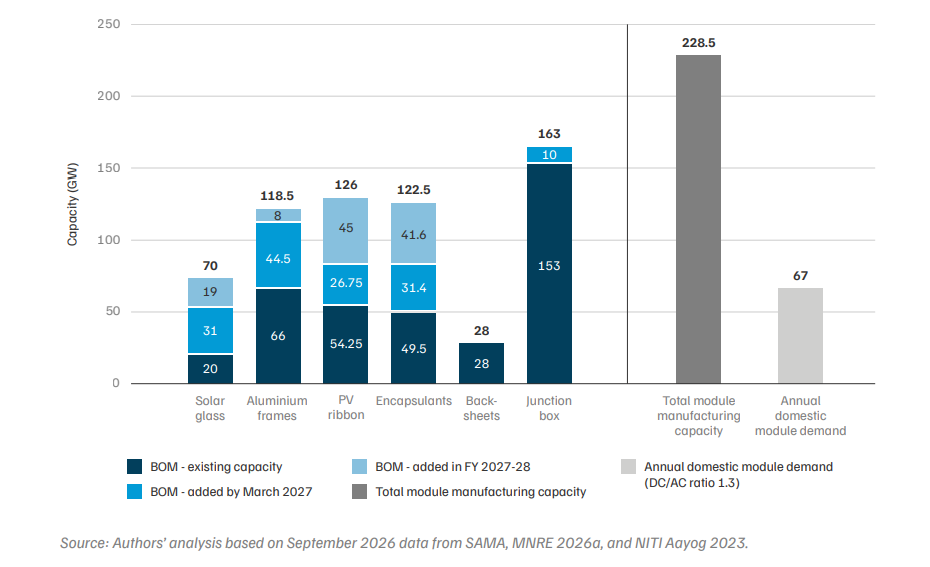
Based on data from the Solar Ancillary Manufacturers’ Association (SAMA), as of September 2026, domestic BOM manufacturing capacities per annum ranged from 20 GW for solar glass, the lowest among the six components, to 153 GW for junction boxes, the highest. Manufacturing capacities for the other components were 66 GW for aluminium frames, 54.25 GW for PV ribbons, 49.5 GW for encapsulants, and 28 GW for backsheets (Figure ES1). By March 2028, planned expansions by existing and new players are estimated to increase cumulative manufacturing capacities to 70 GW for solar glass, 118.5 GW for aluminium frames, 126 GW for PV ribbons, 122.5 GW for encapsulants, and 163 GW for junction boxes. These planned expansions reflect growing investor confidence across the BOM value chain.
Figure ES1. By March 2027, existing and upcoming BOM manufacturing capacities would be sufficient to meet India’s annual module demand, except for solar glass
However, between FY2021 and FY2026, imports of these BOM components surged. Imports of solar glass recorded a compound annual growth rate (CAGR) of 63 per cent, aluminium frames 88 per cent, PV ribbons 51 per cent, encapsulants 68 per cent, backsheets 15 per cent, and junction boxes 92 per cent (MoCI 2026a). India’s growing reliance on imported BOM components is concentrated among a small number of supplier countries. For instance, in FY2026, China accounted for 66 per cent of India’s total glass imports and 70 per cent of its total aluminium frame imports, while Malaysia accounted for 22 per cent of its total solar glass imports. Vietnam and Thailand accounted for 34 and 31 per cent, respectively, of total encapsulant imports. This concentration leaves India’s module manufacturing base exposed to price volatility, supply chain disruptions, and shifts in foreign trade policies.
Expanding domestic BOM manufacturing will strengthen supply chain resilience while presenting an opportunity for India to emerge as an alternative source for international markets seeking to diversify their supply chains. Beyond supply chain security, stronger domestic BOM manufacturing capabilities can provide greater control over product development, including access to innovation in product design, material use, and manufacturing processes. It will also unlock jobs and investments and contribute to progress towards Atmanirbhar Bharat. Further, global policy changes and trade measures necessitate enhancing domestic BOM capacity. For example, China’s value-added tax (VAT) rebate cuts effective April 2026 (MOF China 2026), and India’s anti-dumping duties, have together raised the landed costs for imports. While this creates an opportunity for domestic BOM manufacturing to substitute imports, insufficient local production volume – particularly during the build-out phase – risks disrupting domestic solar module manufacturing unless planned expansions are realised on schedule.
Moreover, translating nameplate capacity into reliable and commercially competitive output requires addressing fundamental technological, manufacturing, quality assurance, supply chain, regulatory, and financial challenges. This study identifies these barriers by mapping gaps in manufacturing processes and raw material requirements across BOM components, analysing trade barriers and their impacts, and assessing performance differences between the product models and variants offered by international and domestic BOM manufacturers. Based on this analysis, the study provides recommendations for domestic manufacturers and policymakers to establish a reliable, cost-competitive, and technologically advanced BOM manufacturing hub capable of closing India’s capacity gap and positioning the country as a global leader in the sector.
Key findings
- As of September 2026, India’s solar BOM manufacturing market is valued at approximately USD 3.61 billion, and it is estimated to reach approximately USD 7.78 billion by March 2028, driven by planned capacity expansions by existing players and new entrants.
- By March 2027, planned capacity expansions for aluminium frames, PV ribbons, and encapsulants would be sufficient to meet annual module demand of around 67 GW (Figure ES1). Domestic solar glass manufacturing capacity would be sufficient to meet this demand by March 2028. Junction boxes are the only BOM segment with sufficient capacity to meet this annual demand at present.
- India has multiple manufacturers across all six BOM components, indicating commercial-scale production capabilities, steady market demand, a competitive domestic manufacturing landscape, and significant opportunities for innovation. Each BOM component has at least six domestic manufacturers, and the largest manufacturers across components have production capacities of at least 6 GW per annum. However, significant technological, supply chain, and regulatory gaps remain across the ecosystem.
- Domestic BOM manufacturers have introduced a range of component variants, but there remains an opportunity to expand their portfolios to include product innovations for new-age module technologies offered by global counterparts. These include reflective PV ribbons for higher optical gains, low-temperature PV ribbons for advanced module technologies such as heterojunction (HJT), and composite frames for reduced weight and enhanced corrosion resistance. Failure to adopt emerging technologies could result in domestic manufacturers losing market share and, over time, their product offerings becoming obsolete.
- Domestic manufacturers are dependent on raw material imports to produce BOM components, including sodium antimonate, soda ash, limestone, and dolomite for solar glass; polymer resins for encapsulants and backsheets; and bypass diodes and copper wires for junction boxes. Market volatility can cause fluctuations in raw material prices, impacting domestic manufacturers’ profit margins and undermining their cost-competitiveness. Import dependence also increases vulnerability to global supply chain disruptions, which can constrain domestic manufacturing.Domestic manufacturers are dependent on raw material imports to produce BOM components, including sodium antimonate, soda ash, limestone, and dolomite for solar glass; polymer resins for encapsulants and backsheets; and bypass diodes and copper wires for junction boxes. Market volatility can cause fluctuations in raw material prices, impacting domestic manufacturers’ profit margins and undermining their cost-competitiveness. Import dependence also increases vulnerability to global supply chain disruptions, which can constrain domestic manufacturing.
- All six BOM components lack dedicated Harmonised System (HS) classifications and are imported under multiple HS codes (MoCI 2019, 2022, 2024a, 2025a; MoF 2026a). This lack of standardisation prevents accurate estimation of import volumes and values, undermining the reliability of trade statistics. It also weakens customs monitoring and makes it challenging for authorities to effectively implement trade remedies, such as anti-dumping and countervailing duties, which are typically linked to specific HS codes. Misclassification puts compliant domestic manufacturers at a competitive disadvantage, as it enables duty evasion and regulatory arbitrage by importers, allowing them to avoid applicable tariffs and quality control measures.
- Domestic BOM manufacturers follow a selection of testing protocols and standards. However, the absence of standardised testing criteria can lead to variations in the quality of locally produced BOM components, compromising their reliability and performance. Global manufacturers also undertake advanced tests to deliver top-quality products to their customers. These quality-control inconsistencies can undermine buyer confidence in domestically produced BOM components.
Key recommendations
To meet the country’s growing demand for high-quality, cost-competitive products while maintaining global competitiveness, the study provides recommendations for India’s BOM manufacturers and policymakers, as summarised in Table ES1 and a detailed breakdown thereafter.
Table ES1. Strategic measures to be taken by bill-of-materials manufacturers and policymakers to enable a resilient and globally competitive solar industry
| Cross-component recommendations |
|
•On supply-side measures
- »Domestic BOM manufacturers should add newer product variants to their product portfolio to meet the performance requirements of advanced module technologies.
- »BOM manufacturers should create a domestic ecosystem that can serve as an additional source of raw materials.
- »The Central Board of Indirect Taxes and Customs (CBIC), in coordination with the Directorate General of Foreign Trade (DGFT) and the Directorate General of Trade Remedies (DGTR), should introduce dedicated HS codes for all product variants of individual BOM components.
- »The Ministry of New and Renewable Energy (MNRE), the Bureau of Indian Standards (BIS), and BOM manufacturers should collaborate to develop and set uniform testing standards and guidelines for all BOM components.
|
|
•On demand-side measures
- »The MNRE should introduce an Approved List of Models and Manufacturers (ALMM) for all BOM components and extend the Domestic Content Requirement (DCR) mandate to all BOM components to anchor domestic demand.
|
| Component specific recommendations |
| Solar glass |
- •Manufacturers should improve solar glass quality by adopting robust manufacturing practices and strengthening testing protocols, especially for thinner glass sheets used in bifacial modules, to deliver solar glass that meets international standards.
- •As solar glass production is highly energy-intensive, manufacturers should aim to procure renewable energy for their operations to reduce their operating costs. They should also establish backup arrangements for natural gas supplies via setting up on-site storage units or diversifying their gas supply-chain through local sourcing to avoid purchasing gas at inflated prices during periods of global supply disruptions.
|
| Aluminium frame |
- •Manufacturers should expand their product portfolios to include products made with advanced materials, such as frames made of composite materials and galvanised steel, to maintain market relevance.
- •Manufacturers should secure their raw material supply through long-term contracts with domestic suppliers, such as National Aluminium Company Ltd (NALCO) and Bharat Aluminium Company Ltd (BALCO), for financial de-risking. However, domestic raw materials exceed global price benchmarks. Easing duties on frame-grade aluminium inputs is urgently needed to bridge this cost gap.
|
| PV ribbon |
- •Manufacturers should add newer PV ribbon technologies, such as reflective ribbons, multi-busbar (MBB) and zero-busbar (0BB) ribbons (used for increasing module efficiencies), and low-temperature ribbons (used in HJT and perovskite production) to remain aligned with evolving market trends.
|
| Component specific recommendations |
| Solar glass |
- •Manufacturers should improve solar glass quality by adopting robust manufacturing practices and strengthening testing protocols, especially for thinner glass sheets used in bifacial modules, to deliver solar glass that meets international standards.
- •As solar glass production is highly energy-intensive, manufacturers should aim to procure renewable energy for their operations to reduce their operating costs. They should also establish backup arrangements for natural gas supplies via setting up on-site storage units or diversifying their gas supply-chain through local sourcing to avoid purchasing gas at inflated prices during periods of global supply disruptions.
|
| Aluminium frame |
- •Manufacturers should expand their product portfolios to include products made with advanced materials, such as frames made of composite materials and galvanised steel, to maintain market relevance.
- •Manufacturers should secure their raw material supply through long-term contracts with domestic suppliers, such as National Aluminium Company Ltd (NALCO) and Bharat Aluminium Company Ltd (BALCO), for financial de-risking. However, domestic raw materials exceed global price benchmarks. Easing duties on frame-grade aluminium inputs is urgently needed to bridge this cost gap.
|
| PV ribbon |
- •Manufacturers should add newer PV ribbon technologies, such as reflective ribbons, multi-busbar (MBB) and zero-busbar (0BB) ribbons (used for increasing module efficiencies), and low-temperature ribbons (used in HJT and perovskite production) to remain aligned with evolving market trends.
|
| Encapsulant |
- •Manufacturers should strengthen collaboration with domestic resin manufacturers that have complementary capabilities, including petrochemical companies such as Gas Authority of India Limited (GAIL) and Indian Oil Corporation Ltd (IOCL), to enhance supply chain resilience. They should jointly design pilots for local ethylene-vinyl acetate (EVA) resin manufacturing, supported by the Ministry of New and Renewable Energy (MNRE) and Ministry of Petroleum and Natural Gas (MoPNG).
- •Manufacturers, the MNRE, and the Bureau of Indian Standards (BIS) should standardise quality control across domestic encapsulant manufacturers to ensure consistent product performance and reliability, increasing buyer confidence.
|
| Backsheet |
- •While demand for backsheets has declined, existing market players should focus on transparent backsheet production to retain demand from bifacial module manufacturers. Their lighter weight compared with solar glass makes modules using them particularly suitable for rooftop applications, where structural load capacity may be a constraint.
- •Manufacturers should collaborate with local resin suppliers to build a resilient raw material supply chain, reducing the impacts of global supply chain disruption.
|
| Junction box |
- •Junction box manufacturers, in collaboration with module manufacturers, should explore the development of adaptable junction box designs for improved reliability and performance.
- •The Ministry of Electronics and Information Technology (MeitY) and the MNRE should collaborate to strengthen domestic manufacturing of bypass diodes by including them under the Electronics Component Manufacturing Scheme (ECMS), released in 2025, to secure the raw material supply chain.
|
Source: Authors’ analysis
- Domestic BOM manufacturers should expand their product portfolios to include newer product variants and technologies that meet the performance requirements of emerging module technologies within the next two financial cycles – FY2028 and FY2029, addressing gaps in domestic product offerings. For instance, PV ribbon manufacturers should offer reflective and multibusbar (MBB) ribbons to module manufacturers seeking higher efficiencies through improved optical gains. Demand for such BOM variants is expected to increase as the market advances towards solar module technologies that are cheaper, lighter, more durable, and more efficient than earlier technologies. Expanding their portfolios will help BOM manufacturers remain competitive domestically while accessing global markets where these components are in demand.
- Indian BOM manufacturers should develop a domestic ecosystem for raw materials, reducing their exposure to market volatility and global supply chain disruptions. To achieve this, manufacturers should collaborate with industries with complementary capabilities to design and upgrade manufacturing processes capable of producing highquality raw materials that meet their requirements. For instance, encapsulant manufacturers and established resin manufacturers, particularly in the oil and gas industry, should collaborate to indigenise the production of polymer resins such as ethylenevinyl acetate (EVA) and polyolefin elastomer (POE). Domestically sourced raw materials must match the quality of imported alternatives and be supplied at prices that enable manufacturers to produce finished goods that are cost-competitive with imported BOM components.
- The Central Board of Indirect Taxes and Customs (CBIC), in coordination with the Directorate General of Foreign Trade (DGFT) and the Directorate General of Trade Remedies (DGTR), should introduce dedicated HS codes for different variants of BOM components before the Union Budget 2027–28. Dedicated codes would enable more accurate tracking of import volumes and strengthen the implementation of trade remedies, such as anti-dumping and countervailing duties, helping ensure these trade barriers are properly enforced and achieve their intended policy objectives.
- The Ministry of New and Renewable Energy (MNRE), the Bureau of Indian Standards (BIS), and BOM manufacturers should collaborate to develop uniform testing standards and guidelines for all BOM components at the earliest. Uniform standards would ensure consistency in quality checks and improve buyer confidence. The standards should also align with international standards to support the quality and global acceptance of Indian products.
- The MNRE should introduce an Approved List of Models and Manufacturers (ALMM) for all BOM components to promote their uptake by domestic module manufacturers. ALMM acts as a non-tariff barrier and promotes domestic manufacturing by heavily restricting imports. The list should be introduced by January 2028 and take effect from January 2029, providing BOM manufacturers sufficient time to establish their facilities and optimise manufacturing processes, thereby preventing supply-chain bottlenecks for module manufacturers. Moreover, the MNRE should extend its Domestic Content Requirement (DCR) to include all BOM components, creating an additional anchor for domestic demand. The DCR mandate should be made effective from January 2028, allowing module manufacturers to seamlessly transition to domestic BOM components. Introducing DCR will mandate local BOM usage across subsidy-linked rooftop and agricultural programs, and other Central Public Sector Undertakings (CPSUs) and government-tendered projects.