Council on Energy, Environment and Water Integrated | International | Independent


Suggested citation: Prakash, Varnika and Akanksha Tyagi. 2026. Localising Battery Electrolyte Manufacturing in India: Capabilities, Constraints, and Policy Support. New Delhi: Council on Energy, Environment and Water.
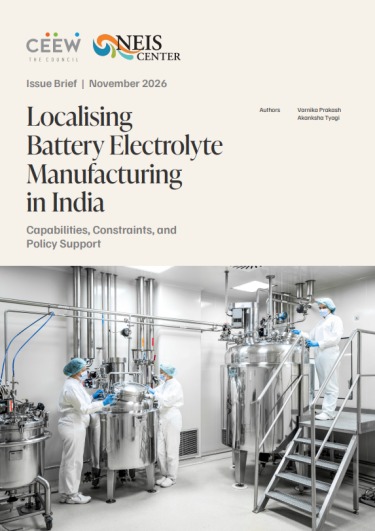
India's battery manufacturing is built on imports it does not control. Almost the entire cell manufacturing industry depends on imported components, predominantly from China. This issue brief, the first in a series on localising cell component manufacturing, examines how domestic production of battery-grade electrolyte can strengthen India's battery manufacturing ecosystem. It assesses the capabilities India already holds, the constraints that have prevented the sector from developing, and the policy support required to close the gap.
The study finds that electrolyte manufacturing draws on industrial strengths India already possesses in fluorochemicals, petrochemicals, pharmaceuticals and fine chemicals, and that several Indian chemical companies have already begun to pivot towards the battery sector. Yet domestic cell manufacturing capacity stands at just 1.4 GWh, and a chicken-and-egg problem persists: electrolyte manufacturers withhold investment without an assured demand signal, while cell manufacturers continue importing because we lack trusted local supply at scale. The brief recommends coordinated action across ministries-covering equipment manufacture, testing infrastructure and standards, technology partnerships, research funding, fiscal support and assured public offtake-to break that deadlock.
India’s battery industry is built on imports it does not control. The entire cell manufacturing industry is almost 100 per cent dependent on imports for all cell components like electrolytes, cathode active materials (CAM), anode active materials (AAM), and separators primarily from China, which creates a deep vulnerability for the industry. This exposure is set to deepen as the global demand for batteries is expected to increase more than 2.6 times by 2030 to reach 4.2 terawatt hour (TWh) (Hughes 2026; McKinsey & Company 2026).
India will represent a small share, with some estimates putting its battery demand to rise 216 gigawatt hour (GWh) by 2030 (Jain and Jhunjhunwala 2025). However, despite the various initiatives to boost local production such as the Advanced Cell Chemistry Production Linked Incentive (ACC PLI) Scheme (MHI ACC PLI 2021) and the exemption of basic customs duty on capital goods used in manufacturing lithium-ion batteries (LiBs) (MoF, GoI 2026), as of October 2025, India commissioned only 1.4 GWh of ACC capacity under the PLI scheme (IEEFA and JMK Research Analytics 2026). The announced projects could take the domestic cell manufacturing capacity to around 150 GWh in the coming years.
This issue brief, first in the series of localising cell components manufacturing, examines how domestic production of battery-grade electrolyte can be a strategic lever in enhancing India’s current battery manufacturing ecosystem. The brief focuses on the lithium ion batteries given the largest share of contribution in the electric vehicles and energy storage (IEA Global EV Outlook 2026).
The business models of electrolyte manufacturing companies globally can be categorised into five types (Figure ES2).
Figure ES1. India has the process and equipment capabilities to manufacture battery-grade electrolytes
Source: Authors’ analysis
Figure ES2. Five business models are prevalent globally for electrolyte manufacturing
Makers formulate and produce to the cell-maker’s specs. Offers flexibility, faster customisation, lower R&D burden for battery producers, next-gen chemistries.
Examples: LANXESS (subsidiary Saltigo, Germany to Tinci)
Cell makers produce electrolyte in-house and secure their IP formulations, cutting dependence on external suppliers.
Example: CATL (China)
Electrolyte firms partner with OEMs/battery makers to co-develop chemistry-specific electrolytes. Offers long-term demand visibility, shared investment risk.
Example: Neogen Chemicals (India)
Plants sited next to gigafactories for just-in-time supply, lower logistics cost and safer transport of hazardous liquid electrolyte.
Example: UBE Corporation (Louisiana), Tinci (Texas), CapChem (Louisiana & Ohio)
Advanced electrolyte for fast charging, high energy density, extreme temperature and next generation chemistries, R&D led
Example: Mitsubishi Chemical, UBE, Soul Brain (South Korea)
Source: Authors’ analysis.
Government ministries should develop a coordinated policy approach to build a self-reliant, globally competitive, future-oriented electrolyte market in India (Table ES1).
Table ES1. Policy recommendations for localising battery electrolytes
| Aim | Recommendations | Implementing ministries |
|---|---|---|
| 1. Build domestic capability of machines and equipment to support battery-grade electrolyte manufacturing | Target grants and upskilling programmes to encourage indigenous manufacturing of electrolyte manufacturing machines | MHI (Capital Goods Scheme Phase II), CSIR-CECRI, CSIR-NML, CMTI, IITs, CSIR-NCL |
| 2. Reduce dependence on foreign testing and OEM qualification | Invest in domestic testing infrastructure and introduce standardised testing norms | MHI, DST (FIST), CSIR-CECRI, CMET, NPL, IITs, NCL, ARCI, BIS, NABL |
| 3. Build a domestic R&D and innovation base rather than relying on technology transfers | Orientate joint ventures (JVs) and international technology transfers for long-term benefits | Industry stakeholders, DPIIT MoC&F (DCPC), (IMPRINT with DST & MoE) |
| 4. Develop next generation electrolyte materials, use indigenised processes and local resources | Encourage R&D for the next -generation electrolyte salts and manufacturing processes | MoC&F (DCPC), (IMPRINT with DST & MoE) |
| 5. Create domestic demand via policy | Introduce direct fiscal support for manufacturing components in upstream segments | MHI, MoC&F (DCPC), BIS |
| 6. Create guaranteed offtake for the domestic electrolyte | Introduce a phased local electrolyte sourcing norms for the upcoming gigafactories Approved List of Battery Component Manufacturers (ALBCM) | MHI, MoP, Ministry of Power, ACC PLI PMA, BIS |
Source: Authors’ analysis.
The electrolyte is the medium that carries lithium ions between the cathode and anode inside a battery cell. It is made up of a lithium salt, usually lithium hexafluorophosphate (LiPF₆), dissolved in carbonate solvents with small quantities of additives. Although it accounts for only around five per cent of a cell's cost, it governs how safely and how well the cell performs, including its stability at high temperature and its tolerance to fast charging.
At the roughly 150 GWh of cell capacity India has announced, the requirement would be around 60,000 to 90,000 tonnes. The range reflects chemistries like lithium iron phosphate cells that use more electrolyte per kilowatt-hour than nickel manganese cobalt cells. Against that, only 1.4 GWh is commissioned today, so the addressable market is still very small.
The underlying capability largely exists. Our mapping finds overlaps with each electrolyte materials: fluorochemical companies already handle the fluorine chemistry that salt synthesis needs, petrochemical refiners run the distillation trains for carbonate solvents, and pharmaceutical producers operate the reactors and purity controls additives require. India also has established markets in the upstream feedstocks, ethylene oxide and ethanol. What is missing is not the chemistry but the specification: battery-grade output demands moisture control, impurity limits and equipment that existing plants were not built for.
Electrolyte manufacturers are reluctant to invest without assured demand from domestic cell producers, while cell producers continue importing because no trusted local supply exists at scale. Four further constraints compound this: limited cost competitiveness against subsidised imports, the absence of advanced processing and purification equipment, no accredited domestic testing infrastructure or accepted standards, and continued import dependence on precursor materials.
The brief recommends six actions across ministries: supporting indigenous manufacture of electrolyte production equipment; building accredited domestic testing infrastructure and India-specific standards; reorienting technology partnerships towards co-development rather than licensing alone; directing research funding at specific industrial bottlenecks; introducing fiscal support for component manufacturing; and creating assured demand through public procurement preference and a certified list of approved manufacturers.
Shaping India’s Next Phase of Solar Manufacturing
Advancing Solar Cell Manufacturing in India
Establishing a Sodium-ion Battery Ecosystem in India