Council on Energy, Environment and Water Integrated | International | Independent


Suggested citation: Srinivasan, Aarathi, and Ushashi Datta. 2026. Assessing Indigenisation in Indian Manufacturing. A Pillar-based Framework Tested in the Wind Industry. New Delhi: Council on Energy, Environment and Water.
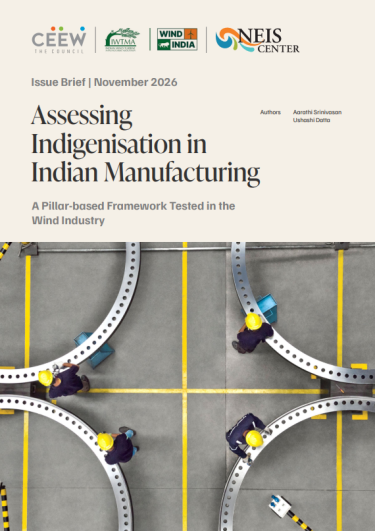
Supply chain disruptions have pushed countries, including India, to expand domestic manufacturing of clean energy technologies. Yet there is no shared understanding of what makes a product genuinely indigenous. Most policies measure indigenisation through domestic value added or rules of origin. These cost-based measures can conceal continued dependence on foreign technology, machinery, skills and finance, leaving structural vulnerabilities in supply chains.
Taking the wind sector as an entry point, the issue brief proposes a framework to define and measure atmanirbharta. It assesses each turbine component across five pillars and four levels of domestic control. Each turbine component is assessed on five pillars: domestic value addition, machinery and equipment, intellectual property and technology, skills and capability, and capital. A four-level scale, from Baseline to Level 3, traces the shift from foreign to domestic control.
Government and industry can use it as a common basis to gauge where the sector stands and to target support where dependence persists. The appropriate level for each component should reflect its strategic criticality, economic feasibility and access to trusted supply, rather than full localisation by default. The approach can also be extended to other clean energy value chains, such as solar and battery storage.
The supply chain disruptions across different clean energy technologies have urged countries globally to deepen indigenisation in manufacturing and become self-reliant. It is also seen as a measure to strengthen energy security and boost economic growth. However, often, it is unclear what it truly means to be indigenous. For instance, does manufacturing the final product locally, while importing the sub-components from outside qualify as being indigenous? How would it compare with a scenario where all components and sub-components are manufactured locally but the intellectual property (IP) around the processes and machines is restricted? Or a scenario where the IP is accessible but the skills and execution capability is locked in foreign talent? A policy that supports domestic manufacturing may be designed depending on what scenario may be preferred keeping a pragmatic view on what may be possible in the short to medium term. Each of these pathways may serve a different purpose and result in certain trade-offs.
Our review of the existing manufacturing policies across countries finds that more often, policies track cost parameters (such as domestic value added) or rules of origin to assess indigenisation levels. Only in a few cases, these cost-based approaches are combined with non-cost economy-wide criteria like local employment and regional investment (Beiter 2022; Department of Finance, Australian Government 2025).
By focusing on the wind industry as an entry point, this brief presents a framework with distinct pillars and levels to assess indigenisation. However, the approach is well replicable beyond wind, offering a template for other clean-energy manufacturing value chains, such as solar and battery storage, that face similar definitional ambiguity. It is important to clarify that the brief does not define indigenisation or recommend a target but provides a structure for discussions that will potentially guide a definition for the sector. Following the publication, we hope to identify the baseline of the sector which can then help guide policies for increasing levels of indigenisation. In the absence of frameworks, it may be difficult to identify the best component to prioritise for local manufacturing.
The framework is a result of extensive literature review of Indian and international policies across different sectors that focus on indigenisation, supplemented with structured discussions with seven wind component manufacturers, covering both Indian-owned firms and Indian subsidiaries of foreign companies.
In a geopolitically volatile world, a narrow approach to assessing indigenisation, such as by focusing on domestic value added, could lead to structural vulnerabilities on technology, machines or human capital. At the same time, taking a more holistic view could help us identify blind spots in the supply chains and design specific interventions (policy, regulatory or market) to overcome those vulnerabilities gradually. This issue brief aims to spark deliberate discussions among the different stakeholders on how India should think about assessing indigenisation levels in manufacturing industries.
As part of this framework, we have developed five pillars to assess indigenisation (Table ES1) and four levels to track progress (Table ES2). Each Approved List of Models and Manufacturers (ALMM) component in a wind turbine (such as tower, gearbox, blade, generator, and bearings) is screened on these pillars to come up with its own definition of the level (See Annexure I on the website for more details).
Table ES1. The five pillars for assessing indigenisation
| Pillar | Definition |
|---|---|
| Domestic value addition | Assesses how much of a component’s value is genuinely created within India, tracing raw materials to the finished part. |
| Machinery and equipment | Assesses whether the machinery and equipment are owned and operated by an Indian entity, without requiring foreign approval. |
| Intellectual property and technology | Assesses whether the design, engineering, and technology are owned by an Indian entity, with the freedom to build, modify, or certify it without foreign consent. |
| Skills and capability | Assesses whether the people who design, engineer, and improve a component are based in India and hold senior, decision-making roles. |
| Capital | Assesses whether the entity’s access to finance is secure and free of external control, so that production remains uninterrupted. |
Source: Authors’ analysis.
These five pillars – domestic value addition, machinery and equipment, intellectual property and technology, skills and capability, and capital – are interdependent and collectively necessary. It is because self-reliance is not determined solely by where production occurs, but by how control is distributed across design, ownership, financing, operation, and innovation functions over time.
Across each pillar, the levels are defined by how indigenisation will progress over time; starting from Baseline to Level 3.
Table ES2. Four levels to track indigenisation
| Levels of indigenisation | Description |
|---|---|
| Baseline | Assembled in India from imported sub-assemblies, with machinery, design, skills, and financing all foreign-controlled. |
| Level 1 | Manufactured in India but remains dependent on imported critical inputs, with core design, senior technical roles, and capital expenditure dependent on foreign approval. |
| Level 2 | Where import substitution is underway, with Indian entities gaining ownership of machinery, co-design rights, senior technical roles, and a growing share of capital. |
| Level 3 | Fully manufactured, owned, designed, staffed, and financed within India, with no foreign approval required at any stage. |
Source: Authors’ analysis.
The levels measure the degree of domestic control over a component; but do not prescribe the level each component should reach. Level 3 is therefore not the appropriate policy target for every component. Setting the desired level is a separate policy judgement, and three considerations can inform it. The first is strategic criticality, meaning the national and economic security risks that would arise without domestic capability. The second is economic feasibility, meaning how well-placed Indian firms are to compete in, and capture the value of, the component industry. The third is the availability of reliable supply from trusted partner countries. Together, these considerations indicate whether a component should aim for full domestic capability, partial localisation, or resilient diversification.
By providing distinct pillars and levels at the subcomponent level, this framework gives government and industry a common frame to have active discussions on assessing the current levels and design policies that will encourage indigenisation. Ministries can apply the framework to assess and reflect on how self-reliant the wind sector is as a whole, evaluate pain points to be addressed through future policies, and evaluate individual firms against the pillars where eligibility for incentives or certification is being determined. Companies can self-assess to map out the structural vulnerabilities and identify specific areas where targeted policy support is needed. These assessments and subsequent discussions among the key ministries and departments should potentially guide a sectorspecific definition of indigenisation for the wind industry and the subsequent design of the policies.
Local content metrics measure value rather than control. A component can meet a high domestic value threshold while its design, machinery or capital remain under foreign control. Such metrics can also overstate domestic capability where imported inputs are routed through Indian vendors and claimed as domestic.
The framework assesses major turbine components rather than the turbine as a whole. These are the blade, tower, gearbox, generator and bearings. Each component has its own level definitions for every pillar.
No. The framework provides guidance on how indigenisation should be assessed. It does not give a definition or quantifiable target. Setting a target is a separate policy judgement, which should be informed by strategic priorities, economic feasibility, capability, and reliable partnerships.
Policy makers can use it to assess the sector as a whole, identify gaps for future policy and evaluate firms where incentives or certification are required. Manufacturers can use it to self-assess and map structural vulnerabilities. Sector-wide assessments can then inform a wind-specific definition of indigenisation.
Localising Battery Electrolyte Manufacturing in India
Shaping India’s Next Phase of Solar Manufacturing
Advancing Solar Cell Manufacturing in India