Council on Energy, Environment and Water Integrated | International | Independent

- India needs an estimated USD 500 billion by 2030 to decarbonise power, industry, and mobility — sectors that account for 70% of its emissions.
- CEEW-Tata Sons report estimates that achieving just 10% of this target, i.e. USD 50 billion through blended finance, could set the tone for the rest to be mobilised in an unsupported manner.
- The report finds that to achieve this USD 50 billion target, only an estimated USD 10 billion may be needed in catalytic capital, indicating a leverage multiple of 5x.
- N Chandrasekaran, Chairman, Tata Sons, says India needs "capital willing to absorb early risks" and envisions a greater role for blended finance in India’s low-carbon growth story.
New Delhi, 27 October 2026: Meeting India's climate goals will require USD 500 billion in investment across 20 low carbon technologies by 2030. But the report, Blended Finance for India's Climate Goals, jointly launched today by the Council on Energy, Environment and Water’s Green Finance Centre (CEEW-GFC) and Tata Sons, finds the route begins with leveraging blended finance as a fundamental tool. The report finds that unlocking a far smaller amount, equivalent to 10% of the USD 500 billion, or USD 50 billion in blended finance, could help build a track record for the rest of the money to follow in an unsupported manner. The report also claims that this USD 50 billion could be mobilised with just USD 10 billion in catalytic capital, indicating that every dollar of catalytic capital mobilises five dollars in blended finance - an indicative leverage multiple of 5x. This combines a dollar of catalytic capital with four dollars of commercial capital financing at market terms.
The CEEW-Tata Sons report is the first to quantify how blended finance could help India meet its 2030 decarbonisation targets across power, industry, and mobility, the three sectors that account for 70 per cent of the country's greenhouse gas emissions. India needs USD 500 billion in climate investment by 2030 across 20 low-carbon technologies in these sectors: USD 198 billion, or 39.6 per cent of the total, in power and renewables; USD 115 billion, or 23 per cent, in green hydrogen; and USD 187 billion, or 37.4 per cent, in electric mobility.
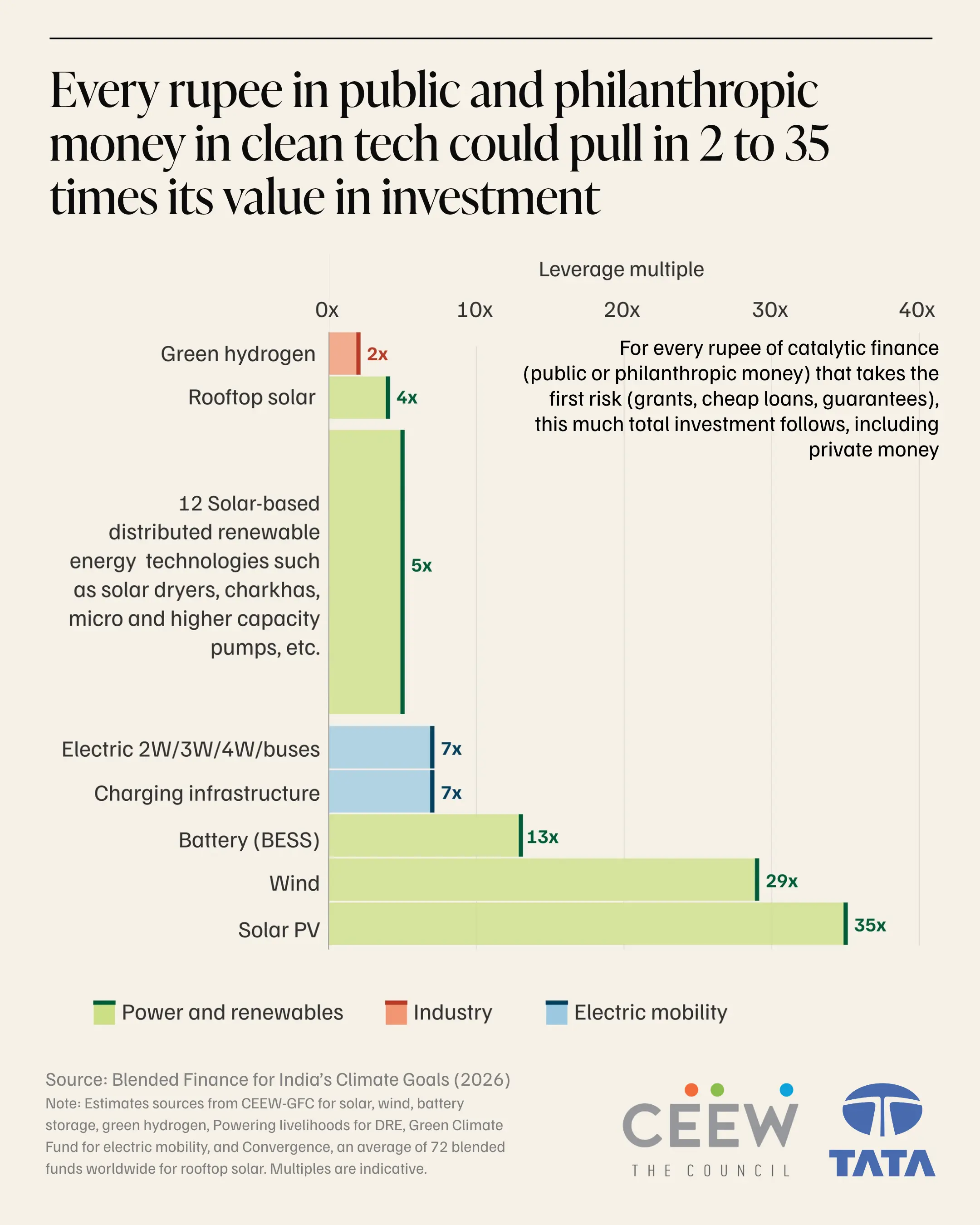
How much catalytic capital a clean technology needs depends on its technoeconomic maturity and track record. The CEEW-TATA Sons report finds a 'leverage multiple' — the total investment mobilised per dollar of catalytic capital — For instance, 35x for solar, a mature technology that mainly needs credit enhancement guarantees, against just 2x for green hydrogen, a nascent technology that needs more equity support. At a sectoral level, power and renewables require USD 1.5 billion in catalytic capital through 2030, green hydrogen needs USD 5.9 billion, and electric mobility needs USD 2.7 billion. Naturally, more mature sectors need less catalytic capital to unlock more commercial, thus having higher leverage multiples compared to less mature ones.
N Chandrasekaran, Chairman, Tata Sons, said, "India's development path calls for decarbonisation while continuing to industrialise, urbanise, and expand prosperity. These twin imperatives place extraordinary demands on our energy systems, industries, and mobility networks, and meeting our 2030 climate commitments will require over half a trillion dollars of investment across them. Conventional finance alone will be insufficient — India needs capital willing to absorb early risks, remain patient, and accept lower near-term returns in pursuit of much larger long-term gains. This is where blended finance becomes critical. With the right financial architecture and incentives, India's climate transition can become a powerful engine of innovation, competitiveness, energy security, and sustainable livelihoods."
Gagan Sidhu, Director, CEEW Green Finance Centre, said: "India's climate transition is a stress test for the financial system — can it evolve fast enough to match the scale and urgency of what lies ahead? Low-carbon technologies are at varying stages of maturity, each with its own financing needs, and the conventional financial architecture was not designed for a transition of this complexity. This is where blended finance can be the bridge. We find that blended finance interventions need only address 10 per cent of India's half-trillion-dollar financing opportunity by 2030, and catalytic capital of just USD 10 billion could mobilise that USD 50 billion, unlocking the rest without further support. What is needed now is an institutional architecture to deploy this catalytic capital with precision — a National Green Finance Institution could be the connective link between India's climate ambitions and the financial system."
Between 2010 and 2022, India recorded USD 5.6 billion in blended finance transactions, or 3.4 per cent of the global market, of which only 17 per cent was catalytic capital. To enable stepping up of blended finance transactions for low-carbon technologies, the report proposes a National Green Finance Institution, as recommended by NITI Aayog, to aggregate catalytic capital from governments, philanthropies, and development partners and deploy it through blended finance structures. Given geopolitical uncertainties, it also proposes looking inward at domestic philanthropies to use catalytic capital for crowding in commercial capital more effectively and also calls for an enabling policy/regulatory environment for the same.
Read the full report Blended Finance for India's Climate Goals by Amlan Bibhudatta, Gagan Sidhu, Arjun Dutt and Labanya Prakash Jena (CEEW team) and Roopa Purushothaman, Vishal Vaibhaw, and Kartikey Vaid (Tata Sons team) here.
For media queries, contact: Tulshe Agnihotri (CEEW) at [email protected]
About CEEW
The Council on Energy, Environment and Water (CEEW) — a homegrown institution with headquarters in New Delhi — is among the world’s leading climate think tanks. The Council is also often ranked among the world’s best-managed and independent think tanks. It uses data, integrated analysis, and strategic outreach to explain — and change — the use, reuse, and misuse of resources. It prides itself on the independence of its high-quality research and strives to impact sustainable development at scale in India and the Global South. In over 15 years of operation, CEEW has impacted over 400 million lives and engaged with over 20 state governments. Follow us on X (formerly Twitter) @CEEWIndia or on LinkedIn for the latest updates.
About TATA Sons
Tata Sons is the principal investment holding company and promoter of the Tata Group companies.
About CEEW-GFC
The CEEW Green Finance Centre (CEEW-GFC) is a special initiative of the Council on Energy, Environment and Water (CEEW). CEEW-GFC acts as a non-partisan observer and catalyst that aims to bridge green financing gaps by addressing financing bottlenecks and enhancing the integration of green considerations in financial decision-making. Its approach is multi-pronged: tracking market trends, publishing research and analysis, developing financial solutions, offering technical assistance, and fostering coherence between policymakers, regulators, financial institutions, and industry. www.ceew.in/gfc