Council on Energy, Environment and Water Integrated | International | Independent


Suggested citation: Thapa, Banashree, Ruchira Goyal, Arnav Mathur, Apoorve Khandelwal and Chandan Jha. 2026. AI in Agriculture: Unlocking New Frontiers for Crop Diversification in India New Delhi: Council on Energy, Environment and Water (CEEW).
Indian agriculture must evolve to meet Viksit Bharat aspirations. A shift from monocultures toward diversified cropping is essential to address import burdens, enhance nutritional security, and build climate resilience. While states like Haryana, Punjab, and Odisha have implemented per-acre direct benefit transfers (DBTs) to promote diversification away from paddy, scaling these efforts is hindered by two critical bottlenecks. For farmers, inadequate incentives, payment delays and weak grievance system weaken trust and participation for diversification. For policymakers, fraudulent claims and challenges in manual verification of farm-level crop shifts reduce administrative confidence in DBTs.
Through this whitepaper, we have attempted to:

To address the above bottlenecks, potential risks and build trust among farmers and policymakers to scale up crop diversification, we suggest the following steps:
Ultimately, while AI streamlines delivery, sustainable diversification will need parallel investments in markets, value chains, and 360-degree transition support for farmers.
Indian agriculture must evolve to meet Viksit Bharat aspirations. A shift from monocultures toward diversified cropping is essential to address import burdens, enhance nutritional security, and build climate resilience. While states like Haryana, Punjab, and Odisha have implemented per-acre direct benefit transfers (DBTs) to promote diversification away from paddy cultivation. However, scaling these efforts is hindered by two critical bottlenecks: insufficiency of incentive amounts and a lack of trust among farmers due to delays in incentive payments or poor grievance redressal, and among policymakers due to fraudulent claims and challenges in manual verification of farm-level crop shifts.
We propose the following recommendations to address these bottlenecks:
Ultimately, while AI streamlines delivery, sustainable diversification will need parallel investments in markets, value chains, and 360-degree transition support for farmers.
The agriculture sector remains central to India’s transformative journey towards Viksit Bharat. It contributes 18 per cent of the nation’s GDP and employs 46 per cent of the country’s workforce (BUR-4 2024). Between 2017 and 2023, the sector grew at an average rate of 5 per cent, marking the highest sustained growth rate since Independence (PIB 2025a). However, this progress has been accompanied by severe ecological and fiscal consequences. Agriculture currently accounts for 14 per cent of India’s GHG emissions (MoEFCC 2024) and over 87 per cent of total annual groundwater extraction (CGWB 2022; Chachei 2024).
India’s cropping pattern remains heavily skewed towards a few staples. Rice, wheat, and sugarcane together occupy 45–48 per cent of total agricultural area (MoAFW 2023) and absorb the majority of the annual INR 1.6 lakh crore fertiliser subsidy bill (0.5 per cent of GDP) (PIB 2025b). This concentration of crop inputs has accelerated soil degradation, which now affects 30 per cent of India’s geographical area(MoEFCC 2023).
This pattern also undermines India’s nutrition, health security, and farmers’ livelihood security ambitions. Cereal-heavy diets are associated with 56 per cent of India’s total disease burden (Shah et al. 2024). Pulse imports contributed to the INR 34,000 crore import bill in 2022–23 (Reuters 2024). At the farm level, climate change has constrained real farm income growth to 0.33 per cent for men and 0.45 per cent for women during 2014–22 (Sneha et al. 2024). As rising temperatures and erratic rainfall intensify due to climate change, this creates livelihood risks for monoculture farmers due to lack of diversified crop alternatives.
Crop diversification emerges as a solution to address these multiple challenges simultaneously. Evidence shows that diversified cropping systems can deliver significant benefits: 24 per cent higher soil organic carbon, 118 per cent higher water-use efficiency, and up to INR 40,000 per ha higher economic returns for farmers (Mahanta et al. 2025). Thus, transforming India’s production system from a monoculture-dominated system to a diversified one is not merely an agronomic choice but an opportunity to strengthen agriculture’s role in advancing Viksit Bharat aspirations.
The policy intent towards diversification is already evident. Central initiatives, such as the Mission for Aatmanirbharta in Pulses, the National Food Security and Nutrition Mission, and the National Mission on Edible Oils – Oilseeds (NMEO–Oilseeds), alongside statelevel policies, aim to shift cropping patterns to address nutrition security, Atmanirbharta, and Viksit Bharat goals. However, these efforts compete with legacy public support structures rooted in the Green Revolution, which support rice–wheat monoculture and input-intensive cultivation. Fertiliser and food subsidies cumulatively cost the exchequer INR 3.7 lakh crore (Union Budget 2026), disproportionately anchoring agricultural support to specific crops and regions while crowding out resources for diversification-focused schemes.
Repurposing subsidy and procurement-based support measures towards per-acre direct benefit measures has been cited as a more effective strategy to free the agriculture system from its monoculture-driven legacies (Gulati and Thangaraj 2026). The latest national Economic Survey (2026) further validates this argument, highlighting the utility of repurposing inefficient government expenditures to enable a calibrated approach to scaling crop diversification in India (MoF 2026). States have already experimented with several price-based mechanisms, such as deficiency payments and procurement at minimum support price (MSP), and income-based mechanisms, such as DBTs, to counter systemic biases and offer incentives that favour rice–wheat dominance. Between price-based and income-based support, evidence suggests that the latter is more effective in driving intended policy outcomes with minimal market distortions (Manikanta and Shailaja 2025; Baghla 2025). Over the past decade, several states, including Haryana, Punjab, and Odisha, have already recognised the potential of DBTs to deliver on crop diversification outcomes and have integrated them at the core of their agricultural strategies.
Thus, in this study, we aim to:
Haryana and Punjab – legacy Green Revolution states – together account for 25 per cent of India’s wheat production and 18 per cent of national rice output, where price support continues to reinforce monoculture (DoAFW 2026a). In contrast, Odisha illustrates an emerging MSP-driven transition, where aggressive procurement is driving a steep increase in rice cultivation (Mohanty 2026). Crop diversification schemes in these states aim to reduce the income and market risks associated with shifting away from water-intensive crops by offering DBTs.
Table 1 summarises three such policy approaches across selected states. These state-level policies serve as case studies for understanding the challenges posed by direct incentivisation approaches.
Table 1. Existing policy initiatives for crop diversification
| States | Scheme | Implementation approach | Challenges faced/Limitations |
|---|---|---|---|
| Haryana | Mera Pani, Meri Virasat (DoAFW 2020) |
Target area identification: Districts/blocks with critically low groundwater levels are selected. Farmer registration: Unified portal (Meri Fasal Mera Byora) for farmer registration, beneficiary identification, and incentive delivery (DoAFW 2026b). Land ownership validation: Web-based Haryana Land Record Information System (Web-HALRIS) to verify land ownership (DITECH 2026). Crop shift monitoring: In-person validation of crop shifts and land records by block/district-level agriculture and revenue officers. Geospatial verification via the Haryana Space Applications Centre (HARSAC) (ESRI India 2025). |
Insufficient incentives relative to profits from paddy cultivation fail to motivate farmers to shift to crop cultivation (Gupta and Mitra 2025; Singh et al. 2024; Deswal 2025). Incorrect beneficiary identification creates risks of DBT allocation to fraudulent claimants (Deswal 2024). Physical verification requirements by agriculture officers for crop shifts have led to delayed payment delivery (Jose and Ponnusamy 2023). Grievance redressal of technical glitches and exclusion errors is delayed. |
| States | Scheme | Implementation approach | Challenges faced/Limitations |
|---|---|---|---|
| Odisha | Mega-Lift Irrigation Project — Crop Diversification (DA&FE, 2024) |
Target area identification: Cluster identification of suitable upland agricultural land is done by liaising with the agriculture and water department, paired with a baseline survey of the major non-paddy crops grown and cultivation inputs required within the cluster. Crop-specific DBT estimation: Crop-wise differentiated DBT amounts are outlined in the policy.1 Farmer registration: Physical form-based registration. Only farmers of below 2 hectare (ha) are eligible. Land ownership validation: Land records are physically verified with revenue records by the agriculture officers. Crop shift monitoring: Physical verification by agriculture officers. 50% DBT disbursement post-sowing of alternative crops directly to the bank account; 50% DBT released after harvest based on prior verification of field surveyors. |
Manual verification process delays incentive disbursement. The policy reduces the incentives over a three-year period, with the expectation that farmers would have established market linkages in this period for alternative crops, but with no clear mechanism to validate this assumption and monitor long-term adoption of the alternative crops.1 |
| Punjab | Kharif Maize Pilot Project (2025) (Punjab Development Commission, n.d) |
Target area identification: target districts selected by the agriculture department. Crop-specific DBT estimation: INR 17,500/ha for farmers keen to diversify to maize. Crop shift monitoring: Punjab Remote Sensing Centre (PRSC) utilises data from Sentinel-1 to monitor crop rotations and acreage shifts, but unsure whether they have been leveraged for this project. |
Current incentive for switching away from paddy monoculture needs to be ~2.5 times higher in order to encourage farmers (Singh et al. 2024; Gupta and Mitra 2025). |
Source: Authors’ compilation
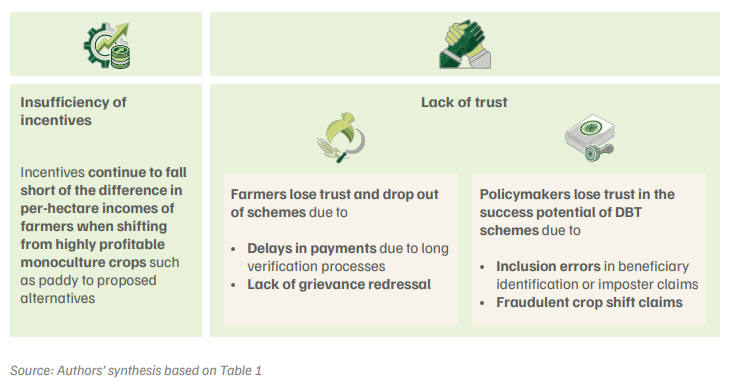
These challenges noted in Table 1 point to two key bottlenecks (see Figure 1) that limit the success of DBTenabled crop diversification away from legacy inputintensive crops:
For farmers, key concerns include:
For policymakers, key concerns include:
The resulting loss of trust has cascading second- and third-order effects such as systemic narratives of distrust, undermining the credibility of both current or future programmes regardless of their actual merit (MSC 2022).
Figure 1. Two key bottlenecks in scaling up effective direct benefit transfer for crop diversification
For a sector comprising of 86 per cent smallholder farmers, ensuring that crop shifts do not risk livelihood security remains the central challenge (Agricultural Census Division 2016; Apsara et al. 2025). Providing adequate incentives to attract farmer participation for crop diversification is therefore critical. However, state exchequers must identify mechanisms to frontend these transition costs while recovering them through systemic savings from crop diversification over time – such as reduced inefficiencies in rice and wheat procurement, lower water use for irrigation, and corresponding savings on power subsidies – so as to avoid budgetary deficits.
We propose that states begin by converging schemes in agriculture and allied sectors (such as water and rural development) to direct additional government support from existing schemes towards crop diversification. The Pradhan Mantri DhanDhaanya Krishi Yojana (PMDDKY) exemplifies this by integrating 36 existing central schemes across 11 different ministries and departments to enable crop diversification and other development outcomes (PIB 2025c). Such convergence mechanisms can improve policy coherence and attain broader outcomes across the interconnected domains of food, land, and water.
Next, to maximise the impact of available crop diversification funds, DBTs should shift from uniform per-hectare payments to a differentiated incentive model, in which DBT values are tailored to the income differences arising from farmers’ specific crop shifts. For example, when farmers shift from paddy to relatively more remunerative crops, such as moong, as shown by Singh et al. (2024) in Punjab, the incentive provided may be smaller than the average per-hectare support. These savings can be used to provide aboveaverage incentive amounts to farmers who shift to less remunerative crops that are nevertheless critical to India’s nutritional security, such as millets.
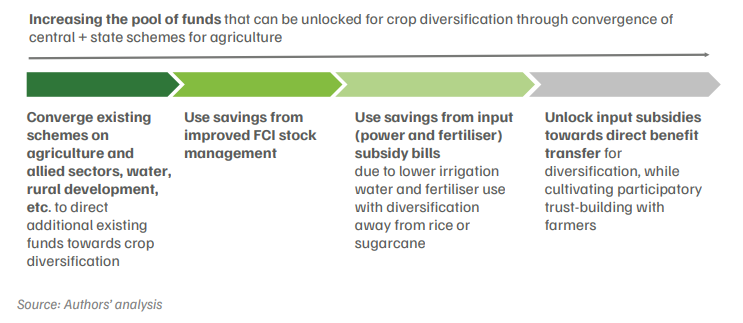
To enhance the pool of funds to incentivise crop diversification, the Economic Survey of India 2026 proposes a calibrated strategy for crop diversification (MoF 2026) that utilises fiscal savings from improved stock management by the Food Corporation of India (FCI), including reduced carrying costs, particularly from rationalising excess buffer stocks of rice. The shift towards less input-intensive crops will eventually result in savings on power and fertiliser subsidies, which can further help states recover initial expenditures.
Ultimately, strengthening trust with farmers through consultative processes and establishing a track record of effective scheme delivery can also encourage states to repurpose and replace input-linked subsidies with direct outcome-linked incentives, such as DBTs, for crop diversification. We recommend a path forward as summarised in Figure 2.
Figure 2. Unlocking funds for calibrated repurposing of existing support to agriculture
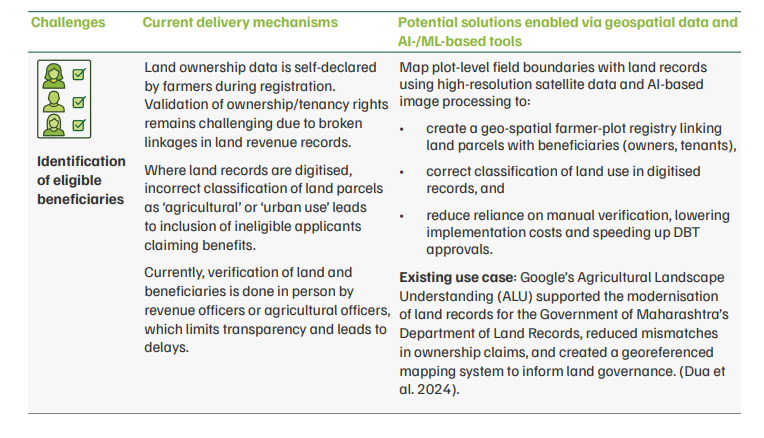
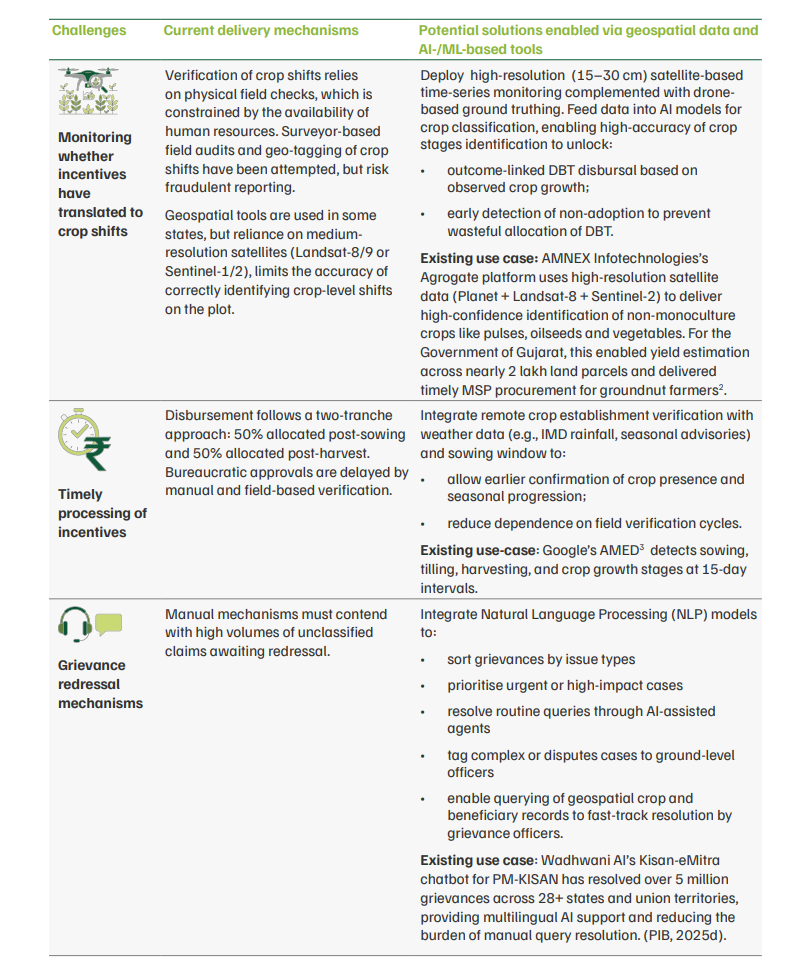
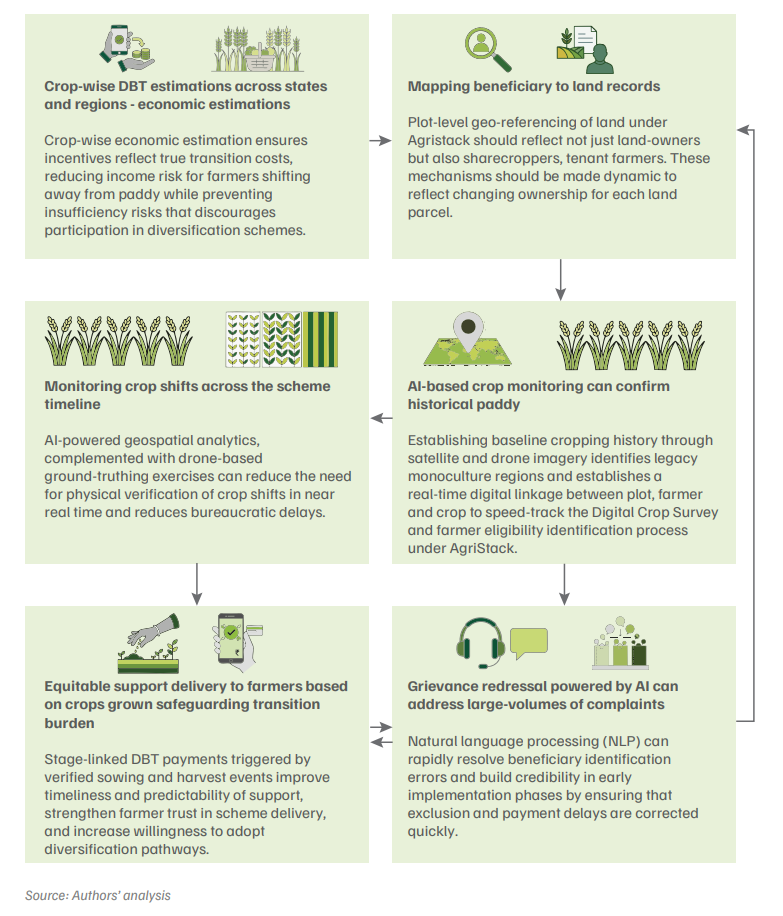
India’s Agri Stack initiative is already digitizing the foundational “who, where, and what” of farming through its federated Farmer, Farm-plot, and Crop Sown Registries (DoAFW n.d.). These registries are built in a decentralized manner, with individual states maintaining records that are updated seasonally through the Digital Crop Survey (DCS) (ibid). This process relies on smartphone-based ground surveys where physical observations are captured with mandatory geotagging and time-stamped crop photographs to ensure plot-level accuracy (ibid). In Table 2 and Figure 3, we outline how high-resolution geospatial data and AI- or machine learning (ML)- based image-processing tools can be integrated into these foundational layers. By utilizing data from satellites, sensors, and drones, these tools can automate and support the verification of crop shifts, reducing the current reliance on manual field checks and accelerating the delivery of targeted, stage-linked Direct Benefit Transfers (DBT).
Table 2. Potential AI-enabled mechanisms to address key challenges in current schemes
| Theme | Risk | Emerging opportunities and mitigation measures |
|---|---|---|
| Effectiveness of solely relying on DBT-based incentivisation for diversification | Direct incentivisation alone yields limited success in stimulating diversification, in the absence of upstream support (input availability, access to credit, insurance, etc.), on-farm advisory on pest management, best practices, etc., and downstream linkages such as access to markets/procurement, storage, processing, or value-chain support for diverse crops. | Crop diversification policies must adopt a 360-degree approach to ensure transition support throughout the value chain for diverse crops. AI-enabled innovations can enable/support this 360-degree approach. For example, large language models (LLMs) that interact in regional languages and dialects can provide advisories on new cultivation practices required for diversification. The recently announced Bharat-VISTAAR (Virtually Integrated System to Access Agricultural Resources) tool in the recent Budget offers this opportunity (Union Budget 2026). |
| Choice of alternative crops to be incentivised | Currently, some states have designed crop diversification schemes to primarily address groundwater depletion challenges (e.g. Punjab, Haryana) without a strategic framework that also considers competing policies, agroecological crop suitability and impact on outcomes – such as the national import burden for edible oils and pulses, trade-offs between nutrition and fuel security, and implications for feed and fibre demand. For example, maize cultivation has been spurred by the biofuel policy and may compete with pulses, oilseeds, millets, soybeans, and cotton - potentially leading to food security risks and threatening nutritional deficiency (MoF 2026). |
State policies must generate options of alternative crops to incentivise, based on a scientific and participatory approach for crop suitability analysis that considers farmers preferences along with multiple regional and national goals, and expand beyond groundwater conservation alone. |
| Theme | Risk | Emerging opportunities and mitigation measures |
|---|---|---|
| Bias in inclusion or skew in better accuracy in geospatial identification towards larger landholding sizes, monoculture regions/crops | Due to India's smallholder farm sizes, diverse terrain, and agroclimatic conditions, farms may be misclassified as non-agricultural land, resulting in higher error rates in crop identification. Similarly, crops grown in intercropping, multi-cropping, agroforestry, and silvipastoral systems may not be identifiable by current AI models. Skewed incentives for only identifiable crops may further entrench monoculture practices (Cieslik, 2025). |
Agri-tech players must invest in extensive model training and ground-truthing of results using diverse datasets across agro-climatic zones, cropping patterns, and landholding conditions. State departments must retain in-person verification of crop shifts for farms where alternate crops are grown in intercropping, multi-cropping, agroforestry, and silvipastoral systems, and invest in research and development (R&D) for developing algorithms to geospatially identify them. Create phygital sandboxes to test for systemic exclusion/inclusion errors. |
| Benefit disbursement based on Aadhaar linkage with bank accounts; exclusion of tenant farmers without formal leases | A large proportion of tenant farmers in India hold informal leases with landowners that may not be digitised and linked to land records. Aadhaar penetration across India stands at 95%, with states such as Bihar (89%), Jharkhand (90%), Odisha (96%), and Nagaland (63%) faring below the national average (UIDAI, 2025). Although women constitute 64% of the agricultural workforce, 46% don't have a personal mobile phone, and only 22% of those with mobile phones use them for financial transactions (NFHS 2019–21). |
Adopt a phased implementation approach, starting with regions with high Aadhaar coverage and a high ratio of personal mobile phone connections among women and marginal farmers. Expand digital and Aadhaar coverage before scaling to other regions. Incorporate mechanisms to identify tenant farmers/sharecroppers, learning from schemes such as the Krushak Assistance for Livelihood and Income Augmentation (KALIA) in Odisha (DaFE 2023). |
| Enhancing the speed of delivery by automating beneficiary identification | Reliance on AI models may lead to a lack of accountability in the proper inclusion or exclusion of eligible farmers. | Retain manual oversight, enable overrides, and have legally mandated 'guardrails' within which models operate (for sensitive decisions). Use open licensing for core algorithms, such as beneficiary identification, to enable external audits and accountability. Create DBT-specific frameworks through participatory methods. (Sanyal et al. 2024) |
Source: Authors’ analysis
To realise the proposed transformation in scheme delivery mechanisms highlighted in the above sections while addressing potential risks and building trust among farmers and policymakers to scale up crop diversification, we suggest the following steps, as outlined in Table 4.
Table 4. Recommendations
The proposed AI-enabled delivery of DBT schemes will need stress testing via phygital policy sandboxes with participation from multiple departments (agriculture, land records, revenue, finance, etc.).
With the proposed AI and digitally-enabled scheme delivery, governments will need to reimagine the role of human resources across departments (which are generally short-staffed) to make them more effective. This shift should start with:
To keep learning and evolving programmes, governments will need to invest in scientific research and development and cultivate state champions.
Source: Authors’ analysis
A calibrated crop diversification approach will require sufficient and effective incentive delivery to build trust and raise adoption of schemes among farmers. State and Central governments must strategically leverage and strengthen India’s digital public infrastructure with AI-powered tools to deliver targeted, timely, accurate, and leakage-proof incentives. This whitepaper outlines a reform pathway that aligns fiscal efficiency with farmer confidence, ensuring that diversification-linked investments translate into measurable crop shifts. Yet, digital delivery is only one pillar. Sustainable diversification will remain incomplete without parallel investments in markets, value chains, procurement reform, and agronomic support to enable a full 360-degree transition support for farmers. Our proposed phygital policy sandboxes should be the first step in testing these ideas.
Instead of uniform per-acre payments, incentives should be calibrated to the actual income gap between existing and alternative crops, based on agroecological crop suitabilities and socio-economic realities of farming households. This makes participation financially viable for farmers and fiscally efficient for governments.
AgriStack links farmer identity, land parcels and crop information. Integrating high-resolution remote sensing and AI tools into these registries allows governments to verify cultivation at the plot level and identify actual cultivators, not just landowners, in a real-time manner. Drone imagery and digital crop surveys can then confirm crop shifts and enable faster, targeted payments.
AI systems may misclassify crops or exclude eligible farmers, especially since farm sizes are small or land records are incomplete. Medium-resolution satellite imagery can also limit the accuracy of crop identification. These risks can be reduced by using high-resolution geospatial data and retaining human oversight and audits during a phased implementation to improve model reliability over time. At the same time, limitations of current AI models in detecting a smaller set of crops and monocultures may skew support away from the huge diversity of crops in India and from intercropping, multi-cropping, and agroforestry systems. This risk warrants retaining physical verification of crop shifts and investing in R&D to update and improve AI models.
What Drives Natural Farming Adoption in Andhra Pradesh?

Water, Nature, Progress: Solutions for a New India
Cattle and Community in a Changing Climate
Understanding Trends in Dietary Diversity in India:
Adapting Agricultural Water Resources Management for a Changing Climate