Council on Energy, Environment and Water Integrated | International | Independent

India’s travel and tourism (T&T) sector is a major economic driver, contributing over 5.8 per cent to India’s GDP and 13 per cent to overall employment opportunities (Ministry of Tourism 2023). The sector has been projected to grow at a 15 per cent CAGR between 2019 and 2027 (Invest India n.d.), owing to the rising foreign tourist arrivals (FTAs)1 and a 9 per cent year-on-year (y-o-y) increase in per capita domestic travel spending (McKinsey 2024).
However, this growth brings significant environmental and social challenges. The T&T sector contributes 5-8 per cent to global greenhouse gas (GHG) emissions (Zhao, Li and Duan 2024; Sustainable Travel International n.d.). In addition, it pressures ecosystems, wildlife, and local communities, and competes for scarce resources like land and water (Ministry of Tourism 2022; Rajamani and Rizal 2014). Recognising these impacts, the Government of India developed a National Strategy for Sustainable Tourism in 2022, aiming to integrate sustainability into the Indian tourism sector to ensure a resilient, inclusive, carbon-neutral, and resource-efficient industry while protecting natural and cultural resources.
Sustainable tourism is, thus, defined as “Tourism that takes full account of its current and future economic, social and environmental impacts, addressing the needs of visitors, the industry, the environment and host communities” (WTO n.d.; Ministry of Tourism 2022). While not being a distinct category, it offers a framework of environmental2 , economic3 and social sustainability4 that extends to all types of tourism.
In light of the seven strategic pillars5 outlined in the National strategy and their intended outcomes, two key focus areas have emerged for our analysis:
Odisha could leverage heritage cultivation practices and natural ecosystems such as the declared Globally Important Agricultural Heritage Systems (GIAHS) (FAO 2012) and Biodiversity Heritage Systems (BHS) (PIB 2023) along with the seven eco-retreats and 50 eco-tourism centres developed by the state, to attract tourist inflow to the state supporting both forest and agriculture-based livelihood diversification.
Eco-tourism
The International Ecotourism Society (TIES) defines ecotourism as “responsible travel to natural areas that conserves the environment, sustains the well-being of the local people, and involves interpretation and education” (TIES 2015).
In Odisha, eco-tourism or ‘Community Managed Nature Tourism’ aims to support forest & wildlife conservation and support active preservation of local and tribal cultures by providing alternative livelihood to forest-dependent communities in the state (DoFECC 2024). With forests legally designated in over 39 per cent of its total geographical area (TGA) (ISFR 2021) and ~12 million people reliant on these forests for their subsistence (RCDC 2018), eco-tourism emerges as a promising avenue for making conservation economically viable. Odisha currently hosts 50 eco-retreats, which are managed by forest community-based organizations such as Van Suraksha Samitis (VSSs) and Eco-Development Committees (EDCs). The state is home to over 13,000 community-based organizations operating in forest areas and tribal and indigenous communities constituting approximately 22 per cent of its population. This demographic, geographic, institutional capacities in forests of Odisha presents a significant, yet underutilized, opportunity to develop eco-tourism initiatives. These initiatives have the potential to enhance financial security through livelihood diversification while simultaneously contributing to conservation and sustainable resource management.
Agri-tourism
UN Tourism defines rural/agri-tourism as “type of tourism activity in which the visitor’s experience is related to a wide range of products generally linked to nature-based activities, agriculture, rural lifestyle/culture, angling and sightseeing (UNWTO 2024)”.
In Odisha, over 40 per cent of the population rely on agriculture, making it the state's largest employment sector. However, the contribution of agriculture and allied sectors to the gross state value added (GSVA) has been declining, estimated at 22.5 per cent in 2022-23. In the state, 40 per cent of its TGA is cultivable land (Finance Department, Govt. of Odisha 2023) —14 per cent of which is under agroforestry (CEEW 2021). However, the farm household incomes of the state is one of lowest in India (PIB 2022) indicating a need for farm-based livelihood diversification. Odisha, through agri-tourism, has the potential to create alternative income sources for farming households by leveraging rich agricultural traditions and initiatives like the Odisha Mushroom Mission, Millet Mission, and Jackfruit Mission.
Jobs, market and investment opportunity
Eco-tourism
Through capacitation of 20 per cent of all the forest community-based institutions i.e., VSSs and EDCs to construct, operate and manage ~1400 eco-tourism centres by 2030, the state could generate ~6300 direct FTE jobs by 2030. This shall unlock the state's capacity to accommodate ~30 million additional tourists annually.
Host ~30 million more tourists annually by 2030 shall require a cumulative investment of ~USD 200 Mn to set up ~1400 eco-tourism centres and facilities, that is expected to generate a minimum annual revenue of ~USD 560 Mn in 2030 in terms tourist expenditures.
Apart from Kendrapara and Puri with their rich mangrove cover which are also the nesting centres for rare Olive Ridley turtles, districts covering Chilika lake, Koraput, Bolangir Kalahandi, Kandhamal, and Gajapati districts have the highest potential for eco-tourism given the availability of subsidy and large forest areas to set up eco-tourism centres in these districts under the Tourism Policy 2022-27 (Department of Tourism 2022).
Agri-tourism
Maharashtra currently leads India's agri-tourism sector, with approximately 1.5 per cent of the state’s total tourist footfall attributed to agri-tourism 7 . If Odisha were to achieve a similar share by 2030, it would necessitate the development of ~130 agri-tourism centers, potentially creating ~1,000 full-time equivalent (FTE) jobs.
The establishment of 130 agri-tourism projects will require an investment of ~USD 10 Mn by 2030 that potentially generate an annual revenue of ~USD 20 Mn in 2030.
Keonjhar, Mayurbhanj, Bargarh, and Koraput districts offer exceptional potential for agri-tourism, owing to their expansive croplands combined with the rich traditional arts, crafts, and cultural heritage unique to each region (Panigrahi 2020).
Boost local economies: Any tourism activity significantly enhances economic activity by driving demand for local products and services, creating jobs, increasing revenue, and reducing poverty. Direct benefits arise from tourism-related activities such as accommodation, transport, and attractions. Sustainable tourism further amplifies these impacts by boosting direct sales of local products like raw honey, spices, fruits, and handicrafts, thereby strengthening local economies (Hypolite et al., 2002). It diversifies income streams for farmers and forest-dependent communities, elevating living standards and building resilience against economic shocks. Opportunities in nature guiding, hospitality, and handicraft sales reduce dependence on subsistence agriculture, while engagement with artisans and community events enriches the tourist experience and supports livelihoods.
Promotion of conservation: Sustainable tourism provides opportunities for usage of alternative energy, efficient waste management, and eco-friendly practices, reducing the carbon footprint (Anup et al. 2020). Further, tourism activities provide an additional economic incentive for communities to engage in conservation of wildlife habitats and natural landscapes. In addition, agri-tourism has the potential to promote and scale sustainable agricultural methods—natural farming, agroforestry, and organic farming—through socialising the benefits of reduced chemical use, improved soil health, and climate resilience to tourists.
Cultural promotion and exchange: Sustainable tourism immerses visitors in rural and tribal lifestyles, offering insights into traditional games, festivals, and rural life. Among tourists, it fosters an appreciation of agriculture, nature, and local food systems while promoting empathy for farmers and forest communities. By allowing for an exchange with indigenous cultures, it offers opportunities for preservation in traditional practices.
Enhanced infrastructure and services: Tourism-driven infrastructure development—such as trails, visitor centres, and sanitation facilities—improves both tourist experiences and local living conditions, benefiting the local communities in remote and rural areas.
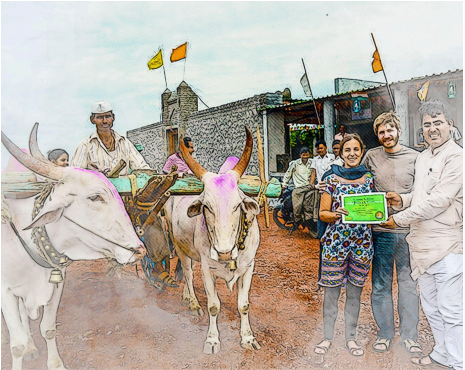
Baramati Agritourism Centre (BAC), established in 2003, is a 28-acre agri-tourism project located 70 km from Pune city in Maharashtra. The farm offers visitors an authentic experience, showcasing village culture, agriculture, and local traditions. BAC's sister company, Agritourism Development Company (ATDC), has successfully implemented agri-tourism models in 328 agri-tourism centres spanning 30 districts in Maharashtra. This endeavour has significantly contributed to the preservation and enrichment of the rural environment, including village traditions, culture, customs, arts, and handicrafts.
According to the ATDC survey conducted in 2014, 2015, and 2016, all the agri-tourism centres collectively welcomed 0.40 million, 0.53 million, and 0.7 million tourists, respectively. This initiative has resulted in a total revenue of INR 3.579 crores for farmers' families while creating employment opportunities for women and youth in rural communities (Palani 2022).
Who could support in scaling sustainable tourism?
1. Role of departments:
Department of Tourism (DoT): to play a pivotal role in positioning sustainable tourism as a niche segment by offering incentives, certifications, branding, and marketing while streamlining processes through a single-window clearance system. It is to establish a dedicated interface to support sustainable tourism operators and collaborate with Skill Development agencies and Indian Institute of Tourism and Travel Management (IITTM) to train farmers and forest-fringe communities in hospitality management and offer courses at doorstep or through ed-tech. The department could create the Agri and Eco Tourism Promotion Council 8 and the Agri and Ecotourism Development Committee to fast-track infrastructure support and ensure the sustainable operation of facilities. It could also regulate tourism practices through strict certification policies, partnering with local organizations to promote genuine sustainability efforts (Sarath et al. 2023).
Forest, Environment and Climate Change Department: to collaborate with DoT to incentivise development of capacities for forest community-based organizations for the uptake of eco-tourism enterprise models. They could also develop certification policies and develop standardised tools for monitoring carbon emissions and sustainability practices across tourism centres. The department could also establish guidelines for site development in forested areas for tourism, develop tourism master plans for protected and buffer zones, conduct carrying capacity assessments to prevent environmental degradation, and promote local culture and biodiversity through resource books.
Department of Agriculture and Farmers' Empowerment: to support agri-tourism by providing crucial inputs for developing guidelines and supporting farmers and agri-entrepreneurs. It could offer support to DoT for crafting sustainable tourism policy for agri-tourism development. In the lines of Forest, Environment and Climate Change Department, this department could identify potential sites and collaborate with the Department of Co-operatives to facilitate scaling up of agri-tourism. The department could also aid in creating ideal or model agri-tourism centres and implementing initiatives under the Mukhyamantri Krushi Udyog Yojana (MKUY) with the Agricultural Promotion and Investment Corporation of Odisha Limited (APICOL). It could collaborate with the Directorate of Horticulture to develop activities like fruit picking and orchard tours, support sustainable agriculture, and facilitate connections with organic farming initiatives. Additionally, it can assist in establishing Agri-Tourism Clusters (MoT 2021) as part of missions such as Odisha Millet Mission and Odisha Jackfruit Mission.
Odisha Skill Development Authority (OSDA): to play a major role in equipping the communities with skills to render hospitality services for tourists that are crucial for sustained tourist inflow. They could collaborate with IITTM to redesign and develop more courses and diplomas on hospital management catered to agri and ecotourism and offer doorstep courses. OSDA could collaborate with the Forest, Environment and Climate Change Department to provide training and certifications programmes for nature guides, camping guides, and birding guides along with naturalist certificates. In addition, the authority could organize workshops and seminars on best practices in hospitality, customer service, and sustainable tourism management with Hotels, Restaurants and Cafes (HORECA) industry associations.
Odia Language Literature & Culture Department: With Odisha's wealth of cultural heritage encompassing historical monuments, archaeological sites, traditional and tribal arts, sculpture, dance, and music, this department plays a pivotal role in integrating and facilitating cultural exchanges of local food and history with sustainable tourism. The department can further support cultural activities, enterprises and events that can be integrated into the sustainable tourism centres, such as traditional/folk music, traditional textiles and handicrafts and dance performances.
Department of Rural Development and Mission Shakti: could be instrumental in promoting agri and eco-tourism as alternative livelihood opportunities through rural livelihood enhancement schemes, policies etc.
2. Role of the private sector:
Establishing tourism networks: Large HORECA players could invest in creating a network of community-led eco-tourism centres and accommodations by collaborating with VSS, EDCs, farmer producer organisations (FPOs) or farmer cooperatives across Odisha while also enhancing coordination, standardisation, certification, and branding efforts.
Exposure and positioning through engagement with travel entities: Private sector could collaborate with airlines, travel agencies, and foreign embassies through initiatives like the Odisha Travel Bazaar internationally and domestically to promote Odisha’s sustainable tourism networks.
Supporting technical development for tracking sustainable tourism practices: Private sector could provide assistance in developing and integrating methodologies such as tourism carrying capacity (TCC)9 , limits of acceptable change (LAC)10 , and visitor impact management (VIM)11 into the sustainable tourism policy framework through hospitality industry associations.
3. Role of local administration and civil society organisations (CSOs):
Community mobilisation: CSOs could be instrumental in engaging with local communities in forests and farms to identify sustainable tourism potential with community-based organisations. They could be critical for sustained community participation and for the uptake of local promotional initiatives, such as village tourism oriented events and formation of tourism cooperatives, in collaboration with local governments.
Public awareness on sustainable tourism: CSOs could run livelihood diversification campaigns among communities and awareness parades for potential tourists in urban areas about genuine sustainable practices, their positive impacts on local communities and the environment to promote tourist inflow to sustainable tourism centres.
Community assistance: CSOs could assist in ensuring that tourism centres comply with sustainability principles by advocating for and monitoring adherence to certification policies, licences, and codes of conduct.
1. Economic challenge/s:
Seasonal variability in tourist in-flow: Despite increased globalization and transportation networks, India’s hotel occupancy rates have plateaued at around ~60-65 per cent since last decade (except for the covid years) (Hotelivate 2024). However, the eco-tourism occupancy rates are always below 30 per cent 12 nation-wide indicating seasonality trends in the industry. Seasonal fluctuations could lead to income instability for communities opting for community-based models of tourism. The overlap of seasonality with harvest periods in agricultural landscapes can result in significant seasonal economic fluctuations and shocks for families and communities.
Way forward: Coordinated efforts by state marketing agencies to leverage tourism inflows to artificially alleviate seasonal nature of the sector are crucial. Incubation support for sustainable tourism enterprises for marketing their facility could be provided through entities like Start-up Odisha. Sustainable tourism project developers with communities could design an year around activity based models to ensure a sustained tourist in-flow. Channels like corporate and school engagements could be leveraged in off-seasons. Additionally, windfall gains in some months of the year from tourism must be effectively managed through wealth management support for enterprises from local cooperative banks and financial institutions to ensure sustained annual community benefit.
2. Skill-related challenge/s:
Lack of skilled labour and training: The sustainable tourism sector in Odisha faces challenges due to the shortage of skilled labour and trained professionals in hospitality and agricultural practices 8 . Many local communities are also unfamiliar with the concept of agri-tourism as it is still in its nascent stage in the region. Many times rural youths lack proper training and limited business planning skills, posing a significant obstacle to the development of tourism. A lack of fluency in commonly spoken languages (English or local dialects) can hinder effective communication and interaction with tourists.
Way forward: Providing training and capacity-building (including business planning skills, hospitality management and language training to enhance communication skills and ensure a positive visitor experience) is essential for local communities to successfully participate in this emerging sector. The OSDA can play a pivotal role by offering training programmes like business development courses and mentorship to agri-tourism entrepreneurs tailored to agri-tourism. These programmes should also encompass best practices in agriculture, nature guides, camping guides, birding guides dairy, hospitality, and customer service. Additionally, promoting awareness and knowledge sharing through farmer associations, forest departments and government-supported initiatives can further enhance the adoption of sustainable tourism practices and improve the quality of services offered to tourists.
3. Conformity challenge/s:
Lack of verification mechanisms for sustainability in tourism centres: Despite the intentions of promoting sustainable tourism, some tourism entities may resort to practices that mislead visitors into believing they are engaging in environmentally responsible activities. These entities could engage in usage of unconferred or false labels to leverage niche tourist inflows. Such actions could not only undermine the authenticity of tourism but could also exacerbate environmental degradation and cultural exploitation.
Way forward: Certification policies and codes of conduct could be established to regulate tourism facilities with regular assessments through linking it to their renewal of licenses. Secondly, enhanced consumer awareness and education regarding genuine sustainable practices and their positive impact on local communities and the environment must be promoted in educational institutions and industries (Poyamalli 2018). Additionally, fostering partnerships between local communities, government agencies, and tourism stakeholders through incentives and targeted interventions could facilitate the development of responsible tourism initiatives that prioritise conservation and community well-being.
Lack of standardised management tools: The current Ecotourism Policy of 2013 and the Tourism Policy of 2022 in Odisha lack provisions or tools for measuring the carbon footprint of eco-tourism centres which may be essential for agri-tourism centres as well. Given that a low carbon footprint is a crucial aspect of authentic sustainable tourism 8 , the absence of a standardised tool to assess and manage carbon emissions without a clear framework for monitoring and reducing carbon footprint, may become a significant barrier to ensure the sustainability of tourism activities in Odisha. This may impact international and domestic tourist inflow and can also manifest to become a major reputational risk.
Way forward: the development of standardised tools and methodologies for calculating and monitoring carbon emissions associated with eco-tourism activities could become a mandatory part of Odisha's Tourism policy. This can be initiated with the help of collaborative partnerships between government agencies, environmental organisations, and academia. Additionally, capacity-building initiatives should be implemented to train managers and stakeholders in the use of these tools effectively. Furthermore, it is imperative to integrate essential methodologies such as TCC, LAC, limits of acceptable use (LAU)13 , the eco-tourism opportunity spectrum (ECOS)14 , VIM, visitor activity management process (VAMP)15 , eco-tourism certification, and integration into the eco-tourism policy framework.
1. Environmental risks:
Overcrowding: High tourist numbers could disturb wildlife and damage fragile ecosystems. In Odisha, a study by the Zoological Survey of India indicated that overcrowding could be both a cause and effect of shifts in nesting zones of Olive Ridley turtles in Gahirmatha Marine Wildlife Sanctuary in the state (Mishra et al 2024). Further, higher and unsustainable tourist foot traffic that leads to waste generation may degrade natural areas while causing pollution from litter and vehicle emissions damaging the environment.
Ecological disturbance and habitat alteration: Hiking, wildlife viewing, and off-road vehicles could disrupt animal behaviour, migrations and breeding patterns, and may lead to introduction and infestation of invasive species. Tourism infrastructure development, like lodges and trails, may necessitate land clearing that may further alter local habitats and natural processes.
Mitigation: To mitigate environmental risks, the identification of tourism hotspots and subsequent assessments of carrying capacities and ecological sensitivities becomes critical. In addition, localised guidelines on activities that can be allowed in these areas could be developed by local governments. Licences for tourism centres could be linked to stringent eligibility criteria and regulations on capacity of facilities based on carrying capacity assessments.
2. Economic risks:
Climate and disaster sensitivity: According to Mohanty and Wadhawan (2021), a high risk of natural hazards could reduce tourism footfall, which is particularly exacerbated in vulnerable states like Odisha. This may cause loss of property and infrastructure and a sustained loss of financial resources for the communities.
Mitigation: To mitigate income instability in vulnerable states like Odisha, insurance instruments for both property and loss of annual incomes must be devised with the state-led financial institutions for compensation, recovery and to aid in restarting the enterprises on account of black swan or unprecedented events.
3. Safety and health risks:
Health and safety risk: Owing to high engagement of the tourists with natural ecosystems in agri and eco-tourism centres, might exacerbate the risk of accidents or injuries (snake bite, animal attack etc) among tourists.
Mitigation: In order to mitigate such risks, the local communities could be trained through courses by the skill development agencies to provide first aid in case of emergencies. A proper infrastructure and transportation network could be established to licensed operators for enhanced and quicker access to ambulance services and hospitals. Strict regulations could be imposed in the form of fines and penalties on both the tourist and facility in case of hazardous breach. A mandatory behavioural guidelines could be developed for tourist behaviour and facility management at the enterprise or tourism center levels in consultations with local government bodies.
We limit the sustainable tourism value chain analysis to capture only direct employment opportunities generated, which includes:
Construction of tourism centres: This stage encompasses the physical development of eco-tourism and agri-tourism facilities, such as eco-lodges, farm stays, visitor centres, and nature trails.
Maintenance and operations of tourism centres: This includes the ongoing operational roles required to maintain and manage sustainable tourism centres. It covers employment opportunities in day-to-day activities such as hospitality management, guiding services, facility maintenance, security, customer service, guides etc.
We exclude the jobs generated during the pre-establishment and post-establishment of sustainable tourism business units. We also exclude indirect as well as induced opportunities—such as jobs created in the supply chain or broader economic impacts triggered by tourism-related activities.
We assume central business units to be sustainable tourism centres such as home stays, mini and micro resorts etc. that are run and managed by the communities.
Eco-tourism:
For eco-tourism value chain, we assume the eco-tourism centres to be established and management by the communities that have either the rights over the forest land through community forest rights (CFRs), or by the community organisations such as Van Suraksha Samitis (VSSs) or eco-development committees (EDCs) 16 which have the administrative responsibility of managing the forest.
Agri-tourism:
For the agri-tourism value chain, we assume the tourism centres to be established and managed by the land owning farmers or a group of farmers and farmer families through farmer producer organisations (FPOs) or farmer co-operatives or self-help groups.
To estimate the potential of eco-tourism in Odisha by 2030, we have developed an ambitious scenario, grounded primarily in supply-side potential assessments. The rationale for focusing on supply-side estimates stems from several key factors. Firstly, tourism growth in Odisha had plateaued prior to the COVID-19 pandemic, particularly in terms of overall tourist numbers. Post-pandemic, any potential recovery in tourism could either be expected to revert to pre-COVID levels by 2030 or show sustained exceptional y-o-y growth.
In addition, historical data shows that only 1.5 per cent of total tourist footfall is directed towards ecotourism sites. However, while the compound annual growth rate (CAGR) of eco-tourism was found to be 63 per cent pre-pandemic and 67 per cent in the immediate post-pandemic years, such sharp increases in demand are unpredictable and may not be sustainable long-term. Given the uncertainties associated with demand-side shifts, our methodology is anchored in assessing the supply-side potential of eco-tourism.
As part of our supply-side assumptions, we assume that Odisha will add 1,000 new community organisations—VSSs and EDCs—through the Ama Jungle Yojana, increasing the current total of 13,000. Given the active roles of Joint Forest Management and Mission Shakti, we further assume that 20 per cent of these VSSs and EDCs, excluding the 50 currently managing ecotourism sites, can be trained and equipped to establish and manage new eco-tourism sites.
This assumption requires Odisha's eco-tourism footfall to grow at a CAGR of 20 per cent by 2030, while overall tourist footfall is anticipated to return to pre-COVID levels. Currently, the conversion rate of total tourists to eco-tourism stands at 1.5 per cent. However, with this growth, Odisha could potentially convert between 19 per cent and 21 per cent of total tourist footfall to eco-tourism. This projection aligns with Kerala, which leads the nation by converting 19 per cent of its total tourist traffic to eco-tourism.
Agri-tourism:
We adopt a demand-side approach to estimate agri-tourism potential in Odisha, contrasting with the supply-driven methodology used in eco-tourism. Maharashtra, a leader in agri-tourism, aims to convert 1.5 per cent of its total tourist footfall to agri-tourism by 2030, facilitated by the establishment of 500 additional agri-tourism centres by ATDC. Drawing on this precedent, we project a return of the tourist footfall in Odisha to pre-COVID levels by 2030 and set a corresponding target of converting 1.5 per cent of the total tourist footfall to agri-tourism under an ambitious growth scenario.
Jobs estimation
We calculate the full-time equivalent (FTE) jobs for both agri-tourism and eco-tourism centres using a standardised approach to calculate the FTE coefficient for each based on employee numbers, working hours, and tourism centre capacity.
Data collection
We conducted eight key informant interviews (KIIs) with tourism centre operators and experts from the T&T sector across India to assess labour requirements for eco and agri-tourism centres. These interviews gathered data on centre capacity, occupancy rates, tourist duration and spending, staffing levels, and working hours. We used a mix of purposive and convenience sampling to ensure the selection of relevant and accessible informants. Five KIIs out of the eight conducted are being used for estimations owing to data quality issues.
We structured the KIIs to capture both quantitative and qualitative information on sustainable tourism centres development. In the quantitative section, we captured the employed people, their corresponding working days and roles, occupancy rates and operational structures across phases of infrastructure development, operations, and tourist engagement. The qualitative questions explored skill requirements, challenges, and risks within the sustainable tourism ecosystem, along with potential strategies and interventions to address these challenges specifically for the state of Odisha.
FTE calculation
We calculated FTE for standardised units of eco and agri-tourism centres based on their capacity and corresponding annual occupancy rates. It is essential to use different standardised units for each category of sustainable tourism due to variations in seasonality and economic viability.
The assumed standardised units for tourism centres17 are as follows:
Table 1: Category wise standard units considered
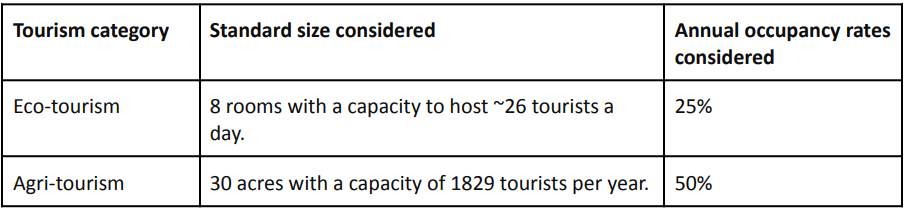
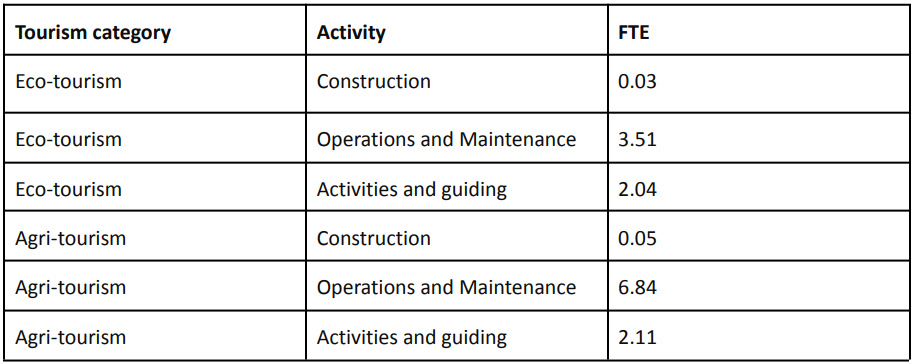
Given that tourism is a year-long activity, 1 FTE is considered to be 8 hrs of work for 365 days in a year.
FTE for tourism centres including construction jobs:

Table 2: Category-wise FTEs as per activities
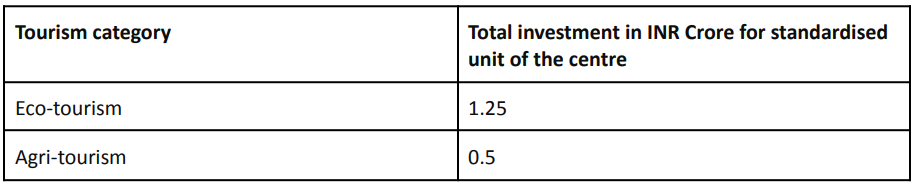
We calculated the investment required to establish standardised units of tourism centres as highlighted in Table 1 for both eco and agri-tourism, focusing solely on infrastructure needs for hospitality and activities while excluding operational expenditures.
For eco-tourism centres, the investment encompasses the construction of accommodations, such as guest rooms, as well as facilities for recreational and educational activities like constructing nature trails, adventure activities etc. In the case of agri-tourism centres, the investment primarily involves developing agricultural infrastructure, such as farming facilities, visitor accommodations, and spaces for educational workshops. In both the cases, investment does not consider the land cost of the occupied facility.
Table 3: Investment per tourism centre
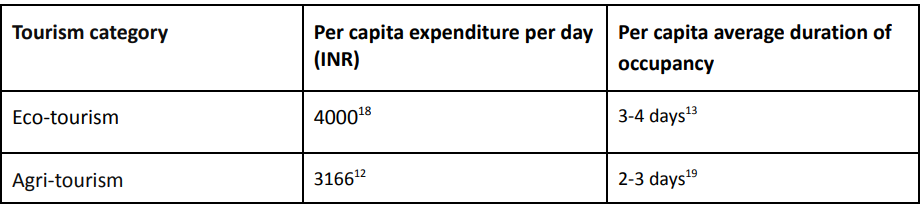
Tourism economy is captured through consumer spending patterns, behaviours and preferences. These are majorly accounted for as per capita expenditure per day and per capita average duration of occupancy. We estimate the market opportunity for both categories of sustainable tourism using the following formula:

Table 4: Consumer behaviour in tourism centres
Anup, K C, Sanjeet Ghimire, and Ankit Dhakal. 2020. “Ecotourism and Its Impact on Indigenous People and Their Local Environment: Case of Ghalegaun and Golaghat of Nepal.” GeoJournal 86 (6): 2747–65. https://doi.org/10.1007/s10708-020-10222-3.
Aravind, Shibi. 2017. “Eco-Tourism in Tribal Regions of Odisha: Its Potential and Prospects.” Www.Academia.Edu, November https://www.academia.edu/35039479/Eco_Tourism_in_Tribal_Regions_of_Odisha_Its_Potential_and Prospects?email_work_card=view-paper.
Bhandare, Dinesh. 2014. “A STUDY OF POTENTIAL FOR THE DEVELOPMENT OF ECOTOURISM IN GAGANBAWADA OF KOLHAPUR DISTRICT OF MAHARASHTRA.” Www.Academia.Edu, August. https://www.academia.edu/7939619/A_STUDY_OF_POTENTIAL_FOR_THE_DEVELOPMENT_OF_ECOT OURISM_IN_GAGANBAWADA_OF_KOLHAPUR_DISTRICT_OF_MAHARASHTRA. CEEW. 2021.
“Agroforestry Potential In India.” Council for Energy, Environment and Water https://www.ceew.in/publications/sustainable-agriculture-india/agroforestry
Chaini, SUSANTA RANJAN and Faculty of Hotel and Tourism Management, SGT University, Gurugram-122 505 (Haryana), India. 2022. “A Research Study on Development of Agritourism Business in Gurugram District (Haryana).” Annals of Agri-Bio Research. Vol. 27. https://agribiop.com/wp-content/uploads/2019/11/238-241.pdf.
D, Jyoti and DownloadProjectReport.com. 2022. “Project Report on Agri Tourism.” Report. Uploaded by NODAL TRAINING INSTITUTE, SSVP-Pune, Ministry of Agriculture & Farmers Welfare, Government of India, and National Institute of Agricultural Extension Management (MANAGE), Hyderabad & NABARD. Agri Clinics & Agri Business Center Scheme. https://www.agriclinics.net/SampleProjects/10.pdf.
Dangi, Vikas. 2018. “The Scenario of Agro - Tourism in India: An Overview.” Journal-article. Journal of Emerging Technologies and Innovative Research (JETIR). Vol. 5. https://www.jetir.org/papers/JETIR1805874.pdf.
Department of Tourism. 2022. Odisha Tourism Policy 2022. Government of Odisha, Department of Tourism. https://dot.odisha.gov.in/sites/default/files/2023-01/Odisha%20Tourism%20Policy%202022.pdf
DoFECC. 2024. Eco-tourism. Department of Forest, Environment and Climate Change, Government of Odisha. https://odishaforest.in/eco-tourism#:~:text=Ecotourism%20or%20%22Community%20Managed%20 Nature,Forest%20dependent%20communities%20in%20State
Dsouza, Komal Jenifer, Ankitha Shetty, Pooja Damodar, Jeet Dogra, and Nachiket Gudi. 2023. “Policy and Regulatory Frameworks for Agritourism Development in India: A Scoping Review.” Cogent Social Sciences 10 (1). https://doi.org/10.1080/23311886.2023.2283922.
Economic Survey. 2024. “Chapter 11: SERVICES: FUELLING GROWTH OPPORTUNITIES.” Union Budget. https://www.indiabudget.gov.in/economicsurvey/doc/eschapter/echap11.pdf.
Finance Department, Government of Odisha. 2023. “Economic Survey 2022-23.” Finance Department.
https://finance.odisha.gov.in/sites/default/files/2023-02/Odisha%20Econo...
FAO. 2012. “Koraput Traditional Agriculture.” Food and Agriculture Organization. https://www.fao.org/giahs/giahsaroundtheworld/designated-sites/asia-and-the-pacific/koraput-tradi tional-agriculture/en/
Government of Maharashtra. 2016. “Maharashtra Tourism Policy 2016.” Department of Tourism & Culture Affairs. https://ffo.gov.in/uploads/film_policy_file/Maharashtra-Tourism-Policy.pdf.
HYPOLITE, E, and G.C GREEN. 2002. “Ecotourism: Its Potential Role in Forest Resource Conservation in the Commonwealth of Dominica, West Indies on JSTOR.” Www.Jstor.Org. https://www.jstor.org/stable/43740098.
Invest India. n.d.“Tourism Industry in India - FDI, Investment, Market Share.” Invest India. Accessed July 19, 2024. https://www.investindia.gov.in/sector/tourism-hospitality.
ISFR. 2021. Indian State of Forest Report. Forest Survey of India. https://fsi.nic.in/forest-report-2021-details
Juganaru, I., Juganaru, M., & Anghel, A. 2008. Sustainable tourism types. Annals of University of Craiova - Economic and Science series, 2, 794-804. http://feaa.ucv.ro/AUCSSE/0036v2-024.pdf
King, C. 2022. Beyond Sustainability: A Global Study of Nature-based Solutions in Regenerative Tourism. Travel and Tourism Research Association: Advancing Tourism Research Globally, 38. https://scholarworks.umass.edu/ttra/2022/researchabstract/38
Manuel Antonio, Costa Rica, From 1985 to 2008.” Landscape Ecology (Print) 27 (5): 731–44. https://doi.org/10.1007/s10980-012-9722-7.
McKinsey. 2024. “The State of Tourism and Hospitality.” McKinsey. https://www.mckinsey.com/industries/travel/our-insights/the-state-of-tou...
Ministry of Tourism, Government of India. 2022a. “OFFICE MEMORANDUM Principal Secretaries/Secretaries/Commissioner (Tourism),.” Ministry of Tourism. https://tourism.gov.in/sites/default/files/2022-05/National%20Strategy%2...
Mishra, M. Pati S., Paul S., Gonçalves. R. M, Acharyya. T, Tripathy B, Marques da Silva R, Guria R, and Santos C.A.G. 2024. ‘Dynamic Shoreline Alterations and Their Impacts on Olive Ridley Turtle (Lepidochelys olivacea) Nesting Sites in Gahirmatha Marine Wildlife Sanctuary, Odisha (India)’. Marine Pollution Bulletin 202 https://doi.org/10.1016/j.marpolbul.2024.116321.
Palani, M. and University of Hyderabad. 2022. “AGRITOURISM - a CASE STUDY OF SUPPLEMENTARY INCOME FOR FARMERS IN INDIA.” Journal of the International Academy for Case Studies. https://www.abacademies.org/articles/Agritourism-a-case-study-of-supplem...
Panigrahi, R. K. 2020. Rural tourism in Odisha. SSRN Electronic Journal. https://doi.org/10.2139/ssrn.3514487
Poyyamoli, G. 2018. “Ecotourism Policy in India: Rhetoric and Reality.” Grassroots Journal of Natural Resources 1 (1): 46–61. https://doi.org/10.33002/nr2581.6853.01015
PIB. 2022. “Income of Farmers.” Press Information Bureau, December 16, 2022. https://pib.gov.in/PressReleasePage.aspx?PRID=1884228.
PIB. 2023. “Sustainable Tourism in Biodiversity Heritage Sites.” Press Information Bureau. https://pib.gov.in/PressReleaseIframePage.aspx?PRID=1944380
Rajamani, Asokan, and Praveen Rizal. 2014. “EMERGING ENVIRONMENTAL ISSUES WITH THE DEVELOPMENT OF TOURISM INDUSTRY IN INDIA: A STUDY.” International Journal of Development Research 4, no. 5 (May): 995-999.
RCDC. 2018. Community Forest Management Initiatives in Odisha by RCDC. Regional Center for Development Cooperation.
https://rcdcindia.org/PbDocument/ecda2b3301d9b09-b82b-4821-8432-25070207...
Samal, Rajashree, and Madhusmita Dash. 2023. “Ecotourism, Biodiversity Conservation and Livelihoods: Understanding the Convergence and Divergence.” International Journal of Geoheritage and Parks 11 (1): 1–20. https://doi.org/10.1016/j.ijgeop.2022.11.001.
Scaria, Roy. 2013. “Plastic Littering and Ecotourism in Kerala: The Challenges and Remedies.” Mgu-In, January. https://www.academia.edu/67601037/Plastic_Littering_and_Ecotourism_in_Kerala_The_Challenge_ and_Remedies.
Sarath, S., and B. Venkata Rao. 2023. “Agritourism: The Stakeholders-Focused Journey in Maharashtra.” Report. National Institute of Agricultural Extension Management (MANAGE). National Institute of Agricultural Extension Management (MANAGE).
https://www.manage.gov.in/publications/reports/internreports/Agri%20Tour...
Shinde, H. R., D. B. Malave, S. C. Phuge, and P. J. Kshirsagar. 2020. “Doubling Farm Income Through AGRO-Tourism Centers (ATCS) in Ratnagiri District (M.S.).” International Journal of Current Microbiology and Applied Sciences, 4161–72. https://www.ijcmas.com/special/11/H.%20R.%20Shinde,%20%20et%20al.pdf.
Sustainable Travel International. n.d. “Carbon Footprint of Tourism.” Sustainable Travel International. Accessed June 29, 2024. https://sustainabletravel.org/issues/carbon-footprint-tourism/.
TIES. 2015. “TIES announces ecotourism principles revision”. The International Ecotourism Society. https://ecotourism.org/news/ties-announces-ecotourism-principles-revision/
World Tourism Organization (WTO). n.d. “Sustainable development.” UN Tourism. Accessed March 23, 2024. https://www.unwto.org/sustainable-development.
Zhao, Xiaochun, Taiwei Li, and Xin Duan. 2024. “Studying tourism development and its impact on carbon emissions.” Scientific Reports 14, no. 7463 (March). https://doi.org/10.1038/s41598-024-58262-w.