Council on Energy, Environment and Water Integrated | International | Independent

Context: The revised Construction and Demolition Waste Management Rules come into effect from April 2026, tackling issues of traceability, compliance, and market demand to enable a circular economy.
Key insights: The rules combine accountability and demand creation through extended producer responsibility, utilisation targets, and monitoring, with potential co-benefits for reducing dust and improving urban air quality.
CEEW recommendation: Effective implementation will require stronger enforcement, fiscal correction to support recycled materials, and sustained awareness to drive compliance.
India’s construction industry is expanding rapidly, growing at a compound annual growth rate (CAGR) of 14.2 per cent between 2021 and 2025, and is projected to grow at 8.8 per cent during 2026–2030. To meet this demand, the country is expected to add 700–900 million square metres of commercial and residential space annually. This sustained growth is reshaping urban landscapes, but rising construction waste and dust emissions have emerged as critical challenges.
On 1 April 2026, the Environment (Construction and Demolition) Waste Management Rules, 2025, will come into effect. Notified in April last year by the Ministry of Environment, Forest and Climate Change of India (MoEFCC), these rules mark the first revision to India’s construction and demolition (C&D) waste regulatory framework in a decade. They aim to align the sector with circular economy principles by introducing extended producer responsibility (EPR), waste utilisation targets, environmental compensation, and a centralised monitoring system.
The expansion in construction has led to a steady rise in C&D waste, such as concrete, bricks, stone, and ceramics, with annual estimates ranging from 150 to 500 million tonnes, i.e. around two-four times the total capacity of all the trucks currently registered in India. Hyperlocal surveys by the Council on Energy, Environment and Water (CEEW) have identified littered C&D waste and dumps in cities such as Mumbai, Thane, and Amritsar as sources of air pollution.
While recycling infrastructure has grown in response, with processing facilities increasing from 16 in 2019 to 34 in 2024 (and another 36 are currently proposed across ten states), their geographical distribution remains misaligned with waste generation and demand centres. For instance, Delhi currently has 106 public C&D waste collection points and four designated for bulk generators, but there is little evidence on how effectively these are located or utilised. The gap could be attributed to the absence of waste traceability mechanisms in the 2016 rules, which inhibited compliance and limited market opportunity for recycled products.
The 2025 rules seek to address these structural gaps by improving traceability, strengthening compliance, and enabling a more efficient and circular C&D waste ecosystem.
Table 1: How are the latest rules different from the C&D Rules, 2016?
| Aspect | 2016 | 2025 |
|---|---|---|
| Centralised portal | Absent | Online portal to enable digital tracking of all aspects related to the C&D rules |
| Extended producer responsibility | Absent | Introduction of the EPR regime |
| Utilisation targets | Guidelines for the utilisation of C&D waste in municipal and road works | Staggered mandatory targets for the use of C&D waste in construction and road works |
| Environmental compensation | No provisions for penalties. Authorities used the Environment (Protection) Act, 1986 and others to impose fines | Provision for the levy of environmental compensation |
| Legacy waste management | Absent | Pollution Control Boards/Committees to inventory and local authorities to manage legacy waste. It also allows the use of environmental compensation to manage legacy waste |
| Monitoring framework | Entrusted to pollution control boards/committees | Government of India-appointed Steering Committee and a state government-appointed Monitoring Committee to supervise implementation |
Source: Authors’ analysis
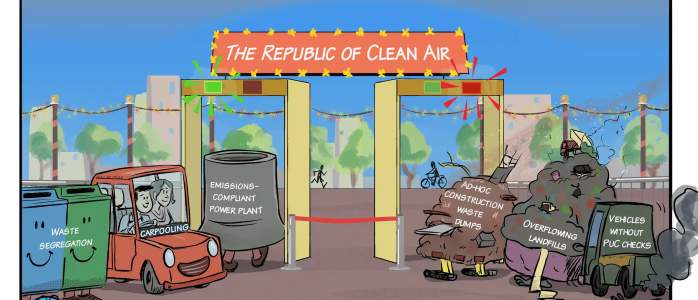
While improving air quality is not the primary objective of the C&D Waste Management Rules 2025, the rules can generate co-benefits in cleaning urban air in three possible ways,
The introduction of EPR, waste utilisation targets, environmental compensation, and improved monitoring will increase accountability across the C&D waste value chain and help enable a steady supply of recycled construction materials. However, a key fiscal anomaly continues to constrain the market for recycled products. While many new construction materials attract a GST rate of five per cent, several recycled alternatives are taxed at 18 per cent as they are classified as intermediate industrial goods, undermining their competitiveness. Addressing this through GST revision could also help stimulate demand and strengthen the economic viability of recycling enterprises.
The introduction of EPR, waste utilisation targets, environmental compensation, and improved monitoring will increase accountability across the C&D waste value chain and help enable a steady supply of recycled construction materials. However, a key fiscal anomaly continues to constrain the market for recycled products. While many new construction materials attract a GST rate of five per cent, several recycled alternatives are taxed at 18 per cent as they are classified as intermediate industrial goods, undermining their competitiveness. Addressing this through GST revision could also help stimulate demand and strengthen the economic viability of recycling enterprises.
Srish Prakash is a Consultant and Arpan Patra is a Programme Associate at the Council on Energy, Environment and Water (CEEW). Send your comments to [email protected].





Add new comment