Council on Energy, Environment and Water Integrated | International | Independent

Context: India recently generated more than half its electricity from fossil-free sources for the first time and has already achieved its target of 50 per cent non-fossil power capacity five years ahead of schedule.
Key insight: As renewable electricity expands, India must move beyond adding clean generation to creating a market that rewards consumers and businesses for shifting electricity demand to when renewable power is abundant.
CEEW recommendation: India should build market rules, digital infrastructure, and regulatory frameworks that enable demand flexibility to become a core power system resource.
At midday on 6 July, India reached a historic milestone in its energy transition. For a period of about 15 minutes, more than half of the electricity generated was from fossil-free energy for the first time. At first glance, due to its brief duration, this could appear as a simply symbolic milestone. Yet others might argue it’s a crossing of the Rubicon — evidence that India’s commitment to decarbonise and improve its energy security with domestically produced energy has reached a point of no return.
India has the third highest electricity demand of any country globally, behind China and the United States (US), and demand continues to grow. Under International Energy Agency scenarios, India will account for nearly one-quarter of global energy demand growth between 2019–40, more than any other country.
In 2025, India reached a target of 50 per cent non-fossil capacity, five years ahead of schedule. But India’s electricity generation is still dominated by fossil fuels, with renewables only accounting for 26 per cent of electricity generation in fiscal year 2025–26. This presents continued challenges for both its energy security and decarbonisation objectives.
But, as its renewable base grows, the next question is about how to best optimise its new power system and ensure clean electricity is used as efficiently as possible. Demand flexibility — through smart charging of electric vehicles, responsive heating and cooling in buildings, and adaptive industrial demand — offers a way to do exactly that.
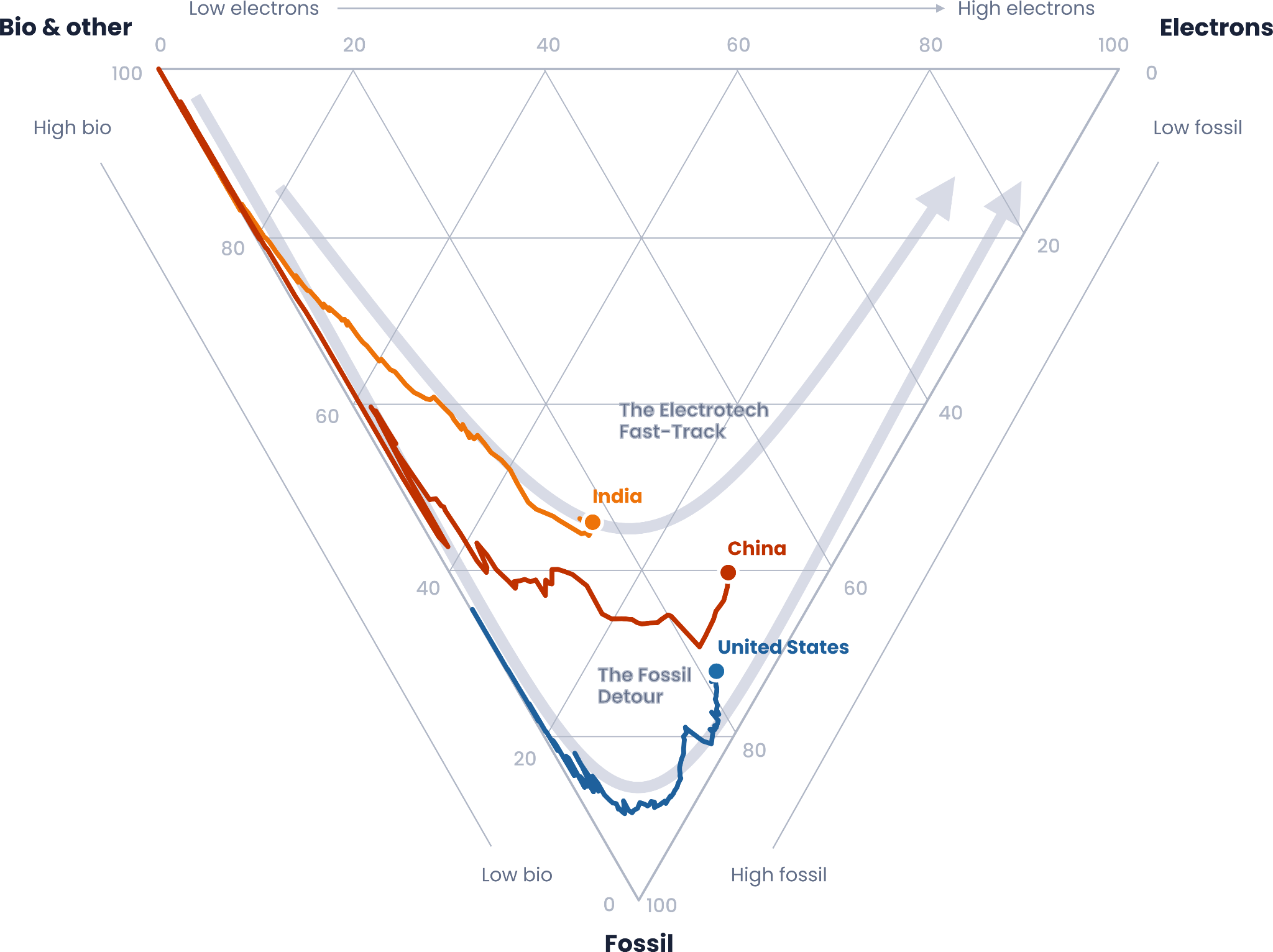
Ember has argued that India is avoiding the "fossil detour" taken by the US and other industrialised economies, with rising electricity demand increasingly being met by clean generation rather than fossil fuels. That creates an equally important opportunity: to avoid a flexibility detour.
Many mature electricity systems are now trying to retrofit flexibility after rapid renewable deployment has already exposed operational challenges. Here, India has an advantage. It can embed the market rules, digital infrastructure, and regulatory frameworks needed for flexibility alongside the clean energy transition, rather than bolting them on afterwards.
Figure 1. India’s electrotech fast track, showing share of final energy consumption as a per cent of total energy demand 1900–2023
That is why Centre for Net Zero partnered with the Council on Energy, Environment and Water (CEEW) on a roadmap for demand flexibility. Centre for Net Zero brings evidence from large-scale flexibility trials and energy system modelling in Great Britain, Europe and the US, while CEEW brings deep expertise in India's power sector and close engagement with policymakers and utilities. Bringing these perspectives together allowed us to explore how India can create a market for demand flexibility, reflecting its institutions, technologies and consumers. For example, cooling, rather than heating, will drive future demand growth in India — projected to increase sixfold by 2040 to more than Germany's entire electricity consumption in 2022.
Demand flexibility is not a new idea in India. Utilities have run demand response programmes for decades. But millions of distributed assets cannot be coordinated through bounded programmes alone.
As renewable electricity becomes more abundant and demand becomes increasingly electrified, the electricity system needs a better way of revealing where, when and how much flexibility is valuable. Markets do exactly that. Rather than treating demand as passive, they allow flexible consumers and aggregators to respond to price signals, helping reduce evening peaks, relieve network constraints and lower system costs, while creating commercially viable business models that can scale.
As we argue in our report:
“The current market structure, designed around centralised thermal generation and passive demand, is not equipped to balance the volatility of [renewable energy] on the one hand and rising peak demand on the other. This creates a structural need to rethink how flexibility can be sourced, valued, and incorporated into the power system.”
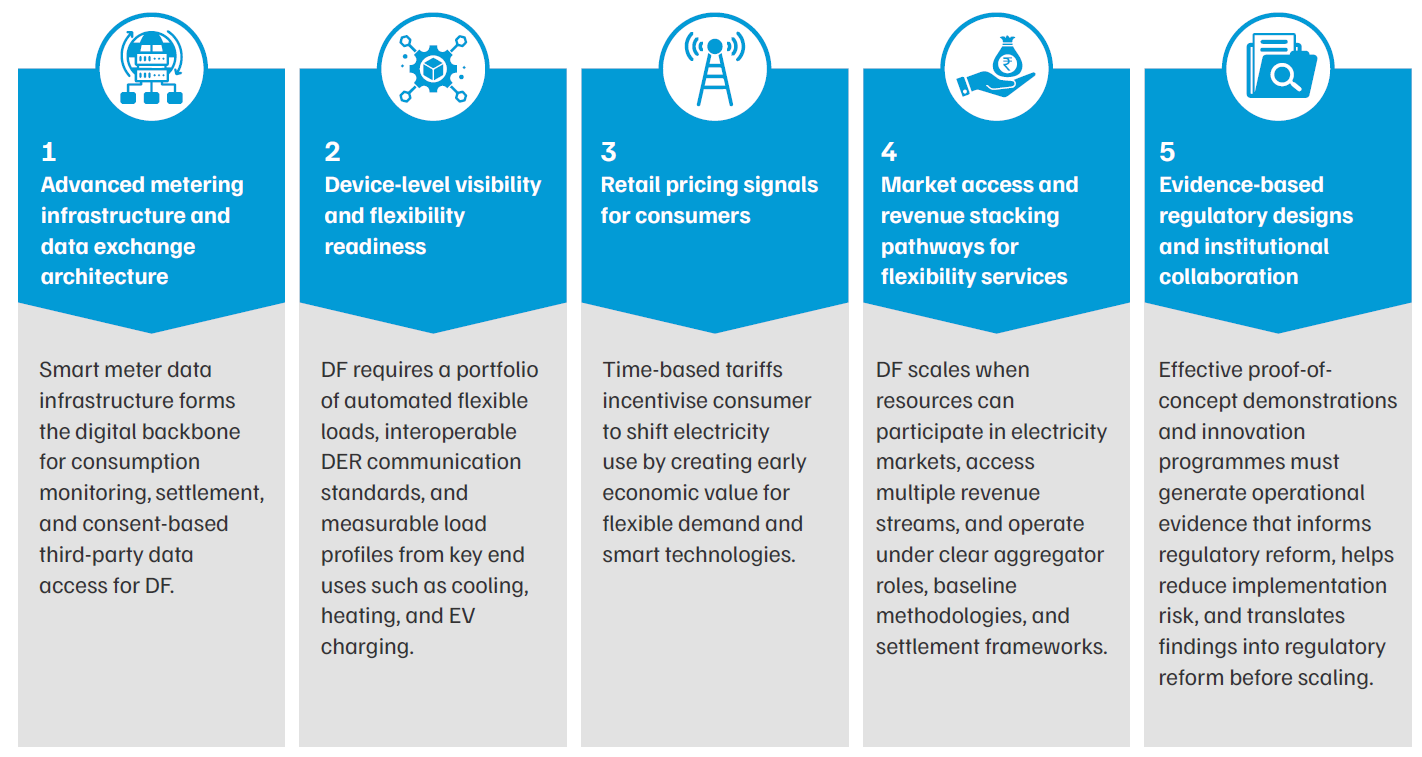
India is already making progress on the foundational elements: from smart meter installations to emerging digital infrastructure like the India Energy Stack. Retail pricing signals are becoming more reflective of system needs with the introduction of Time of Day tariffs, and state regulators are starting to introduce Demand Flexibility Portfolio Obligations (DFPOs) to incentivise utilities to operationalise flexibility. Aligning these building blocks into a coherent market will allow flexibility to compete alongside traditional supply-side resources to help balance the system.
Figure 2. Five pillars support demand flexibility in Great Britain and Australia
As the milestone on 6 July showed, that increasingly means taking advantage of abundant renewable electricity at midday by shifting or storing it for use during the evening peak. If India is to increase the frequency and length of these periods, it will need to evolve from policies focused primarily on deploying renewable generation towards ones that also help consumers use that generation more intelligently.
That means combining rooftop solar with technologies, such as batteries and smart controls, supported by tariffs and automation that reward households and businesses for using clean electricity when it delivers the greatest value to the system. Australia's recent success deploying household batteries alongside rooftop solar illustrates how quickly distributed storage can become a system asset when the right incentives are in place — an experience India now has the opportunity to learn from in its own context, with over 4 million households installing rooftop solar in the last 2 years.
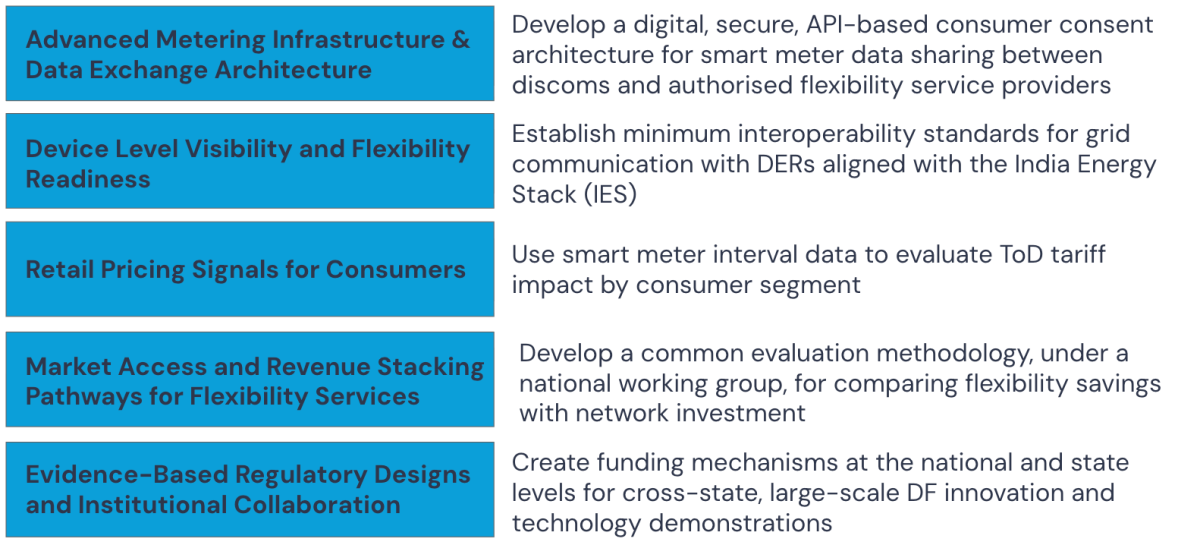
Figure 3. Select short (0–3 years) and medium-term (3–7 years) recommendations for scaling demand flexibility in India
If India can enable flexibility at scale, we will start to see times when renewables surpass 50 per cent of the mix more frequently, for longer than 15-minutes at a time, providing a model for other rapidly electrifying economies seeking to build cleaner, more resilient electricity systems. This month’s milestone fires the starting gun on the next phase of India’s energy transition. A phase where the focus is no longer simply about building more renewable generation, but about mobilising demand to use it.
This blog was originally published on the Centre for Net Zero website.
Amber Woodward leads International Public Affairs at the Centre for Net Zero and Dhruvak Aggarwal is Senior Programme Lead at the Council on Energy, Environment and Water (CEEW). Send your comments to [email protected].





Add new comment