Council on Energy, Environment and Water Integrated | International | Independent


Suggested Citation: Shukla, Shashwat; Sijo Abraham, and Saahil Parekh. 2025. Advancing Climate-resilient Agriculture in India by Strengthening Institutional Capacity: Lessons from Bihar and Odisha. New Delhi: Council on Energy, Environment and Water.
India's agriculture is highly vulnerable to climate change, facing risks from erratic rainfall, extreme weather events, and deteriorating soil health and crop productivity. At the same time, agriculture contributes to climate change through crop residue burning, emissions from rice cultivation practices, and deforestation. Climate-Resilient Agriculture (CRA) offers a pathway to address this dual challenge by enhancing resilience and promoting sustainable livelihoods.
National programmes like National Mission on Sustainable Agriculture (NMSA), the National Innovations in Climate Resilient Agriculture (NICRA), and the Gramin Krishi Mausam Seva (GKMS) have focused on identifying and scaling climate-resilient practices and systems. Since agriculture is a state subject in India, operationalising CRA depends on institutional capacities at the state level. This study assesses the institutional capacity of Bihar and Odisha to deliver CRA and identifies strategies to leverage opportunities.
But how can state institutions rise to the challenge? Advancing Climate-resilient Agriculture in India by Strengthening Institutional Capacity: Lessons from Bihar and Odisha dissects this question through the lens of Bihar and Odisha—two states at the frontline of climate vulnerability. Using the Capacity Assessment Framework (CAF) and qualitative tools, surveys, interviews, and focus groups, this report evaluates eight critical capacity areas to inform state-specific and nationally scalable CRA implementation strategies.
Agriculture in India is profoundly affected by climate change, confronting challenges such as shifting rainfall patterns, extreme weather events, and potential declines in crop yields and livestock output by 2050 (Food and Agriculture Organization, 2015). Additionally, agriculture contributes to climate change through greenhouse gas emissions, crop residue burning, and deforestation. Addressing this dual challenge, the sustainable approach of CRA has emerged as a promising solution, aiming to enhance resilience, reduce emissions, and sustainably increase productivity.
Through literature review and extensive stakeholder consultations, we define CRA in the context of the Global South as a socially inclusive and gender-responsive approach to practising and governing agriculture and allied sectors in a changing climate, to enhance nutritional security and ensure environmentally and financially sustainable livelihoods.
Since agriculture is a state subject, the operationalisation of CRA is uniquely shaped at the state level. States create policies, institutional structures, and local resource allocations based on their contextual priorities for agricultural transition. Hence, the study focuses on the capacities of these institutions at the state level to operationalise CRA priorities on the ground.
The study also focuses on identifying key strategies that can support and accelerate CRA in other states of India.
The following qualitative research tools were employed based on the research design and exploratory goals:
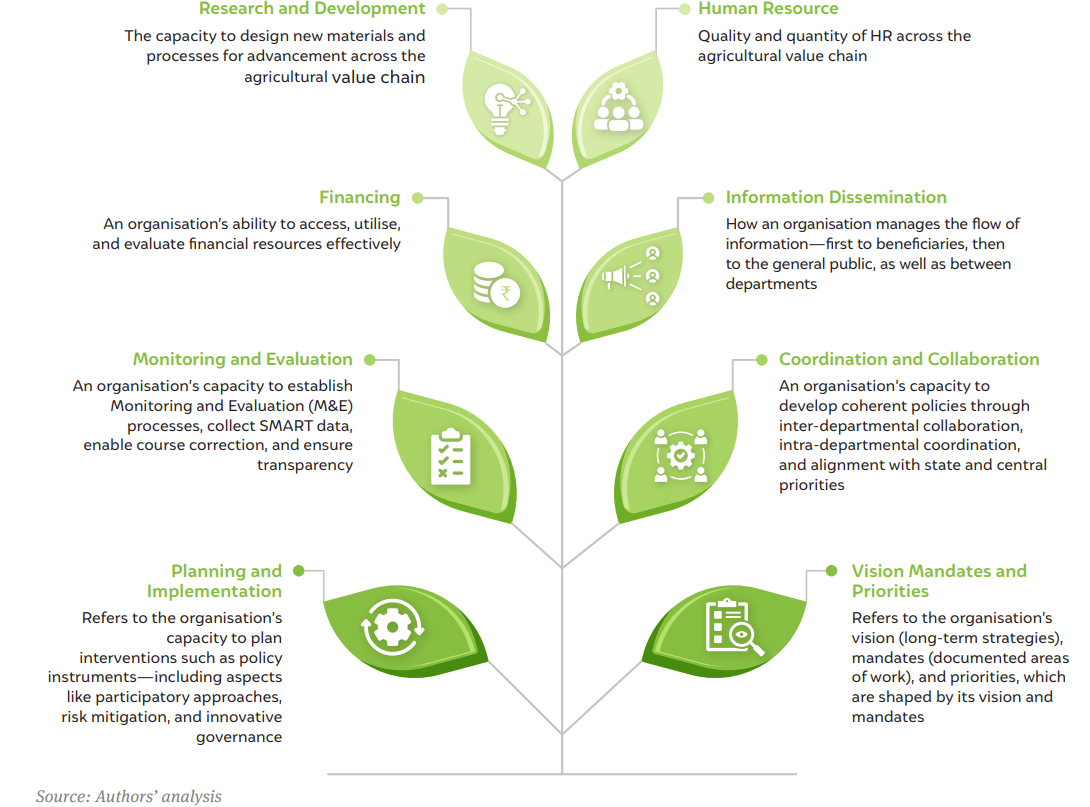
To assess the institutional capacity to advance CRA in the state, we conducted an analysis of capacities at the state and local levels. These capacities were defined using the Capacity Assessment Framework (CAF) adapted from the CEEW’s ‘Re-calibrating Institutions for Climate Action’ report (Abraham et al 2024). Added to these is the capacity indicator for ‘research and development’ as part of the enabling individual capacities, as given by the FAO’s CRA capacity development framework (FAO 2013a; 2013b).
This framework involves eight capacity indicators separated along the capacity to set mandates, technical and functional capacities, and enabling environment, as detailed in Annexure I.
Figure ES1 The Capacity Assessment Framework includes fundamental, technical, and enabling capacities
Bihar
Odisha
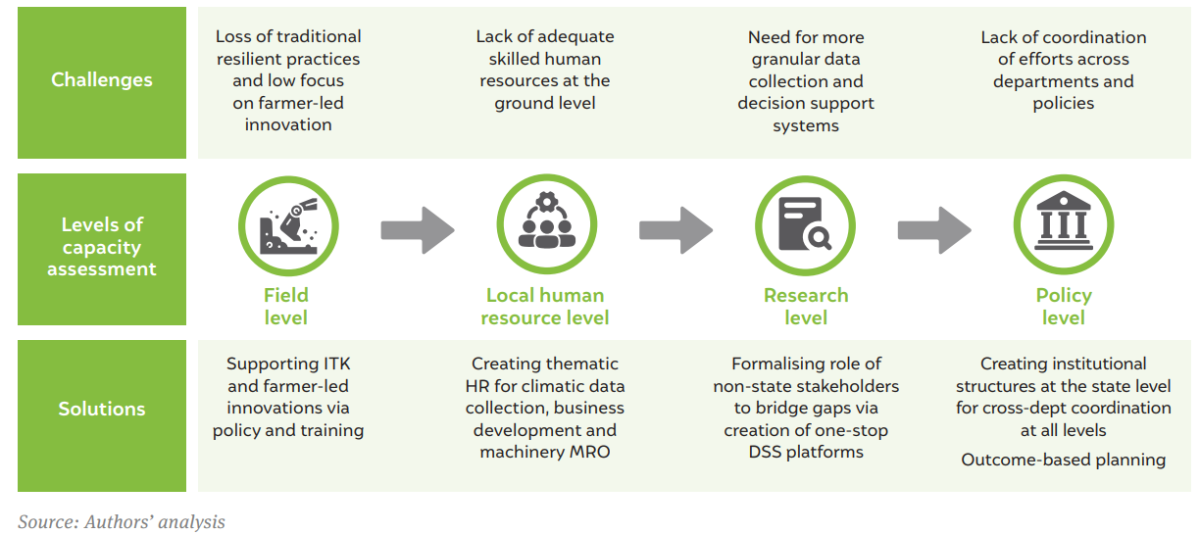
We have identified over 20 and 40 actionable recommendations for the state of Bihar and Odisha respectively, across local and state levels, to enhance institutional capacity. The recommendations focus on how CRA is designed at a policy level to being implemented at the field level by improving capacity in knowledge management and human resource availability.
Using the learnings from Bihar and Odisha, the authors observe that states can be mapped on a spectrum of CRA adoption where states like Bihar are still organising pilot programmes with a smaller coverage per district, whereas states like Odisha have formally institutionalised climate resilience as a pivotal organisational priority with dedicated resources, specialists and funds being pooled with inter-departmental coordination. The purpose of this report is then also to acquaint the reader with the possible institutional trajectory that a state can take to advance CRA adoption in a coordinated, context-sensitive and agile manner.
These recommendations yield some key insights for stakeholders across different policymaking hierarchies, which we highlight here.
Figure ES2 Preserving traditional knowledge is one of the key recommendations for CRA in India
Policy level
Global surface temperatures have surged by 1.1°C in the past decade due to rapidly rising greenhouse gas emissions from anthropogenic activities (Intergovernmental Panel on Climate Change 2023). This poses a grave threat to both natural and anthropogenic ecosystems (IPCC 2023). Climate change triggers severe weather events like heat waves, heavy rains, droughts, and cyclones, severely impacting the agriculture, forestry, fisheries, and energy sectors (IPCC 2023). Climate change reduces crop yields, affects animal and fish health, and disrupts aquaculture. By 2050, key crops (like coarse grains, oil seeds, wheat and rice), which account for approximately 70 per cent of the global cropped area, may see a 17 per cent decline in yields, while tropical fish catches could drop by 30 per cent (Food and Agriculture Organization 2015).
Simultaneously, the FAO predicts a tripled food demand by the 2080s, outpacing crop yield growth, necessitating an average annual net investment of USD 83 billion in developing country agriculture (Food and Agriculture Organization 2009). This exacerbates socioeconomic vulnerabilities, leading to higher mortality, income loss, and gender disparities. The impact spans from individual producers and households, where incomes diminish as production costs soar, to the global agri-food system, where food supply chains are disrupted through price spikes and distortion of trade behaviours. This highlights the urgent need to address climate challenges in agriculture and allied sectors.
India is an important producer of various crops like rice, wheat, sugarcane, groundnuts, fruits, vegetables and cotton (Food and Agriculture Organization, n.d.). It faces significant climate change impacts, especially in agriculture. Over the past decade, India has experienced an average temperature increase of 0.7 degrees Celsius annually (Ministry of Earth Sciences 2020) . India has also seen 0.23 per cent reduction in rainfall, and an average annual increase in water scarcity has also been observed annually in the past decade (Chauhan et al. 2022). A district-level analysis indicated erratic rainfall patterns, with 30 per cent of India’s districts witnessing a high number of deficient rainfall years and 38 per cent witnessing a high number of excessive rainfall years, as well as extreme weather events (Prabhu et al. 2024).
India is the fifth most vulnerable country in the world, according to the climate risk index (Eckstein et al. 2019). Based on an analysis by CEEW, 27 out of 36 states and Union territories are highly prone to hydro-met disasters like floods and droughts, and their compound impact (Mohanty and Wadhawan 2021). Climate change has already reduced rainfed rice and wheat yields by 9 per cent, with projections indicating further declines (Chauhan et al. 2022). With a quarter of the world’s undernourished population and 70 per cent of rural Indians reliant on climate-dependent agriculture, food and nutrition security are critical concerns (World Food Programme 2023) (FAO, n.d.). As per the estimates mentioned in the Government of India’s economic survey of 2017–18, without farmer adaptation and policy changes, farm incomes are expected to decrease by around 12 per cent in the coming years, with unirrigated areas experiencing the most severe losses, amounting to 18 per cent of annual revenue (PIB 2018). A study in Beed, Maharashtra, where agriculture is fully rainfed, found that 16 per cent of the local population migrated during the dry season, with seasonal migration (ranging from 4 per cent to 90 per cent) being a common coping mechanism for landless and marginal landholding households to prevent income loss due to long dry spells and extreme weather conditions (Jaleel and Chattopadhay 2019). Socially, distress migration is a growing issue with an average labour outflow of nine million migrants between states from 2011 to 2016 (Bellampalli and Yadava 2023).
The current challenges facing food systems are intertwined in terms of:
In response, the FAO introduced the concept of Climate-Smart Agriculture (CSA) in 2010 (FAO n.d).
The FAO’s definition of CSA aims to address three main objectives:
Similarly, the World Bank defines CSA as “an integrated approach to managing landscapes— cropland, livestock, forests and fisheries—that address the interlinked challenges of food security and climate change” (World Bank 2024; FAO n.d).
However, while extrapolating this definition to the Global South, we encounter some challenges.
Both the FAO and the World Bank definitions fall short of adequately defining the priorities for the Global South. Reflections from the literature on the critique of CSA’s definition include:
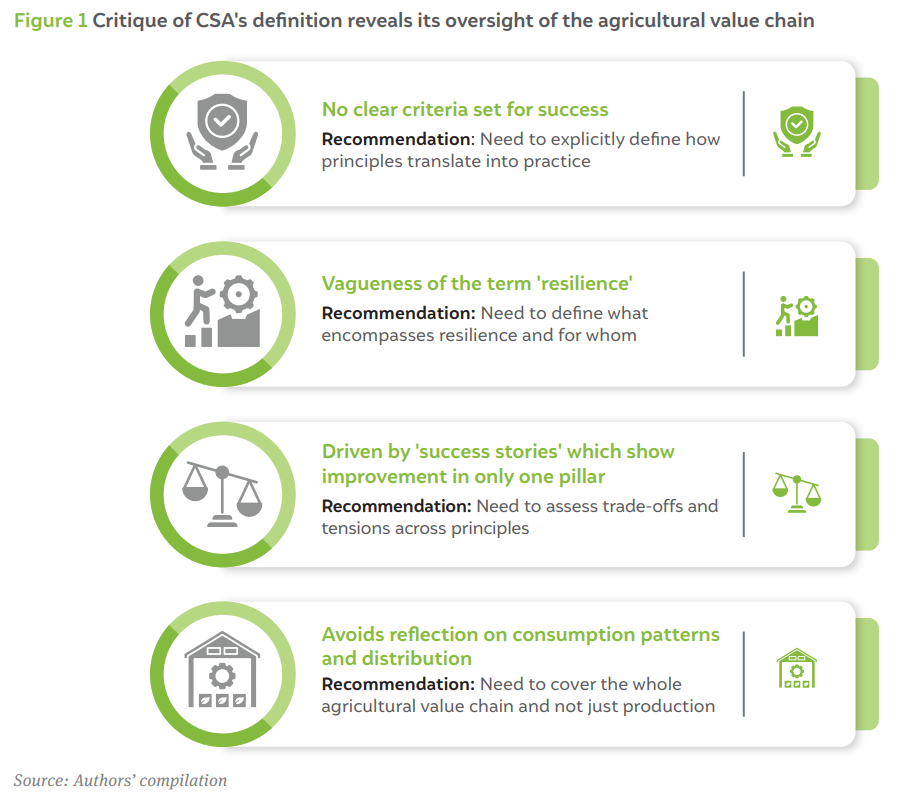
Further, through discussions with twelve food systems experts from India and other parts of south Asia, we found the following reasons that necessitate the need to contextualise CSA outcomes in the Indian context.
Incorporating these nuances, our definition of CRA emphasises social inclusivity, gender responsiveness, and sustainable practices. For the remainder of this report, we consider the following definition of CRA.
This definition carries forward from the global discourse on CSA, and contextualises it to the outcomes of: a) social inclusion, b) gender responsiveness, c) nutrition security, and d) resilience across the food system and not just food production, which are imperative to the contemporary Global South.
In the case of the Global South, CRA is defined as ‘a socially inclusive and genderresponsive approach to practise and govern agriculture and allied sectors in a changing climate to enhance nutritional security and ensure environmentally and financially sustainable livelihoods’.
The World Bank’s definition is used to contextualise CRA in India using the four sectors/ landscapes of cropping, livestock, forests, and fisheries. The outcomes to be achieved are drawn from the FAO definition, with nuances of climate resilience and nutrition security added in. Thus, the four outcomes of CRA considered in this report are:
CRA is actualised on the ground by the Government of India through various policies and programmes that have been designed to cater to different climatic challenges of agriculture over the years. Beginning with the National Action Plan on Climate Change (NAPCC) which provides an overarching policy framework for climate action, the Government of India has enacted various policies which advance CRA on the ground. These include the National Mission on Sustainable Agriculture (NMSA) under the Ministry of Agriculture and Farmers’ Welfare; the National Innovations in Climate Resilient Agriculture (NICRA) project through the Indian Council on Agricultural Research (ICAR), and the Gramin Krishi Mausam Seva (GKMS) through the Indian Meteorology Department (IMD). These involve sub-components and schemes like the Pradhan Mantri Krishi Sinchayi Yojana (PMKSY), the Rainfed Area Development (RAD) programme, Soil Health Mission (SHM), etc. (Ministry of Agriculture and Farmers Welfare 2023).
However, agriculture is a state subject as per the Constitution of India and states adopt their own policies to advance CRA and implement the central policies listed above. This contextualises states’ efforts to their own climatic challenges. We study Bihar and Odisha, two of the most vulnerable states as per CEEW’s Climate Vulnerability Index (Mohanty and Wadhawan 2021) to understand the current adoption and challenges to scale up CRA.
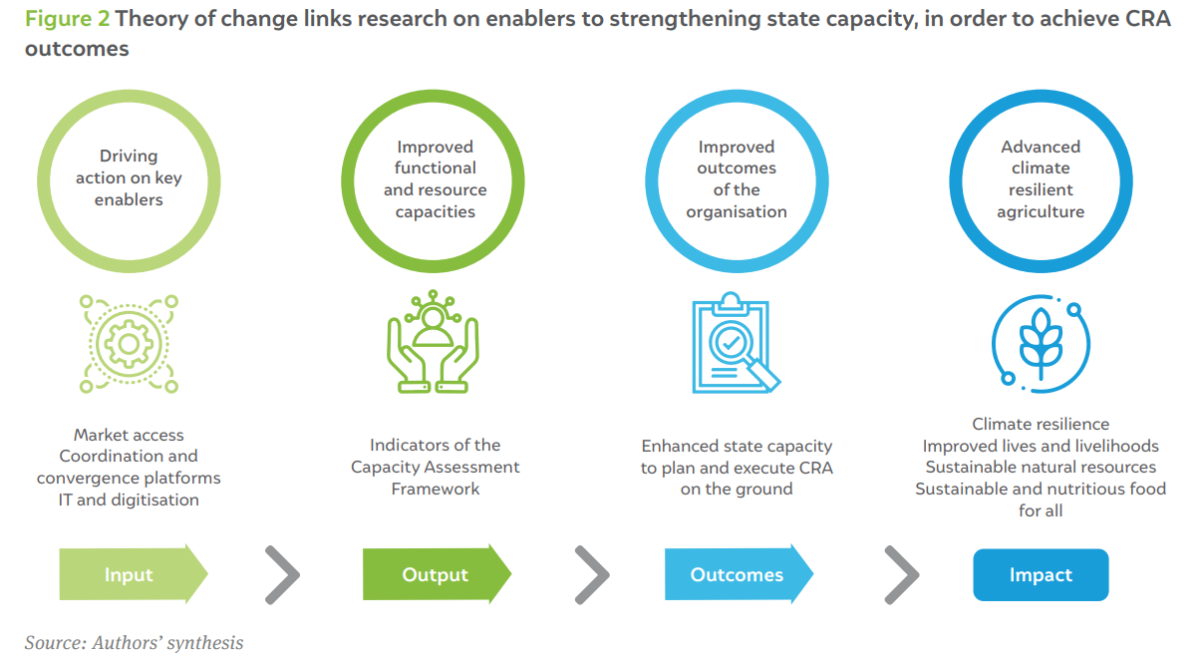
In order to advance CRA on the ground, the state’s institutional architecture must possess certain ‘capacities’ to plan and execute these practices at the local level and scale them up. Institutional capacity is defined as the state’s ability to achieve the targets it sets for itself (Hanson and Sigman 2021). The state meets these targets and goals through various instruments like policies, programmes, schemes, etc.
Such institutional capacity needs to be assessed and mapped across various levels of administration and policymaking in order to ensure a systemic embeddedness of the interventions across the ecosystem.
We conducted an analysis of institutional capacities at the state and local levels of governance. These capacities were defined using the Capacity Assessment Framework (CAF) developed by CEEW’s Re-calibrating Institutions for Climate Action report (Abraham et al 2024).
This framework involves eight capacity indicators, including capacities to set mandates, technical and functional capacities, and enabling environment, as given in Annexure I. In addition to this, we have also identified research and development as a key capacity in the CRA context. This emerged from the need for institutions to develop research on CRA practices and innovative technologies and machinery for building resilience.
Using this framework, we conducted qualitative questionnaire-based surveys, in-depth interviews, and focus group discussions (Mack et al. 2005) (Refer to Annexure IV for survey questionnaires). We used both online and offline modes of data collection. Figure 3 was the research approach for both Bihar and Odisha.
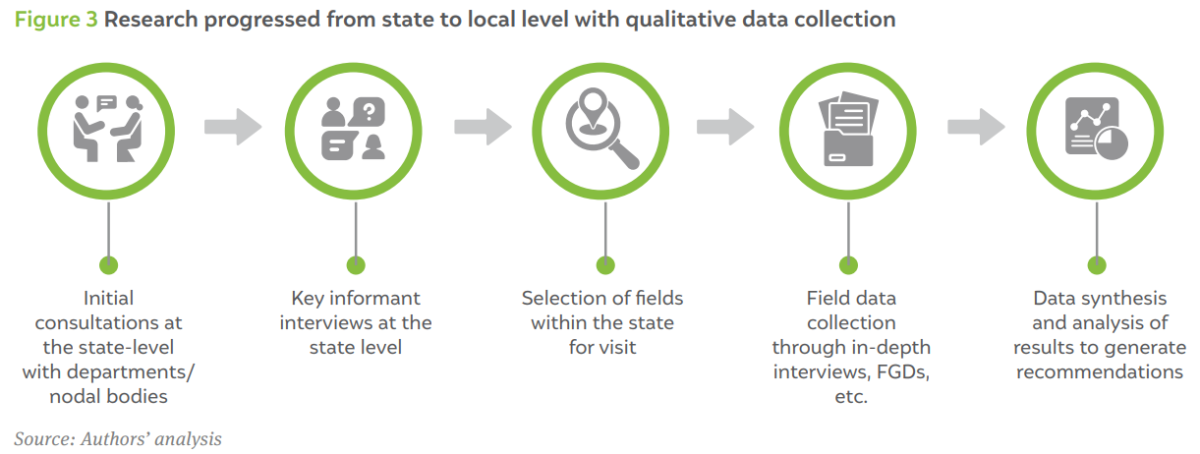
We also looked at interventions from the perspective of four levels:
An analysis of institutional capacity using this CAF and recommendations for actions needed across these four levels have been curated using a qualitative research approach across these two states.
However, due to the qualitative design and exploratory nature of this study, there are some limitations to its findings:
The results of data collection and analysis are discussed in the following chapters.
Bihar urgently requires the adoption of CRA practices due to severe climate impacts such as irregular rainfall, and frequent natural disasters like floods, droughts, and heat waves affecting its predominantly agricultural economy (Singh et al. 2023). The state’s agricultural system is under immense stress, with challenges compounded by the existing pressure on water resources and declining soil fertility. This situation has rendered the local farming population, which sustains a vast majority of the state’s populace, highly vulnerable to the inconsistencies of climate change (Dasgupta et al. 2020). It is crucial to examine these vulnerabilities closely and implement CRA strategies to enhance resilience and ensure sustainable agricultural outputs amidst growing climatic uncertainties.
Bihar’s agriculture sector engages 53.6 per cent of its rural workforce, utilises 57 per cent of the land, and contributes 20 per cent to the GDP (National Council of Applied Economic Research 2022; Hoda et al. 2021). During the Kharif season, rice is cultivated on 30.76 lakh hectares (83.29 per cent of the cultivated area), while the Rabi season is dominated by wheat, cultivated on 21.47 lakh hectares (67.01 per cent of the cultivated area) (PRS Legislative Research 2024). A large portion of this land is managed by marginal farmers, who make up 91.21 per cent of landholders and control 57.73 per cent of the cultivated area. These smallscale farmers face numerous challenges, including fragmented land holdings and limited access to modern agricultural resources.
The climate vulnerability assessment, illustrated by district-level mapping (Mohanty and Wadhawan 2021), shows a diverse hydro-meteorological risk landscape, with 21 out of 37 districts categorised as ‘Very High’ or ‘High’ on the climate change vulnerability scale (CRIDA 2013). With floods being the most common threat followed by droughts, as revealed in CEEW’s Climate Vulnerability Index analysis, agricultural practices in Bihar are significantly threatened, affecting both water availability for irrigation and overall crop health.
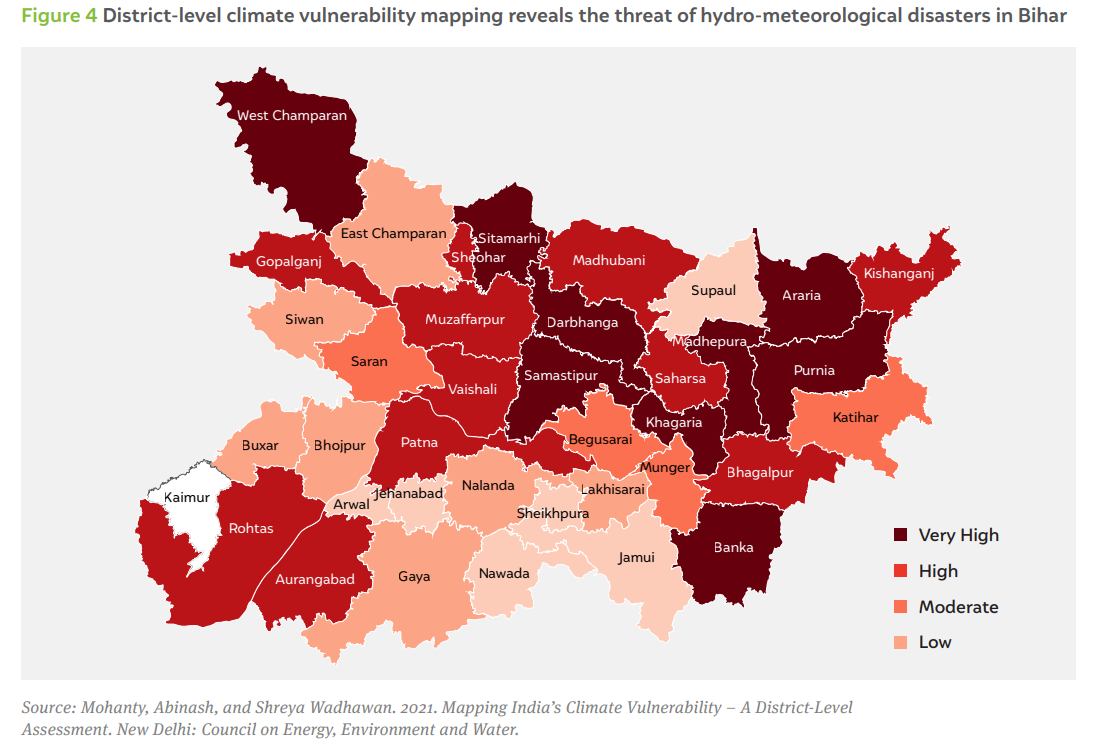
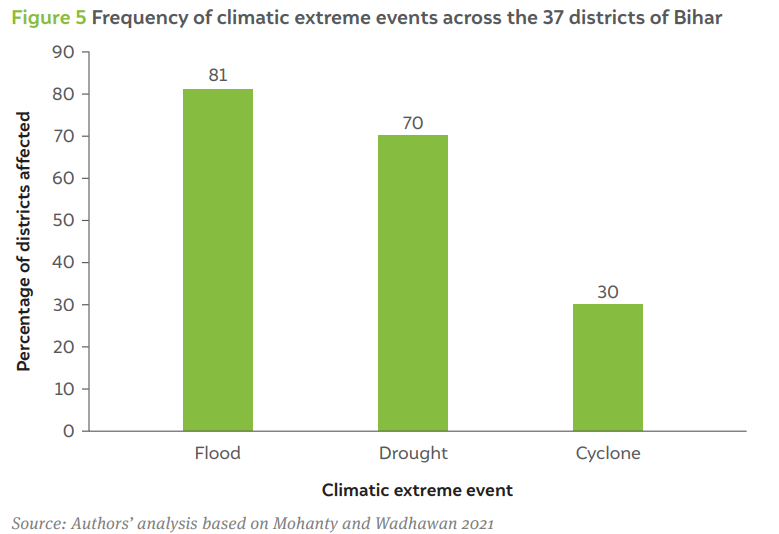
Enhancing the implementation of CRA practices is thus crucial to addressing these issues effectively, promoting sustainability and resilience within Bihar’s agricultural sectors (Khan 2023). The adoption of CRA, promoted in the 2023–28 Agricultural Roadmap, aims to stabilise production and introduce sustainable practices (PIB 2023). Practices such as direct-seeded rice and zero tillage could enhance resilience and productivity, especially for smallholders (Neog et al. 2023; Aryal et al. 2020). The state has begun integrating CRA into policies to address these climatic challenges effectively.
Bihar has launched various schemes under different departments that contribute to the three pillars of CRA. We have explored their alignment with the overall CRA outcomes. A coordinated structure to deliver CRA in Bihar should focus on inter-departmental convergence. We collated a comprehensive list of 14 policies across various departments that are related to one or more CRA outcomes (Refer to Annexure VI).
In the following section, we unpack the policy landscape in Bihar to understand the ownership of relevant departments and how successfully they target CRA outcomes. Our analysis identified the following trends defining the institutional design of its CRA-related policies.
Nodal departments for CRA-related policies
Nodal departments are those responsible for policy design, implementation, and fund management. The analysis of CRA-related policies identifies multiple nodal departments, highlighting the multi-departmental approach towards CRA advancement.
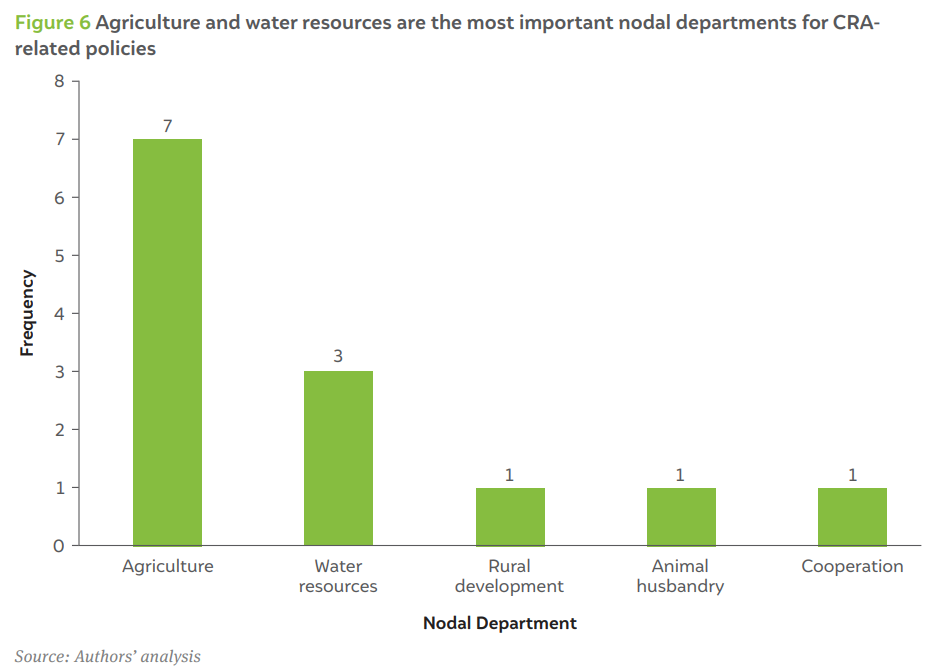
This shows that most policies are housed in the agriculture department. However, departments like rural development also play an important role in CRA advancement, with schemes like the Jal Jeevan Hariyali Mission, which also interacts with the CRA programme on the ground.
Alignment with CRA outcomes
A brief analysis of the objectives and aims in the policy documents for these 14 CRA-related policies in Bihar shows the following analysis of targeted outcomes.
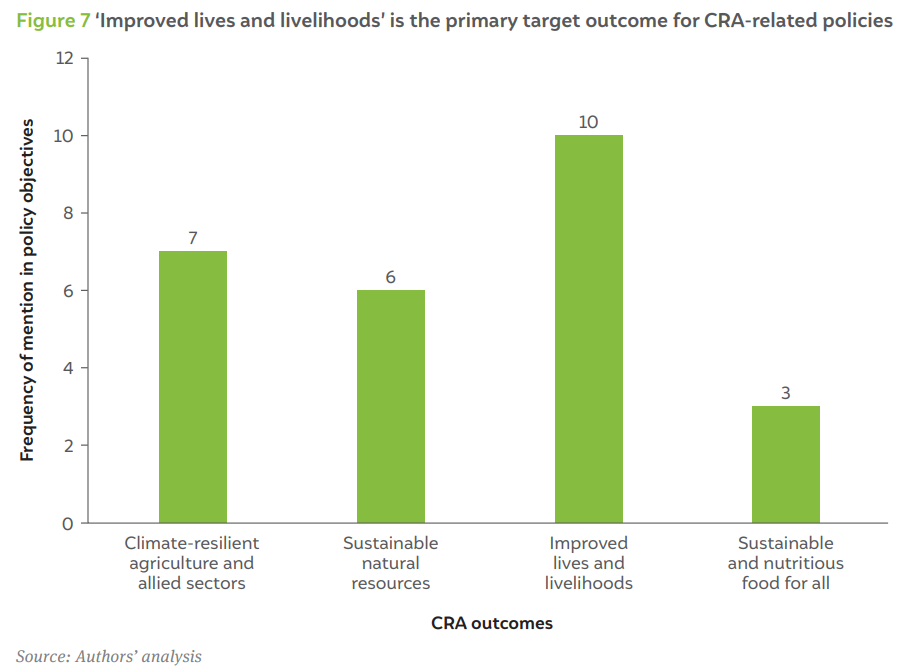
This assessment shows that Bihar’s CRA-related policies prioritise improvement of lives and livelihoods more than the other outcomes.
However, as multiple state-level analyses show, a concerted, convergent, and targeted approach will be needed to accelerate the adoption of CRA in the state (Abraham et al. 2024; Manik 2019; Priyadarshini and Abhilash 2020).
This strategy is necessary to address the multi-layered challenges of agricultural systems within the state, ensuring interventions are well-suited to the local socio-economic and environmental contexts. By aligning efforts across government, NGOs, and the farming community, this approach ensures a unified and efficient push towards CRA adoption. It specifically targets barriers such as economic constraints, technological access, and knowledge gaps, making the adoption process smoother for farmers. Moreover, it emphasises the need for market and institutional reforms to support CRA practices, thereby addressing structural challenges. Integrating CRA with broader development goals ensures that these efforts contribute holistically to the state’s resilience against climate change and agricultural productivity.
Bihar’s Climate Resilient Agriculture programme is central to these effects, as per the state’s fourth Agricultural Roadmap (Department of Agriculture, Government of Bihar 2023). This section looks at the timelines, structure, and brief listing of all practices undertaken by the programme.
Timelines for the programme
In 2019, Bihar launched the CRA programme. Initially launched in eight districts, it was expanded to include all 38 districts the following year. The programme’s core objectives are to create awareness among the farmers on implementing climate-resilient technologies and developing on-farm trials at selected villages and Krishi Vigyan Kendra (KVK) farms. Under this programme, a total of 2,902 acres of area was covered during 2022–23. The programme is being collaboratively implemented by the Bihar Agricultural University (BAU), the Dr Rajendra Prasad Central Agricultural University (RPCAU), the ICAR-Research Complex for Eastern Region (ICAR-RCER), and Borlaug Institute for South Asia (BISA) through the KVKs, with assistance from the Agricultural Technology Management Agency (ATMA) apparatus. The project is guided at the state level by a steering committee headed by the Agriculture Secretary.
Structure of the programme
Bihar’s CRA programme was scaled to all 38 districts of the state in 2020. The coverage of the programme has been expanded from the initial five villages per district to the current target of ten villages under the fourth Agricultural Roadmap of the state (2023–28) (Department of Agriculture, Government of Bihar 2023) with a planned investment of INR 526.06 crore (Department of Agriculture, Government of Bihar 2023). Institutional project hubs were set up for implementing the programme, and divided between four major institutions. The district project hubs are divided among the organisations as follows.
Table 1 Distribution of CRA programme’s project hubs among participating institutions
Source: Authors’ compilation from BISA. n.d. “Climate Resilient Agriculture Program.”
Each project hub serves as a centre for programme implementation in the district. As BAU, RPCAU, and BISA host most project hubs, they become the lead organisations implementing this programme across the state. However, the financial and collaborative functions of the programme are arranged as described below, along with the institutions responsible for funding, implementation, and provision of expertise for the programme. The list is indicative of their broad role outlines for the institutions.
Table 2 The agriculture department remains a funder, while academics and researchers implement policies
| Key organisations under CRA programme | Remarks |
|---|---|
| Department of Agriculture, Government of Bihar | Funding agency |
| BISA-CIMMYT, Pusa, Bihar | Implementation partner |
| RPCAU, Pusa, Bihar | Implementation partner |
| BAU, Sabour, Bihar | Implementation partner |
| ICAR-RCER, Pusa, Bihar | Implementation partner |
| IRRI | Expert agency for crop residue management |
| CIP, Lima, Peru | Expert agency for potato seed production |
Source: Authors’ compilation from BISA. n.d. “Climate Resilient Agriculture Program.”
Package of practices for the CRA programme
The exhaustive list of CRA practices and technologies promoted under various projects in Bihar include (BAU 2023):
This report does not endorse these practices as ideal or without critique. Owing to the multi-departmental approach towards CRA, institutional capacity becomes a key driver in realising the potential of these practices at the state and local levels. In the following sections, we analyse Bihar’s institutional capacity for advancing CRA and make recommendations on strengthening these capacities.
The institutional capacity analysis proceeded with the capacity assessment at the state level, followed by a local-level assessment across four districts of Bihar. It followed the research theory as detailed in Figure 3.
State-level institutional capacity analysis
We conducted a self-assessment survey of 22 state officials from 16 Government of Bihar departments and IMD to assess institutional capacity. This analysis provided insights into the current perception and awareness regarding climate change, perceived roles and responsibilities of departments, and the capacity gaps in scaling up CRA. The list of stakeholders and the survey questionnaire can be found in Annexure IV.
Perceived institutional responsibilities for advancing CRA
One key objective of the joint consultation was to identify the perceived roles and responsibilities of the various departments in advancing CRA. Practices are linked with multiple state objectives like improving soil health, sustainable water management, food security, etc. This mandates a multi-departmental approach towards designing and implementing CRA-related practices. However, this creates a lack of ownership and clear accountability among the policymakers.
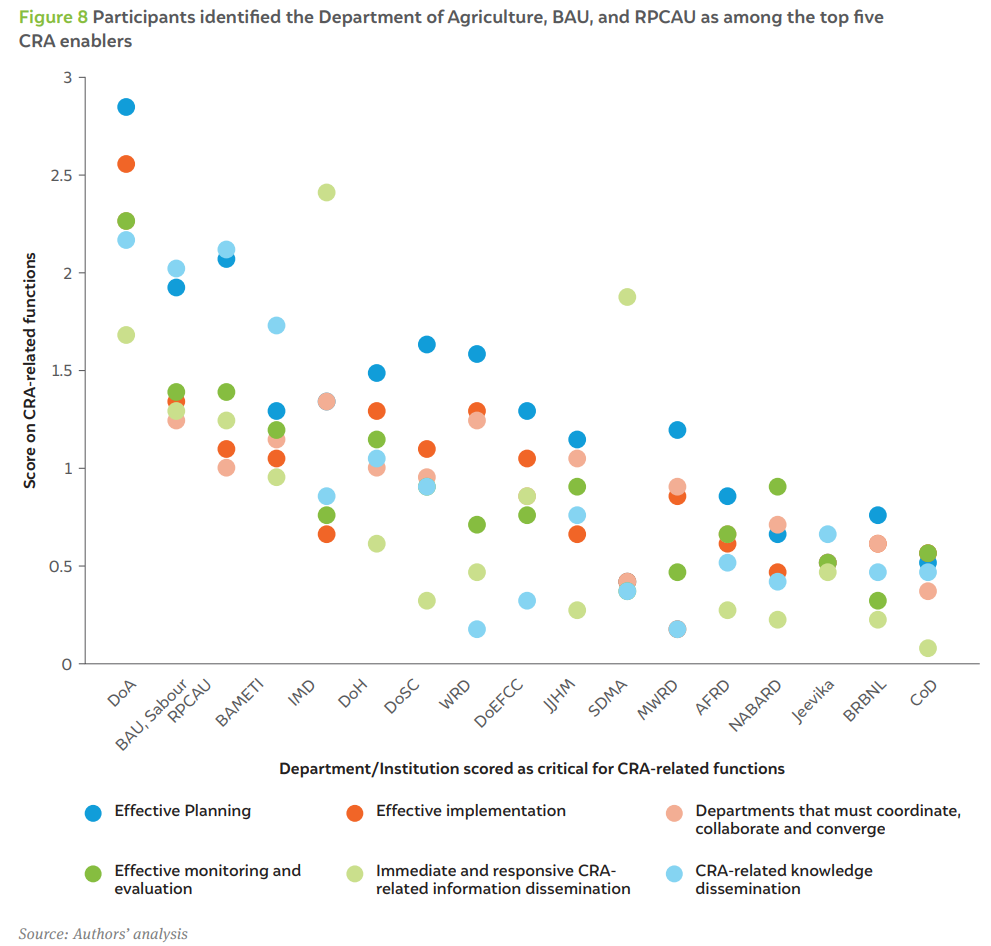
The survey focused on understanding the perception of the participants on the key departments responsible for various activities under CRA. The results are shown in Figures 9 and 10. In Figure 9, the following departments were identified as critical for CRA-related functions:
In Figure 10, the critical gaps that need to be addressed to advance CRA in Bihar, as identified by the survey respondents, were:
The participants identified the Department of Agriculture, BAU Sabour, RPCAU, IMD and the Directorate of Horticulture as the top five departments/institutions responsible for advancing CRA-related activities in the state. Therefore, it was important to assess the capacities of these institutions to deliver on the CRA objectives. The results also show the need for strong collaboration among multiple departments to enable convergent scale-up of CRA in Bihar. This mandates the institutionalisation of CRA at the government level to instil strong ownership in relevant departments. We have also developed an institutional structure to enable this capacity in Section 2.6.2.
Perceived enablers for advancing CRA
The second part of the survey focused on understanding the critical enablers imperative to scale up CRA. The participants ranked the various enablers on a scale of sufficiency in the state.
Following are the results of the survey in detail -
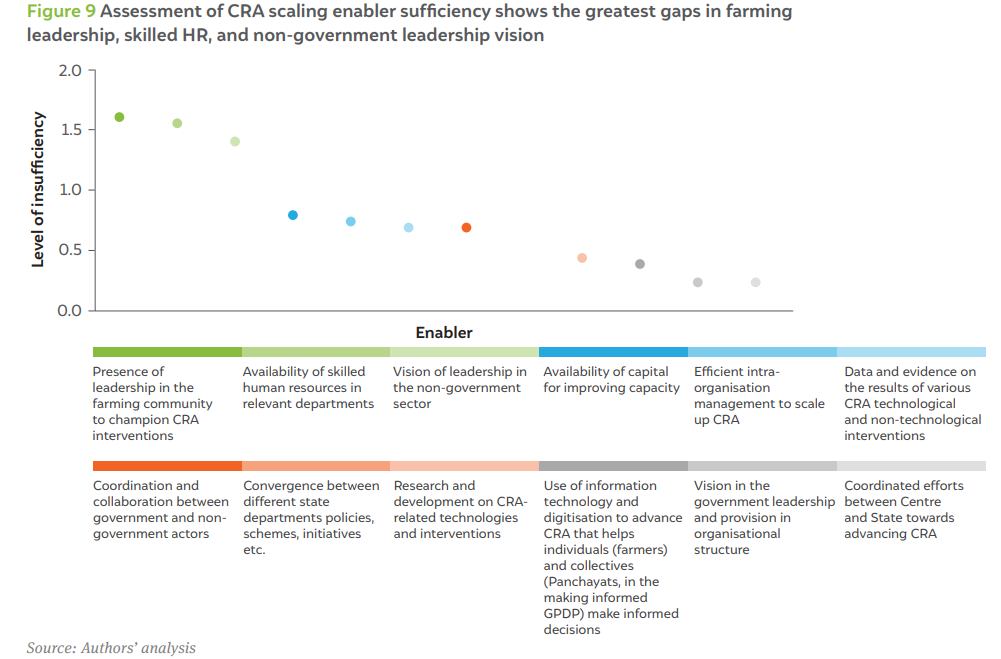
The study further expanded on understanding these enablers through one-on-one consultations with state and field-level officials. It also helped us scoop the study and identify targeted recommendations to advance the scale of CRA.
| District | Vulnerabilities |
|---|---|
| Madhubani | Unpredictable rainfall pattern; low agricultural water holding capacity |
| Darbhanga | Drought-proneness; low agricultural water holding capacity |
| Banka | Rising minimum temperatures; high flood proneness |
| Bhagalpur | Unpredictable rainfall pattern; rising minimum temperatures |
Source: Sehgal, Vinay, P. K. Aggarwal, R. Kumar, J. S. I. Ingram, and M. I. Hussain. 2013. Vulnerability of Agriculture to Climate Change: District Level Assessment in the Indo-Gangetic Plains. New Delhi: Indian Agricultural Research Institute.
Local-level institutional capacity analysis
We conducted four field visits to understand the field-level institutional capacity. The fields in Bihar were selected using the criteria of high vulnerability to climate change, as per assessments performed by multiple studies conducted in the state, and districts targeted for CRA by the government (Rajya Sabha 2023; Sehgal et al. 2013; Mohanty and Wadhawan 2021).
Further consultations were conducted with the key institutions responsible for the CRA programme to select field areas with diverse agroecological characteristics and climatic challenges, and observe CRA practices in these contexts and conditions. The ICAR assessment of Indo-Gangetic plain districts for their vulnerability to climate change (Sehgal et al. 2013) remained a key assessment parameter. Based on this assessment and expert consultations with BAU, RPCAU, and Pusa, three districts were chosen from the three major agroclimatic zones of Bihar for field visits alongside Banka, where expert consultation was received. The following are the rankings of the four selected districts among the overall ranking of over 130 districts in the Indo-Gangetic plains by the report (Sehgal et al. 2013).
Bihar has been agroclimatically categorised into three major zones based on the agroclimatic parameters (BAMETI 2021). Zones 1 and 2 have similar agroclimatic patterns, being in the northern and flood-prone parts of the state. Zone 3 lies in the southern alluvial plains, with drought-prone conditions dominating the districts (BAMETI 2021).
The selection of Darbhanga and Madhubani from Zone 1 and Bhagalpur from Zone 3 meant that we covered significant agroclimatic variations in our sample of observations. It also meant that we covered varied climatic challenges faced by the farmers in these zones. These districts have also been shown to face a trend of a growing risk of both droughts and floods and changes in microclimates (BAMETI 2021).
Realised institutional capacity at the local level
Through the field visit and consultations with eight local officials, we were able to identify the field-level institutional structure responsible for driving the CRA programme on-ground. However, one of the major challenges observed in assessing institutional capacities was a lack of coherence and collaboration among the local human resources responsible for implementing and scaling up CRA practices on the ground.
This section aims to build coherence by providing a bird’s-eye view of the local human resources responsible for the implementation of various functional capacities on the ground. It also assesses the capacity gaps observed in their functioning and execution.
Table 4 Agricultural extension, research and financial institutions dominate local landscape, but face challenges
| No. | Capacity provided | Type of intervention | State-level institution | District/local institution | Operationalisation of institutional capacity observed |
|---|---|---|---|---|---|
| 1. | Information dissemination; on-field trials; data collection on soil, pests, and climatic effects; training and capacity building on agriculture and allied sector activities | Informational; educational; management and planning; social/ behavioural | ICAR; RPCAU; BISA; BAU | KVKs | One KVK covers one whole district with a staff of just four scientists—a head and one subject matter specialist each for home science, agricultural engineering, and soil science. One research fellow and one technical assistant are in charge of covering 595 acres of fields under Kharif, 623 acres under Rabi and 260 acres under Zaid. This includes field trials of new varieties, demonstrations for farmers, exposure visits, training for ATMA officials, and examination duties for AU position exams. (Insights from KVK Bhagalpur, BAU Sabour and KVK Darbhanga consultations) |
| 2. | Agriculture management and some material provisioning | Management and planning; informational | BAMETI | ATMAs | ATMA and KVKs are seen functioning and providing overlapping training in some areas. Farmers adopting CRA practices also mention a lack of interaction with ATMA officials, relying solely on KVKs for any information or material provision. (Insights from FGD in Longain village, Bhagalpur; KVK Sabour field visit) |
| 3. | Meteorological forecasts, climate hazard prediction and weather pattern observational bulletins at the local level; technological advisories | Technological; informational | ATARI (under IMD-ICAR) | DAMUs | DAMUs are poorly funded and understaffed. (Insights from BAU Sabour meeting). Farmers also denied receiving any bulletin from the IMD, relying solely on self-searched internet results and KVK researchers’ inputs for the season. (Insights from FGD with farmers in Bhagalpur and Darbhanga) |
| 4. | Market linkage and access to collective resource hiring, seed provision, and financing as part of Farmer Producer Organisation (FPO) formation | Social/ behavioural; informational | BSFAC | Cluster-based business organisations (CBBOs), which exist in zones rather than districts | FPOs have received little support from CBBOs in terms of agribusiness training and CEO appointment, which provides crucial human resources to them in terms of financial acumen and technical management expertise, which is rare in rural India. (Insights from RPCAU and FPO Madhubani interviews) |
| 5. | Financial input linkage alongside information on subsidies like crop insurance, clinical services for animals, post-harvest management | Financial | NABARD State Unit | District development managers (DDMs) run the agri-clinics and agri-business centres (ACABCs) | Farmers adopting CRA programmes and female members of self-help groups denied having received any information on crop insurance; they also denied receiving any support outside KVK-provided training and support on clinical services for animals, agri-business training or other post-harvest management technology. (Insights from farmer FGDs in Sukhet, Madhubani, and Darbhanga) |
Source: Authors’ analysis
The section finds that the implementation of the CRA programme remains a central point in advancing CRA practices in the state of Bihar. However, the programme itself is executed as a pilot-driven and specialised project run by various extension officials linked to the KVKs, which, in turn, are linked to the state agriculture universities and the BAMETI-led extension system. This leads to challenges like an absence of adequate and skilled human resources for scaling up the programme, and a lack of forward and backward linkages to the capacity built for CRA-based production among the adopting farmers. A linkage to the ‘farm-family’ and ‘agribusiness’ is also absent in the design of the implementation structure of the programme. These observations remain consistent across districts of the state in various agro-climatic zones, which also points to the need for a coherent and inclusive institutional structure to advance CRA, which focuses on addressing these capacity challenges. In section 2.5, we elaborate on the opportunities and recommendations to advance CRA in Bihar.
This section focuses on gaps and the recommendations emerging from them that can create a pathway to scale up CRA adoption in Bihar. Recommendations also involve action points for state and non-state actors, which may involve for-profit ventures or CSO/NGO groups. An exhaustive list of gaps and recommendations has been provided in Annexure IX.
Table 5 Key action points and intervention levels across administrative/policy (p), research (r), local human resource (h), and field (f) levels
| CAF indicator and gap identified | Recommended solution for state actors | Recommended solution for non-state actors |
|---|---|---|
| Vision mandate and priorities Government programmes lack coordination mandates, causing farmers financial challenges. | The institutionalised steering committee should develop a holistic vision for CRA adoption in the state and set SMART targets and goals (p). There is a need for studies from the state and external organisations to understand the challenges within the Progressive Agriculture Cooperative Society (PACS) system and recommend solutions for the state (p). | The institutionalised steering committee should develop a holistic vision for CRA adoption in the state and set SMART targets and goals (p). There is a need for studies from the state and external organisations to understand the challenges within the Progressive Agriculture Cooperative Society (PACS) system and recommend solutions for the state (p). |
| Vision mandate and priorities Gap in supporting women's role in making CRA practices viable with allied activities | A larger definition of 'CRA-adopting family' rather than 'CRA-adopting farmer' is necessary to target family income generation (p). Merging Jeevika and CRA activities in the same household (p). | SHGs supported by non-government stakeholders can be tasked with absorbing women belonging to CRA-adopting families and supporting income-enhancing interventions (f). |
| Collaboration and coordination Presence of leadership in the farming community to champion interventions undertaken as part of CRA programme, and other programmes relevant to it | Champion farmers can be selected through a 'value chain' approach by selecting one farmer in each block as a champion of thematic areas (h):
|
Non-state actors like CSOs, NGOs, and private bodies can provide capacity for identifying and training farm champions (h). |
| Collaboration and coordination Vision of leadership in the non-government sector | Formalisation of representatives from non-state actors into the institutional structure of CRA (p). | Each of the three zones under the CRA programme is to have four thematic NGO groupings with overlapping membership across the four main themes (p):
|
| Collaboration and coordination Efficient intra-organisation management to scale up CRA | Creation of an overarching institutional structure driven by bottom-up feedback and collaboration ground (refer to the institutional structure section for details on this recommendation) (p). | N.A. |
| CAF indicator and gap identified | Recommended solution for state actors | Recommended solution for non-state actors |
|---|---|---|
| Collaboration and coordination Convergence between different departments' policies, schemes, initiatives, etc. | Policy convergence training is required for the three major institutions looking at the implementation of the CRA programme. Documentation and mapping of potential convergences must be a part of the mandates under the programme guidelines (p). | The government’s agro-decision support system (Agro-DSS) platform can be supplemented by non-state databases (r). |
| Collaboration and coordination Coordinated efforts between Centre and State towards advancing CRA | Convergence with central schemes requires an active role of the planning and revenue departments in the CRA institutional structure (refer to the institutional structure section for details on this recommendation) (p). | Non-state actors may be brought in to perform assessments of convergence of policies and provide recommendations for the same in the long run, keeping CRA convergence at the centre of their assessment (r). |
| Collaboration and coordination Animal attacks on crops | The state needs to develop SOPs for responses to animal attacks, especially in the forest-adjacent districts (p). Human resources from the forest and disaster management departments at the local level must be mandated to collaborate with the extension system and champion farmers to reduce action times (h). | Insurance coverage and research on the prevention of animal attacks can be a gap filled by non-state actors (p) |
| Collaboration and coordination Overlap of multiple institutions in the same area for the same programme. | Create a state-level HR map, as attempted by this report, for the local levels, with transparency and accessibility of that database to the farmers and collectives to bridge the information asymmetry that gives rise to an aerial overlaps (r). | Non-state actors can collaborate to create a farmer-facing dashboard and training programme—carrying information on the problem and responsible authorities available to farmers to approach at the panchayat level (r). |
| Information dissemination Data and evidence on the results of various CRA technological and non-technological interventions. | The mandate of the CRA programme should include evidence collection on the climatic adaptive effects of CRA interventions. Funds for satellite-based data monitoring and reporting must be part of the programme documentation, which is currently lacking in the fourth Agricultural Roadmap of Bihar (p). | Non-state actors can support the data and evidence generation on CRA interventions on the ground as they have the capacity and expertise to deliver on this (r). |
| Information dissemination Use of information technology and digitisation to advance CRA that helps individuals (farmers) and collectives (panchayats) in making informed decisions on Gram Panchayat Development Plans or GPDPs. | The creation of an Agro-DSS is already being explored by the state institutions. Agro-DSS can also use an ‘Agri Value Chain’ approach to provide advisors on post-harvest management of produce, and also look to create a panchayat-level feedback mechanism based on soil condition reports. Documentation training should be part of DSS (r). | Information and communication technology (ICT) and related sectors have a high presence of non-state actors and can support this capacity. However, their role needs to be increased in the design and formulation stages, rather than the current involvement in implementation alone (p). |
| CAF indicator and gap identified | Recommended solution for state actors | Recommended solution for non-state actors |
|---|---|---|
| Human resource Lack of HR skilled in climate and emission data measurement, marketing and business training, and MRO for machinery maintenance at a local level. | Appointing one dedicated HR across the four themes suggested below is required at a block level to scale up the CRA program at pace (h):
|
N.A. |
| Human resource Farmer collectives remain non-functional, or struggle due to a lack of expertise and skills in agribusiness management. | Coordination between CRA-focused, farmer-led FPOs and CBBOs must be a programme mandate (p). The new HR on business development must be imparted with mandates for the same. Champion farmers within the institutional structure can be provided with business development training, and business development experts must have this as a KPI (p). | Collaboration with state-adjacent actors like NABARD for agribusiness skill development (f). Post-harvest value addition for CRA produce in collaboration with local non-state stakeholders can be explored (f). |
| Human resource Overburdened local human resources like KVK and ATMA officials | Create a cadre of ‘CRA technical assistants’, with a training module curated for the local area in every panchayat (h). Retrofitting the current Kisan salahkar cadre with better CRA training or bringing them under the supervision of the KVKs with the support of the DAO (h). | Bringing in non-state actors to collaborate with agriculture universities and identify trainees, develop training modules, and conduct skill workshops. Linking a short course or licensing system for formalising private HR will have to be built via the institutional structure in the state (r). |
| Research and development Governmental focus on ‘resilience’ in Bihar's CRA programme leaves other outcomes overlooked. | Agronomic researchers need to be involved alongside crop scientists in the CRA programme mandates (h). Contextualisation of research recommendations via feedback from local KVKs is necessary to make the research viable in local conditions (r). | Non-state actors can contribute significantly to market-based research on CRA products, and create models for successful price discovery, which may be difficult for an overburdened government cadre (r). |
| Research and development Lacking soil pre-condition analysis | Soil condition maps for panchayats must be prepared and updated, with information on varieties being grown and incidences of off-variety germination, salinisation, etc, being regularly documented (f). | Non-state actors can play a critical role in mapping the current state of soil and assessing the risk at speed and scale. State-level stakeholder documentation must be taken up to identify potential parameters for the government in each locality (r). |
| Finance Capital shortage in the programme funds and low farmer support amounts. | Expanding the coverage of Kisan Credit Card (p). Convergence of funds between KVK, Jeevika, and ATMA activities across CRA programme (p). Collaboration of operations with other policies in the state that link with the CRA, such as JJHM, Jeevika, and MGNREGS. | Innovative financing models to run PPP projects led by non-state actors in some high-priority areas (p). International donors and funds like the World Bank can also bridge this finance gap by funding the state’s CRA interventions. |
| CAF indicator and gap identified | Recommended solution for state actors | Recommended solution for non-state actors |
|---|---|---|
| Finance Crop insurance gap | Bringing in a state-run satellite-based insurance assessment and payout scheme (p). A portion of membership fees to the local PACS may be used as a premium for a state-run crop insurance scheme (p). | The private sector can be brought in to run pilot insurance schemes for CRA adopting families through FPO-based insurance payouts and assessments (p). |
| Finance Lack of markets and price discovery via PACS | Increasing the penetration of the KCC (f). Collective financing training as a mandate under the CRA programme for the new institutional structure (p). | Prioritisation of lending to CRA-adopting farmers for non-state actors like MFIs. Incentivising agricultural financing to CRA-adopting farmers can become a mandate for the programme to crowd in private financing (p). |
Source: Authors' compilation
A common theme emerging across the identified gaps and recommendations for Bihar was the lack of a central institutional structure for the CRA programme, which can drive collaboration with other CRA-relevant policies on the ground, and establish a targeted and coherent enabling environment across the agri-food systems for the successful adoption of CRA. In the subsequent sections, we look at the pathway of institutionalisation as a solution to advance CRA in the state and recommend an institutional structure for the same.
As per CEEW’s report on designing scalable and sustainable programmes (Agarwal, Khandelwal and Wal 2023), certain factors will define the state’s success in scaling up any programme. The first two factors that remain vital are institutionalisation at a community level, and institutionalisation at a government level.
Our self-assessment survey with state officials also shows that apart from the availability of skilled human resources and capital, the most significant enablers critically insufficient in the state’s capacity are ‘presence of leadership in the farming community’, ‘vision of leadership in the non-government sector’, and ‘intra-organisational management to scale up CRA’.
While the first two insufficiencies point to the lack of institutionalisation at a community in designing scalable programmes, the latter points to the lack of institutionalisation at a government level (Agarwal, Khandelwal and Wal 2023).
Institutionalisation at the community level
CEEW analysed the factors which enable such institutionalisation at the community level in its report (Agarwal, Khandelwal and Wal 2023). Among these success factors, the creation of community ownership and onboarding of community champions in institutionalisation were the two most reported gaps from the self-assessment survey and our fieldwork in Bihar, respectively.
Institutionalisation at the government level
CEEW also analysed the enabling factors to ensure the successful implementation of institutionalisation through new and existing pathways at the government level (Agarwal, Khandelwal and Wal 2023). From the above pathways recommended, creating a dedicated implementation agency and creating human resources, technical support, and convergence of government schemes are the most commonly identified gaps in the fieldwork in Bihar.
We conducted an in-depth literature review to gather evidence on the identified success factors of institutionalisation at community and government levels. We used the reference of institutional structures in other states looking to implement climate-resilient initiatives in agriculture.
Evidence from other states
To calibrate such an institution to the context of Bihar’s CRA programme, we adopted the methodology used in CEEW’s Policy Study on Sustainable Agriculture (Abraham et al. 2023). This study analysed the institutional structures and evaluated how they fill the critical capacity gaps by engaging with non-state actors, and achieving collaboration and coordination with other departments.
The following programmes’ institutional structures were studied here (for details, refer to Annexure VIII):
Based on the analysis, we have identified five key features in the analysis of institutional structures in other states.
Nodal department
A ‘nodal department’ has been characterised as (Ministry of Rural Development 2024):
Departmental membership within the institutional structure
As already established, CRA requires a multi-departmental approach for its advancement. Therefore, it is imperative that the institutional structures involve all relevant departments at various levels to enhance ownership of the programme. Our analysis shows that departments like finance/revenue, panchayati raj, and planning are also members of the institutional structure, in addition to the departments seen most often in Figure 10b.
Head of the institutional structure
In order to maintain efficient collaboration between multiple departments engaged in advancing climate-resilient practices, an official with the mandate to steer cross-departmental collaboration is imperative. Therefore, we looked at which authority has been appointed as the head of the executive body of the institutional structures created. We observed that all institutions appointed Additional Chief Secretaries or above (refer to Figure 10c).
Embeddedness of the programme
The parallel/embedded nature of the institution is defined referentially from CEEW’s analysis under the Policy Study on Sustainable Agriculture (Abraham et al. 2023). This study defines it as a spectrum—from highly embedded (without change in current institutional structures, when a new programme leads to additional responsibilities for the existing hierarchy of officers), to moderately embedded (when the institution of a parallel hierarchy of officers dedicated to the new programme exists within a relevant department), to parallel (establishment of an entire parallel department dedicated to a new programme). Our analysis showed that most institutional structures did maintain some level of embeddedness within the existing hierarchies (refer to Figure 10d).
Engagement with non-state actors as part of the institutional structure
CEEW’s Policy Study on Sustainable Agriculture (Abraham, Pradhan, and Khandelwal 2023) categorises engagement as low or no engagement to medium (when non-state actors engage as external participants) to high (when non-state actors are embedded within the institutional structure of the government programme). We looked at how these state institutions involve non-state actors like CSOs, scientists, domain experts or target groups within the formal structure. This led to the categorisation of such engagement patterns. We observed that most structures maintained some level of engagement with non-state actors within their formal institutional mechanisms (refer to Figure 10e).
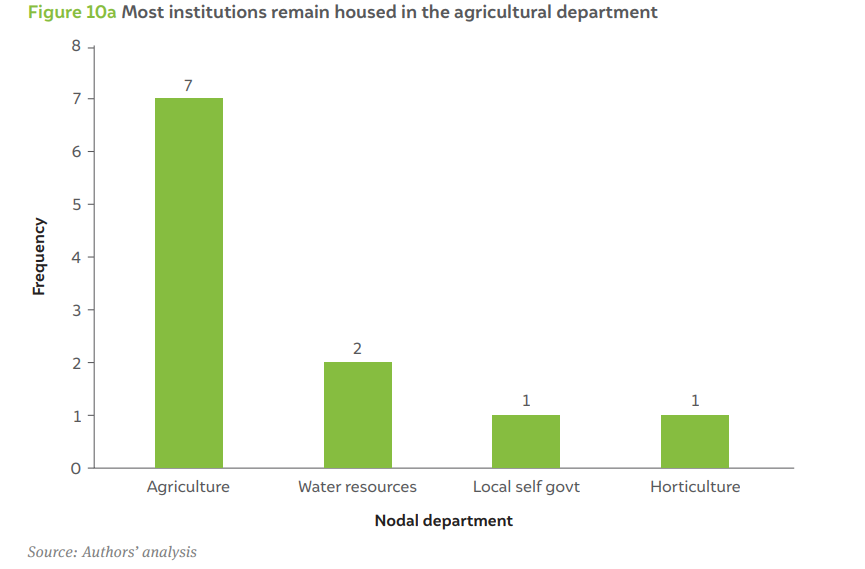
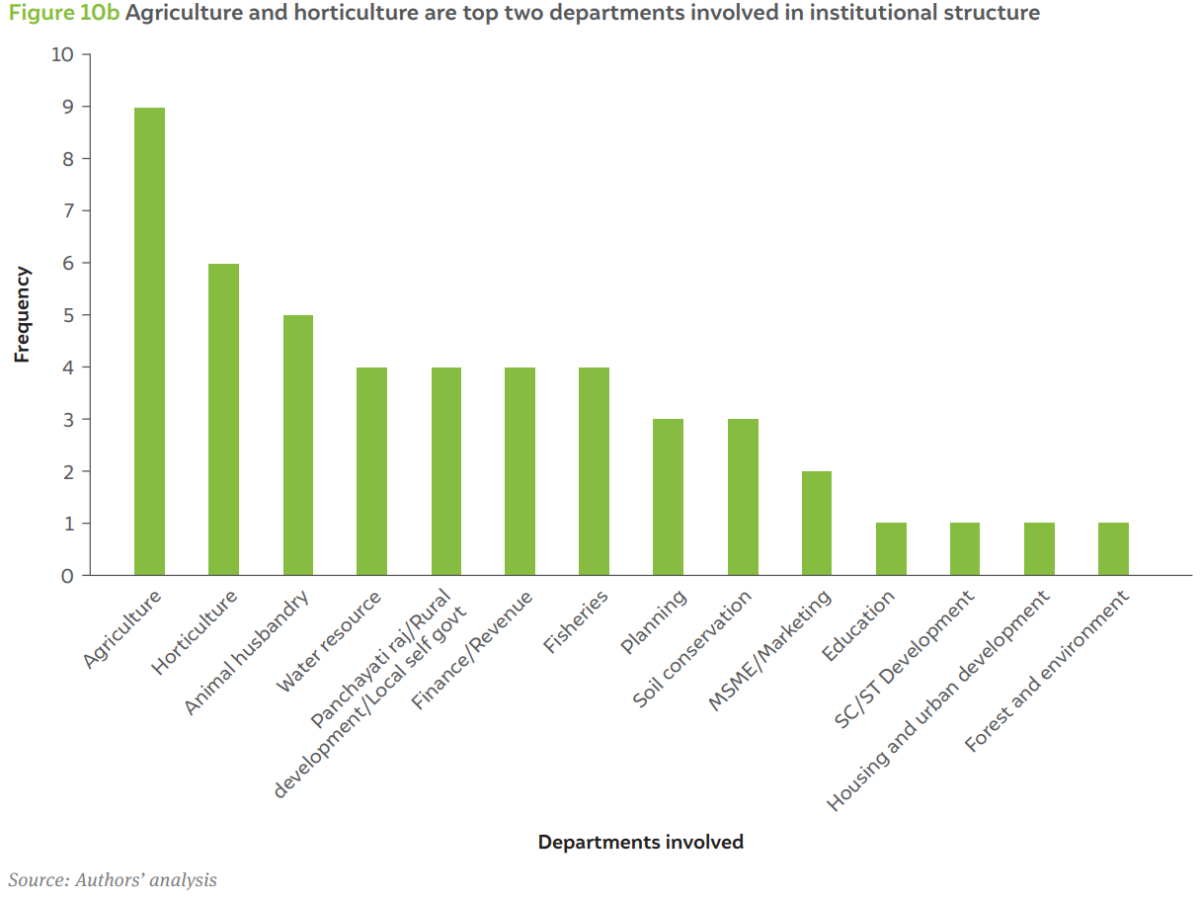
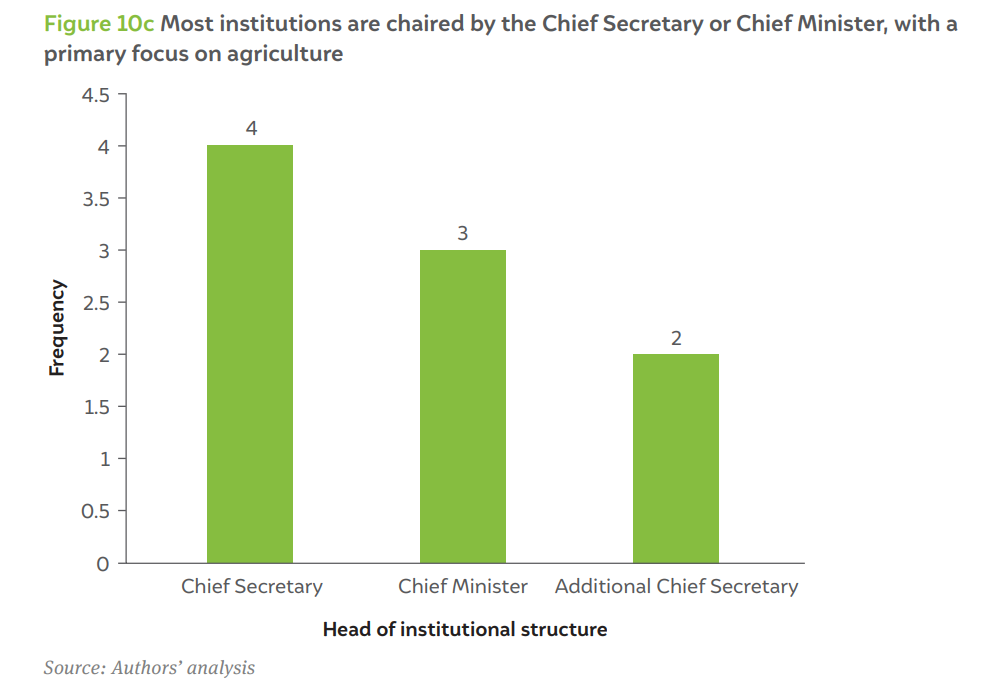
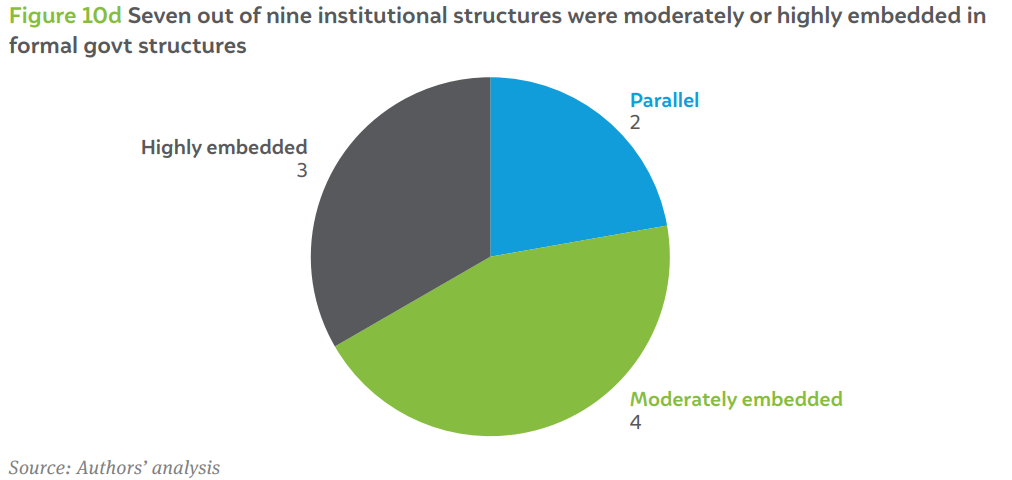
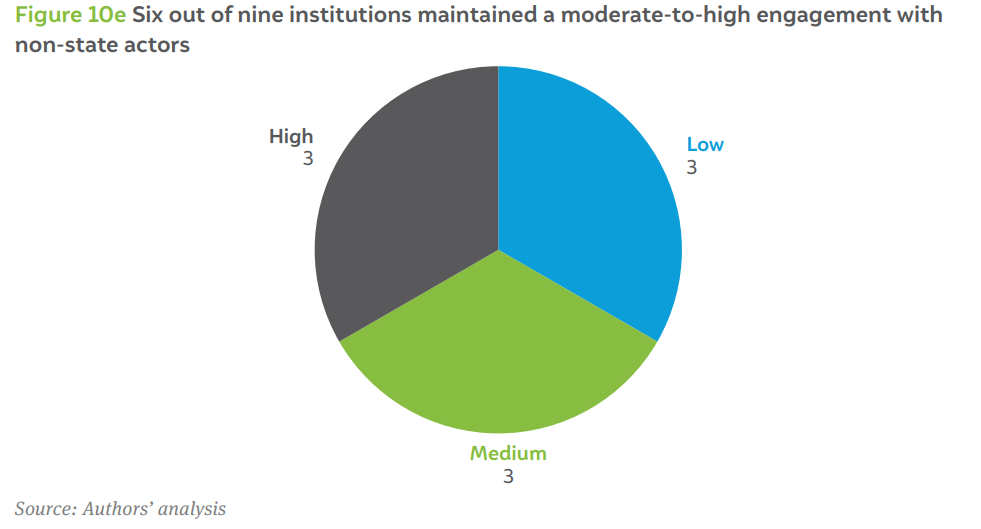
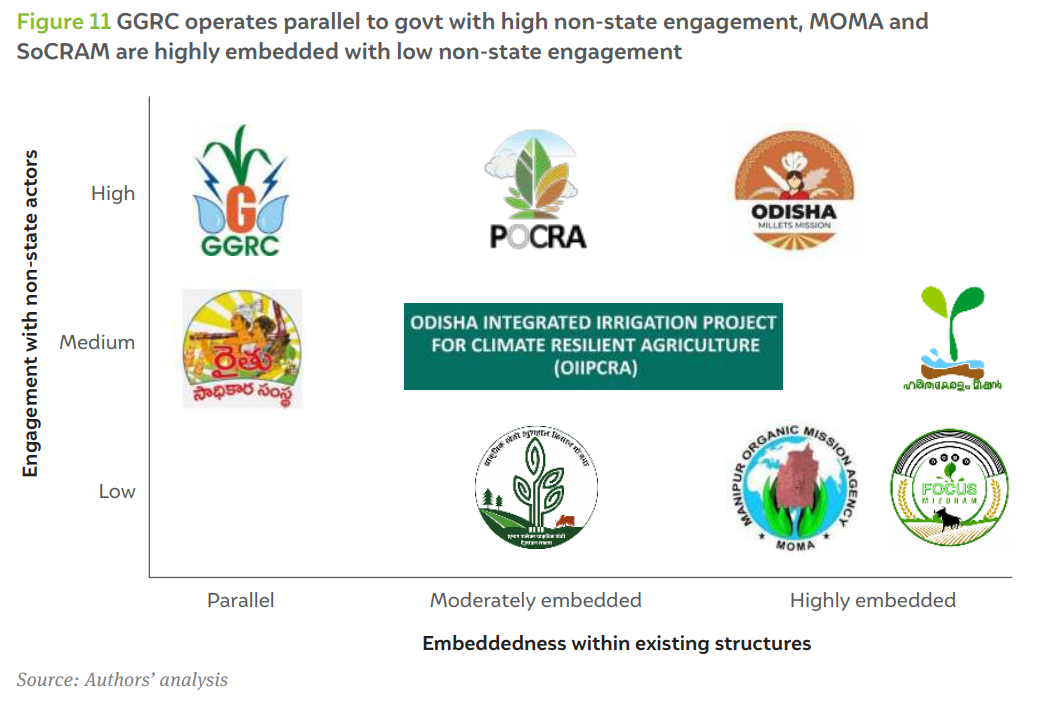
Figure 11 maps these institutional structures on their extent of embeddedness and engagement with non-state actors. We can observe that programmes like MOMA are highly embedded within the existing government hierarchies, and have low engagement with nonstate actors. On the other hand, structures like the Gujarat Green Revolution Company are completely parallel to the existing government hierarchies and engage non-state stakeholders in a formal and institutional manner. When looking at the combination of embeddedness of the institutional structure with that of engagement with non-state actors, the states are represented as such:
Key features for a scalable and reliable institutional structure to advance CRA in Bihar: Insights from comparative studies and capacity gap analysis
As seen in the recommendations in section 2.5, the creation of an institution to drive Bihar’s CRA programme was an important enabler for capacity improvement. Based on the learnings from CAF and external case studies above, we identified the following key needs from the institutional structure:
Perception, knowledge and awareness: The institutional structure must have an expert body of members from academia and industry to contextualise innovations.
Vision, mandate and priorities: The institution can remain embedded within the departmental structure but must be headed by an authority that can establish crossdepartmental mandates and vision for collaboration—the chief secretary or the CM.
Collaboration and coordination: Despite a clear trend to be housed in the agriculture department, it must involve departments like planning, finance, water resources, animal husbandry, fisheries, horticulture and panchayati raj.
The institution needs to converge different schemes of the state with a similar mandate within its own institutional structure.
It should involve and embed non-state actors within the structure across various levels.
It must formalise and involve champion farmers in a partnership at the local level. Monitoring and evaluation: There should be provisions to encourage feedback from the ground up.
Human resource capacity: It should involve and embed non-state experts and actors within the organisation structure to leverage the on-ground human capital. Keeping these key features in mind, the following section proposes an institutional structure to advance CRA in Bihar.
The previous sections have reflected a need for an institutional structure to achieve coherence across various departments and institutions advancing CRA in the state. Based on these observations, we recommend the creation of an institutional structure. We look at the structure and details of its activities, aims, and potential roles and responsibilities of such an institution at various levels. The primary roles and responsibilities, along with membership details for the above structure, are:
State Steering Committee
An overarching committee that sets mandates and monitors the progress of the CRA programme. It would involve members across the departmental hierarchies, with a focus on building convergence beyond limited departmental mandates.
Suggested roles and responsibilities
Suggested chair
Chief Secretary or Chief Minister (as per the analysis of states’ institutional structures)
Suggested members
Suggested meeting frequency
Three times a year.
State Programme Management Unit (SPMU)
The SPMU will be responsible for coordinating and successfully implementing the programme. Coordinators from institutions and non-state stakeholders can potentially be technical partners who play an essential role at this level.
Suggested roles and responsibilities
Suggested chair
Principal secretary, Department of Agriculture
Suggested members
Suggested meeting frequency
Monthly
State expert committee
The committee will be responsible for providing technical recommendations to guide the entire programme. This committee will be responsible for developing relevant Package of Practices (PoPs) for Bihar, top-down and bottom-up innovations, customisation of CRA practices, documentation and publication of CRA evidence, and development of protocols for practice testing, among others.
Suggested roles and responsibilities
Suggested chair
Director of BAMETI/BAU/BISA/RPCAU.
Suggested members
Suggested meeting frequency
Every two weeks.
District Programme Management Unit (DPMU)
The DPMU will also coordinate with the SPMU and drive the programme’s progress at the district level. It will involve members from the research institutions at the district level, like KVKs and ATMAs, in coordination with the district bureaucratic human resources and agricultural value chain bodies.
Suggested roles and responsibilities
Suggested chair
District magistrate
Suggested members
Suggested meeting frequency
Every two weeks
With an eye on contextual advancement of practices and achieving CRA outcomes beyond productivity alone, this body has been recommended as a provider of feedback and data collection. It will also be responsible for the impact evaluation of the programme beyond its stated objectives on external socio-economic indicators.
Suggested roles and responsibilities
Suggested chair
Programme coordinator, KVK
Suggested members
Suggested meeting frequency
Every two weeks
Block Programme Management Unit (BPMU)
To localise the outreach and engagement of the programme’s human resources, a BPMU shall exist at the block level. This body will be responsible for engaging with farmer representatives and local producer organisations directly and implementing the programme activities in a coordinated manner.
Suggested roles and responsibilities
Suggested chair
Block agriculture officer (BAO)
Suggested members
Suggested meeting frequency
Weekly
The above institutional structure has received input and feedback from some state and nonstate experts. However, a further detailed study is required to validate and streamline the design of Bihar’s structure.
This section attempted to provide a higher level of understanding of the possible roles and responsibilities these bodies could take up. Moving forward, a complete responsibility matrix for different departments must be created, after validation and critique by multiple stakeholders. However, since that was beyond the time and scope of this research, we recommend that as a next step to this project. Based on the emerging analysis above, the proposed institutional structure can thus look like this.
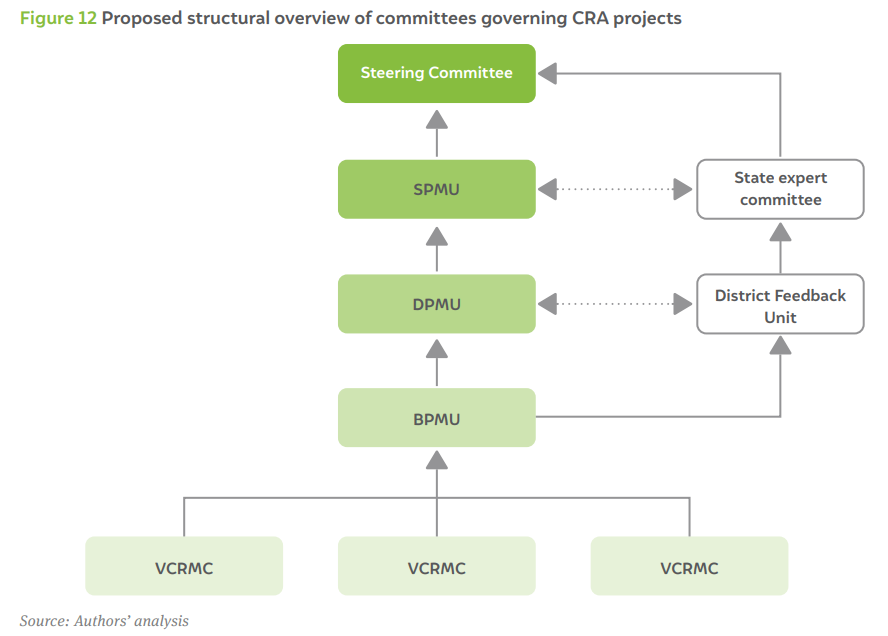
This proposed institutional structure can enable Bihar’s efforts to advance a context-specific, coherent, and convergent strategy for CRA. This will also pave the way for realising the state’s ambition, as highlighted in the fourth Agricultural Roadmap.
Odisha is vulnerable to climate change due to its 480-km coastline, which is exposed to cyclones and coastal erosion, and its monsoon-dependent agricultural system (Dasgupta et al. 2020). Therefore, we begin by looking at the state’s agricultural sector and its vulnerabilities to climate change in detail.
Odisha’s economy is predominantly agrarian, with a significant portion of its rural workforce engaged in agriculture and allied sectors. These sectors contributed 22.5 per cent to the Gross State Value Added (GSVA) for the fiscal year 2022–23, as the Odisha finance department reported in 2023. The state’s agriculture primarily relies on rainfed cultivation, encompassing 74 per cent of its cultivable land (Odisha Finance Department 2023). The cultivation area is notably higher in the coastal districts, including Balasore, Bhadrak, Cuttack, Ganjam, Jajpur, Jagatsinghpur, Kendrapara, Khurda, Nayagarh, and Puri. These regions are pivotal in Odisha’s agricultural framework.
Major crops and fisheries
Odisha is renowned for its production of rice, pulses, oil seeds, jute, coconut, and turmeric, contributing significantly to India’s agricultural output. The state is particularly noted for providing one-tenth of India’s total rice production. In addition to crop production, fishery is a crucial economic activity. Leveraging its vast freshwater and brackish water resources, as well as its lengthy coastline, Odisha stands as a key maritime state with substantial potential in fisheries development (Odisha Finance Department 2023).
The state government aims to double inland fish production and substantially increase exports from INR 4,526 crore to INR 20,000 crore (Arya 2023). The total provisional fish production in 2018–19 was recorded at 7.59 lakh MTs (DAFE Odisha 2020).
Odisha’s vulnerability to extreme climate events has been increasingly evident, with significant impacts on its landscape, communities, and agricultural practices. Moreover, climate change and rising sea levels exacerbate these problems by facilitating saltwater intrusion into coastal aquifers, jeopardising agriculture and potable water sources, and heightening agricultural susceptibility to droughts (Hornbeck and Keskin 2014; Zhang et al. 2015).
The Climate Vulnerability Index report by CEEW highlights that an alarming 73 per cent of the state’s districts are exposed to extreme floods and associated events (Mohanty and Wadhawan 2021). Since 1970, there has been a noticeable two-fold increase in the frequency and intensity of extreme weather events, including floods and cyclones. Additionally, the state has experienced a similar surge in the occurrence and severity of drought events over the past decade, further exacerbating the challenges faced by its residents and the agricultural sector.
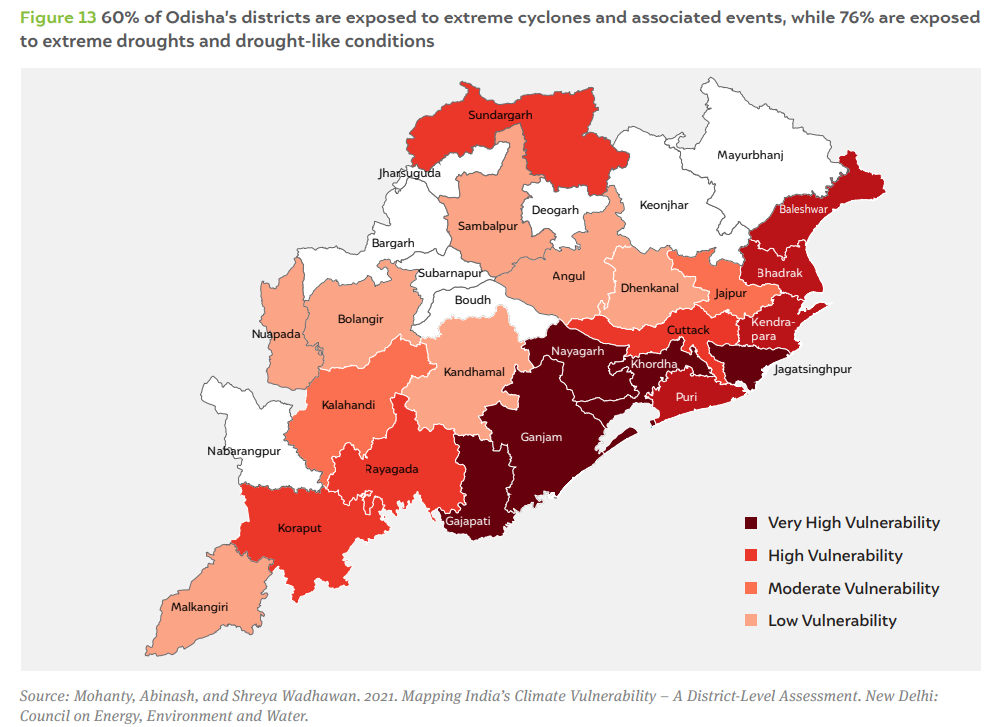
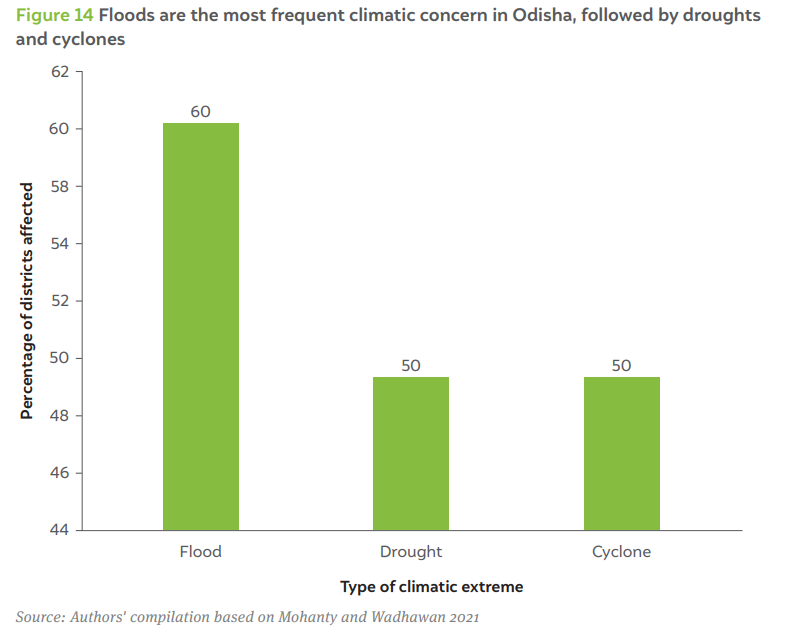
Research conducted by the ICAR-Central Research Institute for Dryland Agriculture (CRIDA) offers a detailed analysis of the state’s exposure, vulnerability, and overall risk to future hazards, considering various agro-economic and climatic indicators (CRIDA 2019). The findings reveal that a significant majority of Odisha’s districts, 19 out of 30, fall into the ‘high’ to ‘very high’ categories in terms of climate change risk intensity. Moreover, 28 out of 30 districts are categorised as facing ‘moderate’ to ‘highly unfavourable’ risk levels for future hazards (CRIDA 2019). Among these, 17 districts are particularly threatened by potential increases in minimum temperatures, while two districts are at an increased risk of becoming more drought-prone.
Different topographies have a different climatic vulnerability
Odisha’s upland and lowland districts face varied climatic extremes. Cyclones frequently hit coastal areas, and floods and waterlogging are common for coastal agriculture (Singh et al. 2023). Due to groundwater overexploitation, the coastal areas also face increasing salinisation of soils and saltwater intrusion (Anirudh K. Singh 2020). On the other hand, the upland areas face drought conditions and unpredictable precipitation patterns (Anirudh K. Singh 2020). These insights underline the critical need for Odisha to adopt comprehensive and adaptive strategies to mitigate the effects of these climatic extremes. This necessitates strengthening infrastructure, enhancing community resilience, and integrating sustainable agricultural practices. By addressing these challenges head-on, Odisha can work towards safeguarding its environment, economy, and the well-being of its people against the backdrop of an increasingly volatile climate. CRA has emerged as one of the pathways to address these challenges.
In Odisha, as in other states, CRA has emerged as a solution to the challenge of extreme climatic risk to the sector (Ghosh 2019; Bahinipati and Venkatachalam 2015; Sharma, Reddy and Sahu 2014). Keeping the challenges observed in the agriculture sector in mind, the state began efforts to promote CRA outcomes through various programmes and policies, beginning with the State Action Plan on Climate Change (SAPCC) of 2007 (Department of Forest Environment and Climate Change 2021).
The SAPCC was updated in 2021. The action plan focused on agriculture, fisheries, and animal husbandry. Odisha has highlighted an action plan for each of these sectors to build resilience (Department of Forest Environment and Climate Change 2021). The state focuses on creating awareness for farmers on climate change adaptation, establishing seed banks, scientific animal health management, fish farming, etc.
Odisha’s efforts at making its agriculture ‘climate-resilient’ manifested as multiple policies that tackled some of the CRA outcomes. We evaluated the current CRA-relevant policy ecosystem across the state’s departments.
CRA policy ecosystem in Odisha
The state also launched multiple policies to achieve various CRA outcomes. These policies came from various departments and are analysed with a focus on their prioritisation of various CRA outcomes. We have performed an analysis of 18 such policies, which can be referred to in Annexure XII.
In the following section, we unpack the policy landscape in Odisha to understand the ownership of relevant departments, and how successfully they target CRA outcomes. Our analysis identified the following trends defining the institutional design of its CRA-related policies.
Nodal departments for CRA-related policies
As established in the previous section, the nodal department is responsible for fund allocation and task distribution at the local level (refer to the Annexure XII).
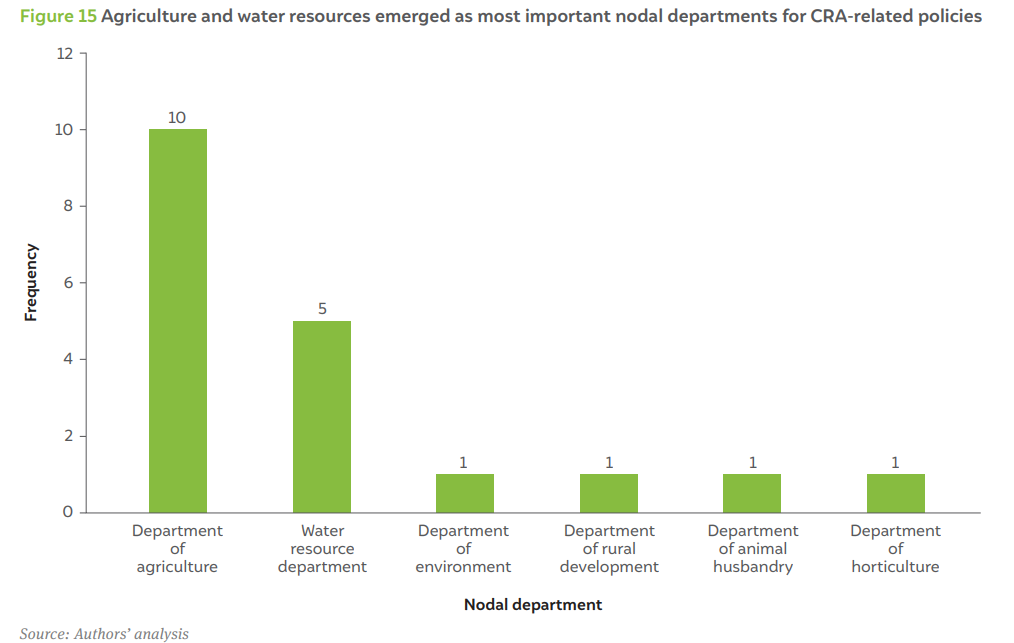
In Odisha’s case, the analysed nodal departments and CRA outcomes show that most of the CRA-related policies are housed with the Department of Agriculture or Water Resource Department. However, the presence of other departments, such as nodal departments, for the implementation of CRA-related policies shows that inter-departmental collaboration at various levels would be important for the advancement of CRA.
Alignment with CRA outcomes
A brief analysis of the objectives and aims in the policy documents for these 18 CRA-related policies in Odisha shows the following analysis of targeted outcomes.
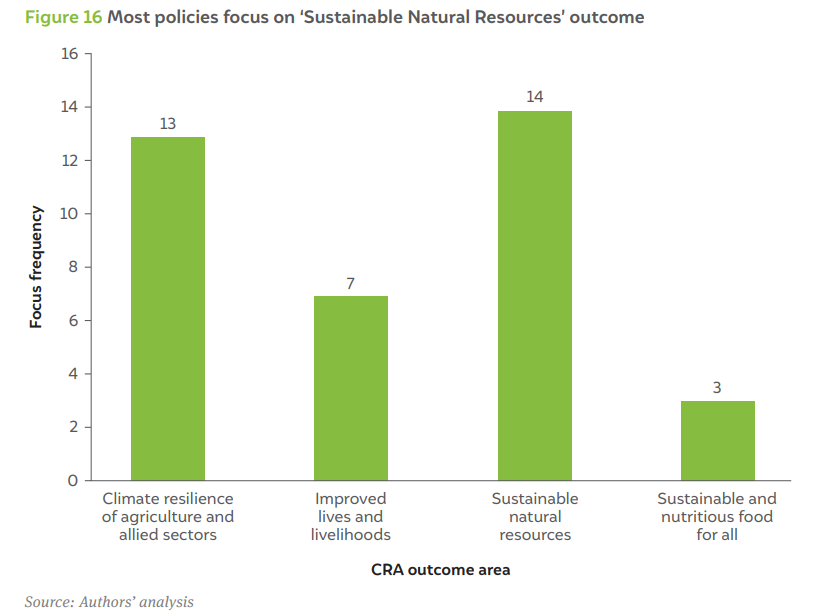
This means that needs for collaboration and coordination may arise depending on the targeted areas of the schemes and the requirement for interaction with external stakeholders and population groups, which a policy may not recognise. Unlike in Bihar, Odisha’s policy landscape shows that sustainable natural resources and climate resilience are the most targeted outcomes. However, sustainable and nutritious food outcomes are found to be less important in the analysed policies.
In consultation with experts at the state and local level, we observed that Odisha prioritises seven thematic areas of intervention for pursuing the advancement of CRA through its various policies and programmes. These thematic areas also find relevant prioritisation within the SAPCC (Department of Forest Environment and Climate Change 2021). A disclaimer must be made here that this report only compiles the prioritisation of practices for CRA advancement as per the states' policies. They are:
The seven practices that were prioritised positively impacted ‘Outcome 1’ of CRA: Climate Resilience of Agriculture and Allied Sectors (Behera 2019; Senapati and Goyari 2020). As the seven priority thematic areas were identified in Odisha’s SAPCC (Department of Forest Environment and Climate Change 2021), their positive impact on ‘Outcome 1’ of CRA does not warrant further investigation. We elucidate how these practices impact the other three CRA outcomes using a further literature review. These are tabulated in the Annexure XI.
Given the cross-departmental nature of these priority areas and the requirement of collaboration at the local level to implement them, institutional capacity emerges as a key enabler. In the following sections, we analyse Odisha’s institutional capacity for advancing CRA and make recommendations for strengthening these capacities.
The methodology used to perform the institutional capacity assessment in Odisha was the same as referred to in Figure 3 (section 1). However, the contexts of the institutional arrangements in the state affected the mode of consultations at the state level and the selection criteria for fields. The data collection and analysis results are discussed in the following sections.
State-level institutional capacity analysis
We conducted one-on-one consultations with state-level officials at Project Nodal Officer-level and above from directorates and state research organisations. We then went into the field and interviewed district and local level officials along with farmers via FGDs.
We conducted 19 in-depth interviews involving six departments of the state government, five universities and research institutions, and three non-state stakeholders. The details of individual consultations can be found in Annexure II.
Our consultations at the state level led to the identification of the Climate Resilience Cell (CRC) within the Department of Agriculture and Farmer Empowerment (DAFE) as the key institution in building collaborative capacities for CRA. We conduct a deep dive into this institution’s current capacities and key outcomes from strengthening these capacities in the long term in section 3.6.2.
Local-level institutional capacity analysis
For the selection of fields for visit, we created a CRA-critical score for the districts using the following criteria (districts which were not covered by either OMM or OIIPCRA were not considered for the field visit):
The top five districts based on the CRA-critical score (an average of coverage of the OMM, OIIPCRA and the district’s own vulnerability to climate change—see calculation in Annexure X) are given below
Table 6 Keonjhar, Bolangir, and Ganjam were selected from the top five CRA-critical districts based on their mixed topography and expert consultations
| Name | Farmers covered under OMM (normalised) | Area covered under OIIPCRA (normalised) | CRIDA vulnerability Score (normalised) | CRA-critical score |
|---|---|---|---|---|
| Ganjam | 0.9 | 1 | 0.5 | 0.8 |
| Keonjhar | 0.718 | 0.66 | 1 | 0.793 |
| Mayurbhanj | 0.794 | 0.618 | 0.5 | 0.638 |
| Bolangir | 0.869 | 0.261 | 0.5 | 0.543 |
| Nabarangapur | 1 | 0.002 | 0.5 | 0.5 |
Source: Authors’ analysis in Annexure X
The selection of Ganjam, Bolangir, and Keonjhar was based on further expert consultations to prioritise coverage of diverse topographies and climatic vulnerabilities, and assess institutional capacity in these conditions. Though other parameters may be added to further nuance a score for the CRA-criticality of a district, Odisha’s own available databases and prioritisation of OMM and OIIPCRA made them imperative for field selection to the state’s context. The details of the districts’ topography and vulnerability are given below.
Table 7 Ganjam, Bolangir, and Keonjhar represent coastal, midland, and upland topographies, facing multiple climatic risks such as cyclones and droughts
| District | Topography | Vulnerability |
|---|---|---|
| Ganjam | Mixed—coastal plains with hills and uplands | Low agricultural water holding capacity, rising minimum temperatures, high cyclone-proneness |
| Bolangir | Midland topography | High drought-proneness, rising minimum temperatures |
| Keonjhar | Upland topography | High cyclone-proneness, rising minimum temperatures |
Source: Authors’ compilation
An analysis of capacity gaps identified during these consultations at the state and local level led to the emergence of over fifty recommendations for action across four levels for the seven thematic areas of CRA in Odisha. This detailed analysis is presented in Annexure XIII. To be more outcome-oriented in the advancement of CRA in the state, we identified twelve major opportunity areas for the CRC, where capacity strengthening may lead to positive outcomes for other capacity challenges as well.
This section discusses the results obtained from the assessment of qualitative data collected across the state and local levels in Odisha. We look at the anchoring institutional structure in Odisha for CRA, the Climate Resilient Cell (CRC), and its origin and functions. We then look at the emerging gaps in the CAF indicator areas in the state based on our qualitative research and provide recommendations for strengthening the institutional structure along with the expected outcomes from the short, medium, and long-term actions.
Driving convergence through Climate Resilient Cell (CRC)
Odisha became one of the first states to get approval for its SAPCC for 2021–30 (Odisha Finance Department 2023). Under this plan, the state has established a Climate Change Cell in the Department of Forest and Environment to coordinate efforts among eleven identified departments working on and sensitive to climate change-related issues. The Department of Agriculture is one department that participates in the planned activities
As part of the DAFE’s efforts to establish an institutional delivery mechanism to promote best practices on climate change, a Climate Resilience Cell (CRC) team was established within the Department of Agriculture in January 2023. The initial brief of the CRC team was to analyse the state’s SAPCC to provide insights on activities to be taken up by the DAFE as part of the plan.
However, its mandate as an institutional mechanism establishing coordination has been expanded to include:
The creation of the CRC within Odisha’s DAFE is a critical institutional development, underscoring the state’s commitment to advancing CRA. The CRC serves as a central nexus for catalysing and coordinating Odisha’s climate resilience initiatives by extending its role to encompass capacity building, technological demonstrations, and multi-sectoral collaborations. This strategic institutional arrangement enhances the department’s ability to implement CRA practices effectively, ensuring a unified and robust approach to tackling climate change challenges, thereby significantly boosting the department’s capacity for sustainable agricultural development.
Roadmap for strengthening CRC
Through the state and field-level consultations, we have made recommendations for the state to advance the scale-up of CRA in Odisha, through actions that the CRC can take in partnership with other stakeholders. Table 8 looks at how opportunities emerging from the state and local-level data collection could be channelled towards outcomes in Odisha’s advancement of CRA. We have also prioritised the recommended actions into short (1–3 years), medium (3–5 years), and long-term (5–10 years) on the basis of feasibility.
Table 8 How short-, medium-, and long-term actions can shape outcomes across 12 broad opportunity areas
| Capacity area | Opportunity identified | Action area - short term | Action area - medium term | Action area - long term | Outcome envisioned |
|---|---|---|---|---|---|
| Vision mandate and prioritisation | Mandate for cross-sector CRA prioritisation: Departments and schemes outside agriculture activities like MSME, energy, SC/ST development, etc., lack a ‘climate-resilient’ lens, and coordination with sectoral experts on schematic areas. | Collaborate with the three directorates under the agriculture department along with non-state experts to reexamine and prioritise climate-resilient interventions and develop a climate-resilient checklist to foster alignment under various programmes, e.g., restructuring programme finance allocated to diesel-based mechanisation and increasing patterns of assistance to laser land leveller or zero seed tiller. | Partner with non-state and state experts to include collaboration as a KPI for local and district officials to include collaboration. | Set up a platform for collaboration with all departments and relevant non-state actors in these thematic areas to examine policies with agricultural components to streamline allocations and targets towards CRA outcomes. | Creation of a CRA outcome dashboard for all policies across departments, attached to the Green Budget, with recalibration of the CCRS (Climate Change Relevance Share in Odisha’s Green Budget)—which measures how benefits from development programmes additionally contribute to improving resilience to climate change) in Odisha Green Budget towards CRA-related outcomes. |
| Vision mandate and prioritisation | Lack of departmental mandates for collaborative implementation on the ground; Departments focus only on their schematic targets and not on collaboration to converge on the ground. | Assess departmental targets across CRA-relevant schemes and consolidate them at the block/ district level. | |||
| Vision mandate and priorities | State- and local-level seed advisories do not include land type assessment, creating a misalignment of priorities. This is because soil conservation requires land assessment of marginal/off lands which do not support long-duration varieties. | Collaborate with the Department of Revenue and Odisha University of Agriculture and Technology (OUAT) to set up a seed advisory analysis to review the mismatches between land types and seed advisories in the state. | Perform a state-level seed-demand assessment alongside the seed advisory analysis. | Setting up a seed advisory portal that combines land typology data, crop diversification targets, and seed demand assessment at the state level. | Setting up a context-driven, dynamic and flexible seed distribution and advisory system for the state will enhance resilience on the field and mitigate land-related risks. |
| Capacity area | Opportunity identified | Action area - short term | Action area - medium term | Action area - long term | Outcome envisioned |
|---|---|---|---|---|---|
| Vision mandate and priorities | Improve quality and quantity of climate resilient extension services, human resource and species planning in the fisheries sector. | Assess the demand of the fisheries sector on the farmer’s end (looking at input requirements) and institutional end (looking at extension resources, infrastructure, inputs, etc, required by the institutions to run an extension system) for analysis of skill base, seed demand and gaps in the extension system. | Partner with non-state experts to create a human resource base through short-duration extension courses. Licence private sector extension providers for aquaculture. | N.A. | Setting up a robust climate-resilient and locally driven fisheries ecosystem with a human resource base and seed provision plans can improve the livelihoods of farmers by providing additional income. |
| Collaboration and coordination | Non-uniform success of block technical teams (BTTs). Some BTTs have overburdened records and meetings on paper, leading to non-achievement of scheme targets in their areas. | Identify and institute a district-level authority to monitor BTT performance. | Design outcome-based KPIs for BTTs in collaboration with experts. For example, instead of focusing on the number of training courses conducted, the KPI should focus on measuring the improvement of livelihoods of the engaged beneficiaries. | Create a new reporting structure for the BTTs to establish cross-departmental KPIs enforcement. (BTTs, being a cross-department body, aren’t effectively monitored by being under the ATMA Management Committee alone) | Convergent implementation of CRA outcomes on the ground through collaboration at the BTT level, guided by new KPIs and a reporting structure for them. |
| Research and development | Absence of low cost contextual equipment for small and medium farmers (SMF). Extension workers identified a demand from SMFs and female farmers for quality and quantity of mechanisation equipment like solar pumps, micro tractors, etc., relevant to their geography and landholding sizes. | Assess new innovations coming up under Mukhyamantri Abhinav Krishi Yantrapa Amman Yojana and link them to Mukhyamantri Krishi Udyog Yojana (MKUY) as potential scale is observed in local contexts. A CRC mandate must be collaboration with the Farmers Information and Advisory Centre (FIAC) and the Agricultural Promotion and Investment Corporation of Odisha Limited (APICOL). |
Assess all farm mechanisation mandates across the policies like OIIPCRA, OMM, MKUY, etc.; examine SMF-focused features and create research on equipment creation and distribution, in collaboration with non-state actors. | Design and implement a research project on nature-based solutions for Odisha’s local context. Commission research for innovation in machinery for land preparation, processing, value addition, etc for SMFs. |
A research and distribution value chain for locally relevant low-cost innovations for SMFs, which can link policy funding to entrepreneurs and farmer organisations, and ease the adoption of CRA. |
| Capacity area | Opportunity identified | Action area - short term | Action area - medium term | Action area - long term | Outcome envisioned |
|---|---|---|---|---|---|
| Research and development | Minor millet value chains face challenge due to lack of specific machinery like processing, value addition, etc. | Addition of millet mechanisation for minor millets to the Odisha Millets Mission guidelines and funding priorities, in collaboration with the CRC and OMM cell. | Collaborate with non-state experts and entrepreneurs to set up a research platform for minor millet value chains. | Collaborate with non-state experts and entrepreneurs to set up a research platform for minor millet value chains. | Advancing CRA outcomes through minor millet value chains as part of crop diversification priorities in the state, to increase the income of farmers. |
| Monitoring and evaluation | Private players have been hesitant to provide insurance for fisheries, as there are no standards for monitoring and evaluation of fisheries production processes. | Collaborate with industry and academic experts to create a body for developing standards, to ensure fisheries operations in the State. | Getting early adopters of these standards on board for a pilot programme for fisheries insurance. | Setting a fisheries insurance programme with feedback from the pilots and scaling it up across the state. | The creation of a fisheries insurance programme with functional M&E standards, with incentives for private players to become insurance providers, can mitigate risks and advance adoption. |
| Monitoring and evaluation | Farmers buying and selling unlicensed seeds. | N.A. | Design a CRA seed village programme, in collaboration with farmer collectives, industry and grassroots non-state actors. This will fulfil seed availability gaps at the local level. | The CRC should consult experts to design a seed quality control portal. This can be combined with the seed demand assessment, the enforcement officers at the local level, and the seed advisory plan to be prepared in conjunction with the Odisha State Seed Corporation (OSSC) and OUAT. | Setting up enforceable examination and punitive mechanisms for seeds and scaling up of community seed banks for CRA-related seeds across the state to increase accessibility of CRA-relevant seeds. |
| Human resource capacity | Operation and management of CRA-relevant technologies was observed as a challenge. There was lack of requisite human resources at the local level for the maintenance and repair of CRA machinery. | Perform a skill demand assessment for the CRA-related machinery at the district level. | Coordinate with industry experts and research organisations to set up a skill upgradation module for unskilling existing MRO workers in CRA-related machinery practices | Partner with the skill development department to bring MRO skills in agriculture under the agricultural capacity building components in agriculture schemes. | The creation of a demand-based skilled cadre of MRO technicians, with a focus on reskilling traditional skill bases can reduce the operation cost of adopting CRA-related machinery. |
| Capacity area | Opportunity identified | Action area - short term | Action area - medium term | Action area - long term | Outcome envisioned |
|---|---|---|---|---|---|
| Planning and implementation | Training and capacity building workshops target farmers unselectively and without context. | Improving monitoring and evaluation of farmer training through the use of ICT and pre-training data collection of farm typologies for targeting farmers. MnE data collection SOP and analysis can be designed with non-state actors as partners. | Design new KPIs for trainers in collaboration with non-state and state experts to contextualise training performance with targeted farming typologies and technological interventions that are used after the training. | Attach data from farmer training and CRA outcomes to a common dashboard for endline surveys of impact assessment of training. | Creating a training assessment and impact analysis system for farmers can enable targeted and coherent capacity building of farmers. |
| Information dissemination | Farmers and extension officials receive information only on input-related supply chains through lean communication mechanisms like Kisan Mobile Advisory Service (KMAS). | Partner with other departments, non-state actors, and experts to create advisories on post-harvest and marketing-based information in local languages. Design messaging SOPs involving post-harvest training under the KMAS portal messaging to create contextual advisories on post-harvest management and marketing of produce. | Set up MnE for designed advisories and their updation, in partnership with non-state actors. | Create block-level advisory portals with the collaboration of all departments and grassroots organisations, to send time-bound advisories across the value chain with information on document verification and grievance redressal at a granular level. | Creation of a locally-sensitive advisory system with a focus on the entire value chain can enable better price discovery for CRA farmers. |
| Information dissemination | Traditional knowledge like paira crop cultivation has been lost. Residual soil moisture in many areas has not been suitable for paira cultivation due to a decline in soil moisture after climate change and extensive agriculture. | Undertake ‘Odisha paira crop’ potential assessment. Research and consultation to develop paira crop advisory for farmers must be part of CRC's mandate. | Partner with grassroots organisations to promote paira crops at the local level through pilots. | N.A. | Scaling up traditional knowledge-based practices like paira crops across the state can enable farmers to increase productivity with reduced input costs. |
The establishment of the CRC provides a unique opportunity to coordinate these efforts and leverage the state’s institutional capacity for the benefit of its agricultural sector and the wider community. In collaboration with state and non-state actors, the CRC is positioned as a key institution to streamline CRA initiatives and address the identified capacity gaps. It is imperative for the CRC to work closely with all stakeholders, including government departments, research institutions, farmer organisations, and the private sector, to ensure the effective implementation of the recommended actions.
CEEW’s analysis on building scalable and sustainable programmes for agriculture emphasises levers like receiving technical support, receiving infrastructural support, facilitating allocation of human resources, and sustainable financing (Agarwal, Khandelwal and Wal 2024). However, these areas have been identified as significant gaps across stakeholder consultations and interviews from the states. Building non-state actor engagement also remains one of the critical levers for the success of institutional structures advancing CRA outcomes in multiple states.
This makes it essential for states to embed non-state actors into their policy designs for advancing CRA. Section 1, analysing the national policies, looked at the map of non-state stakeholders across the literature. The types of interventions that non-state stakeholders can undertake have also been taken into consideration.
The following section looks at key gap areas that various types of non-state actors can fill using different levels of interventions across various capacity indicators. The typologies of non-state stakeholders that we engaged with during the process of research have been identified as follows:
We identify context-specific CRA opportunities for non-state actors, such as designing household-focused frameworks, streamlining agriculture schools towards resilience, enhancing livestock and fisheries support, improving capacity building, etc. Non-state actors can drive change through research, policy advocacy, and strengthening value chains.
Table 9 Gaps and opportunities for non-state actors to advance CRA at the field, local human resource, research, and policy levels
| Capacity indicator | Key gap identified | Recommendation/opportunity for non-state actors | Types of stakeholder | Relevant level of intervention |
|---|---|---|---|---|
| Vision mandate and priorities | There is a lack of vision for context-specific CRA. There is a need to identify goals and milestones using data and evidence for context-specific risk and vulnerability of the target region. This can enable the advancement of relevant CRA-related interventions to build resilience in the food systems. | Map the risk and vulnerability of agricultural systems due to various external factors like climate and market risk. | Think-tanks, universities, consultancies | Research level |
| Vision mandate and priorities | Develop a playbook at a regional level that can highlight all the applicable CRA-related solutions to build regional resilience. | Universities, think-tanks, grassroots organisations, consultancies | Research level | |
| Vision mandate and priorities | Engage farmer collectives in developing village or gram panchayat-level vision for evidence-based bottom-up decision-making. | Collectives, grassroots organisations, think-tanks | Field level | |
| Vision mandate and priorities | Current CRA programmes focus on individual beneficiaries. This reduces the household’s risk appetite for adopting and continuing CRA practices. | Shifting the agricultural ecosystem towards a farming household-based framework that can support income resilience at a household-level. This includes developing data and evidence, conducting pilots to operationalise household-level framework and building narratives around shifting the focus from farmer to household-level. | Think-tanks, universities, consultancies, grassroots organisations, bilateral and multilateral organisations, philanthropy, and financial institutions | Policy level |
| Vision mandate and priorities | There are multiple schools of agriculture competing in the ecosystem, like Natural Farming (NF), Organic Farming (OF), Permaculture (PA), CRA, etc. This creates confusion among farmers and hinders concerted efforts towards resilient agriculture. | Develop outcome-based grant-making strategies for effective transformation. | Think-tanks, bilateral and multilateral organisations, philanthropy and CSR, financial institutions | Policy level |
| Planning and implementation | There is a disproportionate focus on crops under CRA, while other activities like livestock, fisheries, etc. do not get sufficient support. | CRA planning should include recommendations and interventions promoting livestock and fisheries sectors. This will further provide alternatives to crop production at a farm level. | Bilateral and multilateral agencies, private sector (inputs), private sector (VC), grassroots organisations, think-tanks, consultancies | Policy level |
| Planning and implementation | Focus on developing and strengthening the input and post-harvest value chains for resilient livestock and fish farming. This can include providing high-quality feed and fodder, as a fodder deficit for dry feed was the highest expressed gap in stakeholder consultations. | Private sector (inputs), private sector (VC), collective, philanthropy and CSR, industry associations, financial institutions | Field level |
| Capacity indicator | Key gap identified | Recommendation/opportunity for non-state actors | Types of stakeholder | Relevant level of intervention |
|---|---|---|---|---|
| Capacity indicator | Demand/need assessment for fishery and livestock produce and consumption at a local level can guide the relevant stakeholders working on the production side. | Think-tanks, universities, consultancies, collective, private sector (inputs), private sector (VC) | Research level | |
| Capacity indicator | Collaborative action between farmers’ collectives and the hotel, restaurant and catering (HoReCa) sector to create a closed loop of resilient local supply chains. | Collectives, industry associations, private sector (VC), consultancies | Field level | |
| Capacity indicator | There is a lack of targeted capacity building and training among CRA programmes and interventions. For example, farmers are called for crop cultivation training without consideration for their own crop bundles. | Creating farmer interest groups (FIGs) locally. These can collectively demand specific training relevant to their practices and challenges. Non-state actors active in certain areas can take up the role of information dissemination for training for interested farmers. | Grassroots organisations, collectives, ICT, private sector (VC) | Field level |
| Capacity indicator | Accessibility and availability of seeds compatible with CRA PoPs as identified by the state is limited at the local level. | Non-state actors can build an estimate of the demand and supply of specific varieties of seeds with high uptake amongst CRA farmers. Entrepreneurs can promote decentralised seed banks at a local level. | Private sector (inputs), collectives, grassroots organisations | Research level |
| Capacity indicator | Scaling up of prospective resilient varieties has a high gestation period before reaching farmers. | Non-state actors can take the responsibility of expediting such varieties through scaled-up trials, evidence collection and dissemination. | Universities, think-tanks, consultancies, grassroots organisations, private sector (inputs) | Field and research levels |
| Collaboration and coordination | There is a lack of targeted and convergent actions among non-state actors due to a lack of collaboration and coordination. This leads to oversaturation in certain regions, while other regions are ignored. This also leads to the promotion of multiple techniques and technologies, often competing among the same farmers. | The creation of non-state actors’ consortiums and coalitions can enable coordinated and convergent action. To streamline activities on the ground, this coalition should include regional players from the private sector, civil society organisations, donor organisations, farmers’ collectives, etc. | Collectives and coalitions, industry associations, grassroots organisations, philanthropy and CSR, bilateral and multilateral agencies, private sector (inputs), private sector (VC) | Policy level |
| Capacity indicator | Key gap identified | Recommendation/opportunity for non-state actors | Types of stakeholder | Relevant level of intervention |
|---|---|---|---|---|
| Capacity indicator | Access to markets for better price discovery limits the adoption of CRA interventions. There is a disconnect between the production and value chains in regions that disincentives farmers from diversifying to more resilient crops. | Entrepreneurs and the private sector need to strengthen resilient value chains in alignment with producers and context-specific crops. Establishing these value chains can be a powerful tool in enabling the transition to resilient crops. For example, one of the key reasons for the reduction of pulse production in Bihar was the lack of strong value chains. | Private sector (VC), industry associations, collectives, think-tanks, consultancies | Field level |
| Monitoring and evaluation | The CRA system in states remains focused on output-based parameters for evaluation of fisheries production processes. Even the success of institutional bodies at the state and local levels remains focused on outputs such as the number of training sessions conducted or the number of machines distributed. Outcome-based parameters lack an evidence base and standard to be adopted by governments at a larger scale. | Non-state actors can develop data and evidence on outcomes, which can become the new drivers of KPIs for the system and state actors in general. | Bilateral and multilateral agencies, grassroots organisations, think-tanks, universities, collectives and consortiums | Policy level |
| Monitoring and evaluation | There is a lack of frameworks to monitor and evaluate activities related to the fisheries sector. This leads to the absence of insurance for fish production and disincentives farmers from adopting fisheries as an alternative. | Research institutes and the private sector need to collaborate on developing better methodologies to monitor and evaluate the fisheries sector. This will enable farmers to mitigate potential risks and increase profitability. | Think tanks, consultancies, universities, grassroots organisations, collectives | Research level |
| Information dissemination | There is a lack of a robust system that can provide micro-climatic level decision support with enough lead time. This leaves CRA adopters to incur crop loss due to sudden-onset climate events like rainfall. | Non-state actors like the private sector and research institutes can develop micro-climatic integrated decision tools for agricultural support. These need to include faster relay of information on upcoming climate risks and weather based crop advisories, and can potentially connect potential markets to the producers. | Private sector (inputs), private sector (VC), universities, think-tanks, consultancies, ICT, grassroots organisations | Research level |
| Capacity indicator | Key gap identified | Recommendation/opportunity for non-state actors | Types of stakeholder | Relevant level of intervention |
|---|---|---|---|---|
| Capacity indicator | Farmers cannot access governmental support from schemes and policies due to a lack of awareness and digital literacy. | Entrepreneurs and the private sector need to strengthen resilient value chains in alignment with producers and context-specific crops. Establishing these value chains can be a powerful tool in enabling the transition to resilient crops. For example, one of the key reasons for the reduction of pulse production in Bihar was the lack of strong value chains. | Grassroots organisations, ICT, coalitions and consortiums, philanthropy and CSR, bilateral and multilateral agencies | Field level |
| Capacity indicator | Develop a one-stop-shop platform to collect, consolidate, and disseminate various governmental schemes and policies for easy application. | ICT, private sector (VC), think-tanks, consultancies | Policy level | |
| Human resources | Skill development of incoming agriculture science graduates remains a challenge, with old college syllabi and a lack of quality institutions that can provide a sustained agriculture extension workforce. | Relevant stakeholders can take up technological training modules in state universities. | ICT, Think tanks, consultancies, Private Sector (inputs) | Local human resource level |
| Human resources | Non-government stakeholders can also run shorter skill development courses outside formal university training to foster turnaround time to build a skilled local workforce. | Philanthropy and CSR, grassroots organisations, university, private sector (inputs) | Local human resource level | |
| Human resources | KVKs, ATMAs, and DAMUs are understaffed to cover large areas within the district in short cropping windows, to advance CRA practices and maintain regular follow-ups. | Micro-entrepreneurs at the local level can be brought in to fill the gap as a multiplier for the district level extension team. Upskilling existing HR like Kisan Salahkars can be taken up by non-state actors. | Grassroots organisations, collectives, philanthropy and CSR, universities, private sector (inputs) | Local human resource level |
| Financing | There is a lack of affordable and accessible crop insurance. Structures to reduce the financial burden due to climate-related crop failure. The existing schemes, like Pradhan Mantri Fasal Bima Yojana (PMFBY), do not provide long-term returns, as they work at a district level. However, due to climate change, there is an increase in the variability of climate across a district, affecting some farmers disproportionately. This variability in micro-climates also means that farmer payouts may be unrepresentative of their condition. For example, a farmer whose area witnessed normal rainfall gets a payout in a district that suffered low/affected and vice-versa. | This requires better crop insurance models that can provide farm level insurance based on the practices followed by farmers. Private insurance providers can reduce the premium for farmers who adopt climate-resilient practices, therefore incentivising the scale-up of CRA. | Financial institutions, private sector (inputs), private sector (VC), grassroots organisations | Policy level |
| Financing | Developing better standards for micro-climate data-based insurance standards and payouts can make the system more targeted. For this, non-state actors can act as providers of locally sensitive data. An example is the GSM Association’s telecom data-based insurance model. | ICT, philanthropy and CSR, think-tanks, consultancies, private sector (VC) | Research level |
| Capacity indicator | Key gap identified | Recommendation/opportunity for non-state actors | Types of stakeholder | Relevant level of intervention |
|---|---|---|---|---|
| Research and development | Availability of cost-effective and low input machinery which is sensitive to local contexts is a major hurdle in the adoption of CRA practices, especially for SMFs and female farmers. | Non-state actors can act as developers of locally relevant low-cost solutions for farmers. They can also act as incubators for emerging bottom-up solutions from the ground level. | Collectives, universities, think-tanks, consultancies, private sector (VC), private sector (inputs) | Field level |
| Research and development | There is a lack of data and evidence on the effect of specific agricultural and fishery practices and machinery on adaptability or mitigation. | Non-state actors must produce such data in order to evolve context and outcome-sensitive practices and machinery. | Collectives, universities, think-tanks, consultancies, private sector (VC), private sector (inputs) | Research level |
Source: Authors’ compilation
An analysis of these recommended actions shows the following pattern of intervention priorities and stakeholders required to fill the gaps arising in these opportunity areas.
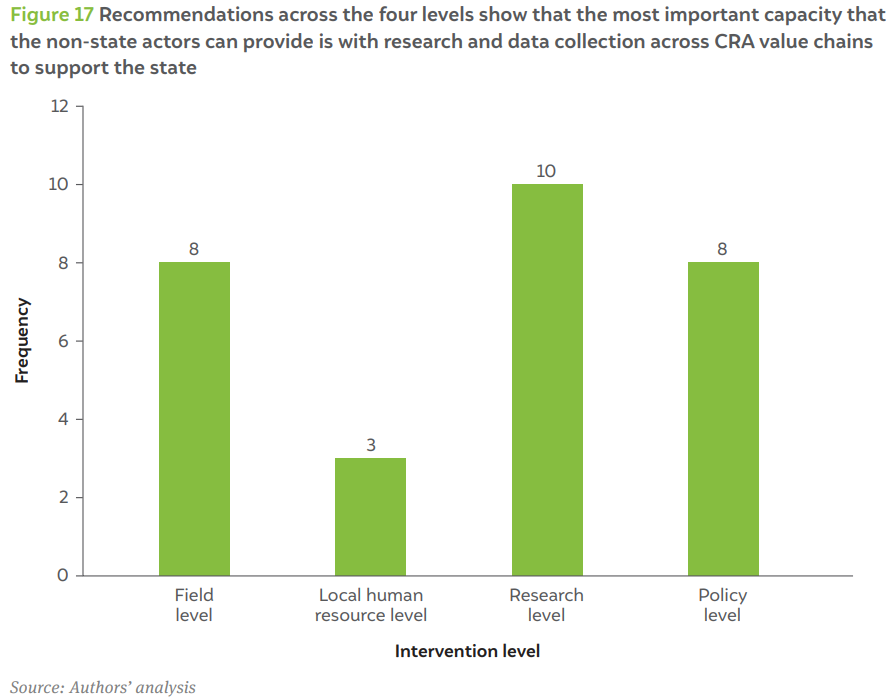
An important observation here is that the major interventions would also require stakeholders with expertise in these interventions to prioritise actions on CRA in the future. The combined action points across the private sector (input and value chain) are the most across recommendations—26. This shows an important role for them in advancing institutional capacity. The importance of informational interventions underscores the action priorities for think-tanks, consultancies, and grassroots organisations. The alignment of actions from nonstate actors with state-level interventions can provide a convergent approach towards scaling up CRA.
This report has identified over 20 actionable recommendations for Bihar and 40 for Odisha, spanning local and state levels, to strengthen institutional capacity for climateresilient agriculture (CRA). These recommendations address the entire spectrum of CRA implementation, from policy design to field-level execution, with a focus on improving knowledge management and human resource availability. By addressing these gaps, states can build a more robust framework to support farmers in adapting to the challenges posed by climate change, ensuring sustainable agricultural practices and improved livelihoods.
The experiences of Bihar and Odisha offer valuable insights into the varying stages of CRA adoption across states. While Bihar is still in the pilot phase with limited coverage, Odisha has made significant strides by institutionalising climate resilience as a core priority, supported by dedicated resources, specialists, and inter-departmental coordination.
This spectrum of adoption highlights the potential trajectory for other states to follow, providing a roadmap for advancing CRA in a coordinated, context-sensitive, and agile manner. The lessons from these states underscore the importance of tailored strategies that align with local realities while fostering collaboration across stakeholders.
India’s agriculture sector is at a critical juncture, with climate change posing unprecedented challenges that demand transformative solutions. This study underscores the urgency of adopting CRA as a national priority and presents five broad-scale recommendations to design efficient CRA policies and accelerate adoption across the country. By leveraging the learnings from Bihar and Odisha, policymakers and practitioners can work towards a more resilient agricultural system that not only mitigates the impacts of climate change but also aligns with India’s broader developmental goals. The path forward requires sustained commitment, innovation, and collaboration to ensure that CRA becomes a cornerstone of India’s agricultural future.
Shift from targeting ‘CRA-adopting farmers’ to ‘CRA-adopting families’
CRA programmes must evolve to prioritise household-level resilience by targeting families, not just individual farmers. Field evidence shows that farming households engaged in diversified livelihoods, including allied activities like livestock rearing, exhibit greater risk appetite for CRA adoption. However, climate-induced challenges in allied sectors have eroded this resilience. Programmes like Bihar’s CRA, which focus narrowly on landowners, overlook practitioners of allied activities—often managed by women. Integrating credit, insurance, and training for allied activities alongside crop-centric interventions can stabilise incomes and incentivise CRA adoption. Gender-sensitive policies are critical: empowering women through targeted support for allied sectors can enhance household resilience and foster inclusive CRA transitions.
Strengthen linkages between CBBOs and FPOs for local skill-building
Securing sustained price discovery for farmers during yield stagnation remains a critical challenge. Farmer Producer Organisations (FPOs) are pivotal in bridging market gaps but struggle due to financial and technical skill deficits in their leadership. Prioritising CRAfocused FPOs for partnerships with Cluster-Based Business Organisations (CBBOs) under state programmes can address these gaps. The private sector’s role is equally vital: leveraging their expertise in agribusiness training and market linkages can enhance FPO capacities. States must institutionalise these partnerships to ensure farmers receive timely price support, reducing financial risks during the transition to CRA practices.
Develop a holistic outcome based framework for MEL of CRA programmes
CRA programmes promise to deliver on multiple outcomes across Livelihood, Environment and Health and nutrition. Therfore, it is imperative to develop a holistic multidimensional outcome framework to measure the success of any CRA programme. This will ensure that the interventions implemented under any programm advance the outcomes at a field, community and landscape level.
Develop thematic human resources at the block level
A severe bottleneck in CRA adoption is the lack of skilled human resources at local levels which impedes capacity building and knowledge transfer. Field visits revealed acute shortages in agribusiness, climate data analysis, and machinery maintenance. To address this, block-level deployment of thematic experts is essential:
Strengthening extension services through partnerships with NGOs and private players can fast-track capacity-building. Tailored training programmes, aligned with regional challenges, will ensure a robust human resource base to advance CRA.
Formalise non-state consortiums to address state capacity gaps
Government systems face constraints in scaling technical training, data dissemination, and machinery support. Non-state consortiums—comprising NGOs, CSOs, and private actors—can bridge these gaps through formalised structures and platforms. For instance:
Systematically document and disseminate Indigenous Traditional Knowledge (ITK)
Indigenous practices like ‘Paira’ cropping and crop residue-based mushroom cultivation offer proven, low-cost climate resilience. However, the Green Revolution’s rice-wheat-fallow regime has marginalised ITK. States must collaborate with CSOs, tribal departments, and institutions like ICAR to update and formalise ITK documentation (last attempted in 2002). Regionspecific repositories can preserve this knowledge while integrating it with modern techniques through participatory research. Making ITK a formal component of CRA institutional structures will enhance adaptability and farmer trust in resilience practices.
Scale bottom-up CRA innovations through state schemes
Farmer-led innovations, such as using crop residue for mushroom cultivation, demonstrate grassroots potential for emission reduction and resilience. States like Odisha can leverage schemes like the Mukhyamantri Abhinav Krishi Yantrapati Samman Yojana to scale such practices. Incentivising farmer participation in innovation contests, providing grants for local solutions, and integrating these into formal CRA programmes will foster a bottomup approach. This aligns with national priorities while ensuring context-specific, scalable solutions.
Scaling CRA nationally demands robust institutional frameworks, skilled human resources, diversified livelihood support, and innovative partnerships. These recommendations, rooted in field insights and stakeholder consultations, offer a roadmap for aligning CRA with India’s broader developmental priorities. By addressing these gaps strategically, India can ensure sustainable agriculture that supports livelihoods, conserves resources and withstands climate challenges.
In the context of the Global South, we define CRA as a socially inclusive and gender-responsive approach to practising and governing agriculture and allied sectors in a changing climate to enhance nutritional security and ensure environmentally and financially sustainable livelihoods.
A value-chain-based approach tackles weak links in market access, price discovery, and consumer demand—key barriers to scaling climate-resilient agriculture. Addressing these gaps aligns farmer incentives with environmental and economic goals.
Sustainable practices support healthier diets and stable food supplies while conserving resources. Integrating nutrition, livelihood, and environmental goals ensures policies go beyond yield-focused metrics for holistic food system outcomes.
The report’s Capacity Assessment Framework (CAF) evaluates institutional capacity across nine dimensions: vision and mandate, planning and implementation, coordination and collaboration, monitoring and evaluation, information dissemination, financing, human resources, research and development, and stakeholder engagement, ensuring a thorough analysis of governance systems.
Non-state actors bolster CRA by mapping climate risks, supporting farmer groups, strengthening value chains, and driving innovation. Think tanks contribute research and policy advocacy; NGOs build community capacity; private firms enhance market systems; ICT firms deliver climate tools; and CSR/philanthropy provide funding and coordination.
What Drives Natural Farming Adoption in Andhra Pradesh?
Water, Nature, Progress: Solutions for a New India
Cattle and Community in a Changing Climate
Understanding Trends in Dietary Diversity in India: