Council on Energy, Environment and Water Integrated | International | Independent


Suggested citation: Mohan, Dharshan Siddarth, Karthik Shetty, Hemant Prakash Singh, Sabarish Elango, and Hemant Mallya. 2026. How Secure is India’s Energy Future? Assessing Accessibility, Reliability, and Affordability. New Delhi: Council on Energy, Environment and Water.
Geopolitical shocks, from the Russia-Ukraine conflict and West Asian tensions to Indonesia's coal export ban, have exposed how fragile global energy supply chains remain. For India, the world's third-largest energy consumer, these disruptions compound an already acute domestic challenge: the country imports 88 per cent of its crude oil, nearly 48 per cent of its natural gas, and about 26 per cent of its coal, with over 93 per cent of its primary energy supply still met by fossil fuels. As India pursues its goal of energy independence by 2047, this issue brief assesses how secure the country's coal, oil, and gas supply chains truly are, using a three-pillar framework of accessibility, reliability, and affordability.
Global energy markets have faced heightened volatility in recent years (2020 onwards). The Russia–Ukraine conflict in 2022 exposed Europe’s gas vulnerability, Indonesia’s coal export ban in January 2022 spiked Asian prices, and sanctions on Iran and Venezuela disrupted oil flows. As of early 2026, escalating tensions in West Asia and attacks on shipping routes have renewed concerns over maritime energy trade. The Strait of Hormuz alone handles one-fifth of global oil trade and a significant share of liquefied natural gas (LNG) flows (IEA 2026). The resulting supply disruptions and price hikes underscore that energy security directly affects economic stability, inflation, and livelihoods.
For India, the world’s third-largest energy consumer, these global pressures are exacerbating existing domestic challenges. Domestic energy production has not kept pace with rising demand driven by rapid economic growth. India imported 88 per cent of its crude oil, nearly 48 per cent of its natural gas (in the form of liquefied natural gas), and about 26 per cent of its coal in 2024 (MoSPI 2025). This reliance also makes India a significant player in global energy trade. It accounts for roughly 8.6 per cent of global oil imports, 4.3 per cent of global liquefied natural gas (LNG) trade, and 14.7 per cent of global coal imports (Energy Institute 2025). This dependence not only risks widening India’s trade deficit but also exposes the economy to external shocks.
This report evaluates India’s energy security using a three-pillar framework derived from established methodologies (APERC 2007; Kruyt et al. 2009; IEA 2014):
We discuss our findings under each pillar and recommend policy interventions across short- and medium-to-long-term horizons to strengthen India’s energy security.
India’s energy insecurity is not just an importdependence problem. It is a systems-level vulnerability. India’s energy security challenge is no longer limited to the question of how much fuel the country imports. The deeper concern is how vulnerable the overall energy system becomes when global markets tighten, shipping routes are disrupted, or prices rise sharply. Across coal, oil, and gas, India faces overlapping risks linked to import dependence, supplier concentration, limited storage, infrastructure bottlenecks, and direct exposure to global price volatility. These pressures affect households, industries, government finances, and inflation simultaneously.
The findings below show that India’s energy insecurity is not confined to a single fuel or sector. Instead, it cuts across accessibility, reliability, and affordability, creating system-wide risks that can quickly spill over from one part of the economy to another.
LPG is India’s hidden household energy-security vulnerability, with aggregate import exposure nearing 95 per cent - LPG1 is the cooking gas used by over 330 million households. India directly imports more than 60 per cent of its LPG. The rest is produced domestically, but mostly from imported crude oil. Together, this means nearly 95 per cent of LPG depends on imports. If global crude supply is disrupted, cooking gas for hundreds of millions of homes is at risk.
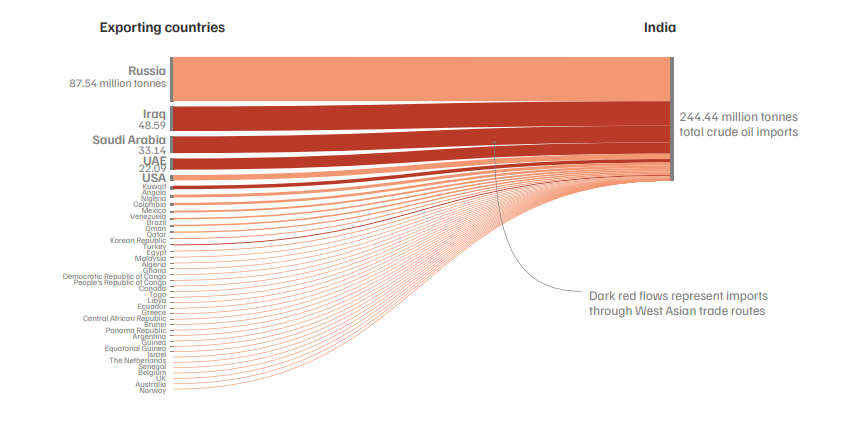
India’s crude security is constrained by six-supplier concentration and refinery inflexibility. More than 85 per cent of India’s crude oil comes from just six countries, several of which have been involved in recent conflicts, including Russia and several Middle Eastern nations. Indian refineries are also built to process specific grades of crude, so switching suppliers quickly is not easy. This narrows India’s options during a supply shock.
India’s coal and gas supply chains are vulnerable to import concentration and geopolitical chokepoints. India has large coal reserves at home, but it still imports high-quality coking coal needed for steel, mainly from Australia. Imports of non-coking thermal coal also depend heavily on Indonesia’s export policies, while domestic coal allocation rules limit access for nonpower industries such as steel and cement. India’s gas supply is similarly exposed to a concentrated set of LNG suppliers, led by Qatar and the USA. Most LNG cargoes pass through narrow maritime routes that can be disrupted during geopolitical conflicts, as seen in the Strait of Hormuz. Long-term LNG contracts provide price stability but reduce flexibility to redirect cargoes during emergencies.
India’s fuel buffers are too thin for a major disruption: oil reserves cover only 9 to 10 days, and gas needs strategic storage - India’s strategic petroleum reserves hold enough crude oil for just 9 to 10 days of net imports. Another 64 days of cover comes from operational stocks at refineries. Japan, by comparison, holds around 200 days and South Korea around 207 days. For natural gas, India currently does not maintain dedicated strategic storage, even though it imports nearly half of its gas. LNG import terminals and pipelines are underused, and fertiliser plants and city gas distribution networks have little cushion if imports are interrupted.
India’s coal supply is growing in volume but weakening in quality. The quality of India’s domestic coal is declining. The energy content of coal (gross calorific value) is falling, more rock has to be moved to extract each tonne (rising stripping ratios2 ), and most mining now happens in open pits. This raises questions about how long domestic coal can reliably meet demand.
Gas may not remain an affordable transition fuel if city gas and fertiliser become more LNG-dependent. Natural gas is often promoted as a cleaner bridge fuel, but its prices are volatile. Domestic gas production has stagnated while LNG imports have doubled. When global LNG prices spiked in 2022 to 2023, India’s fertiliser subsidy bill rose sharply. Our analysis shows that if the share of imported LNG in city gas networks rises from 15 per cent to 50 per cent, compressed natural gas (CNG) prices for vehicles could go up by 15 to 17 per cent during periods of high global prices.
India’s oil price stability depends heavily on discounted Russian crude. India avoided the worst of the 2022 to 2025 global oil price shocks largely because it bought discounted Russian crude. This is a short-term advantage that depends on geopolitics, not a structural fix. If India had to buy oil at full market prices, petrol and diesel costs would rise significantly, pushing up inflation across the economy.
Coal is losing its traditional cost advantage as mining and imports become more expensive. Mining domestic coal is getting more expensive, and imported coking coal prices are volatile, raising costs for power and steel. Coal’s traditional cost advantage is also weakening as renewable energy paired with storage becomes cheaper.
Clean energy is becoming India’s energy-security hedge, but critical minerals are the next strategic dependence. Unlike fossil fuels, where the energy vectors themselves must be continuously imported and transported, renewable energy systems rely on domestically available energy vectors once capacity is installed, reducing exposure to fuel import dependence, geopolitical disruptions, and global fuel price volatility. While some dependence on imported technologies and industrial inputs may persist, this is fundamentally different from fossil fuels, where import dependence persists throughout the life of the energy system.
Overall, our findings suggest that India’s energy security challenge is no longer just about securing enough fuel. It is about building a more resilient system that can withstand geopolitical disruptions, price shocks, and long-term structural changes in global energy markets.
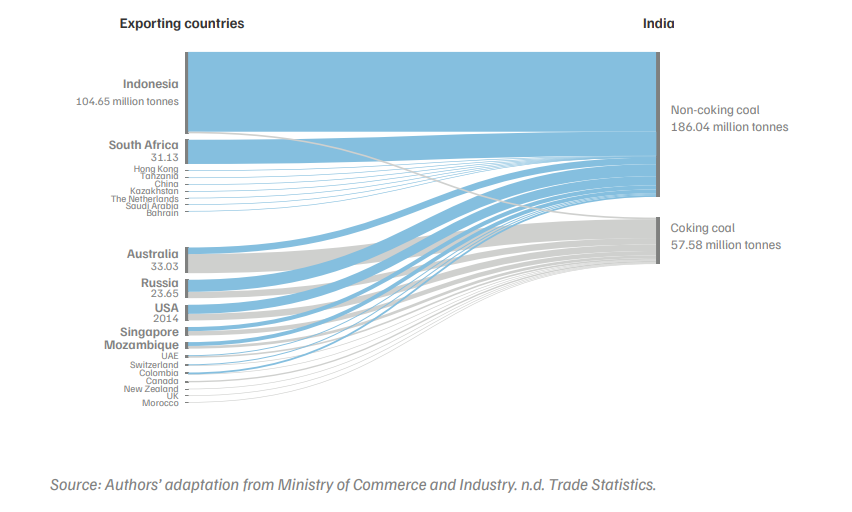
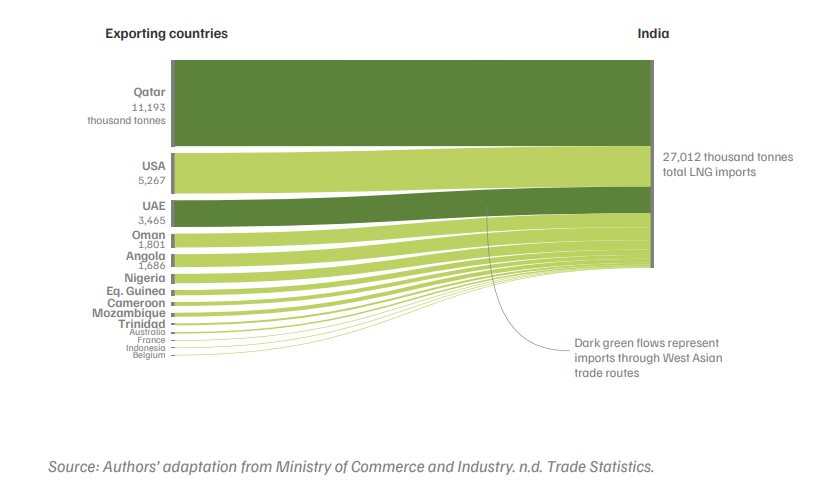
Figure ES1. India is highly dependent on imports from a concentrated group of geopolitically volatile regions
Coal imports
Crude oil imports
Natural gas imports
The findings provide a strong impetus to manage the risks of fossil energy dependence while hastening the transition to indigenous clean energy alternatives. Based on our analysis, we recommend the following measures to bolster India’s energy security.
Recommended immediate interventions
Diversify supply sources and contract structures
Align infrastructure with future demand trajectories
Strengthen the domestic energy production base
Accelerate demand-side substitution
By treating the energy transition as a national security imperative rather than only an environmental objective, India can reduce exposure to global fuel and technology shocks, strengthen system-wide resilience, and build a more self-reliant and stable economic engine.
Global energy markets have faced heightened volatility in recent years (2020 onwards) due to geopolitical shocks and supply disruptions, underscoring the strategic importance of energy security. The Russia–Ukraine conflict has highlighted Europe’s reliance on imported gas, forcing countries to seek alternative energy sources and exposing weaknesses in existing energy supply chains (IEA n.d.). Indonesia’s temporary ban (January 2022) on thermal coal led to sudden price hikes across Asian markets (Russell 2022). Similar dynamics have been observed in the case of sanctions on Iran and Venezuela – both major oil producers – and coordinated production decisions by oil-exporting countries. As of early 2026, escalating tensions in West Asia and attacks on energy infrastructure and shipping routes have renewed concerns over supply disruptions and maritime security in key energy corridors. The Strait of Hormuz alone handles roughly one-fifth of global oil trade and a significant share of global LNG flows, making it one of the world’s critical energy chokepoints (IEA 2026). These events demonstrate that energy security is not an abstract concept; it directly impacts economic stability, inflation, and individual livelihoods.
For India, the world’s third-largest energy consumer, these global pressures intensify an already acute domestic challenge. Rapid economic growth and rising incomes are driving energy demand upward while domestic energy production lags. India relies heavily on imports to meet its energy needs: nearly 88 per cent of its crude oil, 48 per cent of its natural gas, and 26 per cent of its coal are imported (Sharma 2024). A large share of these imports originates in or transits through West Asia, particularly via the Strait of Hormuz, including roughly 50–60 per cent of crude oil, 56 per cent of LNG, and 80– 85 per cent of LPG (Biswas 2026). As a result, geopolitical tensions in the region can affect India directly – through higher import costs, increased shipping and insurance premiums, and broader macroeconomic pressures such as inflation and current account stress. Energy security in India is therefore a pressing policy issue, cutting across economics, foreign policy, and long-term energy transition goals.
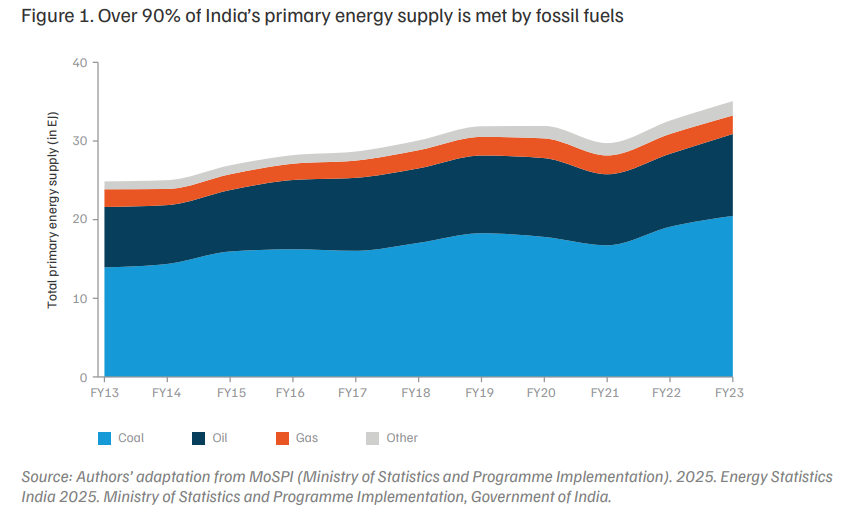
India’s primary energy demands are dominated by coal and oil. In 2022–23, coal constituted the largest share of India’s total energy supply (over 58 per cent), followed by crude oil (29 per cent). Natural gas still accounts for a fraction of India’s total energy supply (7 per cent), while renewables, hydropower, nuclear power, and biofuels constitute the remainder. Overall, fossil fuels still account for roughly 93 per cent of India’s total primary energy supply (MoSPI 2025).
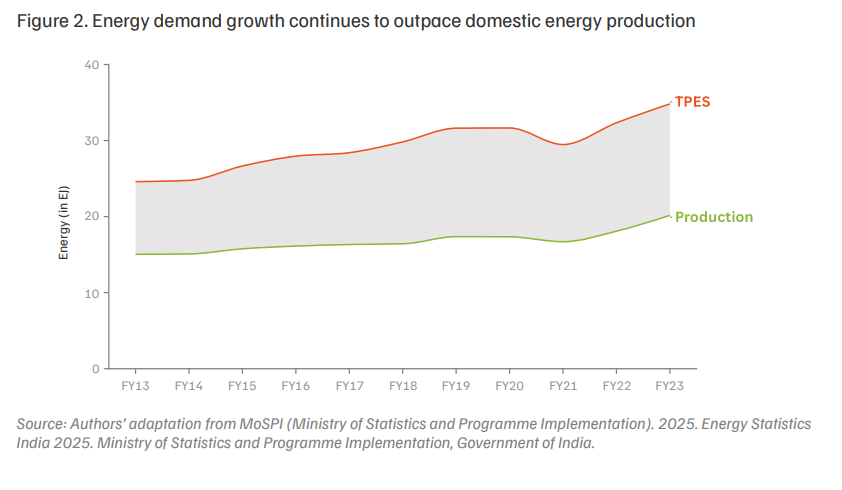
Figure 2 captures the growing mismatch between India’s energy demand and domestic supply since 2012–13. While domestic energy production has increased only gradually, total primary energy supply (TPES) has grown more rapidly, leading to a sustained rise in energy imports. Energy exports have remained stable at around 2–3 exajoules (EJ) over the period, whereas imports increased by about 46 per cent, from 12.4 EJ in 2012–13 to 18.1 EJ in 2022–23 (Figure A1). This widening gap between demand and supply leaves India increasingly reliant on external sources, with direct implications for energy affordability and macroeconomic stability.
In this policy brief, we assess India’s energy security using a three-pillar framework – accessibility, reliability, and affordability – to evaluate the resilience of the country’s three primary energy vectors: coal, oil, and natural gas.
Established international approaches treat energy security as a multidimensional concept, encompassing secure access to energy resources, reliability and resilience of supply systems, and economic affordability for consumers and industry.
Institutions such as the Asia Pacific Energy Research Centre (APERC) and the International Energy Agency (IEA), place similar emphasis on these dimensions when assessing national energy systems (APERC 2007; IEA 2014). APERC’s 2007 assessment of energy security in the Asia-Pacific region structured its analysis around the availability, accessibility, affordability, and acceptability of energy resources. The IEA’s 2014 energy supply security framework evaluated the emergency response capacity of member countries across dimensions of supply diversity, infrastructure resilience, and price stability. Kruyt et al. (2009) reviewed over thirty indicators of energy security and found that most could be mapped onto dimensions of availability-accessibility, affordability, and efficiency-sustainability. A related but distinct framework is the ‘energy trilemma’ used by the World Energy Council, which includes environmental sustainability as a third dimension alongside energy security and energy equity (World Energy Council 2023).
Based on these assessments, we apply a three-pillar framework to assess the security of India’s coal, oil, and gas sectors. We define the pillars as follows:
• Accessibility refers to India’s ability to obtain energy – from domestic or international sources – in the required grade, quantity, and form. It concerns domestic allocation rules, trade policy, import dependence, export restrictions, and supplier concentration.
• Reliability refers to the stability and continuity of energy flows once the energy is accessed. It concerns production stability, infrastructure adequacy, storage buffers, maritime security, and exposure to geopolitical disruptions that may interrupt supply.
• Affordability concerns the cost and price stability of energy, including exposure to global price swings and implications for consumers, industry, and public finances.
We have defined the three pillars to be analytically distinct, even though real-world interactions exist between them. A fuel may be accessible but unreliable (e.g., imported LNG during a Strait of Hormuz disruption); reliable but unaffordable (e.g., long-term contracted gas during a price spike); or affordable but inaccessible (e.g., cheap coal that cannot reach non-power industries due to allocation constraints). Such strategic trade-offs between these dimensions are discussed in Section 3.
We do not consider sustainability as a fourth pillar as the purpose of this brief is to assess the security vulnerabilities of India’s existing fossil fuel system and present a case for a sustainable energy transition that is mandated by security needs and not solely by sustainability objectives. We therefore treat environmental sustainability as the most optimal outcome of energy security interventions. A separate assessment of transition risks, including critical mineral dependencies, clean energy supply chain vulnerabilities, and the fiscal implications of fossil fuel revenue loss, would be a necessary complement to this work and is flagged as an area for further research.
2.1 Accessibility
Coal: Allocation constraints and external dependence
Coal accounts for around 58 per cent5 of India’s total primary energy supply (MoSPI 2025) and over 73 per cent of its electricity generation mix (CEA 2024). India’s dependence on coal is driven by its vast domestic reserves – about 389 billion tonnes as of April 2024. This enormous resource base is a key pillar of the country’s energy security.
However, the availability of reserves does not translate directly into an accessible, optimal supply of coal. Access depends on domestic allocation patterns and external sourcing. In 2023–24, India produced 997.8 million tonnes (Mt) of coal and 43 Mt of lignite, while importing 264.5 Mt of coal – roughly one-fifth of total consumption (Figure A2). Imports were led by non-coking coal (205.7 Mt) for power and industrial use and coking coal (58.8 Mt) for steel production, highlighting the persistent challenges in achieving both the volume and grade required for self-sufficiency (CCO 2024).
Lignite and non-coking coal
Domestic non-coking coal is mostly allocated to public power utilities, leaving non-power industries in coastal and western regions dependent on imports despite rising inland production. This has constrained coal access for sectors such as cement, steel, and small-scale captive power producers, which often face higher costs or are compelled to rely on imported fuel.
Policy reforms under the Coal Mines (Special Provisions) Act, 2015 and the Mines and Minerals (Amendment) Act, 2020 aimed to ease these constraints by allowing captive mining and removing end-use restrictions. While non-Coal India Limited (CIL) and Singareni Collieries Company Limited (SCCL) opencast production more than doubled from 68 Mt in 2020–21 to 152 Mt in 2023–24, over half of the allocated mines (64 out of 121) remain non-operational. As a result, import dependence persists even for non-coking coal (Figure A2) (CCO 2024).
Domestic non-coking coal is mostly allocated to public power utilities, leaving non-power industries in coastal and western regions dependent on imports.
Lignite production in India, concentrated mainly in Tamil Nadu and partly in Gujarat and Rajasthan, provides localised fuel security but remains constrained by low gross calorific value (around 2,460–2,970 kcal/kg), high moisture content, and transport limitations. These factors limit its role as a regional fuel. Consequently, lignite’s contribution to India’s overall energy mix remains low (NLC n.d.).
Even as the share of imported non-coking coal has declined, India still imported over 180 Mt in FY2022–23 (CCO 2024), largely from Indonesia and South Africa. Non-coking coal imports are particularly exposed to fluctuations in Indonesian policies, including export restrictions, price caps, and market interventions that periodically disrupt global supply. Such volatility affects India’s coastal power plants and cement industries, which depend on imported coal for blending and quality consistency. As a result, supply security remains contingent on policy decisions outside India’s control.
For example, under its Just Energy Transition Partnership (JETP) commitments, Indonesia has pledged to accelerate power-sector decarbonisation, including through the early retirement of coal-fired power plants and a rapid scale-up of clean energy (JETP 2022). Over time, this could alter domestic coal demand in Indonesia and weaken the long-term economic viability of coal production and export-oriented investments.
Coking coal
Coking coal, critical for India’s steel sector, remains highly import-dependent. Over the past decade, coking coal imports have grown steadily, increasing from 43.7 Mt in 2014–15 to 58.8 Mt in 2023–24, representing an overall rise of approximately 35 per cent (CCO 2024). Raw coking coal production remains limited, at approximately 67 Mt in 2023–24, leaving India heavily dependent on imports to meet its metallurgical coal demand.
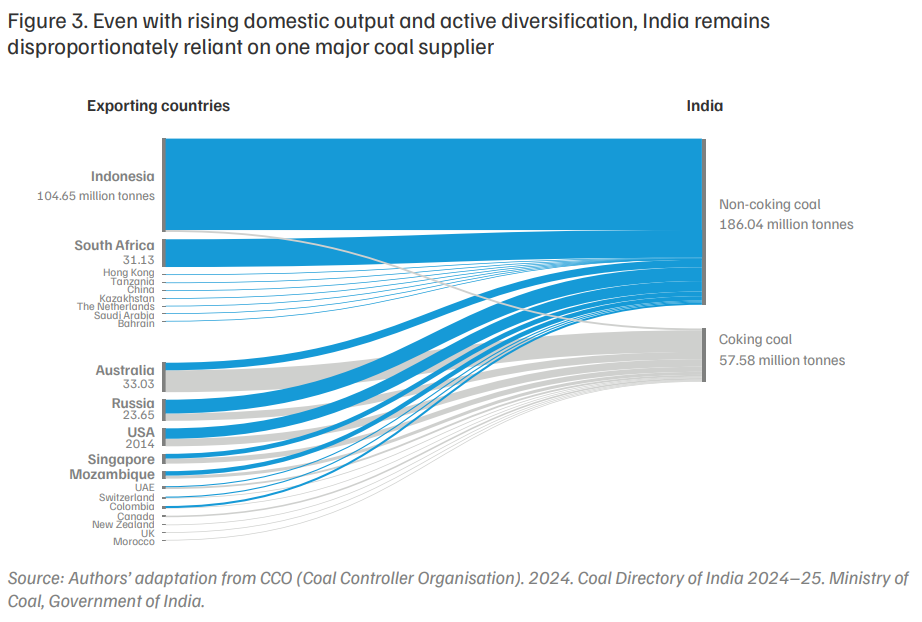
As shown in Figure 3, Australia continues to dominate India’s coking coal imports for the steel industry, although diversification towards Russia, the US, Canada, and Mozambique have accelerated since 2021. However, the limited number of suppliers globally and the technical specificity6 of coking coal make such diversification challenging.
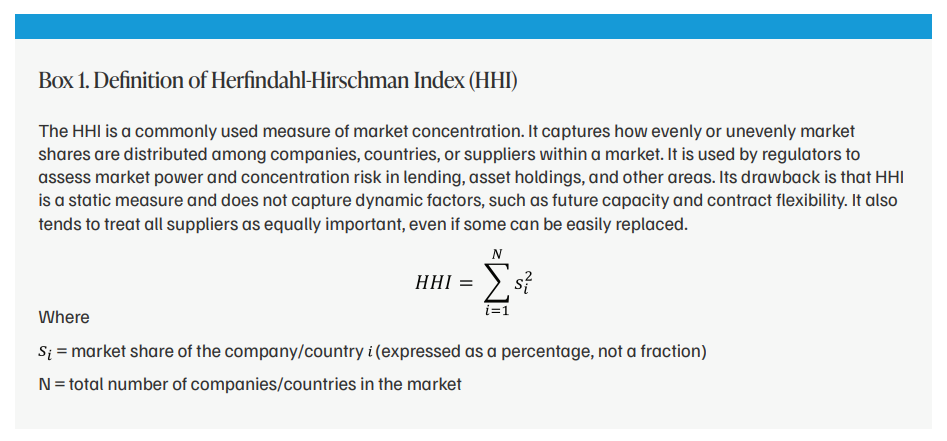
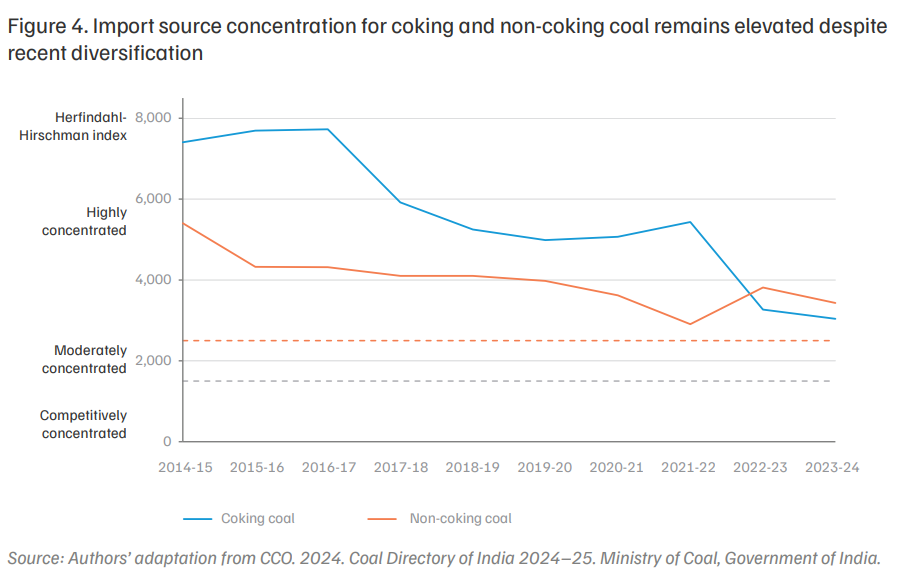
Trade concentration indicators, shown in Figure 4, show these vulnerabilities. The Herfindahl–Hirschman Index (HHI), a standard measure of market concentration, has declined in recent years for both coking and non-coking coal imports, reflecting moderate diversification. Coking coal’s HHI fell from above 6,000 in 2014–15 to 2,500– 3,000 in 2023–24, while non-coking coal’s concentration decreased from 5,400 in 2014–15 to 3,400 in 2023–24. Despite this convergence, coking coal remains a greater strategic risk: its sources are fewer, substitution options are limited, and nearly 50 per cent of total metallurgical demand is met by imports.
In Australia, which is India’s largest supplier of coking coal, rigid regulations and increasing legal scrutiny are slowing the development of new projects. In Queensland, stricter environmental approvals, frequent legal challenges, and local opposition have made it slower and more challenging to bring new coal mines online. Changes to the state’s coal royalty regime have also affected investment decisions, with BHP (originally Broken Hill Proprietary Company, now known as BHP Group Limited) citing the tax increase when pausing further investment in its Queensland metallurgical coal operations (QRC 2023). At the same time, court decisions are playing a larger role in shaping access, as seen in the Waratah Coal Pty Ltd v. Youth Verdict Ltd & Ors case, in which a mining lease was recommended for refusal on climate and human-rights grounds (QHRC 2023).
The prolonged and contested development of Adani’s Carmichael thermal coal project further illustrates how domestic political, legal, and social dynamics in exporting countries can delay, scale back, or complicate access to coal exports, even when reserves and export infrastructure are available.
Takeaway: India’s coal accessibility challenge is not one of reserve scarcity but of quality mismatch, allocation constraints, and concentrated external dependence. Nonpower industries and the steel sector remain structurally exposed to import risk, while supplier concentration and export-country policy shifts add further vulnerability
Oil: Structural import dependence and constrained sourcing
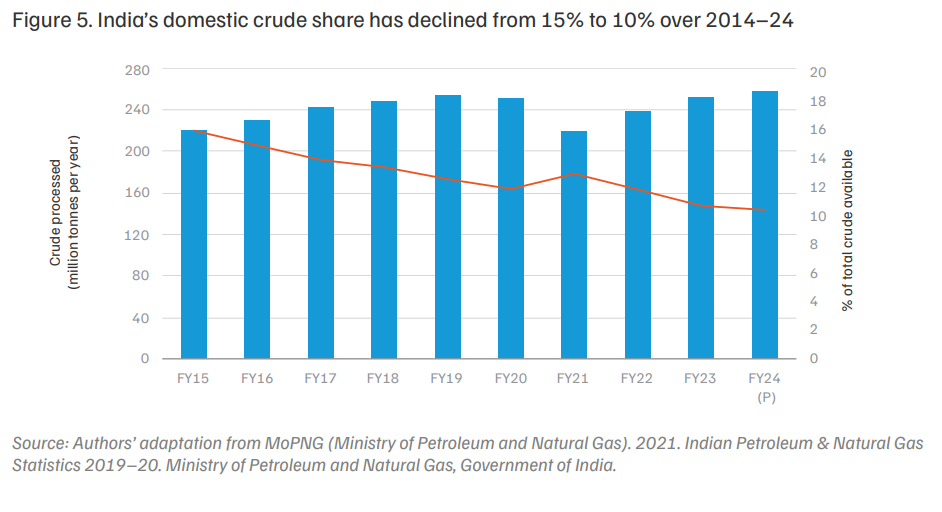
India is the third-largest consumer of crude oil globally, with domestic production meeting only 12–13 per cent of its demand of over 250 Mt each year (MoPNG 2025). In 2023–24, over 87 per cent of India’s crude oil consumption was met through imports, reflecting a steady rise in import dependence from 70 per cent in the early 2000s to 85–90 per cent in recent years (MoPNG 2025; MoPNG 2021; Sharma 2024). This widening gap reflects a sustained decline in output from India’s mature producing basins. The Mumbai High and Assam fields, which historically anchored domestic production, have entered a natural decline, with limited scope for recovery under current investment levels. Frontier basins, including deepwater blocks in the Krishna–Godavari (KG) Basin and the Andaman offshore, have yielded few commercially viable discoveries despite successive licensing rounds under the New Exploration Licensing Policy (NELP) and Open Acreage Licensing Policy (OALP). As a result, domestic output has stagnated at approximately 29–30 Mt per annum over the past decade, even as consumption has risen sharply (Mohanty 2025, ScanX 2025, IEA 2024).
The transport sector accounts for a large share of oil consumption. The primary driver of petroleum product consumption is the demand from the road, aviation and shipping industries for petrol, diesel, jet fuel, and fuel oil. Other sectors – such as refining (where some oil is consumed for internal energy requirements), industry, and power – consume smaller volumes. Fuel demand in road transport alone is projected to grow from 140 billion litres in 2023 to 218 billion litres by 2045, further reinforcing India’s reliance on imported crude to meet future demand (Mohan, et al. 2025).
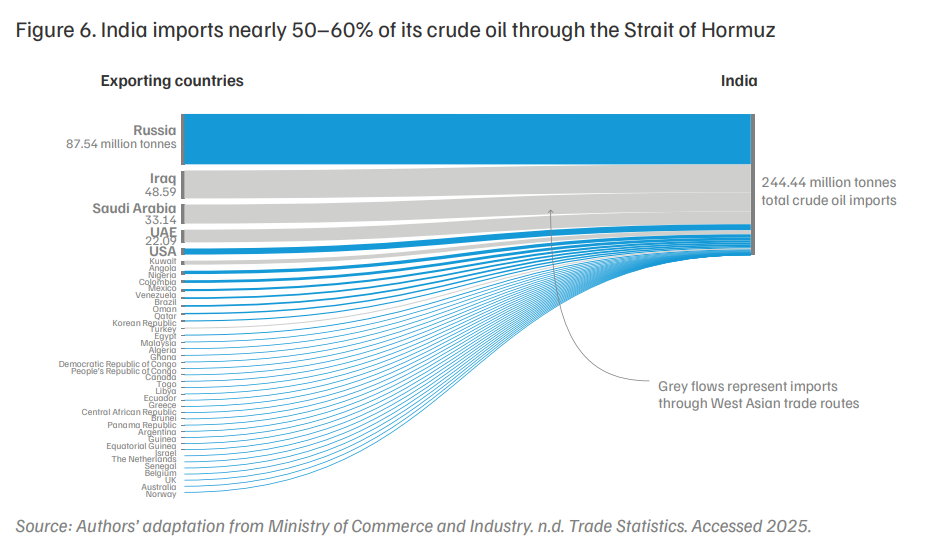
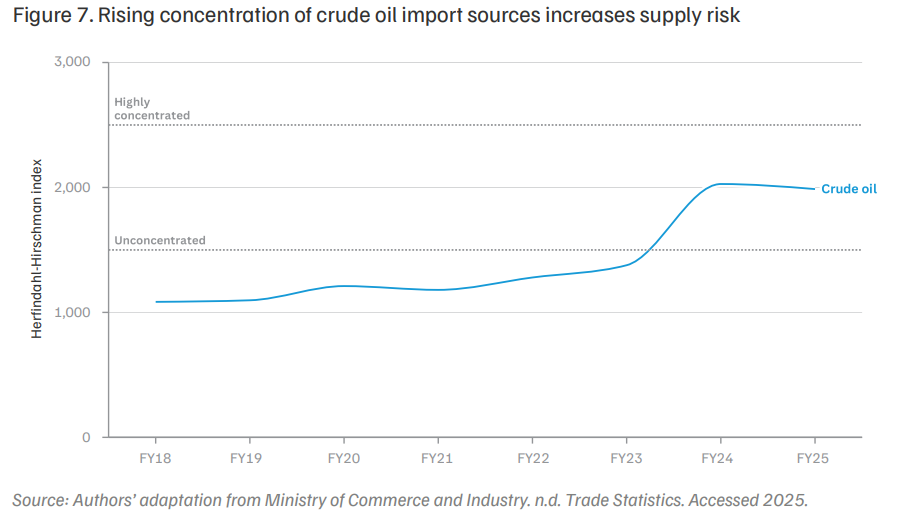
This heavy import dependence raises questions about how diverse and flexible India’s supply sources truly are. India’s crude oil import basket is moderately concentrated, reflected by its HHI index of 1,988. This suggests a meaningful reliance on a limited group of suppliers, though not an extreme level of concentration. In 2024–25, India sourced more than 85 per cent of its crude from a narrow base of just six suppliers. Refinery configuration further constrains diversification. Out of roughly 250 crude grades traded globally, Indian refineries typically purchase only about 50 each year (Lok Sabha Committee 2023). Crude purchasing decisions are shaped by refinery configuration, seasonal demand patterns, price considerations, and operational constraints. Many vintage refineries face technical limitations in processing a broader range of crudes, restricting the set of grades that can be run economically and safely. This limits India’s effective set of choices in global markets and reduces its ability to switch suppliers or grades quickly.
Global investment patterns also influence India’s longterm access to oil supplies. According to the IEA, the West Asia region accounts for roughly USD 130 billion of global upstream investment (around one-fifth of total spending). At the same time, state-owned companies are responsible for an increasing share of global upstream investment, indicating that future oil supply growth will likely depend more heavily on national producers in the region. This concentration of investment and production capacity heightens the strategic importance of West Asia for oil-importing economies such as India.
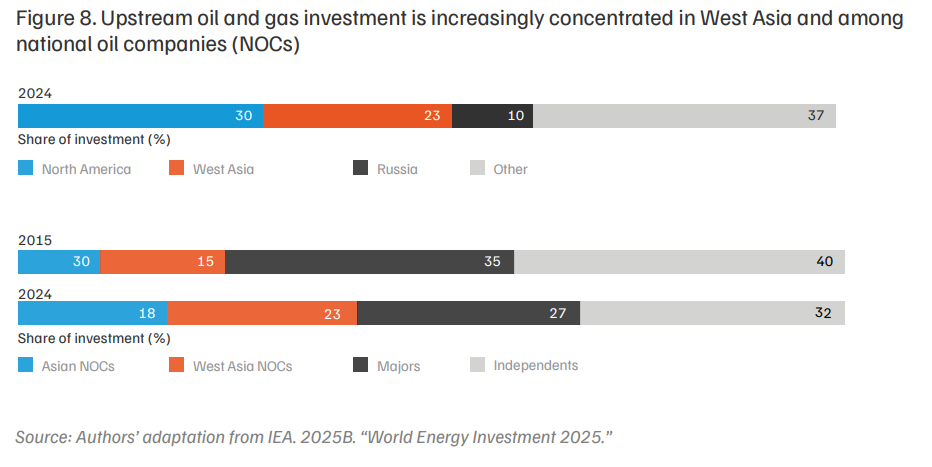
Competition for medium-to-heavy-grade crude oil within Asia further shapes accessibility. India sources much of this grade from Russia, Saudi Arabia, Iraq, and the UAE. The same suppliers serve China, Japan, South Korea, Thailand, and other Asian economies, which have similarly complex refining systems. For instance, Iraq and Saudi Arabia channel most of their exports (72 and 75 per cent, respectively) to Asian markets, where China alone commands a dominant share (Energy Information Administration 2025b, EIA 2024). Any disruption in supply flows from a major producer would therefore force India into intensified competition in an already crowded market
This structural import dependence extends beyond crude oil to refined products such as LPG, which serves as the primary fuel for over 330 million domestic consumers (PIB 2024). LPG import dependence has risen from about 45 per cent in FY2014–15 to over 58 per cent in FY2023–24. The West Asia region accounts for 92 per cent of LPG imports, as shown in Figure A4 in the Annexure. This growing dependence reflects commercial incentives rather than capacity constraints. Indian refineries are optimised to maximise yields of high-value distillates such as petrol, diesel, and aviation turbine fuel, which command significantly higher margins than LPG and are also exported in large quantities. Since LPG is a subsidised product, refiners are disincentivised to increase LPG output at the expense of more profitable products. As a result, despite substantial refining overcapacity, domestic LPG production has remained relatively stagnant, with the shortfall met through imports from West Asia, at a significant strategic cost.
Takeaway: India’s oil accessibility is defined by deep structural import dependence, moderate supplier concentration, limited crude-grade flexibility, competition for medium- to heavy-grade crude in Asian markets, and significant reliance on LPG imports. At the same time, a growing share of global upstream investment is concentrated in West Asia and among state-owned producers, linking future supply availability more closely to developments in the region. While structural sourcing options exist, India’s ability to switch quickly across suppliers or crude grades remains constrained.
Gas: Hedging against short-term risks
The Government of India (GoI) has set a target for 15 per cent penetration of natural gas in the primary energy mix by 2030 (PIB 2023b). However, overall gas output has struggled to grow due to declining production from mature fields and limited new upstream discoveries. Imports of LNG now account for nearly half of India’s total gas supply, doubling from 17 billion cubic metres (bcm) in 2012–13 to 36 bcm in 2024–25 (PPAC 2025). Given the supplier concentration and contracting constraints documented in this section, achieving the target without significantly amplifying India’s import exposure appears unlikely.
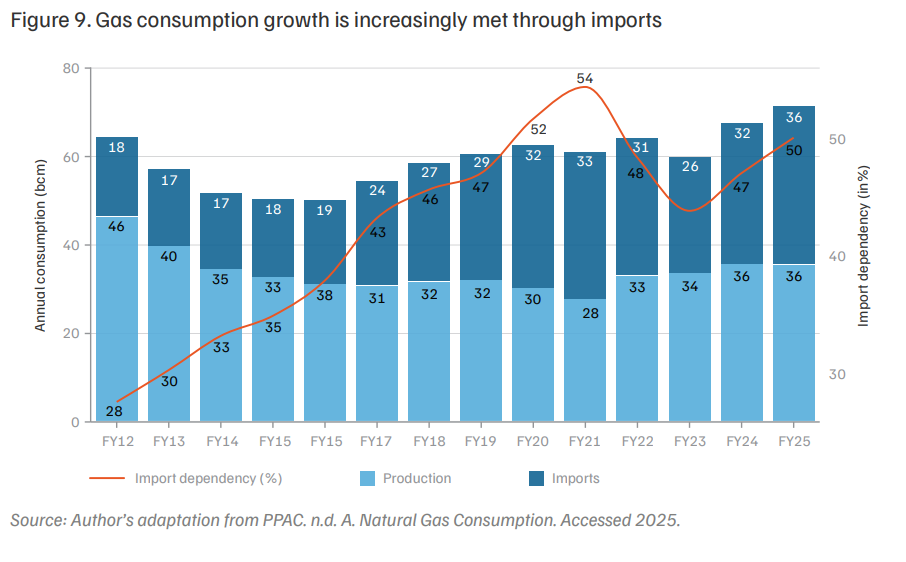
India’s LNG import portfolio remains heavily tilted towards a handful of suppliers. Qatar alone accounts for 41 per cent of India’s LNG imports, followed by the US (19 per cent) and the UAE (13 per cent). The other suppliers, such as Angola, Mozambique, Nigeria, Oman, and Australia, contribute smaller shares (Ministry of Commerce and Industry n.d.).
The HHI index for India’s LNG imports stood at 2,381 in 2024–25, indicating a moderately concentrated supply base. This is notably higher than India’s crude oil import HHI (1,988), suggesting that LNG sourcing is more concentrated than oil sourcing. While this is not as risky as a highly concentrated structure, this highlights that India’s gas security is still dependent on a few major exporters.
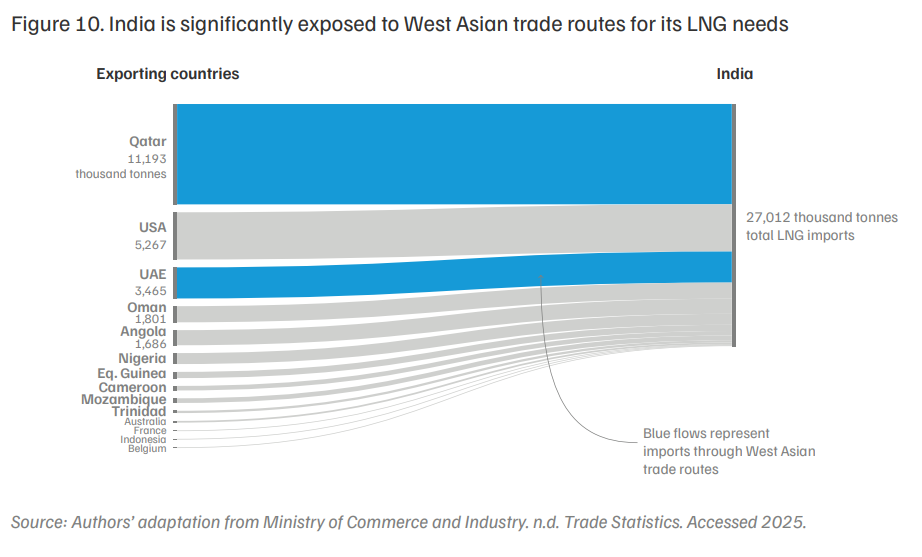
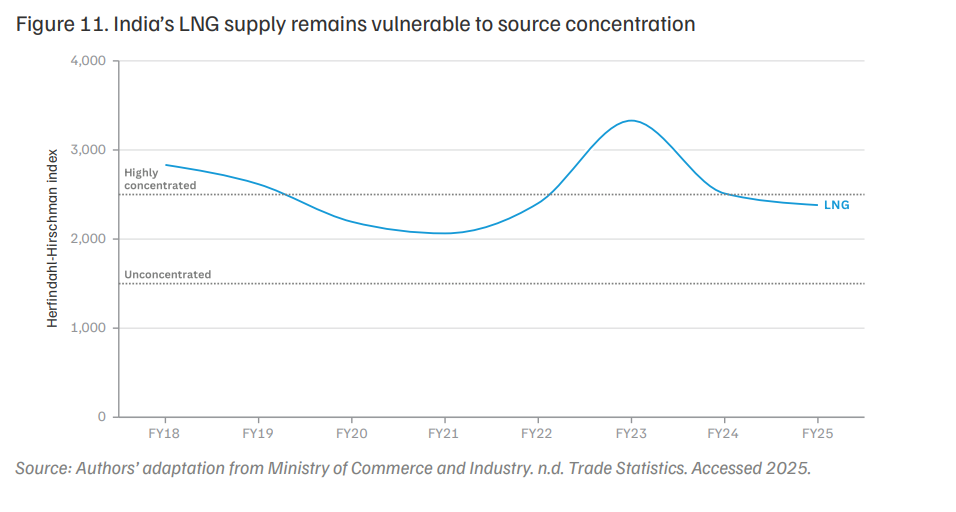
Figure A6 illustrates India’s LNG imports by source alongside the share of spot LNG purchases. Spot LNG purchases have declined to roughly one-third of total LNG imports, reflecting a conscious policy decision to secure more long-term contracts and to reduce exposure to volatile global LNG prices (Pande 2025). New deals – such as GAIL–QatarEnergy and BPCL–ADNOC Trading – with five-year or longer tenures are evidence of this shift (Press Trust of India 2025, Offshore Technology 2024).
Global LNG oversupply expected by 2030 creates an opportunity for India to leverage its scale to secure base load contracts while negotiating flexible pricing and narrower price bands.
At the same time, an emerging counterpoint is also apparent: global LNG markets are expected to move towards oversupply, with significant new export capacity coming online, especially in the US and Qatar, and many existing projects having uncontracted volumes (Figure A7). While overall LNG demand is expected to continue rising, growth is increasingly concentrated in specific regions, particularly in Asia, as several advanced economies slow or stabilise their gas consumption as part of broader energy transitions. This evolving supply– demand balance could lead to lower spot prices in the coming years (Runciman 2024). For a large importer such as India, this creates an opportunity to improve accessibility by leveraging its scale to secure long-term contracts that ensure base supply while seeking more favourable and flexible pricing mechanisms, including narrower price bands. Such arrangements can provide suppliers with demand certainty while improving India’s ability to access LNG on predictable and competitive terms amid shifting regional market dynamics.
India’s LNG contracting strategy reflects a careful balancing act between security and flexibility. Long-term contracts, such as Petronet’s 7.5 Mt per annum (Mtpa) agreement with Qatar, provide stable delivered ex-ship (DES) supplies that anchor politically and economically sensitive sectors (such as fertilisers and CGD), shielding them from short-term price swings (Petronet LNG 2024).
The downside is that DES contracts limit flexibility in diversion. Free-on-board (FOB) contracts, by contrast, place shipping responsibility on the buyer but offer greater flexibility in responding to market conditions. As global LNG supply expands, India’s challenge is to secure sufficient long-term DES volumes while maintaining a meaningful share of flexible FOB and spot purchases to benefit from periods of market softness. In this context, contract structures themselves become a key tool of energy security, shaping both the resilience and adaptability of India’s LNG portfolio.
Takeaway: India’s gas accessibility is shaped by stagnating domestic production, rising LNG dependence, moderate supplier concentration, uneven sectoral import reliance, and a contracting strategy that balances long-term security with market flexibility. Physical import capacity exists, but effective access depends on utilisation, infrastructure integration, and contract design.
2.2 Reliability
Coal: Quantity expansion, quality decline
While accessibility is shaped by sourcing and allocation, reliability depends on the stability, quality, and durability of supply once coal is secured.
Coal production remains concentrated mainly by Coal India Limited (CIL) and Singareni Collieries Company Limited (SCCL). Domestic output reached a record 997.8 Mt in 2023–24, a 6.5 per cent increase from the previous year and about 37 per cent higher than in 2018–19 (CCO 2024). However, persistent gaps between annual production targets and actual PSU output indicate a persistent need for further diversification in coal mining (MoC 2026).
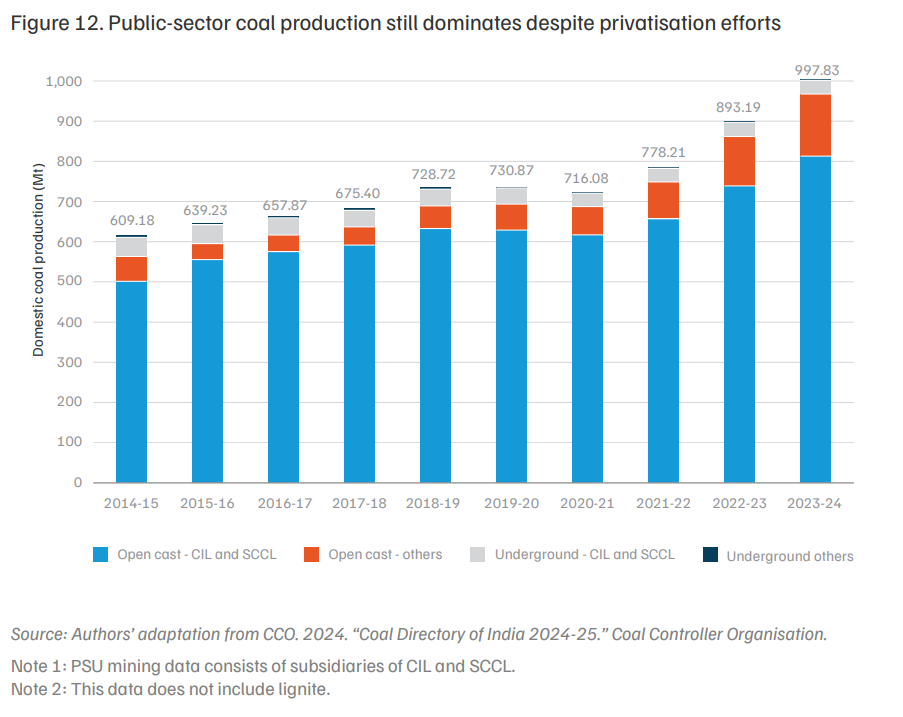
Opencast mines, which now account for almost the entire incremental output, have enabled large-scale production at competitive costs. In contrast, the share of underground mining has declined sharply from about 8 per cent in 2014–15 to just 3.4 per cent in 2023–24. While the expansion of opencast mining has strengthened short-term reliability by supporting record production levels, it has simultaneously increased environmental pressures through a rising stripping ratio and a greater share of high-ash coal in the total output, reinforcing a production mix dominated by lower gross calorific value (GCV) coal.
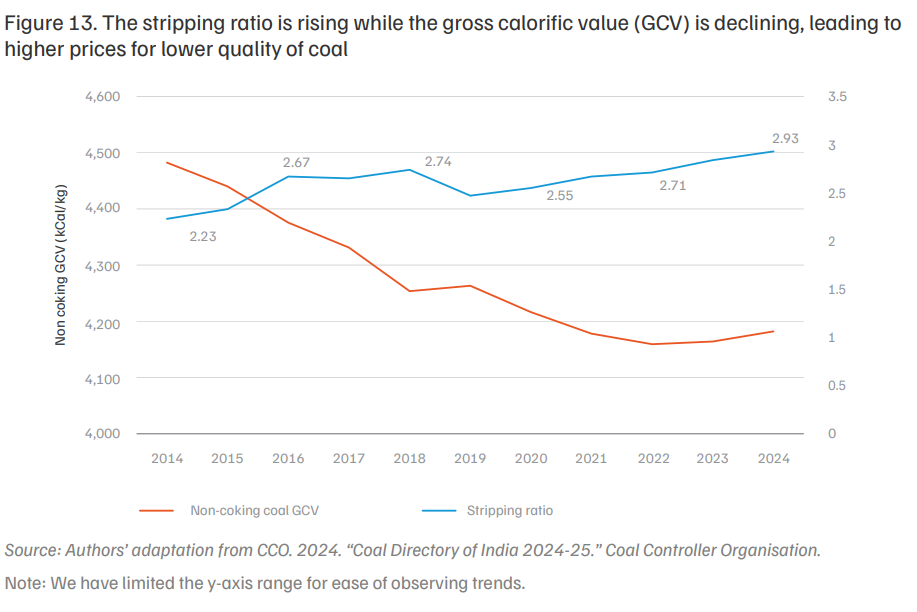
The average GCV of domestic non-coking coal fell from about 4,480 kcal/kg in 2014–15 to 4,150 kcal/kg in 2023–24, as shown in Figure 13. This decline reflects a growing dependence on shallow, high-ash seams that are easier and cheaper to mine but yield lower-quality coal. Over the same period, the stripping ratio rose from 2.23 to 2.93 (CCO 2024), implying that increasingly large volumes of earth and waste material must be displaced to access similar quantities of coal.
Meanwhile, the high ash content in domestic coking coal (often exceeding 35–40 per cent) underscores the growing need for coal washing and beneficiation to improve efficiency and reduce emissions intensity. However, the share of coal products (which includes washed coal and middling) has not increased meaningfully over time. Output of washed and beneficiated coal has stagnated at 25–30 Mt annually, well below the requirements of steel and other industrial users (PIB 2021, MoC 2024). Efforts to enhance the supply of higher-quality coal have been slow, and limited beneficiation capacity has contributed to higher emissions and reduced efficiency across end-use industries.
Takeaway: India has prioritised production growth, largely through opencast expansion, but this has come at the cost of declining fuel quality and rising stripping ratios. Without improvements in underground mining and operational efficiency, the durability of coal supply may weaken even if headline production remains high.
Oil: Geopolitical exposure and system resilience
The reliability of oil supplies is a critical challenge, given India’s structural dependence on imported crude oil for its domestic needs.
Following the collapse in oil demand due to COVID-19 and the subsequent Russia–Ukraine conflict, India’s oil import portfolio shifted significantly. Russia emerged as India’s largest crude supplier, with imports rising from less than 2 per cent in 2020–21 to over 35 per cent by 2023–24 (Ministry of Commerce and Industry n.d.). This shift enabled India to reduce its earlier dependence on four Middle Eastern suppliers – Iraq, Saudi Arabia, the UAE, and Kuwait – whose combined share in India’s crude imports fell from about 60 per cent before sanctions on Russia to 45 per cent, as of early 2026.
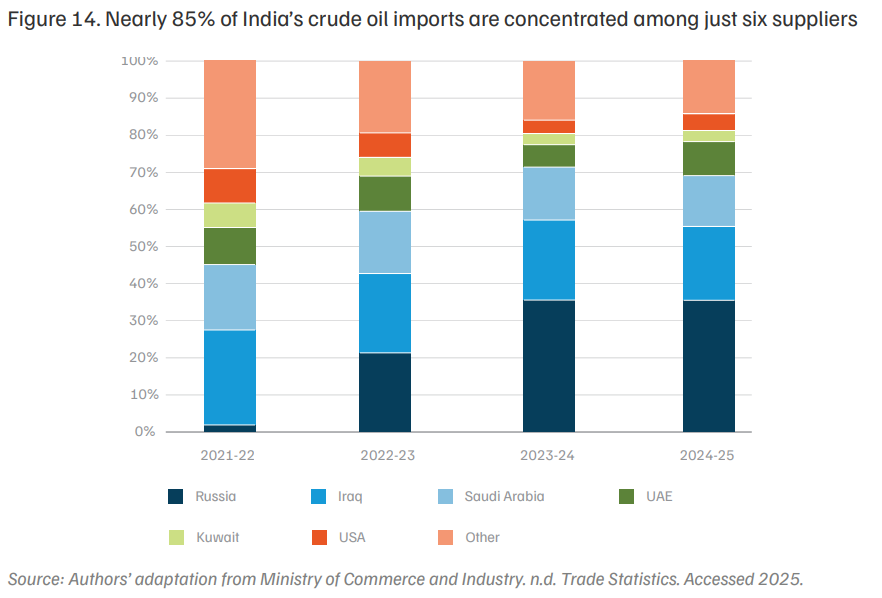
Such dependence leaves India’s supply reliability exposed to external shocks. In the event of tighter sanctions or disruptions, West Asia remains India’s fallback supplier. IEA projections show that Saudi Arabia, UAE, Iraq, and Kuwait are investing heavily in upstream capacity and natural gas liquids (NGL) production, while also maintaining significant spare production capacity (IEA 2025d). These producers could offset shocks, but India’s bargaining power depends on maintaining diversified and flexible import channels.
The structural dependence creates reliability challenges on three fronts:
• Transport-sector vulnerability: With limited substitutes for oil in road freight, aviation, and shipping, reliability issues can cascade into inflationary shocks.
• Refinery-system exposure: India’s 22 refineries – with a capacity of over 256 Mtpa and most operating above the nameplate capacity – require continuous crude inflows. Any interruption risks refinery operations and, by extension, fuel supply to consumers.
• Limited resilience buffer: Strategic petroleum reserves (SPR) cover only 9–10 days of net imports compared to the 90 days mandated for IEA members.
Other import-dependent economies provide a useful contrast. Japan maintains close to 200 days of import cover (S&P Global 2025b). Under Japan’s Oil Stockpiling Act, 1975, public stockpiling must equal at least 90 days of net oil imports, while refiners are required to maintain additional stocks equivalent to 70 days (IEA 2022A). South Korea holds approximately 207 days of reserves as a strategic buffer and further enhances reliability by investing in overseas oil fields through the Korea National Oil Corporation (KNOC), securing equity oil abroad (Kim 2024).
In comparison, India’s strategic petroleum reserves remain limited. With an existing capacity of about 5.33 Mt spread across Visakhapatnam, Mangaluru, and Padur, they provide roughly 9–10 days of net import cover. Even when commercial inventories7 held by oil marketing companies are included, the total coverage reaches 74 days – still short of the 90-day stockholding requirement (S&P Global 2025a). India plans to expand its SPR capacity by an additional 6.5 Mt by 2027. Of this, while contracts for 2.5 Mt of capacity have recently been finalised, progress on the remaining capacity has been delayed due to financing and land-acquisition challenges (PIB 2025b; IEA 2024).
India’s refining system is among the most sophisticated in the world, capable of processing a wide variety of crudes. Reliance’s Jamnagar refinery, with a Nelson Complexity Index of 21.1, is one example. However, Indian domestic crude is mostly light, and refiners rely on heavier imports to balance their slate.8 Rystad data indicate that the ideal mix is roughly 60 per cent medium-sour, 30 per cent light-sweet and 10 per cent heavy, with about half of the medium-sour requirement recently met by Russian Urals (Invezz 2025) (Figure A3). This technical alignment deepens exposure to disruptions affecting specific grades.
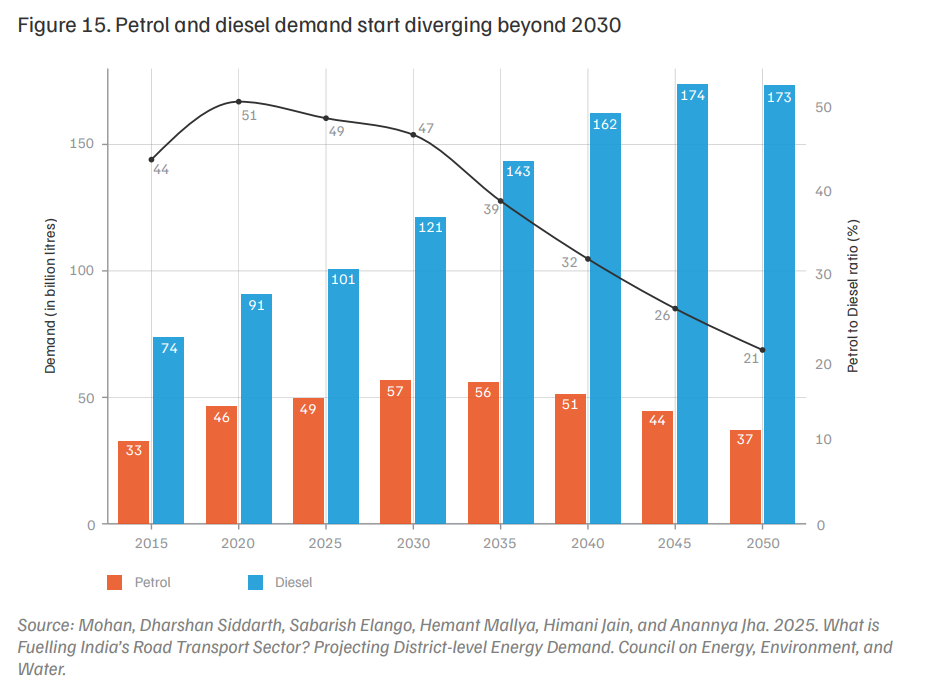
Future demand trends are expected to heighten these reliability concerns. According to a recent CEEW study, India’s domestic demand for diesel is projected to rise by more than 60 per cent and peak around 2047 (Figure 15). In contrast, petrol demand is expected to peak by 2032 and then decline by nearly 25 per cent to current levels by mid-century (Mohan, et al. 2025). Rising diesel demand will require refineries to incorporate a higher share of medium- to heavy-grade crude oil into their processing mix, sourced from a more concentrated supplier base, while declining petrol consumption could leave refineries with surplus petrol and naphtha.
Reliability is also shaped by vulnerabilities along key maritime transit routes. Nearly 20 per cent of global oil passes through the Strait of Hormuz, and the Strait of Malacca handles the bulk of Asia-bound crude shipments (Butler, Mann and Jackson 2026). Any disruption along these chokepoints, whether due to geopolitical tensions or logistical constraints, can raise costs and delays shipments to India.
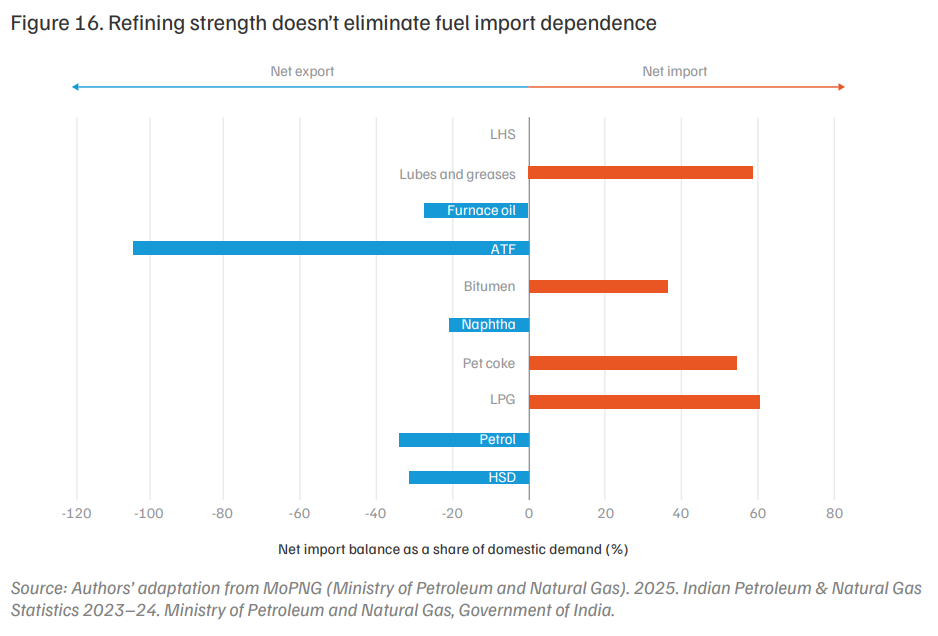
Reliability risks extend beyond transport fuels. As noted in Section 2.1, India’s LPG import dependence now exceeds 58 per cent, with 92 per cent of imports sourced from West Asia, led by Qatar (27 per cent), the UAE (26 per cent), and Saudi Arabia (19 per cent) (Powell et al. 2023). Even when LPG is procurable, the absence of productlevel strategic reserves and limited underground storage means that any disruption along West Asian supply routes could affect the availability of household cooking fuel within weeks, as witnessed during the recent crisis in Iran.
Takeaway: India’s oil reliability risks arise from concentration among geopolitically exposed suppliers, limited strategic reserves, dependence on uninterrupted crude flows for refinery operations, diesel-driven reliance on specific crude grades, exposure to maritime chokepoints, and vulnerability in LPG supply. Operational capacity is strong, but resilience to external shocks remains limited.
Gas: Infrastructure bottlenecks and storage gaps
The reliability of natural gas supply depends on a balance between domestic production, import infrastructure, and the ability to store and transport gas across regions.
Gas demand in India is concentrated among a few key end-use sectors – fertiliser (28.7 per cent), CGD (21.1 per cent), power (12.5 per cent), and refineries (8.2 per cent). Among these, CGD has emerged as the fastest-growing segment, with demand rising at a compound annual growth rate (CAGR) of 12 per cent, from 5.46 bcm in FY2016 to 15.05 bcm in FY2025 (Figure A5) (PPAC n.d. a).
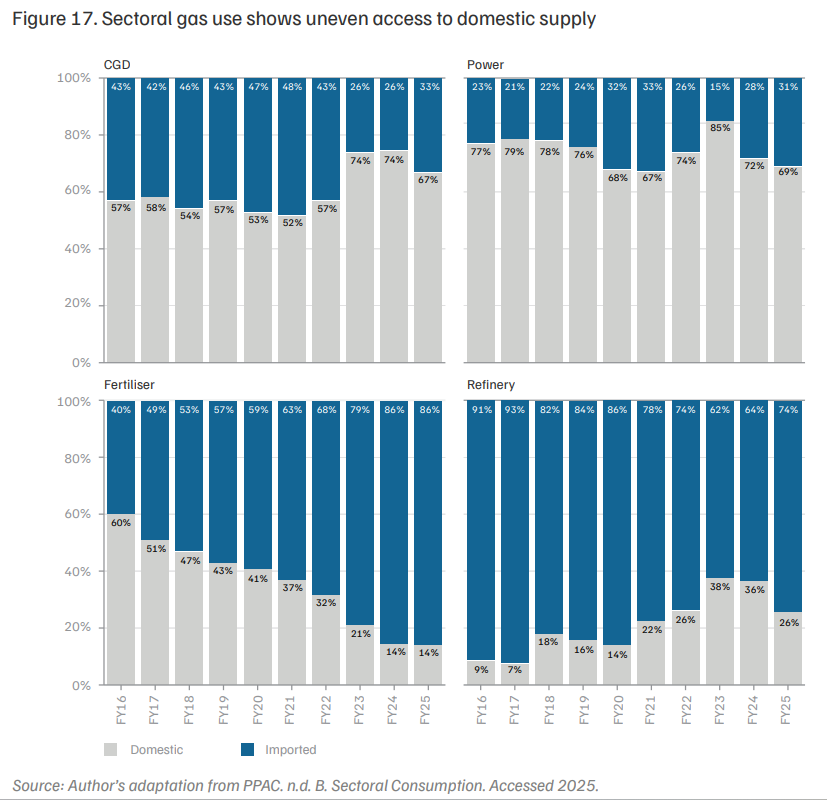
However, the composition of supply across these sectors reveals uneven import dependence (Figure 17). Fertiliser, for instance, has seen a sharp shift from 60 per cent domestic gas in 2015–16 to just 14 per cent by 2024–25, with the remaining 86 per cent met through imported LNG. Refineries also remain heavily importreliant, consistently sourcing about 60–70 per cent of their requirements from imported LNG (PPAC n.d. b). In contrast, the power sector remains anchored mainly in domestic supply, although the volumes are modest. The CGD sector exhibits a volatile mix, with import dependence fluctuating in response to global LNG prices. Notably, the government allocated more domestic gas during the price spikes of 2022 and 2023, with imported LNG accounting for only 26 per cent of supply – the lowest in the past decade (PSU Watch 2022). However, it risks increasing reliance on LNG, as CGD demand growth is unlikely to be adequately serviced by stagnating domestic gas production.
India currently operates eight onshore LNG import terminals with a combined regasification capacity of 52.7 Mtpa. Yet, their utilisation remains low, with all but one terminal operating at less than 50 per cent. This underuse reflects not only weak demand but also reliability challenges, such as inadequate pipeline connectivity, volatile LNG pricing, and terminal-specific constraints (Reynolds and Jain 2025). With LNG terminals underutilised, the capacity-weighted average utilisation rate of India’s major natural gas pipelines is also only 41 per cent (Table A1) (Reynolds and Jain 2025). While an additional 34 Mtpa of regasification capacity is at various stages of development, this persistent gap between available infrastructure and actual throughput indicates that physical capacity alone does not guarantee supply reliability. Without addressing bottlenecks concerning natural gas demand, India risks building stranded assets rather than enhancing the resilience of its natural gas system (PNGRB 2024).
Compounding this challenge is the absence of strategic gas storage. Unlike oil, for which India maintains some strategic petroleum reserves, there are currently no dedicated natural gas reserves to cushion disruptions. This leaves the country vulnerable to supply disruptions and price shocks. In contrast, European countries held around 100 bcm of storage in 2024, representing about one-third of the EU’s annual gas consumption (Directorate-General for Energy 2024). India’s stateowned GAIL (India) Ltd has outlined plans to develop 3–4 bcm of storage in depleted gas wells by 2027 (Reuters 2023). However, these remain at a preliminary stage and are modest relative to international benchmarks. Dedicated gas storage would not only improve security but also enable India to purchase and store gas during periods of low spot market prices, reducing volatility during market tightness. Until more of these facilities materialise, India’s gas system will remain fragile, limiting its reliability as a pillar of energy security.
The geopolitical dimension is increasingly central to global gas market stability, with several major LNG suppliers facing risks from sanctions, internal political shifts, export controls, or geographic vulnerabilities. The Russia–Ukraine conflict in 2022 highlighted how energy can be weaponised, with sanctions on Russian gas and the loss of pipeline flows to Europe driving LNG prices to record highs and reshaping global trade flows. The US, now the world’s largest LNG exporter, has also introduced uncertainty by pausing approvals for new export projects to non-free trade agreement (non-FTA) nations, while its Gulf Coast infrastructure remains vulnerable to extreme weather disruptions (Gardner 2024).
Qatar is considered a reliable supplier, with its North Field expansion set to significantly boost exports by 2030; however, its dependence on the Strait of Hormuz, through which nearly 20 per cent of global LNG passes, remains a strategic vulnerability (Energy Information Administration 2025a). Australia, another major supplier, faces declining legacy fields and domestic gas shortfalls, while its ambitious climate policies may affect longterm export commitments (Warner, Jeffery and Ryan 2025). In Africa, Mozambique’s vast LNG potential is stalled by insurgency-related security risks, while Nigeria continues to struggle with underinvestment and upstream disruptions (Ajala 2025). Finally, LNG shipping routes remain vulnerable, with chokepoints such as the Suez Canal and Bab el-Mandeb Strait threatened by geopolitical instability, as seen in the 2023–24 Red Sea attacks (Reuters 2024).
Takeaway: India’s gas reliability risks stem from underutilised infrastructure, the absence of strategic storage, sectoral vulnerability to imported LNG, exposure to geopolitically sensitive suppliers, and vulnerable shipping routes. Import capacity has expanded, but system resilience remains limited.
2.3 Affordability
Import dependence hurts the Indian economy most directly through affordability. Global price volatility is transmitted directly into inflation for consumers and industries.
Coal: Rising floor price
Recent fiscal and tax changes have reshaped the price structure of coal. The earlier Clean Energy Cess of INR 400 per tonne, levied uniformly across all grades, has been withdrawn, and the Goods and Services Tax (GST) on coal has been increased from 5 per cent to 18 per cent (PIB 2025a). Because the cess imposed a flat rate per tonne, it disproportionately affected cheaper, low-GCV coal. Its removal as part of the shift to a percentagebased GST has made low-grade domestic coal relatively more affordable than higher-grade and imported coal. This has improved the price competitiveness for domestic coal and marginally lowered the effective generation cost for power plants dependent on low-calorific grades (G11 being the most-produced domestic coal in India).
Rising coal prices and coking coal volatility threaten thermal power economics as solar, wind, and firm renewable energy with storage become cost-competitive at INR 4–5 per kWh.
However, this relative affordability masks broader cost trends. As Figure 18 on wholesale price index (WPI) trends shows, coal prices have increased steadily over the past decade, although at a slower rate than the overall WPI for all commodities and electricity. Imported coal prices also remain volatile and have significantly increased in certain years, with impacts reflected in coking coal prices, which showed a corresponding increase. The rising costs of coal over time therefore pose risks to thermal power prices and may create feasibility challenges for power plants without long-term contracts, as solar- and wind-based power continue to decline in cost. New coal power also faces a significant challenge from non-conventional sources, particularly with firm and dispatchable renewable energy (RE + storage), which is already available at lower prices of around INR 4–5/kWh (Grover 2025).
For example, the Rajasthan Electricity Regulatory Commission rejected a proposal by the state energy utility to build a 3.2 GW coal power plant, noting that it was not cost-justifiable compared to a similarly sized RE + storage plant. The role of coal in providing baseload stability during the energy transition remains relevant. However, the Rajasthan regulator’s decision reflects a growing recognition that the cost of system flexibility is better addressed through RE + storage configurations rather than through new thermal plants, whose fixed-cost recovery takes decades (Goyal 2025). Continuing to build coal capacity thus risks locking consumers into higher tariffs relative to the declining cost curve of renewables and adds inflexibility to the power system, which is unfavourable for higher RE penetration.
Further, as Figure 19 shows, volatility and rising coking coal imports also increase the cost of steel manufacturing in India. Given the commodity nature of steel manufacturing, higher coking coal costs hinder decarbonisation initiatives as companies prioritise cost competitiveness.
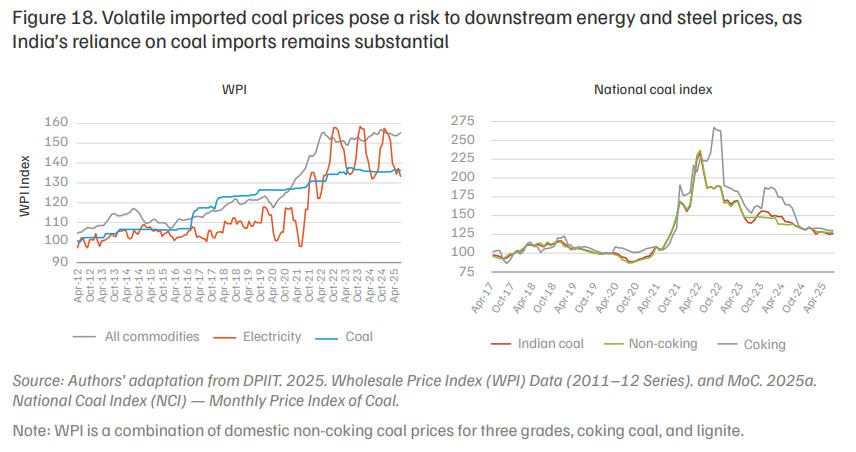
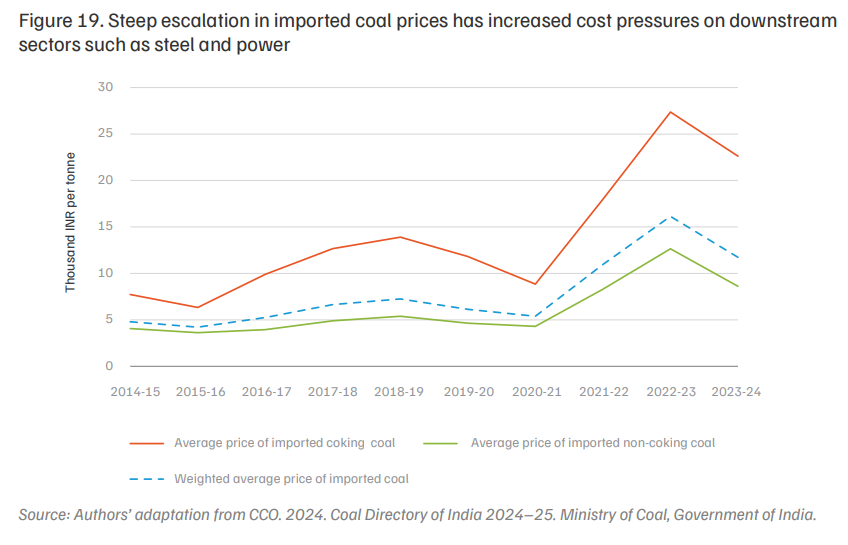
Given the shortage of viable domestic substitutes at scale, the near-linear relationship between coking coal prices and blast furnace–basic oxygen furnace (BF–BOF) steel production costs (Figure A8) implies that fluctuations in international coking coal prices are transmitted almost directly into steel costs, limiting the sector’s ability to insulate itself from external price shocks. A 10 per cent increase in coking coal prices leads to a 0.4–0.6 per cent increase in steel production costs, with a near-linear cost pass-through. This structural dependence reinforces the importance of diversification strategies and demand-side transitions, such as higher scrap utilisation.
The co-movement between the National Coal Index (NCI) for non-coking coal and electricity prices (Figure A9) reflects the continued influence of coal costs on power tariffs in India, even as the CIL and the government notify coal prices for power to contain electricity prices. The weakening of this relationship in recent years also points to a declining share of coal in electricity generation as renewable capacity expands, reducing the sensitivity of power tariffs to coal price movements over time.
Takeaway: Coal mining costs have been steadily rising even as coal quality declines, and even as tax changes temporarily improved the competitiveness of low-grade thermal variants. While domestic coal remains central to the energy mix, its long-term viability is challenged by the declining cost of RE with storage. Recent regulatory rejections of new thermal capacity indicate a shift toward avoiding high-tariff lock-ins and system inflexibility. Beyond direct costs, the economic profile of coal is further affected by volatile import prices and the financial pressure on decarbonisation efforts in major importedcoal-consuming industries, such as steel manufacturing.
Oil: Price transmission and stranded asset risk
India’s high import dependence translates into trade imbalances and inflation. Russian barrels have provided price discounts and supported refinery margins. Indian refineries have been optimised to maximise the yield of high-value distillates and capture export profitability. Diesel and petrol production now exceeds domestic demand by roughly 30 per cent and 22 per cent, respectively, with the surplus directed to export markets.
In principle, this suggests India could meet its transport fuel requirements without significant refinery capacity expansion. Yet capacity additions of nearly 50 Mtpa are already planned by 2028, representing close to USD 100 billion in oil and gas investments with an expected operational life of 30–40 years (Anand 2024, The Times Of India 2026). Given that petrol demand is projected to peak by 2032 and total transport demand may plateau before 2050, some of this new capacity could face utilisation challenges well before the end of its economic life. Without a national refinery transition plan that assesses future crude requirements across multiple demand scenarios, India risks deepening import dependence in the near term while building assets whose long-term returns are uncertain.
India’s recent management of oil affordability has relied heavily on Russian price discounts. Over the 39 months following the imposition of Western sanctions on Russian oil, India is estimated to have received an average discount of about USD 7 per barrel on Russian crude compared to non-Russian grades. On a gross basis, this translates into cumulative savings of nearly USD 12.6 billion up to June 2025, helping Indian refiners cushion inflationary pressures and stabilise the economy (Mukul 2025). A sustained shift away from discounted Russian supplies would place additional strain on India’s import expenditure.
This presents a deliberate trade-off. India has leveraged discounted Russian crude as a short-term affordability buffer. However, this opportunistic strategy should not be conflated with structural resilience. The accessibility and reliability risks associated with Russian supply concentration, documented in Sections 2.1 and 2.2, remain material: sanctions regimes may tighten, shipping and insurance constraints could intensify, and India’s bargaining position weakens if alternative buyers (particularly China) absorb a larger share of Russian exports. The policy challenge is not to forgo Russian crude, but to avoid building a supply structure that depends on its continued availability at below-market prices.
A shift to market-rate pricing for roughly 35 per cent of India’s crude basket would translate into higher petrol and diesel prices, thereby raising transport inflation and economy-wide logistics costs. In recent years, India absorbed around 1.8 million barrels per day (Mbpd) of Russian oil in a global market of about 105 Mbpd (IEA 2025c); a forced withdrawal would leave nearly 2 per cent of global supply without a major buyer, likely tightening markets. Past episodes show how such shifts can amplify volatility: for instance, OPEC+ cuts of about 1.2 Mbpd in 2017–18 pushed Brent prices up by over 70 per cent, from around USD 45 to nearly USD 80 per barrel, suggesting that a similar shock today could lift prices towards USD 100 per barrel in a tight market (Salmeron 2018).
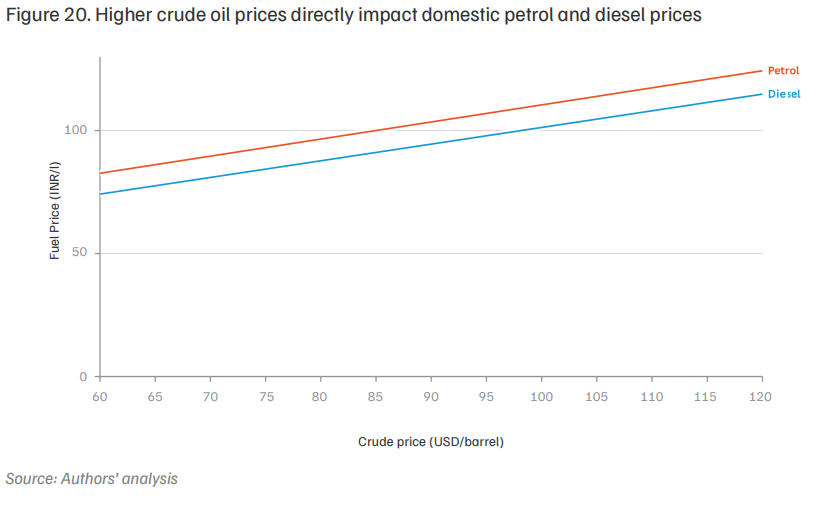
The volatility in crude oil prices directly affects India’s domestic fuel prices, as crude oil constitutes the dominant cost component of petrol and diesel. Figure 20 illustrates a clear relationship between crude prices and retail fuel prices: as crude oil prices rise, petrol and diesel prices rise almost linearly. When crude oil prices approach USD 100 per barrel, average retail petrol prices rise to around INR 105–110 per litre, while diesel prices increase to INR 95–100 per litre. Compared to current price levels, this implies an increase of around INR 15–20 per litre for both fuels.
Such increases have wide-ranging consequences for India’s transport sector. Higher diesel prices increase freight and logistics costs, which directly affect the prices of goods across the economy. Public transport systems (road, rail, and aviation) have higher operating costs, thus intensifying pressure on fares or government subsidies. For households, higher fuel prices directly raise commuting expenses and indirectly increase the cost of essential goods, reinforcing the link between oil price volatility and inflation.
Takeaway: India’s recent ability to manage oil affordability relied on access to discounted Russian crude. A shift back to market-priced supplies would expose domestic fuel prices to global oil volatility, raising transport and logistics costs across the economy. As crude prices feed quickly into petrol and diesel prices, oil affordability remains a key vulnerability for households, public transport systems, and overall inflation.
Gas: Managing price volatility
Over the years, LNG spot prices have declined following the peaks they achieved during the Russia–Ukraine conflict in 2022. Despite the declining trend in spot prices, Indian companies have been entering long-term agreements to secure stable supplies. These long-term contracts offer more predictable pricing structures, which may lead to higher costs compared to spot purchases, especially if global LNG prices decline in the future.
The Ministry of Petroleum and Natural Gas (MoPNG) facilitates the allocation of price-controlled domestic gas to price-sensitive sectors under the Administered Price Mechanism (APM), which has been fixed at USD 6.75/ MMBtu from April 2025 onwards (Rediff Money Desk 2025). In contrast, imported LNG when landed, especially during price spikes, has reached multiples of these levels, at about USD 30/MMBtu, compressing margins and increasing subsidy bills (Figure A10). In FY2022–23, the fertiliser sector consumed 79 per cent of imported LNG, and the subsidy burden rose to over USD 30.5 billion (INR 2.25 trillion) as global prices surged (Kothadiya, Mallya and Yadav 2024). Consequently, sectors such as power and industry, which lack subsidy buffers, have seen their throughput curtailed. The utilisation of India’s gas-fired plants fell below 10 per cent during the winter months of 2024–25 (Reynolds and Jain 2025).
CNG has been promoted as a cheaper, cleaner alternative to diesel. However, its affordability depends on the availability of cheap domestic gas. If domestic volumes stagnate or are prioritised for the fertiliser sector, CGD networks will be forced to blend in expensive imported LNG. If CNG rise to parity with diesel under high LNG costs, the economic case for vehicle conversion may not hold. This could stall the decarbonisation of light transport and leave fleet operators with stranded assets. Furthermore, the fertiliser sector’s reliance on expensive LNG has already created a massive fiscal burden, with the annual fertiliser subsidy bill exceeding USD 30 billion in 2022–23. This proves that imported gas is not an affordable fuel across sectors; in some cases, it requires significant state subsidies to remain viable for Indian users.
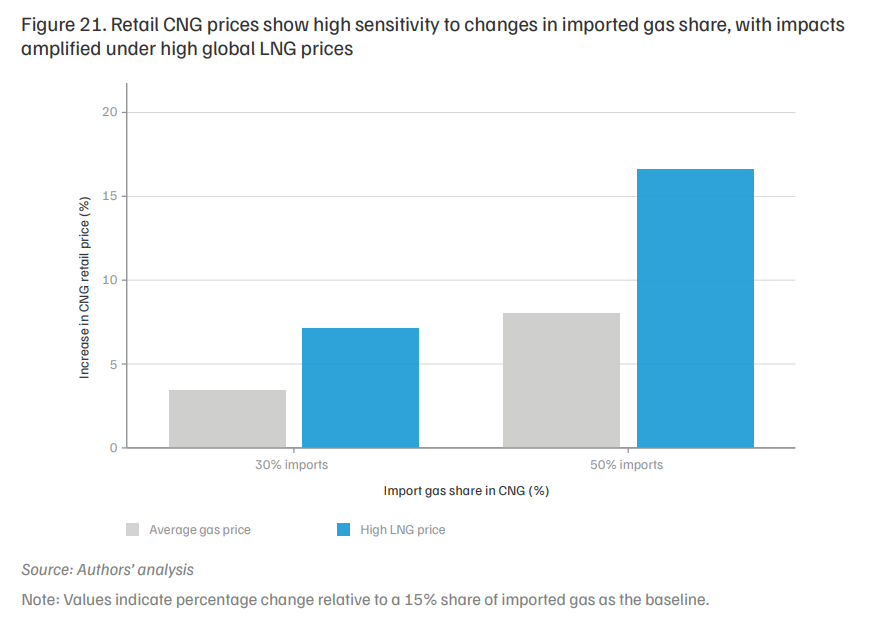
Considering domestic natural gas production in India has remained largely stagnant over the years, any additional demand from gas-consuming sectors can be met in only two ways: either by allocating a large share of existing domestic gas to the CGD sector – potentially at the expense of other priority sectors – or by increasing the share of imported LNG in the supply mix. Figure 21 illustrates the affordability implications of this choice under two global gas price conditions. The average-gasprice scenario reflects the average gas price prevailing over the last two to three years, while the high-LNG-price scenario reflects a price shock similar to those observed in the 2022 crisis. With a 15 per cent import share as the baseline, increasing import dependence to 30 per cent and 50 per cent leads to higher CNG prices in both cases, with substantially higher effects under the high-price scenario (17 per cent). This underscores that even a modest increase in reliance on imported gas can impact domestic CNG affordability when global gas prices spike, further weakening its cost advantage over conventional fuels.
Compressed biogas (CBG) blending in CGD networks is an emerging complementary option. The PNGRB has been examining increased mandatory CBG blending percentages to reduce dependence on imported gas. While promising, CBG production in India remains at an early stage, with gaps in feedstock aggregation and offtake certainty. Its potential contribution to gas security merits dedicated analysis (PNGRB 2025, PIB 2023a).
The three pillars of energy security do not operate independently; policy actions that strengthens one pillar often create tensions with another. We highlight three structural trade-offs that emerge from our analysis.
3.1 Reliability vs. Affordability: The contracting dilemma
Long-term LNG contracts improve reliability by guaranteeing base supply volumes and protecting importers from spot markets. But they also lock India into multi-decade fiscal commitments at contracted prices that may exceed future spot prices if the anticipated global LNG supply glut comes to fruition. Conversely, if India relies heavily on spot purchases, it maximises price flexibility but leaves critical sectors such as fertilisers exposed to supply disruptions. The optimal strategy is a calibrated portfolio: long-term DES contracts for base supply required by price-sensitive sectors, with flexible FOB and spot procurement for the remainder, with indexation to different price benchmarks.
3.2 Accessibility vs. Affordability: The Russia question
India’s post-2022 shift to Russian crude improved affordability (cumulative savings of USD 12.6 billion) and accessibility by adding a major new supplier. However, the accessibility gain is dependent on Western sanctions and the availability of shipping and insurance for Russian crude. The affordability benefit is lost if sanctions are tightened. It also affects the accessibility pillar, leaving India more exposed than if it maintained a more diverse, high-cost portfolio. The conclusion is that diversification towards a sanctioned supplier does not guarantee supply security. Policy should treat the Russian discount as a windfall to be invested in structural resilience (SPR expansion, electrification), rather than a permanent feature of the supply landscape.
3.3 Affordability vs. Reliability: The fiscal burden of buffers
Expanding SPRs, building gas storage, and maintaining LNG inventory buffers all improve reliability but impose fiscal costs. The capital expenditure for Phase II of India’s SPR expansion alone is estimated at several billion dollars, and the opportunity cost of holding oil in underground caverns rather than investing in renewable energy capacity is non-trivial. The fiscal space directly affects macroeconomic outcomes for a developing economy like India. Therefore, the question, ‘Can India sustainably finance its chosen strategies?’, must be answered alongside, ‘What strategies should India choose?’. We argue for a sequenced approach: prioritising the highest-impact, lowest-cost buffers first (such as an SPR architecture built around cost arbitrage model) before scaling up capital-intensive public infrastructure.
Our assessment indicates that fossil-fuel dependence is a national security liability
• Accessibility is threatened by supply-chain concentration in geopolitically volatile regions (such as Russia and the Middle East) and exposure to logistical chokepoints.
• Reliability is compromised by the deteriorating quality of domestic coal and the lack of strategic reserves for oil and gas.
• Affordability is affected by rising domestic extraction costs and global price volatility, which significantly increase India’s import bill and fiscal deficit.
These risks cannot be addressed through incremental fuel substitution alone. They point to the need for a structural shift in how India produces, stores, and consumes energy. Investing in indigenous clean energy value chains is crucial for addressing these security challenges. Unlike fossil fuels, renewable energy relies on domestic resources that are not subject to geopolitical blockades. Once capacity is installed, they are not dependent on global supply chain challenges; and in many cases they are already more affordable.
However, the clean energy transition introduces new supply chain vulnerabilities, particularly in critical minerals (lithium, cobalt, rare earths) and manufacturing inputs (polysilicon, high-purity silica for solar panels). India’s import dependence on these materials is an emerging energy security challenge that, to an extent, replaces fossil fuel import dependence. While the nature of the dependence is different, as import exposure on input materials rather than on the energy vectors is less of a risk, it still necessitates a dedicated assessment that is beyond the scope of this report but is flagged as a priority for further research.
Policy recommendations
For the purposes of this section, immediate interventions refer to measures actionable within one to three years, while medium- to long-term refers to actions spanning three years and beyond. To shift from vulnerability to resilience, we recommend the following policy interventions:
Proposed immediate interventions
Mandate and commercialise strategic oil, gas and LPG reserves
Strengthen India’s Strategic Petroleum Reserves (SPR) by placing oil and gas stockholding requirements on a clear statutory footing. Government reserves should continue to be built under ISPRL, while oil and gas marketing companies should be mandated to hold emergency stocks over and above operational inventories. Accelerate the development of natural gas storage in depleted wells (including GAIL’s planned 3–4 bcm storage project). Include underutilised storage capacity at LNG terminals as utilisation-linked strategic reserves that can be managed by a government entity. Recognise LPG as a strategic fuel by expanding underground storage and including this under the SPR framework.
Establish a clear business model to manage the SPR. Crude oil and natural gas stocked up over years for a once-in-a-few-decades crisis-like situation can represent significant capital locked in without any returns, a luxury for a country like India. A clear economic and commercial plan is required to ensure SPRs are not stranded capital. One option is to position SPR as a store of value, similar to gold exchange-traded funds; this can be accessible for traders only or to the larger financial markets. This option will provide access control, but not price control. Another option is for the government to use it as an arbitrage over its own procurement of fossil fuels: buy and store when prices are low and release when they are higher than purchase price.
Agencies responsible: Ministry of Petroleum and Natural Gas, Indian Strategic Petroleum Reserves Limited, and Ministry of Finance
Accelerate transport fuel diversification as a demand-side affordability intervention
Prioritise EVs in segments where it is already commercially viable and use LNG as a transition fuel for road freight. Our prior analysis indicates that petrol demand may peak in the early 2030s, while diesel demand will only peak by the late 2040s due to a lack of feasible alternatives for heavy-duty road freight (Mohan et al. 2025). LNG may be a necessity to abate diesel demand growth in this segment until electrification or green hydrogen-based powertrains become technoeconomically viable.
Agencies responsible: Ministry of Petroleum and Natural Gas, Ministry of Road Transport and Highways
Mandate a national refinery transition plan
Align refinery configuration with evolving fuel demand to manage the potential divergence in demand for petrol and diesel post 2030. Divert diesel exports to the domestic market where possible to manage the need for additional refining capacity that may become stranded investments beyond 2040. Incentivise higher domestic LPG and petrochemical feedstock yield to reduce import dependence.
Agencies responsible: Ministry of Petroleum and Natural Gas
Plan alternative revenue mechanisms to delink government fiscal dependence from fossil fuels
Transitioning away from fossil fuels results in a massive loss in tax revenue (GST on coal, excise duties on petrol and diesel). The government should begin developing alternative revenue instruments, such as distance-based taxation for mobility that monetises the infrastructure investment the government is making, so that the pace of the energy transition is not affected by fiscal dependence on the fuels being displaced.
Agencies responsible: Ministry of Finance, Ministry of Road Transport and Highways
Promote electrification of cooking as a near-term demand-side intervention
Leverage the current period of elevated LPG import costs to accelerate behavioural transition towards efficient electric cooking technologies, supported by reliable electricity access. Green hydrogen may also be a viable option where large volumes or temperature modulation is essential.
Agencies responsible: Ministry of Power, Ministry of Petroleum and Natural Gas
5.2 Medium-and long-term policy directions
Diversify supply sources and contract structures
• Expand crude sourcing from emerging Atlantic Basin suppliers, such as Brazil, Guyana, and West Africa, through term contracts and upstream equity partnerships.
• Maintain a balanced LNG contracting strategy combining long-term DES contracts for base security with flexible FOB contracts that allows diversion and opportunistic procurement. Avoid locking into inflexible take-or-pay LNG contracts that may become stranded assets as the hydrogen economy matures.
• Increase the share of LNG contracts indexed to gas hubs, such as Henry Hub, rather than crude oil benchmarks. Hub-linked pricing reflects gas market fundamentals and has historically shown lower volatility than oil-indexed LNG; this can help reduce price shocks and subsidy burdens.
• Diversify LNG supply sources beyond West Asia by increasing procurement from the US, Canada, Australia, and West African exporters.
Align infrastructure with future demand trajectories
• Substitute some coal-based power-generation capacity additions by strengthening the grid integration of captive power plants used by industries. In 2023–24, coal-based captive power plants had a total installed capacity of 46 GW, accounting for a significant 17 per cent of the total coal-based power generation capacity in India. The capacity utilisation factor for these captive power plants was only 45 per cent in the same year (CEA 2025a). Prioritising the efficient utilisation of these power plants will reduce the risk of new coal power capacity becoming stranded investments.
• Encourage phased modernisation of vintage refineries by adding residue-upgrading and stronger hydro-processing units to process a wider range of heavier and higher-sulphur crude oils, thereby expanding crude-sourcing options while helping meet India’s growing diesel demand.
• Align future LNG terminal and pipeline capacity additions with demonstrable downstream demand, including from steel (DRI-EAF) and expanding CGD networks, and ensure integrated pipeline connectivity before commissioning new regasification capacity. Terminal and pipeline investments should follow detailed assessments of offtake potential (volume and price) to avoid repeating the current underutilisation pattern, where all but one terminal operates below 50 per cent capacity
• Plan for steel capacity expansion using natural gas– based DRI-EAF technology that produces substantially lower emissions and can transition to green hydrogen, while leveraging demand aggregation across sectors for better contract terms.
Strengthen the domestic energy production base
• Continue developing domestic oil and gas resources to strengthen supply security during the transition, while prioritising cost-competitive projects and assessing long-term transition risks to avoid stranded assets, especially in deepwater offshore projects.
• Evaluate coal gasification at pithead locations with CCS as a targeted transitional measure for syngas production, while recognising current technology maturity constraints (TRL 3-4 for coal-CCS in India), high water use, ash handling challenges, and seam leakage risks for underground coal gasification.
Accelerate demand side substitution
• Incorporate the rising true cost of coal (including logistics, environmental externalities, and declining GCV) into power system planning to avoid locking consumers into higher tariffs.
• Beyond transport, electrification of low- and medium-temperature industrial process heat (sub400 °C applications such as textiles, food processing, and chemicals) could further shift consumption from imported fuels to domestically produced electricity.
By treating the energy transition as a national security imperative rather than solely an environmental objective, India can insulate itself from global volatility and build a robust, self-reliant economic engine.
The study evaluates India's energy security across three dimensions: Accessibility (whether India can secure fuel in the right grade, quantity, and form), Reliability (whether supply chains can deliver fuel without interruption), and Affordability (whether the cost burden is sustainable and the system is protected from price volatility). This framework draws on established methodologies from the Asia Pacific Energy Research Centre (APERC), the International Energy Agency (IEA), and academic scholarship on energy security metrics.
India imports roughly 88 per cent of its crude oil, nearly 48 per cent of its natural gas (in the form of LNG), and about 26 per cent of its coal. A large share of these imports originates in or transits through West Asia, particularly via the Strait of Hormuz, including roughly 50 to 60 per cent of crude oil, 56 per cent of LNG, and 80 to 85 per cent of LPG. Energy imports have increased by about 46 per cent over the past 13 years, from 12.4 EJ in 2012-13 to 18.1 EJ in FY2023.
India aims to achieve energy independence by 2047. Our study provides the analytical foundation for that ambition by mapping the specific vulnerabilities in India's current fossil-fuel-dependent system. The risks identified, ranging from supply-chain concentration and infrastructure gaps to price volatility, underscore why a structural shift towards domestically produced clean energy is essential. Our study argues that investing in indigenous renewable energy value chains, alongside targeted fossil fuel interventions in the transition period, is the most credible pathway to reducing import dependence and building long-term energy resilience.
The HHI measures how concentrated India's import sourcing is across suppliers. A higher score means greater dependence on fewer countries. India's LNG import HHI (2,381) is notably higher than its crude oil HHI (1,988), indicating that gas sourcing is more concentrated and therefore more vulnerable to disruption.
India has a limited strategic petroleum reserve (SPR) programme but lacks any meaningful strategic gas storage. The absence of gas reserves leaves price-sensitive sectors such as fertilisers and city gas distribution exposed to sudden supply disruptions.
While renewable energy reduces fossil fuel import dependence, it creates new vulnerabilities in critical minerals such as lithium, cobalt, and rare earths, as well as manufacturing inputs like polysilicon. These supply chains are currently concentrated, particularly in China. Diversifying mineral sourcing and building domestic processing capacity are essential to avoid replacing one form of import vulnerability with another.

Enabling investment in clean primary steel

Can white hydrogen accelerate India’s energy transition?
Unlocking the Potential for a Gas-Based Economy in India

Advancing India’s Green Steel Transition

CO₂ Pipeline Network for Carbon Capture and Storage in India