Council on Energy, Environment and Water Integrated | International | Independent


Suggested Citation: Verma, Shubhi, Sunita Patra, and Prarthana Borah. 2026. Strengthening Air Emissions Disclosures in ESG Reporting: Review of India's BRSR and Global Regulatory Frameworks. New Delhi: Council on Energy, Environment and Water.
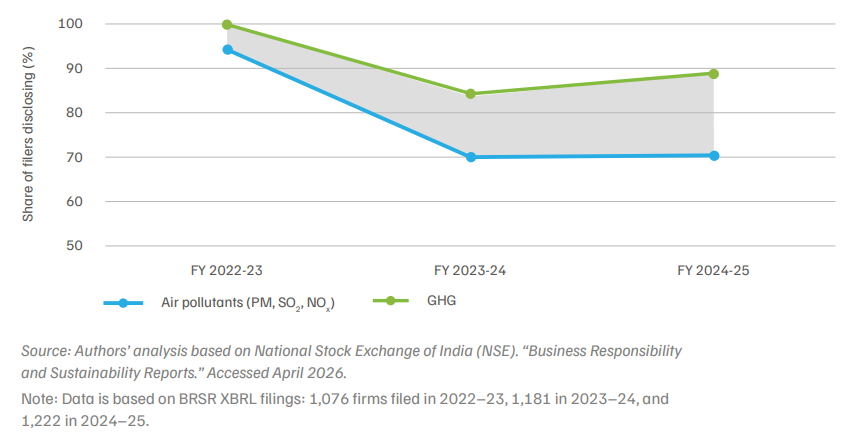
This issue brief examines a widening gap in India's corporate sustainability reporting: while greenhouse gas (GHG) disclosure under the BRSR framework is consistent and standardised, reporting on criteria air pollutants, PM, SO2, and NOX remains scattered and incomplete. Drawing on all BRSR filings from 1,258 NSE-listed companies over three years (FY2022-23 to FY2024-25) and a review of eight global ESG frameworks, the study finds air pollutant disclosure (70.7 per cent in FY2024-25) trails GHG disclosure (87.6 per cent) by a gap that grew from 9 to 17 per cent. Even where firms report, the data is often unusable; PM alone appears in a dozen-plus incompatible units, about five per cent of companies report either unexplained zeros or wrong units, and reporting happens at the company rather than plant level.
The report argues this is a fixable design gap, not an inherent limitation, since much of the underlying data already exists via CEMS and CPCB filings but is not converted into standardised BRSR disclosures. It recommends action from three actors: regulators (SEBI, MoEFCC, CPCB) should standardise units and measurement methods and bring air pollutants into the assured BRSR Core; corporations should treat air emissions as a material financial risk, not a compliance afterthought; and investors should factor air pollutant performance into ESG and capital-allocation decisions, given its currently disproportionate lack of market scrutiny compared to carbon.
Since the adoption of the Business Responsibility and Sustainability Reporting (BRSR) framework in 2022–23, environmental reporting has shifted from being a peripheral sustainability exercise to becoming a major component of corporate accountability. Investors, regulatory bodies, lenders, customers, and civil society now evaluate firms based on their environmental management and sustainability disclosures, not just their financial performance. Under the BRSR, 1,000 of India's leading firms by market capitalisation are required to report emissions of criteria air pollutants. These include particulate matter (PM), sulphur dioxide (SO₂ ), nitrogen oxides (NOx ), and greenhouse gases (GHGs). The framework recognises that corporate environmental performance extends beyond the contribution of firms to global warming and includes local pollutants. It includes local pollutants that affect public health and ecological conditions. The BRSR is one of the very few sustainability disclosure regimes that mention air pollution as part of ESG disclosures. In 2023, SEBI also introduced BRSR Core, a subset of key performance indicators requiring independent thirdparty assurance, rather than self-disclosure alone.
However, on reviewing the first three years of disclosures under the BRSR framework, we found a significant imbalance between GHG emissions reporting and criteria air pollutant reporting. While GHG emissions reporting has gained traction and become more consistent, standardised, and investor-oriented, criteria air pollutant reporting remains scattered and incomplete. This has significant on-the-ground implications, as air pollution poses one of the most pressing environmental risks for companies, impacting public health, regulation, business continuity, and reputation. It is estimated that air pollution imposes an annual cost burden of almost USD 95 billion (~INR 9 lakh crore) in India – equivalent to 3 per cent of the country’s GDP (Dalberg Advisors, CII, and Clean Air Fund 2021). While some regulatory measures have been introduced to improve air quality, this aspect is not adequately addressed in disclosures or incorporated into valuations or investment decisions.
In this study, we propose recommendations to transform the BRSR framework from a disclosure mechanism into a system that produces decision-useful information to inform regulation, investment, and corporate action. We intend to strengthen corporate air emissions reporting, making it a financially material metric in investment and financing decisions. At present, air pollutant data remains inconsistently disclosed, rarely thirdparty verified, and seldom incorporated into capital allocation decision-making despite its significant implications for regulatory compliance, operational resilience, and environmental risk. By improving the quality, consistency, and credibility of air pollutant disclosures, we aim to make air emissions reporting a meaningful market signal that can guide regulatory oversight, inform investor decision-making, and mobilise greater corporate and private capital towards air quality management and emissions reduction. More transparent disclosures are therefore not an end in themselves, but a means to direct finance towards cleaner industrial practices and measurable improvements in air quality.
To achieve this, we address two questions that are fundamental to making air emissions performance relevant to regulatory and financial decision-making:
Our research focuses on air emissions disclosures rather than on measuring emissions levels. We chose BRSR as our primary dataset because they constitute the mandatory corporate reporting framework for listed companies in India. Our objective is to assess the coverage, consistency, comparability, and decision usefulness of the air emissions disclosures in these reports. Although datasets such as those produced by continuous emissions monitoring systems (CEMS) are very useful in assessing emissions and measuring compliance, they do not provide any information about air emissions disclosure practices, reporting quality, or the treatment of air pollutants within ESG reporting.
Our analysis proceeds in two parts:
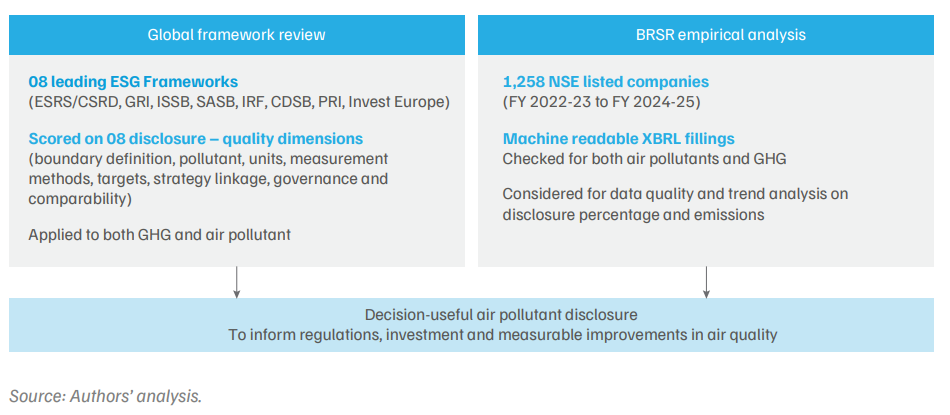
Figure ES1. Two complementary analyses: A global framework review and a full-population BRSR analysis
From the global review
Modern sustainability reporting was introduced as a solution to the dual problem of climate change and industrial energy consumption. With growing scientific evidence linking the increase in GHGs to global warming, stakeholders in finance and regulation realised the need for effective methods for measuring and reporting on the associated risks. In response, innovative frameworks such as the Global Reporting Initiative (GRI) and the Carbon Disclosure Project (CDP) were developed in 1997 and 2000, respectively, forming the basis for modern sustainability reporting. Today, many frameworks (ISSB, SASB, and many more) continue to build on this foundation.
Consequently, climate change discourse around GHGs dominated sustainability reporting, while the impact of other air pollutants remained largely underexamined. Our review of eight leading global disclosure frameworks reveals that only two frameworks, the ESRS and SASB, require standardised and comparable disclosure of data on specific air pollutants. In most other cases, reporting on PM, SO2 , NOx , and other harmful pollutants is left to the discretion of firms, making it voluntary, fragmented, or absent altogether. Consequently, there is inadequate information on most companies’ air-quality risks and their local environmental impacts.
From the BRSR filings
By mandating the reporting of multiple air pollutants, requiring disclosures be submitted in a machine-readable XBRL format, and generating three consecutive years of company-level data, the BRSR has created a corporate air emissions disclosure system and offers a unique opportunity to improve corporate accountability for clean air.
We analysed firms’ BRSR filings through the lens of four interrelated questions:
Our analysis yields the following five key findings.
Figure ES2. The air–GHG disclosure gap has widened across three years of BRSR reporting
We found that of the 1,222 companies that filed BRSR in 2024–25, 823 disclosed both air pollutant and GHG data, 247 disclosed GHG, but no air pollutant data, 111 disclosed neither, and just 41 disclosed air pollutant data without any accompanying GHG figures.
Figure ES3. Nearly 1 in 5 firms stops at GHG reporting, skipping air pollutants entirely
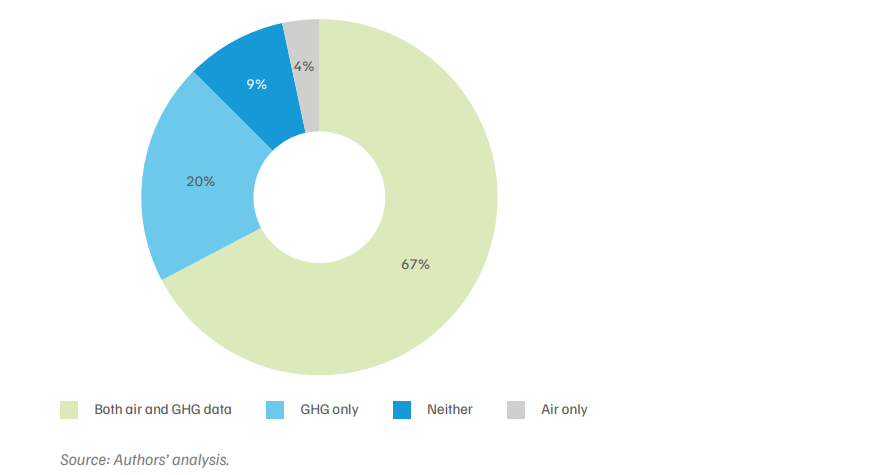
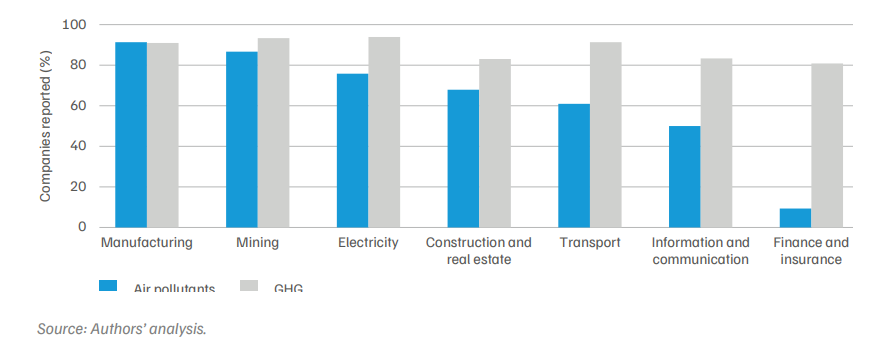
Figure ES4. Air pollutant disclosures lag behind GHG disclosures in almost every sector (FY 2024–25)
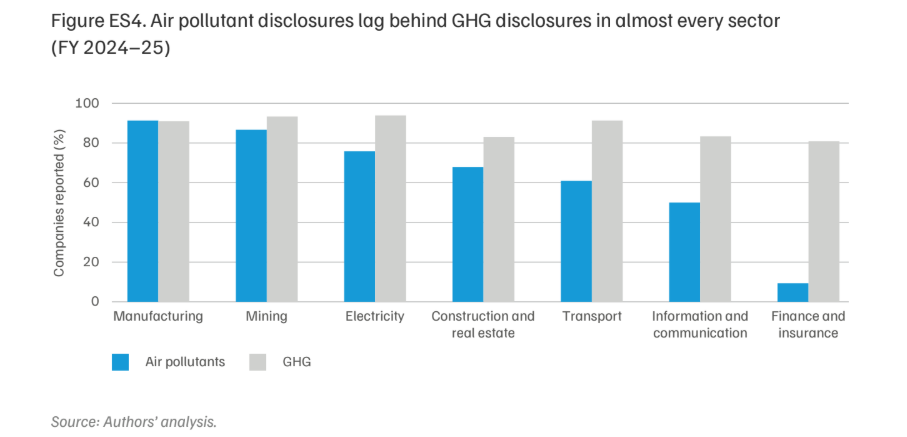
Figure ES5. Nearly half of the firms reported improvement in the air emissions
To fully leverage the BRSR’s potential as a tool to improve air quality, action is needed from three sets of actors: regulators who set the rules, companies that generate and manage emissions, and investors who can create demand for better performance through capital allocation. To move the BRSR from a framework that merely collects air pollutant data to one that generates credible, comparable, and decision-useful information, we recommend the following actor-specific interventions.
Regulators (SEBI, along with the Ministry of Environment, Forest and Climate Change [MoEF&CC] and CPCB) should:
Every companies have their GHG reduction targets and this is because GHG is prioritised globally because og climate change and global warming potential. However, air pollution has a regional impact. It not only impacts the health, but gradually deteriorating Air quality leads to GRAP like measures which impacts business. It is self regulatory action and this can be done by treating air emission in the same way like GHG, such as making emission reduction targets, shifting to cleaner fuel, and accounting their supply chain emissions.
Financial risk is the major influence for the companies. Investors must consider that the companies or the companies having heavy emitter supply chain is always at risk of regulatory compliance. This should be considered other than only looking at GHG emissions. measure, disclose, and reduce their emissions.
India’s sustainability disclosure regime is at a turning point. Three years of mandatory BRSR filing have already produced a longitudinal dataset. The extension of the BRSR Core to the top 1,000 companies by FY 2026–27, the phasing-in of value-chain disclosures, and closer cooperation between SEBI and environmental regulators can together create an opportunity for greater institutional alignment to improve air quality. SEBI has already shown, through its GHG guidance note and the BRSR Core, that it can convert a difficult environmental requirement into a workable one. Applying the same principles to air pollutants by framing guidelines on units and measurement as well as adding PM, SO2 , and NOx to the BRSR Core can transform the BRSR from a world-leading disclosure mandate to a powerful instrument for cleaner air.
This study is limited to the listed companies within the BRSR mandate and to PM, SO₂, and NOx . Future research can deepen the findings on standardised, sector-specific reporting protocols and unit-conversion methodologies, and eventually integrate industrial CEMS data with BRSR disclosures.
The Business Responsibility and Sustainability Reporting (BRSR) is the Securities and Exchange Board of India's (SEBI) mandatory ESG disclosure framework for India's top 1,000 listed companies by market capitalisation, in force since FY 2022-23. Under Principle 6, it requires firms to disclose Scope 1 and 2 GHG emissions alongside six categories of air pollutants: PM, SO2, NOX, persistent organic pollutants (POPs), volatile organic compounds (VOCs), and hazardous air pollutants(HAPs). This makes the BRSR more prescriptive on air pollutants than most voluntary global frameworks, and gives India a three-year, company-level dataset to test whether current disclosures are useful for regulators and investors.
Unlocking Finance for India’s Textile Waste Management
Are Clean Cooking Fuels Reaching India's Urban Poor?
Understanding Clean Cooking Fuel Usage Among Migrants