Council on Energy, Environment and Water Integrated | International | Independent

Suggested Citation: Das, Rahul, Anwesha Sarma, and Abhishek Kar. 2026. Subsidised, Not Sustained: Rural Cooking-fuel Usage Trends in Six Indian States. New Delhi: Council on Energy, Environment and Water.
Since 2016, the Pradhan Mantri Ujjwala Yojana (PMUY) has provided deposit-free LPG connections to over 105 million women from low-income households (PMUY, as of July 2026). This has reshaped India's clean cooking landscape. Yet solid fuel use remains widespread: NFHS-5 (2019–21) reports 56 per cent of rural households still cook with firewood, dung cakes, or coal; and HCES 2023–24 indicates rural firewood use at 47 per cent.
This access-consumption gap stems largely from high refill costs, alongside poor accessibility and behavioural factors, resulting in poor sustained usage of LPG. PMUY beneficiaries consume on average just 4.8 cylinders annually, well below the 7–8 needed for exclusive LPG use. CEEW’s IRES survey in 2021 indicated that 78 per cent of non-exclusive LPG users cite cost as a major barrier. Because refills are a recurring cash outlay that competes with food, rent and other essentials, while biomass typically carries no cash price, sustained clean fuel use is a question of affordability at the margin. Understanding willingness to pay (WTP) is thus key to identifying the price point at which refill behaviour shifts, linking physical access to functional adoption.
This margin has grown more precarious since COVID-19, which reversed clean cooking gains in several developing countries. This issue brief examines fuel choices and WTP among rural households, drawing on a survey of 4,000+ respondents across economically vulnerable groups such as urban informal settlements, migrants, and rural households. It focuses on findings from 2,222 rural households across six states - Assam, Jharkhand, Maharashtra, Telangana, Uttar Pradesh, and Uttarakhand - surveyed between November 2024 and January 2025.
The launch of the Pradhan Mantri Ujjwala Yojana (PMUY) scheme has fundamentally reshaped India’s efforts towards achieving universal access to clean cooking fuels. Between May 2016 and July 2026, over 105 million women from low-income households received deposit-free liquefied petroleum gas (LPG) connections under the scheme (based on PMUY website as on 31 July 2026).
Despite this significant progress in expanding access to clean cooking energy, large sections of rural India still rely on solid fuels, such as firewood, coal, and cow dung cakes. According to NFHS-5 (2019–21), 41 per cent of Indian households use solid fuels for cooking, primarily firewood and dung cakes (IIPS 2021). This reliance is far more pronounced in rural areas, where 56 per cent of households use solid fuels, compared with only 10 per cent in urban areas. Latest data from HCES 2023–24 further show that 47 per cent of rural households use firewood as their primary cooking fuel (MoSPI 2025).
This gap between connections (i.e., LPG access) and consumption (i.e., sustained use) is primarily driven by costs, along with other factors such as poor accessibility in remote areas, and behavioural factors —leading to low refill rates for LPG in India (Kar et al. 2024). PMUY beneficiaries use only 4.8 cylinders per year (PPAC 2026), whereas a typical household needs seven to eight 14.2 kg LPG cylinders per year to achieve exclusive use (Mani et al. 2021). Data from the India Residential Energy Survey (IRES), indicate that 78 per cent of non-exclusive LPG users cite the high cost of LPG as a major barrier to sustained usage (Mani et al. 2021). Because refills are a recurring cash outlay that competes with food, rent and other essentials, while biomass typically carries no cash price, sustained clean fuel use is a question of affordability at the margin. Assessing the status of usage, and willingness to pay (WTP) is therefore crucial to understand this margin: it identifies the price point at which refill behaviour changes, and so bridges physical access and functional adoption.
That margin has become more precarious. Globally, there were indicators that the COVID-19 pandemic had reversed the gains in clean cooking access, and usage of clean cooking fuels in several developing countries (World Bank ESMAP 2022; Pachauri et al. 2021). This has impacted the WTP for clean fuels. Accordingly, this issue brief examines fuel choices for cooking and WTP for cleaner fuels, among economically vulnerable population groups. The findings presented here are part of a larger survey of more than 4,000 respondents across urban informal settlements (n = 1,116), migrant workers (n = 1,061) and rural households (n = 2,222). We selected these three respondent groups given they are more likely to rebound to solid fuels as a result of the pandemic. This issue brief presents findings from 2,222 rural households across six states—Assam, Jharkhand, Maharashtra, Telangana, Uttar Pradesh, and Uttarakhand. The key respondents to the survey were the primary cook of households. The survey was conducted between November 2024 and January 2025.
1. Poor sustained usage of clean fuels persists in rural households.
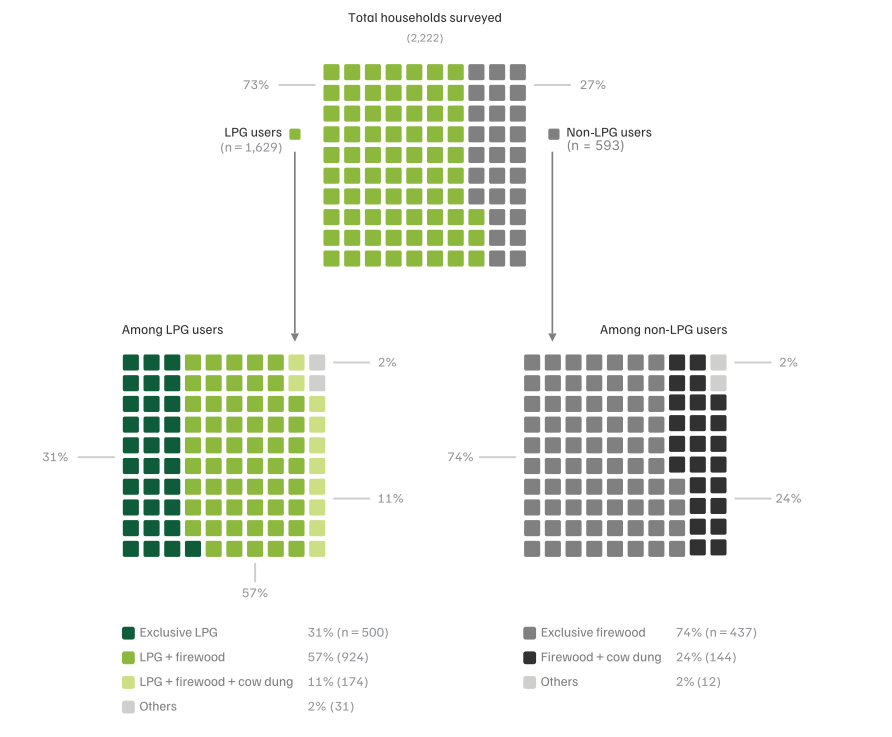
The study finds that both LPG and firewood have prominent positions in the cooking fuel mix for rural households. Around 73 per cent of respondents reported using LPG during the three months preceding the survey. However, the majority of households continue to practise fuel stacking, combining LPG usage with solid fuels. Only 23 per cent reported exclusive use of LPG in the total sample. Around 48 per cent of households use LPG as their primary cooking fuel, while 50 per cent primarily use firewood.
Figure ES1. Out of the total households surveyed, only 23 per cent reported exclusive use of LPG.
Source: Authors’ analysis.
Note: (a) n = 2,222, (b) Data from 6 states: Assam, Jharkhand, Maharashtra, Telangana, Uttar Pradesh, and Uttarakhand, (c) one square = 1 per cent of the group shown, (d) group values may not add up to 100 due to rounding off.
2. Affordability is the key barrier to the transition and sustained usage of LPG.
High LPG refill costs are a major deterrent to the transition and sustained usage of cleaner fuels. Among respondents who do not use LPG (n = 593), 70 per cent cited high refill costs as a significant barrier to transitioning, followed by factors such as the inconsistent availability of LPG, easy availability of firewood and a cultural preference for meals cooked on a chulha (traditional cookstove).
The WTP analysed in this study indicates stated preferences for LPG refill prices. To analyse WTP, households were asked the price they would be willing to pay for a 14.2 kg LPG cylinder to transition to exclusive LPG use. The study defines the ‘affordability limit’ as the maximum price point at which 80 per cent of households self-report that they would switch to exclusive use of LPG. The relevant policy question is therefore not what the average household can afford, but the price point that leaves the fewest households behind. We analysed the WTP across different LPG connection types (Figure ES2). Our survey results for the overall sample show that, at a stated WTP of INR 400, at least 80 per cent of respondents would transition to exclusive LPG use for cooking.
Figure ES2. 80% of respondents from our total sample self-report that at a price of INR 400 per cylinder, they would switch to exclusive use of LPG
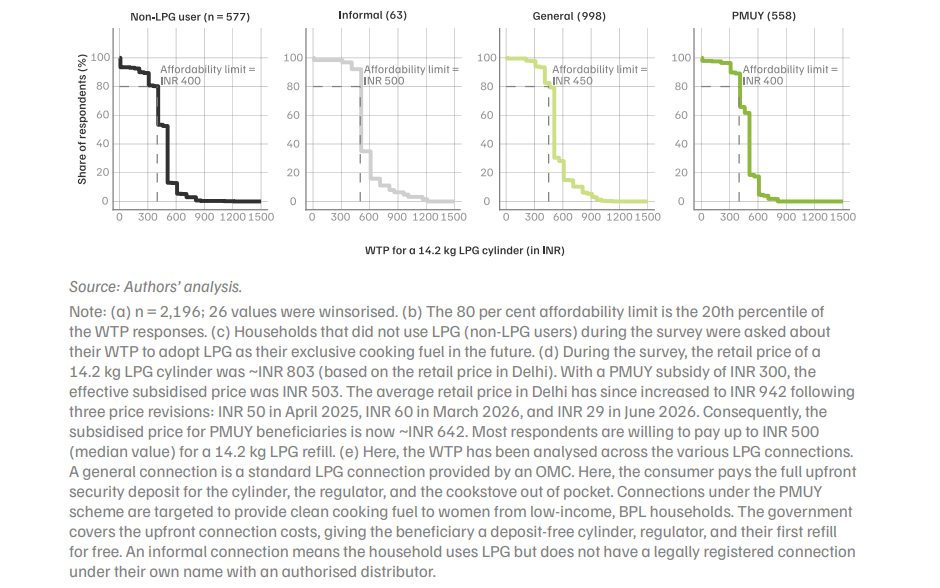
This stated or self-reported WTP may not accurately reflect actual purchasing behaviour if LPG prices change in the future, because stated WTP often overestimates actual behaviour change. Households may continue to rely on locally collected firewood and other solid fuels as secondary fuels alongside LPG for their cooking needs. Such discrepancies between stated responses and revealed preferences are well documented (Mobarak et al. 2012). Thus, stated WTP may not accurately reflect real-world choices.
3. Home delivery rates remain low for rural households.
Only 47 per cent of LPG-using households (n = 1,629) reported receiving doorstep delivery. The remaining respondents travelled to LPG distributors, kirana (grocery shop) stores, or roadside collection points to obtain refills, incurring additional time, costs, and effort in the refill process. CEEW has previously documented this delivery gap — in a 2024 survey, only 52 per cent of rural distributors self-reported delivering LPG to more than 90 per cent of their consumers (Kar et al. 2024). This delivery gap underscores the need to rethink last-mile distribution models, particularly in remote rural areas.
This issue brief proposes 4 key measures to improve the transition to cleaner cooking fuels:
Fuel stacking is when a household uses multiple fuels for cooking. For example, in rural kitchens of India, LPG and solid fuels like firewood are often used side by side. It is a common practice, primarily because of the high cost of LPG refills, whereas firewood is often freely available. Other reasons for fuel stacking include a preference for the taste of food cooked on a traditional chulha, unreliable or infrequent LPG refill availability, and continued easy access to free solid fuels.
Cooking with firewood produces significant household air pollution, which is linked to respiratory illness and other health harms, particularly for women and children who spend the most time near the cookstove. It also contributes to local environmental degradation from biomass collection and to greenhouse gas emissions, undermining India's broader clean cooking and climate goals.
PMUY is a government scheme launched to reshape India's push for universal clean cooking access, targeted at women from low-income, below poverty line (BPL) households. It covers upfront connection costs, giving beneficiaries a deposit-free cylinder, regulator, and first refill at no cost. Between May 2016 and July 2026, it has issued over 105 million such connections.
In this study, WTP is measured as the amount households self-report they would be willing to pay for a 14.2 kg LPG cylinder to change their cooking behaviour, specifically to switch to exclusive LPG use. This captures the price point that could potentially drive a real-world shift in cooking practices, rather than simply measuring whether a household currently owns an LPG connection.
The states are Assam, Jharkhand, Maharashtra, Telangana, Uttar Pradesh, and Uttarakhand. They were chosen using a composite index built from a prior CEEW study, scoring states on alternative fuel availability, affordability, awareness, and the bandwagon effect (how much LPG is used by people around you). States were grouped into six tiers based on this index, and one state was randomly picked from each tier, so together they represent a realistic spread of where Indian states stand in the transition to exclusive LPG use.
Unlocking Finance for India’s Textile Waste Management
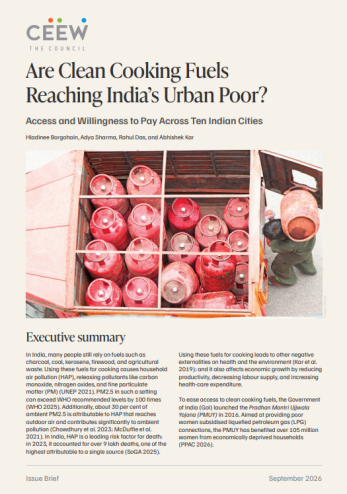
Are Clean Cooking Fuels Reaching India's Urban Poor?
Understanding Clean Cooking Fuel Usage Among Migrants