Council on Energy, Environment and Water Integrated | International | Independent

–A global electrification target of 35 per cent by 2035 must consider country starting points: some can go higher, while India is on course for ~27 per cent on current trends
–Transition is not just swapping energy sources: for developing economies it reshapes jobs, budgets and industry together, and only an inclusive transition is just and equitable
– Only seven countries, including India, China and South Africa, are on track for 2030 NDC targets. Developed economies such as the EU, UK, Switzerland and Canada are falling behind
New Delhi, 04 November 2026: Nearly three years after Parties agreed at COP28 to contribute to global efforts to transition away from fossil fuels in a just, orderly, and equitable manner, the world agrees on the need but not on the process or who pays. A new study by the Council on Energy, Environment and Water (CEEW), Whose Transition? Unpacking the Discourse on Transitioning Away from Fossil Fuels in Climate Negotiations, analyses the 21 Party submissions, covering 115 countries, made to the COP30 Presidency on its fossil fuel roadmap. Over three-quarters tie their expectations to instruments already agreed under the UNFCCC, such as NDCs and net-zero commitments. But transition is not just a mitigation goal or a question of swapping energy sources. It involves multiple whole-of-economy transformations, so implementation pathways must be nationally determined.
Electrification shows what that means for targets. It is central to the energy transition, and the COP31 Presidency’s 35by35 target already exceeds the IEA’s global projection of 33 per cent by 2035. CEEW analysis shows India’s share of electricity in final energy use rising to ~27 per cent by 2035 on current trends, alongside a fast clean power build-out. To ensure equity, some countries can take higher electrification targets, such as 40 or 45 per cent, while India takes a slower one, so that the world still achieves 35 per cent electrification by 2035.
“Belém asked the world to move from promises to delivery. Antalya has to show it can. The Global South is already delivering: India reached 50 per cent non-fossil capacity five years early, and the BASIC countries in post-Paris have emitted 8.5 GtCO2e less than their pre-Paris trend. Southern economies are learning from one another and accelerating together. The North, which is projected to miss its own targets, can learn from them. This year the second Global Stocktake begins, and our progress must not be dismissed,” said James Abraham, CEO, CEEW. “The CEEW studies we are releasing point to the same fix: clear responsibilities, money that reaches the ground, and rules that developing countries have a hand in writing.”
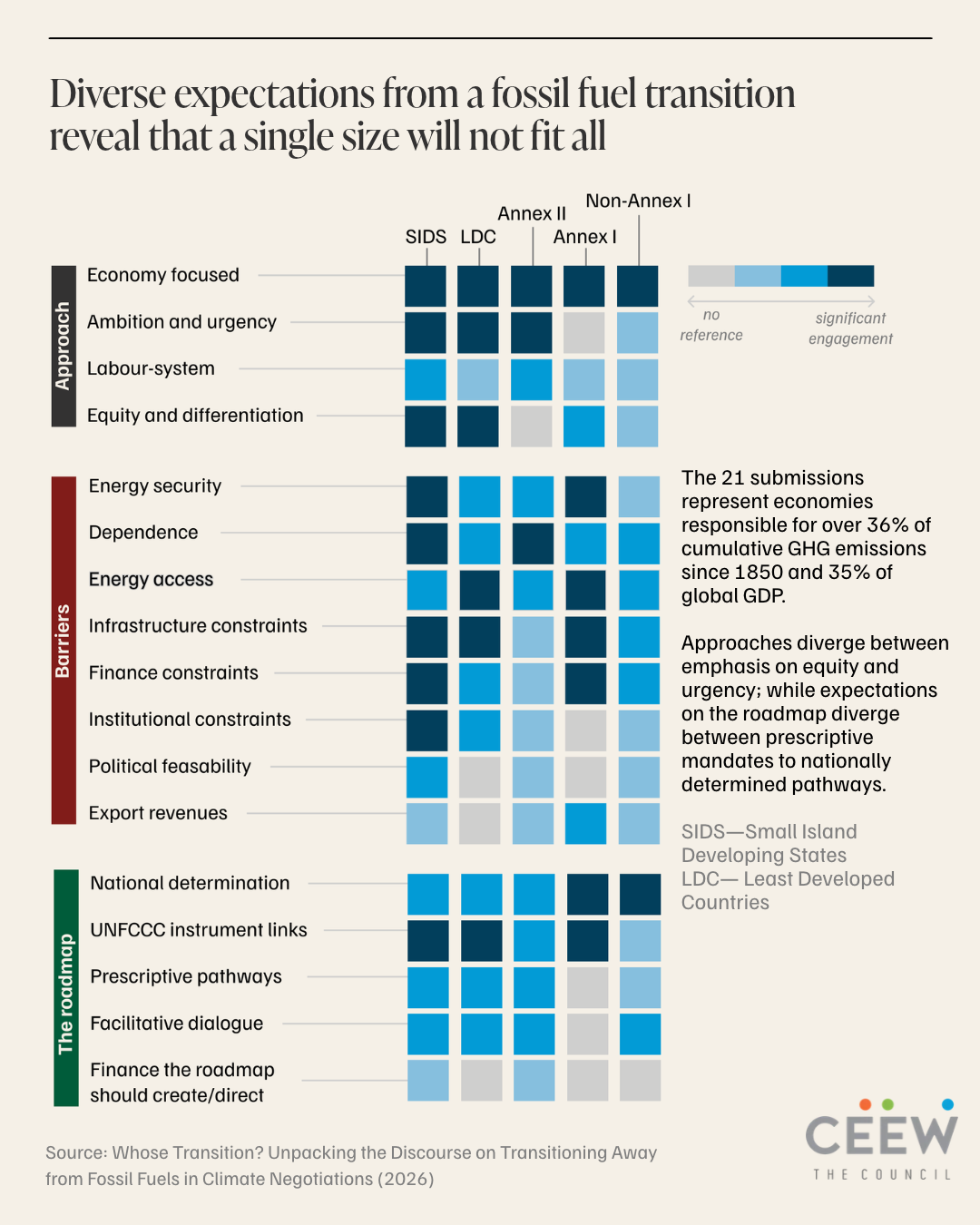
The CEEW study also finds a two-tier process emerging. The Santa Marta conference in April 2026 brought together 57 countries but did not invite several major Global South economies, including China and India. Yet both are already transitioning: India reached 50 per cent non-fossil installed power capacity in 2025, five years ahead of its 2030 target, and 54 per cent by July 2026. Acceleration cannot come at the cost of inclusion: only an inclusive transition can be just and equitable.
“Economies such as India are already transitioning away from fossil fuels at a fast pace, prioritising energy security. What they are missing is the finance, technology and fiscal space to go faster,” said Sumit Prasad, Senior Programme Lead, CEEW. “A roadmap outside the negotiations cannot replace what the UNFCCC has already agreed. And non-participation in a voluntary process cannot be read as a lack of ambition; countries across the Global South are transitioning and delivering on their NDCs. COP31 should strengthen the implementation through the mandates it has, starting with the Just Transition Mechanism.”
Moreover, transition finance is not keeping pace. The new collective climate finance goal of USD 300 billion a year remains far below developing countries’ estimated needs of USD 455-584 billion a year through 2030. Government interest payments in developing countries rose by 102 per cent over the past decade, compared with a 39 per cent rise in revenues. Fundamentally shifting the burden of financing the transition onto the countries themselves.
The CEEW study suggests that the UNFCCC should strengthen the mandates it already has: the Just Transition Mechanism, to be operationalised at COP31, for reskilling and social safety nets; the Technology Implementation Programme for transition technologies, since the G20 holds around 91 per cent of environmental technology patents; and the Article 9 work programme on finance.
Holding up the Mirror, published by CEEW in June 2026, tracked climate action across UNFCCC negotiating groups. A decade after the Paris Agreement, only seven countries, including India, China and South Africa, are on track to achieve their 2030 NDC targets, while major developed economies like the European Union, United Kingdom, Switzerland, Canada and New Zealand are falling behind. Importantly, the BASIC group (including India, China, Brazil and South Africa) slowed its annual emissions growth rate from 3.3 per cent in the pre-Paris period (2009-2015) to 2.1 per cent after Paris (2016-22). In doing so, they have emitted 8.5 GtCO₂e less than what they would have if pre-Paris trends had continued. This is against a reduction of 3.7 GtCO₂e for the Umbrella Group, EU and EIG combined during the same period.
The EU’s carbon border adjustment mechanism (CBAM) entered its definitive phase in 2026. CEEW’s brief, Climate and Trade: Strengthening Cooperation through the UNFCCC, notes that India’s unwrought aluminium exports to the EU fell by ~42 per cent in the year to January 2026, with CBAM one of several possible factors. The brief proposes a standing expert committee, with the WTO, UNCTAD and the International Trade Centre, to measure how such measures affect developing countries. Countries would agree on its job in 2027, review its findings in 2028, and make climate and trade a permanent UNFCCC agenda item.
“Carbon border measures change who can sell what, and to whom, yet they are decided in a handful of capitals. The UNFCCC cannot be a bystander. A technical committee that assesses the impact on developing countries is a practical first step,” said Ravi Shankar Prasad, Distinguished Fellow, CEEW.
Access the studies below:
Tulshe Agnihotri – [email protected]
The Council on Energy, Environment and Water (CEEW)—a home-grown institution with headquarters in New Delhi—is among the world’s leading climate think tanks. The Council uses data, integrated analysis, and strategic outreach to support public policy, transform markets, shape technology, and nudge behaviour. It addresses pressing regional and global challenges through an integrated and internationally focused approach. The Council prides itself on the independence of its high-quality research and strives to impact sustainable development at scale.
Follow us on X (formerly Twitter) @CEEWIndia or on LinkedIn for the latest updates.