Council on Energy, Environment and Water Integrated | International | Independent

Suggested citation: Sukhija, Simran, and Ravi Shankar Prasad. 2026. Climate and Trade: Strengthening Cooperation through the UNFCCC. New Delhi: Council on Energy, Environment and Water.
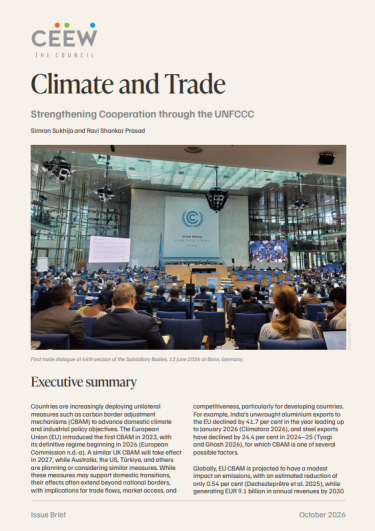
Unilateral measures, particularly carbon border adjustment mechanisms (CBAMs), are increasingly being used to advance domestic climate and industrial policy objectives. Following the European Union’s (EU) introduction of CBAM in 2023, with its definitive regime commenced in 2026 (European Commission n.d.-a), the United Kingdom is set to introduce a similar mechanism in 2027, while Australia, the United States, Türkiye and others are considering comparable measures. While these instruments may support domestic decarbonisation, their cross-border implications for trade flows, market access and export competitiveness are particularly significant for developing countries. Amid persistent climate finance shortfalls, increasing reliance on loans rather than grants, and limited progress on proposals to redistribute CBAM revenues, these outcomes raise concerns about the equity and effectiveness of unilateral approaches (Oxfam and CARE 2025; Scott 2026).
Despite growing recognition of the climate–trade nexus, it remains peripheral to the United Nations Framework Convention on Climate Change (UNFCCC) process. The Global Mutirão decision at COP30 established dialogues at the 64th, 66th and 68th sessions of the Subsidiary Bodies on international cooperation on trade, involving countries and institutions such as the World Trade Organisation (WTO), UN Trade and Development (UNCTAD) and the International Trade Centre (ITC), alongside a high-level event in 2028 (UNFCCC 2026). The first dialogue at SB64 in June 2026 revealed divergent views, with developing countries advocating a stronger, Party-driven and outcome-oriented UNFCCC process, grounded in Article 3.5 of the Convention, equity and Common but Differentiated Responsibilities and Respective Capabilities (CBDR-RC), to identify corrective actions and cooperative alternatives. Developed countries, by contrast, favoured a facilitative dialogue that builds on, rather than duplicates, existing work at the WTO and other institutions.
Addressing these differences requires a coordinated approach grounded in equity and Common but Differentiated Responsibilities and Respective Capabilities (CBDR-RC). Drawing on this analysis and a review of existing research and policy discussions, this brief proposes a roadmap for defining the UNFCCC’s role, identifies priorities for forthcoming dialogues, and outlines how India can shape this evolving agenda.
Countries are increasingly deploying unilateral measures such as carbon border adjustment mechanisms (CBAM) to advance domestic climate and industrial policy objectives. The European Union (EU) introduced the first CBAM in 2023, with its definitive regime beginning in 2026 (European Commission n.d.-a). A similar UK CBAM will take effect in 2027, while Australia, the US, Türkiye, and others are planning or considering similar measures. While these measures may support domestic transitions, their effects often extend beyond national borders, with implications for trade flows, market access, and competitiveness, particularly for developing countries. For example, India’s unwrought aluminium exports to the EU declined by 41.7 per cent in the year leading up to January 2026 (Climatora 2026), and steel exports have declined by 24.4 per cent in 2024–25 (Tyagi and Ghosh 2026), for which CBAM is one of several possible factors.
Globally, EU CBAM is projected to have a modest impact on emissions, with an estimated reduction of only 0.54 per cent (Dechezleprêtre et al. 2025), while generating EUR 9.1 billion in annual revenues by 2030 (Pleeck and Mitchell 2023). This is concerning, given the shortfall in climate finance from developed countries and the growing reliance on loans (rather than grants), which further increases developing countries’ debt burdens (Oxfam and CARE 2025). Calls to redistribute CBAM revenues have also been sidelined, adding to the distress (Scott 2026). In effect, the disproportionate burden such measures impose on developing countries, and their modest global emissions reduction, show the limitations and inequity of unilateral measures.
Climate forums — in particular, the UNFCCC — broadly recognise the climate–trade nexus, but it has remained a peripheral topic in discussions. The Global Mutirão decision (FCCC/PA/CMA/2025/19/Add.1) at the 30th Conference of the Parties (COP30) established a set of dialogues to be held at the 64th, 66th, and 68th subsidiary sessions to explore opportunities, challenges, and barriers to international cooperation on trade, with the participation of countries and key stakeholders, including the World Trade Organisation (WTO), UN Trade and Development (UNCTAD), and the International Trade Centre (ITC) (UNFCCC 2026). It was also decided to exchange experiences and views on related matters at a high-level event in 2028.
In June 2026, the first climate and trade dialogue was held at the 64th session of the Subsidiary Bodies (SB64) – an important first step. However, our analysis of countries’ statements at this dialogue reveals deep-seated differences between developed and developing countries over the dialogue’s nature and objectives. To bridge these differences, the UNFCCC needs a coordinated approach grounded in the principles of equity and Common but Differentiated Responsibilities and Respective Capabilities (CBDR-RC). Drawing on our analysis of countries’ statements and an extensive review of existing research and policy discussions, this brief proposes a roadmap that defines the UNFCCC’s role, recommends themes for forthcoming dialogues, and suggests a strategy that India can use to shape this evolving agenda.
Figure ES1. A roadmap for establishing a dedicated climate–trade agenda under the UNFCCC
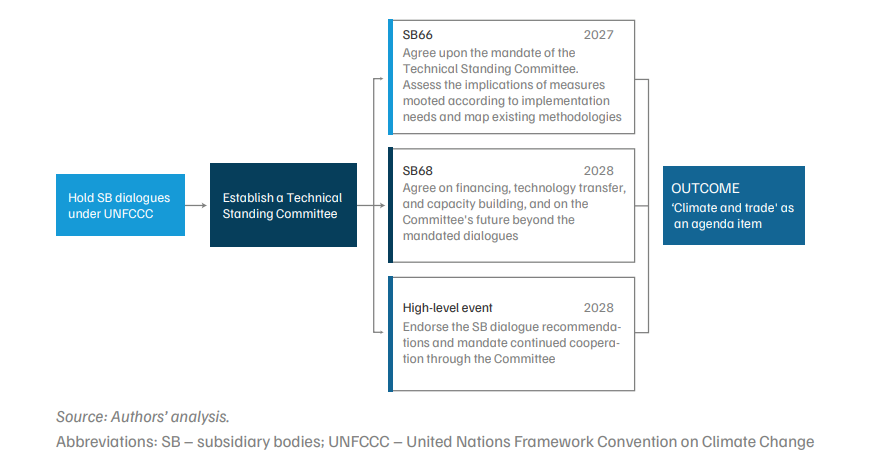
The study analyses official country statements made at the 64th session of the Subsidiary Bodies (statements submitted to the UNFCCC submission portal were only taken), highlighting the divergent positions taken by countries and negotiating groups on climate–trade issues. Based on this analysis and a review of existing literature and policy discussions, the study proposes a structured pathway for advancing climate–trade discussions under the UNFCCC, including recommendations for future SB dialogues, the development of a dedicated climate–trade agenda, and the steps India could take to advance its priorities in this process.
Unilateral measures are economic, financial, or regulatory actions taken by a country independently, without a mutually agreed multilateral framework. In the context of climate and trade, these include measures such as the Carbon Border Adjustment Mechanism (CBAM), which applies a carbon-related cost to certain imported goods.
Established in 2011, the Forum provides a platform under the UNFCCC to assess and address the economic, social, and environmental consequences of climate policies and actions. Its 2026–2030 work plan includes examining the cross-border impacts of climate measures.
Unilateral measures, particularly trade measures, can create trade barriers, restrict market access, increase compliance costs for exporters, and affect the competitiveness of goods from developing countries. They can also raise concerns about equity and the principle of Common but Differentiated Responsibilities and Respective Capabilities (CBDR-RC). A dedicated agenda item under the UNFCCC would provide a formal space to discuss these measures, assess their implications for countries, and explore alternative approaches that align with the principles of the UNFCCC.
The Carbon Credit Trading Scheme (CCTS) in India is a mechanism designed to reduce greenhouse gas emissions through carbon pricing. It involves two key elements: a compliance mechanism for obligated entities (primarily industrial sectors) and an offset mechanism for voluntary participation. The CCTS aims to incentivise and support entities in their efforts to decarbonise the Indian economy. CCTS laid the foundation for the Indian Carbon Market (ICM) by establishing the institutional framework.
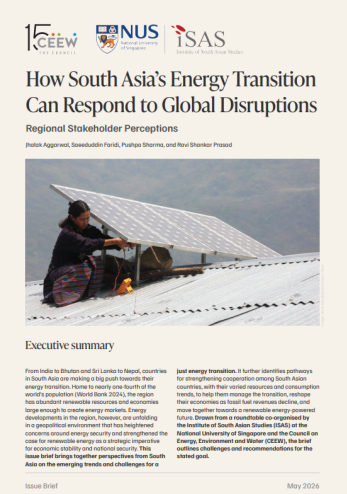
How South Asia’s Energy Transition Can Respond to Global Disruptions
Time to develop an Asia-Pacific Green Development Agenda
The India StoryA Green Investment Handbook
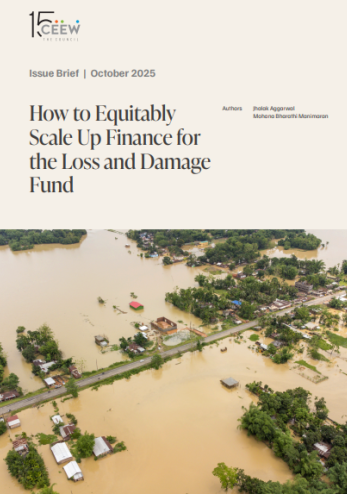
How to Equitably Scale Up Finance for the Loss and Damage Fund